


Porpoising: A lesson from history and one of F1’s greatest teams
Although the 2022 Formula 1 season is destined to be forever linked to the word ‘porpoising’, this is not a new phenomenon. In fact, it’s a problem that was identified at the start of the first ground-effects era and has returned with a change in the rules that once more allow downforce-generating floors
To understand the concepts involved, why porpoising occurs and how it led to F1's most radical design we need to look back to the mid-1970s and the figure who first harnessed ground-effects – Colin Chapman.
Chapman was the genius behind that most innovative of F1 teams, Lotus, which found itself struggling by the mid-1970s following a period of incredible success. Its engine, the Cosworth DFV, was already struggling to match the power produced by Ferrari and the dawning of the turbo era would only accelerate its ultimate demise.
With no alternative engine suppliers available, Chapman was already considering his options in 1975 while on holiday in Ibiza. Lotus had pioneered the use of wings to create an aerodynamic downward load on the car (downforce), pushing it onto the track to increase grip. However, although wings generate high loads to help in the corners, their resistance to being propelled through the air (drag) is quite high. Something especially important on the straights when you don't have the most powerful engine.
His breakthrough was to understand that using a shaped floor to generate downforce instead would give a better trade-off. The amount of downforce created would not come at such a high cost in terms of drag, making any power disadvantage less of an issue.
Top 10 Lotus F1 drivers ranked: Clark, Andretti, Senna and more
Peter Wright, an aerodynamicist at Lotus, was dispatched to the windtunnel at Imperial College. This was unusual at the time in having a rolling road that mimicked the interaction between a car and the surface it was travelling over more accurately.
Different ideas and floor profiles were tried without startling results until one design was brought – perhaps by accident – very close to the moving road. A reduction in clearance equivalent to moving from 6” to 4” on the full-size car doubled the amount of downforce generated. This exponential rise was, as Colin's son Clive Chapman is keen to stress, erroneously named “ground effect”.
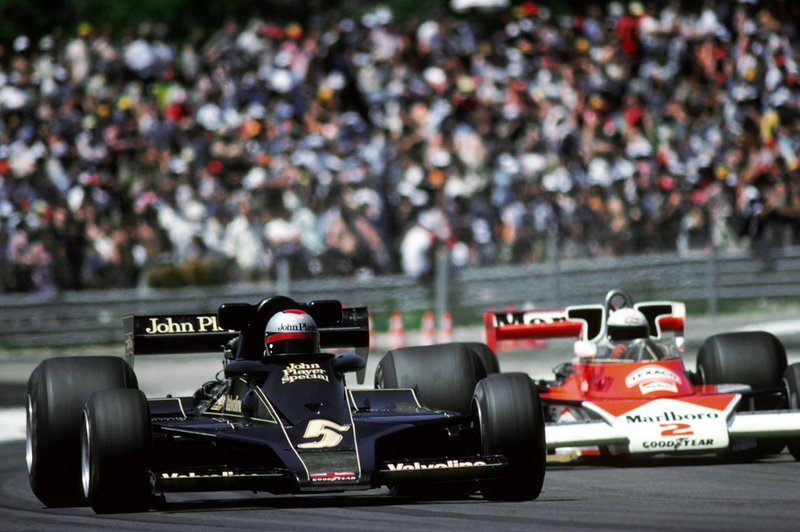
Mario Andretti in his Lotus 78 leads McLaren's Jochen Mass
Photo by: David Phipps
The term originates in the aircraft industry to describe a wing riding a cushion of air when close to the ground but it’s now accepted as also meaning this dramatic increase in effectiveness related to proximity with the track surface.
The Lotus 78 was designed to exploit this principle, with sidepods shaped like inverted wings mounted low at the sides. They created a low-pressure area underneath the car and it’s the difference between this and the higher pressure on the upper surfaces that pushes the car down, the term ‘suction’ being misleading is best avoided.
One problem quickly found was that the air alongside the car bled into the low-pressure area by passing under the sides. Rigid skirts that rubbed against the track surface, moving vertically in slots along the outer edge of the side pods, were developed to stop this.
Such was the advantage that, despite the 78 being ready for the end of the 1976 season, Chapman debuted it at the start of 1977 to maintain secrecy. The team’s number one driver Mario Andretti described the handling as “like it was painted to the road”, although as the sidepods were still essentially acting like wings there was quite a lot of drag. They were also an inherent part of the car so one design had to be used for all circuits.
Such was the advantage that, despite the 78 being ready for the end of the 1976 season, Chapman debuted it at the start of 1977 to maintain secrecy
Poor engine reliability and an impetuous Andretti handed the championship to Niki Lauda at Ferrari but the ground-effects genie was now out of the bottle and Lotus needed a car that would advance the technology further. That would arrive the following season with the stunningly beautiful Lotus 79.
A change in the rules meant that the fuel could be moved to a single cell behind the driver, freeing space in the sidepods for proper venturi tunnels. A venturi is essentially a pipe (in this case one wall of which is the road surface) that changes in cross-sectional area to change the speed and therefore pressure of the air flowing through it. Creating less drag than wings, they can generate a low-pressure area under the car in a sophisticated, tuneable way.
Autosport Podcast: Top 10 Lotus F1 drivers ranked
With the 79, the team could also swap in alternative sidepods with different venturis. It had its problems – the chassis and bodywork needed to be more rigid – but with such a lead Lotus emphatically took the drivers’ and constructors’ championships in 1978.

Mario Andretti leads Ronnie Peterson in their Lotus 79 cars at Paul Ricard, 1978
Photo by: David Phipps
By 1979 the other teams were catching up and there were a number of Type 79-themed cars (we’ll refrain here from calling some of them copies!) to be seen on the grid. Lotus, though, felt it had finally reached the point where the original vision of the ‘wingless car’ could be built and the Type 80 was unveiled at the start of the season.
A large car with flowing lines in plan view, the intent to maximise the efficiency of the airflow underneath was immediately apparent. Chapman is quoted in legendary motorsport journalist and figure Jabby Crombac's biography as stating that the design of mechanical components were driven by the aero requirements, standard practice now but novel then.
The chassis was stiffer to help cope with the loads, while the skirts extended as far as possible with small ones under the nose and the main elements following the bodywork's curves. A large wing-like flap at the rear adjusted the downforce and a trim tab at the front was used to balance this. Visually it inferred that Lotus had left everyone else behind but the 80's late debut, at the fifth world championship race of the season in Spain, hinted at the problems being found.
PLUS: Formula 1's great Lotus landmarks - Lotus 79
It finished a creditable third at Jarama but the car that raced was no longer the intended pure ground-effects machine. Having sprouted wings at both front and rear, it had forfeited its advantage with no return and would only make two further appearances, at Monaco and Dijon.
The problems with the 80 can be summarised as inconsistent handling, becoming particularly unsettled over kerbs and in low-speed corners, with severe porpoising.
Some of the inconsistency could be traced to skirts stuck in a partly raised position, a consequence of the complexity needed to follow the curved bodywork. The porpoising, although inherent with any ground-effects car, was the first to be so severe that it was catastrophic. The term, coined by Andretti, refers to a rapid vertical cycling of the car at high speed: the suspension compresses until it reaches its limit then is released and the car lifts before descending again.
It’s easy to understand that as the car builds speed down a straight, the pressure underneath drops and the car is pushed down against its springs – crucially the ground-effects increasing towards the lower limit of travel. The confusion comes when we try to understand why the car starts to rise again.

The Williams FW07B took Lotus' ground effect idea, but did it better
Photo by: Motorsport Images
A number of reasons have been suggested for this, from vague references about stalling to detailed descriptions of flutter. Who better to turn to for making sense of it all than Frank Dernie, responsible for the aerodynamics of the Williams FW07 and FW08 championship-winning ground-effects cars? His answer can be summed up as “it’s complicated”.
PLUS: Why the last innovative F1 Lotus was banned
Unpicking it all is helped by splitting the popular theories into two main camps, these seeing either flutter or aerodynamic disruption as the key problem.
Wright remains convinced that the major influence is flutter, another term taken from the aircraft industry. The core of the theory is that there are aerodynamic and mechanical forces acting against each other out of phase. The car descends, hits its bump stops and the momentum is absorbed into the various components and tyres. These act like an undamped spring, which then release the energy and force the car to rise again until the downforce reasserts its authority. Crucially, the aerodynamics lag slightly in taking effect and this produces the cycle.
According to Dernie, the problem “is too complicated to explain simply”, and he goes on to cite “floor stiffness” and “unsteady flow” among other additional factors that need to be considered
With aerodynamic disruption, the use of the road as the fourth wall of the venturi introduces an inherent limitation to its shape, and this promotes a stall once the cross-sectional area is reduced to a certain point. The stalled section prevents clean airflow, allowing the pressure under the car to climb towards ambient levels. The car lifts on the suspension, which opens up the venturi, allowing the airflow to re-establish itself and restart the cycle.
According to Dernie, the problem “is too complicated to explain simply”, and he goes on to cite “floor stiffness” and “unsteady flow” among other additional factors that need to be considered. Reliably analysing such a complex system is impossible, the inescapable inference being that reasons given for porpoising are based more in convenient plausibility than fully understood fact, which helps to explain the problems that Mercedes (and others) have had in fixing the issue even in 2022.
Although the phenomenon can be reduced by increasing the minimum rideheight, this also brings a significant loss in downforce. Another fix was found by Stephen South while testing the 80 at Paul Ricard, which is to run super-stiff springs to control the movement of the body, unfortunately also increasing vibration to unacceptable levels and making the cars unpleasant to drive.
Lotus battled on with an outdated 79 followed by the conventional Type 81 based on the 80's tub but Chapman was already developing his next step forwards. This, the Type 86 of 1980 would be tested but made obsolete before having a chance to compete through rule changes introduced in an attempt to make sliding skirts impossible. Its pertinent features, most famously the ‘twin chassis’ would be used on the subsequent Type 88.

The Lotus 88 featured an innovative twin-chassis design, but this was later banned
Photo by: Motorsport Images
Tony Matthews, doyen of the technical illustration, recalls being contacted in 1981 and asked to visit Team Lotus' base in Ketteringham Hall. An “old and tired looking” Chapman took him through the principles of the twin chassis, giving him a couple of days to provide the illustrations for the 88's technical documentation.
As sketched out, the main tub with engine, driver and ancillaries are mounted on a conventional suspension but the aerodynamic bodywork is mounted to the wheel hubs through a second set of components. The bodywork is held clear of the ground, then sinks due to aero loads once the car is moving, until it is in contact with the track.
Matthews sums up his recollection of Chapman's explanation about the way it works as “being like an upturned shoebox with a rat underneath, able to scamper about while the box kept its bottom edge on the ground”.
The main advantage as Chapman saw it, or the advantage he was most willing to reveal, was to allow a consistent relationship between aero surfaces and track; isolated from the dynamic influences of the main mass. Crombac's biography states the key advantage of the twin chassis was that driver and engine could be protected from the harsh ride enforced by the springs required to control the porpoising.
Both are true but the design of the 88 went beyond this. If you look at it next to its contemporaries, the Lotus is much narrower. This allows the airflow to be kept as straight as possible from front to back and any induced vertical offset of the sidepod edges (ie through riding a kerb) is minimised.
Most revealingly, the 88 has no wings but a flap at the back to control the downforce. While it tends to be viewed in the context of purely solving the problems of the 80, it is in fact the ultimate realisation of the vision that started F1 down the road to ground-effects in 1975. The genius doesn't lie in the twin-chassis design, it lies in using that as part of a suite of solutions to attain the ultimate goal of reducing drag to offset the power disadvantage of the Cosworth engine (or to gain an advantage over the many teams using the same powerplant).
Destined never to race in period, the 88 was only used in practice three times with the mire of intrigue and flipped decisions around its disqualification pointing the finger at political machinations during turbulent times in F1 rather than any inherent illegality.
PLUS: F1’s great Lotus landmarks – the Lotus 72
Chapman was deeply angry and bitterly disillusioned but, when viewed as the end point of a six-year journey rather than simply a solution to the problems found with the Lotus 80 a couple of years before, this is entirely understandable.
However, the 88 did make history by become the first F1 car to use a carbonfibre chassis, beating the McLaren MP4/1 by a couple of weeks, and in 2011 Dan Collins would finally give the twin-chassis car its moment of glory by setting the fastest time at the Goodwood Festival of Speed in it.
Although Elio de Angelis didn't like the car, claiming there were times the two chassis were trying to do different things, Collins is more positive. He finds the 88 to be a bit unpredictable at times but thinks it could have been developed to give significant advantages.
It remains to be seen whether there is scope for similarly radical solutions to be brought to the porpoising problem today. Let's hope any that appear are at least allowed the opportunity to prove their worth on the track.

Elio de Angelis didn't enjoy driving the Lotus 88
Photo by: Sutton Images

Why Norris doesn’t buy Russell’s driving style theory

Evans: Late puncture was “harsh” but WRC title position is still “okay”

How Antonelli is proving unbeatable, even when he's beaten

F1 drivers push for Madring changes after "very poor" Spanish GP: "I almost fell asleep"
Subscribe and access Autosport.com with your ad-blocker.
From Formula 1 to MotoGP we report straight from the paddock because we love our sport, just like you. In order to keep delivering our expert journalism, our website uses advertising. Still, we want to give you the opportunity to enjoy an ad-free and tracker-free website and to continue using your adblocker.


Top Comments