


Jordan 191 to 'Pink Mercedes' - The shifting fortunes of Aston's F1 forebearers
It's 30 years since the Aston Martin Formula 1 team was originally founded as Jordan in 1991, and in that time its competitiveness has fluctuated significantly. Here are the benchmarks that the current iteration of 'Team Silverstone' should aim to exceed in its latest guise

The Silverstone-based Formula 1 team initially known as Jordan will race under the Aston Martin banner from this season and has high hopes of building on a promising 2020.
During its three decades at the pinnacle of motorsport – under the names Jordan, Midland, Spyker, Force India and Racing Point – the popular squad has experienced pretty much everything. From having to pre-qualify for its first grand prix in 1991, it fought for wins in the late 1990s and even got itself into the title fight in 1999 but was propping up the grid by the middle of the following decade.
More recently it has gained a reputation for making efficient use of its resources, so the possibilities of the Lawrence Stroll/Aston Martin era are intriguing, despite a tricky start in pre-season testing for new signing Sebastian Vettel.
Here is our analysis of those 30 years, with the help of supertimes. Supertimes are based on the fastest single lap by each car at each race weekend, expressed as a percentage of the fastest single lap overall (100.000%) and averaged over the season.
PLUS: When was F1 closest?

The team’s first car, the famous Jordan 191 in which Michael Schumacher made his F1 debut, made quite an impact in 1991. Although it was a massive 3.313% off the frontrunning pace – a gap that would have put it last in 2020 – that was good enough to be sixth fastest. Eddie Jordan’s squad converted that to fifth in the constructors’ table, putting it immediately to the front of the midfield.
But as is often the case, the second year proved tougher. The team tumbled to 14th in 1992, a whopping 5.525% off the pace, as it switched from Ford to Yamaha power. Even though the dominant Williams FW14B left everyone trailing and opened up the gaps, the fact Jordan scored a single point underlined the struggle. It remains the team’s worst season in terms of raw speed.
In relative terms, the 197 – driven by inexperienced pairing Giancarlo Fisichella and Ralf Schumacher – was the fastest Jordan to that point, underlining designer Gary Anderson’s assertion that it was the team’s best car not to win a race
Jordan improved to 4.396% and ninth fastest in 1993, but still only scored three points. All of those were picked up in the Japanese Grand Prix thanks to Rubens Barrichello and Eddie Irvine, who joined the team for the last two races of the season in a car engineered by Autosport technical consultant Tim Wright amid a musical chairs scenario in the second car.
PLUS: From F1 to British GT via Prost, Senna and Schumacher
The banning of many of the gizmos pioneered by Williams for 1994 closed up the field. Jordan’s more stable line up of Barrichello and Irvine – and Hart power – also helped. The team jumped to fifth fastest, 1.897% off, and finished a strong fifth in the constructors’ table. Barrichello even took the squad’s first pole in rain-affected Belgian GP qualifying.
The team had now reestablished itself at the front of the midfield and gradually improved over the next few seasons with Peugeot power. It remained fifth quickest for another four years, with its supertimes deficits being 1.888% (1995), 1.670% (1996), 1.047% (1997) and 1.811% (1998).

Giancarlo Fisichella, 1997 German GP
Photo by: Motorsport Images
In relative terms, the 197 – driven by inexperienced pairing Giancarlo Fisichella and Ralf Schumacher – was the fastest Jordan to that point, underlining designer Gary Anderson’s assertion that it was the team’s best car not to win a race.
PLUS: The best F1 cars never to win a GP
The Mugen-Honda-powered 198 – Jordan’s answer to the new narrow-car/grooved-tyre regulations – suffered a troubled early life. But Jordan had already signalled its intent by signing 1996 world champion Damon Hill.
The 198 was reworked and developed during the season, becoming a regular top-six contender before Jordan finally got its breakthrough win in a dramatic Belgian GP, Hill leading Schumacher in a famous 1-2.
PLUS: Damon Hill's 10 greatest F1 drives
An increasingly disinterested Hill was off the boil in 1999, but Heinz-Harald Frentzen made good use of the most competitive Jordan yet – 1.004% off in third. In addition to two wins at Magny-Cours and Monza, and as the team’s second pole, the German was briefly thrust into title contention thanks to myriad dramas at McLaren and Ferrari.
Jordan celebrated its 10th F1 season with the EJ10 and it is still the team’s most competitive car in terms of supertimes – 0.884% in third. But this time the team failed to capitalise on that pace, with Frentzen and Jarno Trulli struggling with unreliability. Jordan slipped from third to sixth in the constructors’ table.
Factory Honda-supplied engines arrived for 2001, but things got worse. Jordan slipped to fourth fastest, 1.051% behind pacesetting Ferrari, and reliability remained a problem. There were also driver errors and Frentzen was replaced before the end of the season.
Jordan pipped the similarly powered BAR team to fifth in the points table, but the slide continued. The team was more than 2% off the pace in 2002 and 2003, as sponsorship became harder to find, falling to sixth and ninth respectively in both the supertimes and constructors’ championship.
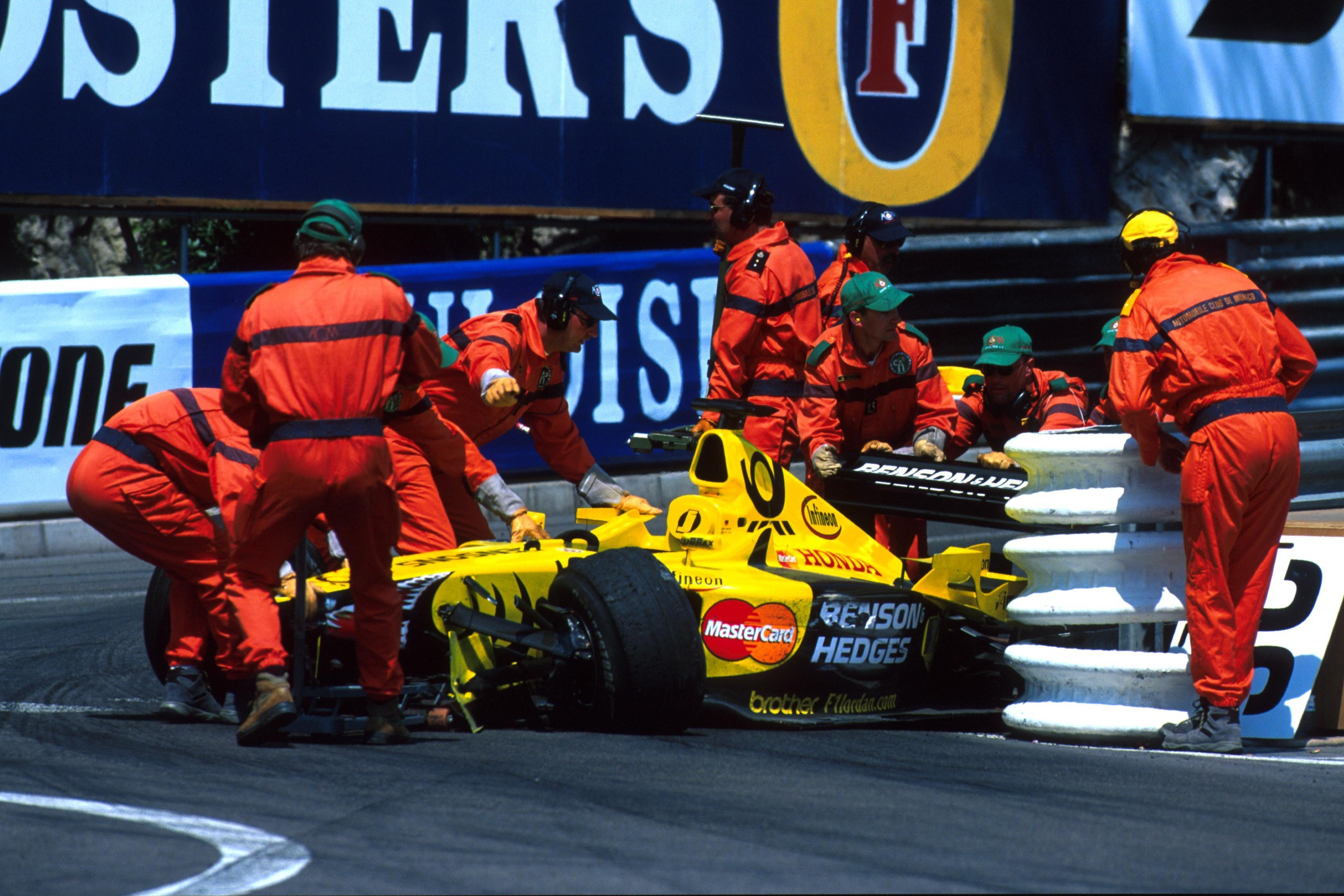
Heinz-Harald Frentzen, 2001 Monaco GP
Photo by: Motorsport Images
Team returnee Fisichella scored a remarkable victory in the 2003 Brazilian GP, but the EJ13 was off the pace and unreliable. A sizeable crash for rookie Ralph Firman when the rear wing fell off at the Hungaroring forced him to miss two races, replaced by the unspectacular Hungarian Zsolt Baumgartner.
PLUS: The worst F1 car to win a grand prix?
Across 2003-05 Jordan only finished ahead of Minardi in the points race as its financial woes grew, and by 2005 it had fallen 3.904% behind the frontrunners. Aside from Indianapolis, where all of the Michelin cars were forced to withdraw and it finished third and fourth of the six cars to start, it's only point came with an eighth place at Spa for Tiago Monteiro. By then the team had been bought by the Russian-owned Midland Group, leading to the F1 squad’s first change of identity in 2006.
PLUS: The driver who gained most from F1's famous farce
The Midland name was in F1 for just one season, in which the team scored no points and was 3.081% off Ferrari. Spyker Cars then bought the team but, despite Markus Winkelhock famously leading the 2007 European GP in his one F1 start, it wasn’t until the outfit was sold to a consortium led by Vijay Mallya that things began to improve.
Investment and a technical partnership with McLaren helped establish Force India as a consistent points scorer. Though the gap to the front see-sawed, the overall trend was a move up the field
Now known as Force India, the team again finished the season point-less in 2008, but the supertimes deficit to the front narrowed from 3.433% to 2.224%. The gap fell to 1.241% as new rules arrived in 2009.
In 2020 that would have put the team only fractionally behind where Racing Point actually was – and ahead of Ferrari – but 2009 was the closest season in world championship history in terms of the raw pace gap from front to back.
That helps to explain why the ‘slowest’ car in the field – the VJM02 – actually took pole position for the Belgian GP. Back for a third spell with the team after three years at Renault, Fisichella was only beaten to victory by a restart and the KERS-equipped Ferrari of Kimi Raikkonen.

Giancarlo Fisichella, 2009 Belgian GP
Photo by: Motorsport Images
Over the next few years, investment and a technical partnership with McLaren helped establish Force India as a consistent points scorer. Though the gap to the front see-sawed, the overall trend was a move up the field.
The 2012 VJM05 was the second-fastest car in the history of 'Team Silverstone' at 0.939% off, although it only yielded 8th in the points. Nico Hulkenberg shone in the rain in Brazil, but missed out on his best chance of an F1 victory when he tangled with Lewis Hamilton.
At the end of the 2.4-litre V8 era in 2013, Force India was sixth fastest, a respectable 1.178% off the pace, and finished in that spot in the constructors’ table.
The team’s first turbo-hybrid car, the VJM07, fell to seventh and 1.968% away, though the later statistic was mainly due to Mercedes pulling out an advantage over everyone – the gap to second was very similar to the year before.
The quality line-up of Hulkenberg and Sergio Perez helped the team to sixth in the constructors’ championship and it improved to fifth in 2015 despite Force India remaining seventh fastest overall. It’s not hard to see how the team gained its reputation for punching above its weight – Force India ‘overperformed’ again in 2016, finishing fourth with the fifth fastest car, 1.708% off the pace.
Although F1’s more aggressive regulations from 2017 helped close the gap at the front of the field, it widened the gap behind and Force India was 2.114% adrift of Mercedes despite still being fifth fastest and again taking fourth in the points table.

Sergio Perez, 2017 Singapore GP
Photo by: Motorsport Images
Financial difficulties delayed developments and resulted in a consortium led by Stroll buying the team’s assets in the middle of 2018, and the squad remained about 2% off the pace through 2018-19. That did mean it fell down the supertimes table as others improved, but the race team’s savviness kept it in the game – combining its scores before and after the takeover would have given it fourth in the table again in 2018, instead of the seventh it was officially awarded.
The RP20 was the third fastest car of last season and closed to within 1.202% of the front, the team’s best performance since the start of the turbo-hybrid era
Perhaps one of the reasons behind Racing Point’s controversial ‘pink Mercedes’ RP20 can be found in its 2019 performance. The RP19 was only quicker than the beleaguered Williams squad’s FW42 and was still 2.171% slower than Mercedes. The team managed to turn that into seventh in the constructors’ fight but, with the current regulations originally set to finish at the end of 2020, it made sense to take a risk and change philosophy – and investigate the Mercedes-based concept.
Despite the controversy, that move clearly worked. The RP20 was the third fastest car of last season and closed to within 1.202% of the front, the team’s best performance since the start of the turbo-hybrid era. Despite the 15-point penalty it received for the RP20’s brake duct design and Lance Stroll’s inconsistent campaign, Racing Point finished only seven points behind McLaren in the battle for third in the constructors’ table.
PLUS: How McLaren triumphed in 2020's best battle
Question marks remain over the renamed Aston Martin team’s driver line-up for 2021, but the group’s history is largely that of making a lot out of a little. It has never quite reached the top but, with a sounder financial footing and the foundation of its most competitive car for two decades, the Silverstone squad has rarely been in better shape.
Fastest 'Team Silverstone' F1 cars (based on supertimes deficit)
The below are the team’s only cars to have got within 1.5% of the fastest that season.
| Position | Year | Car | Deficit | Supertime Pos |
| 1 | 2000 | Jordan EJ10 | 0.884% | 3rd |
| 2 | 2012 | Force India VJM05 | 0.939% | 8th |
| 3 | 1999 | Jordan 199 | 1.004% | 3rd |
| 4 | 1997 | Jordan 197 | 1.047% | 5th |
| 5 | 2001 | Jordan EJ11 | 1.051% | 4th |
| 6 | 2013 | Force India VJM06 | 1.178% | 6th |
| 7 | 2020 | Racing Point RP20 | 1.202% | 3rd |
| 8 | 2009 | Force India VJM02 | 1.241% | 10th |

Jarno Trulli, 2000 Monaco GP
Photo by: Motorsport Images


Top 10 Can-Am cars

Top 10 greatest F1 qualifiers

Top 10 Tyrrell F1 drivers: Alesi, Brundle, Stewart and more

Autosport magazine: We grade the 2026 F1 grid so far

Top 10 unexpected F1 polesitters

Top 10 rookie seasons in F1

Helping McLaren’s greats go faster for 40 years

The deep and lasting significance of the McLaren MP4/4’s forgotten older brother

Ferrari not yet switching focus to 2027 F1 car

The verdict on the WRC Rally Chile tyre solution

Top five roles on Motorsport Jobs this week

Quartararo explains why Yamaha relationship has strained ahead of Honda move
Subscribe and access Autosport.com with your ad-blocker.
From Formula 1 to MotoGP we report straight from the paddock because we love our sport, just like you. In order to keep delivering our expert journalism, our website uses advertising. Still, we want to give you the opportunity to enjoy an ad-free and tracker-free website and to continue using your adblocker.


Top Comments