


How Verstappen's record-breaking 2022 season compares to the F1 greats
The 2022 Formula 1 season will be remembered as a record book rewriting Max Verstappen masterclass, a completely different challenge to his maiden world championship last year, and a clear sign he is still raising his own level. But where does it stack up against the all-time great F1 campaigns?

Max Verstappen has pointed out that Formula 1 seasons are longer now than they used to be and, like most active sportspeople, he’s not too bothered about breaking records. But his new benchmark of 15 wins from a single world championship season is still remarkable and deserves to be compared to some of the finest campaigns in F1 history.
Working out the strike rate is an easy way of minimising the impact of the ever-growing F1 schedule. Verstappen’s tally from 22 races gives a 68% success rate. Yes, Ferrari’s strategy blunders and unreliability have boosted this figure, but Verstappen still had to get the job done. And he did that despite various challenges along the way, such as grid penalties at Spa and Monza.
The bald statistics are impressive, but what makes Verstappen’s season stand out is that, in raw performance, the Red Bull RB18 had a smaller advantage than most machines that have racked up similar successes. Taking a look at the supertimes is one way of demonstrating this.
Supertimes are based on the fastest single lap by each car at each race weekend, expressed as a percentage of the fastest single lap overall (100.000%) and averaged over the season. There are some limitations to this approach because it’s based on the best lap time of a weekend, which usually means qualifying. And qualifying pace does not, of course, always translate into race pace.
The Ferrari F2004 that Michael Schumacher took to 13 wins from 18 races (72%) in 2004 ‘only’ had a supertimes advantage of 0.218%. In reality it was larger, mainly because Ferrari’s Bridgestone tyres were better race (and worse qualifying) tyres than the Michelins on the rival cars. The F2004’s true domination was greater than the supertimes suggest.
PLUS: The car so good it shocked Ferrari
The RB18 is similar in that it has tended to be a better race car than a qualifying car – or the rival Ferrari F1-75 was a better one-lap wonder than a GP contender. The Red Bull actually ended the season 0.017% behind the Ferrari, though it would take a particularly bold tifoso to argue that the RB18 wasn’t the best car of 2022…
Nevertheless, the supertimes approach does help provide a basis from which we can compare some of F1’s greatest seasons.
|
Year |
Champion |
Wins |
Percentage |
Supertimes adv |
|
1952 |
Ascari |
6 |
75/86 |
3.70% |
|
2004 |
Schumacher |
13 |
72 |
0.218% |
|
1963 |
Clark |
7 |
70 |
0.474% |
|
2022 |
Verstappen |
15 |
68 |
-0.017% |
|
2013 |
Vettel |
13 |
68 |
0.105% |
|
1954 |
Fangio |
6 |
67/75 |
0.158%* |
|
2002 |
Schumacher |
11 |
65 |
0.283% |
|
2020 |
Hamilton |
11 |
65/69 |
0.594% |
|
1965 |
Clark |
6 |
60 |
0.089% |
|
2011 |
Vettel |
11 |
58 |
0.489% |
|
2014 |
Hamilton |
11 |
58 |
0.881% |
* Estimated
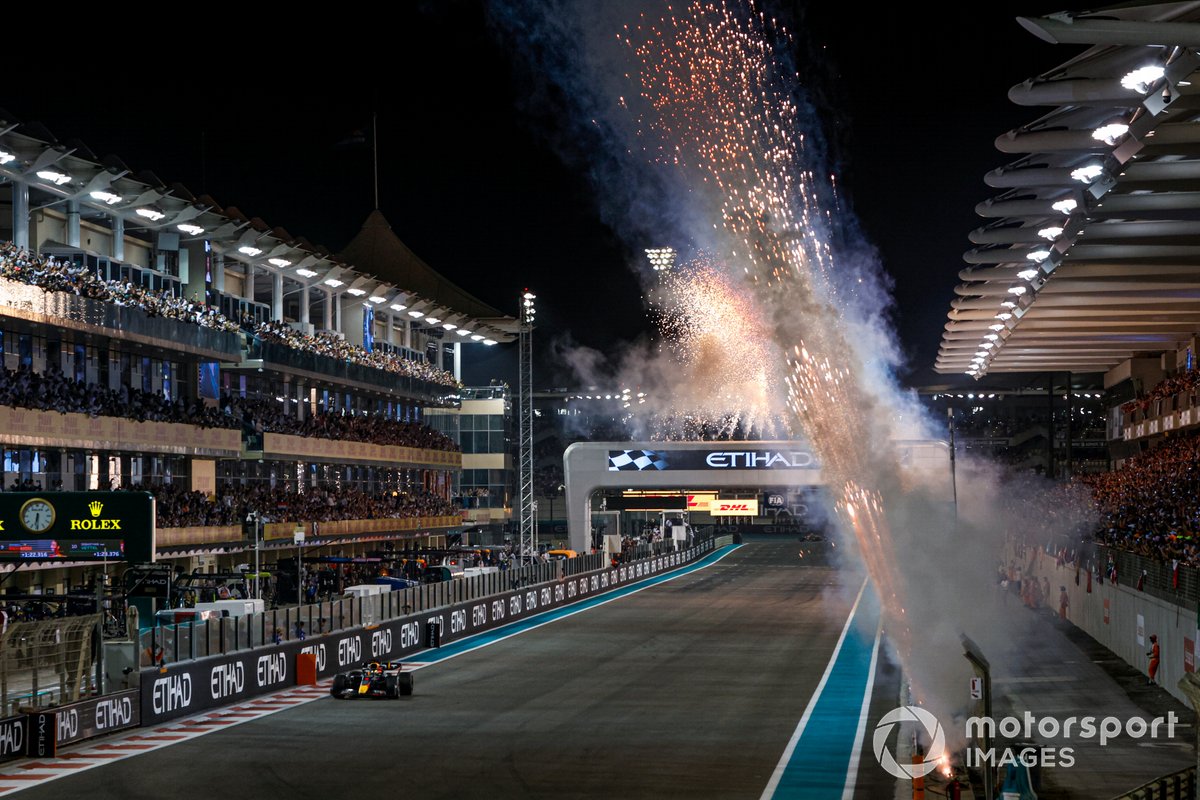
Verstappen's 15 wins set a new record for most victories in an F1 season, while Sergio Perez also added two more to Red Bull's haul
Photo by: Steven Tee / Motorsport Images
One of the first things to jump out from the table is Ferrari’s enormous advantage in 1952, when the world championship was run to F2 regulations. Apart from the Ferrari 500’s pace, Alberto Ascari also didn’t have to deal with the other standout of the era, Juan Manuel Fangio, who missed the whole season through injury. Ascari still had some good team-mates to beat and his strike rate (75%, or 86% if the Indianapolis 500 is excluded) is outstanding, but the level of opposition was not as high as in subsequent eras.
Fangio’s 1954 crown can be thought of in similar terms, even though the supertimes advantage is much smaller. The figures are clouded by the late arrivals of Mercedes and then Lancia, but it’s fair to say that Fangio usually had the best machinery, not only when he started the season in a Maserati 250F but after he switched to the Mercedes W196.
When the as-yet-undeveloped Lancia D50 arrived for the Spanish GP finale, the Argentinian did face a faster car, but the title had already been secured and neither he nor the Lancia won the race. The fact that chief rival Ascari missed most of the campaign means that Fangio’s less-dominant 1951 and 1957 seasons should probably be held in higher regard than 1954.
Verstappen is the only driver on our table with a supertimes disadvantage, even if the reality was a little different and Ferrari failed to make the most of its performance
One of the smallest supertimes advantages that translated into domination came from Red Bull in 2013. The RB9 Sebastian Vettel took to 13 wins from 19 GPs (68%) was only 0.105% clear of the pack. That’s partly because the rapid Mercedes F1 W04 often ate its tyres in races, but it also underlines the reliability and efficiency of Red Bull – the team’s pitstops and strategy rarely gave wins away, just as in 2022. That must be factored into Verstappen’s success – it’s no coincidence that Red Bull won the Fastest Pit Stop Award five years in a row.
It’s a similar story for the Ferrari team of 2002 and 2004. Although the pace advantage is understated by the supertimes, the sheer reliability and strategic nous of Jean Todt/Ross Brawn’s squad left rivals standing. Like Verstappen, Schumacher also did not have to worry about a consistent challenge from a team-mate. Rubens Barrichello was rarely on his pace and occasionally asked to move aside when he was, such as at the infamous 2002 Austrian GP.
Jim Clark’s two world titles stand out. The combination of the Scot and Colin Chapman’s ground-breaking Lotus designs was often the pacesetter in the 1960s, and Clark’s seven wins from 10 (not to mention numerous non-championship F1 race wins) in 1963 set a new benchmark. But his six from 10 races in 1965, against strong BRM opposition and a revived Ferrari, is perhaps even more impressive given Lotus’s pace advantage was just 0.089% compared to 0.474% in 1963.
PLUS: F1’s great Lotus game-changers - the 25
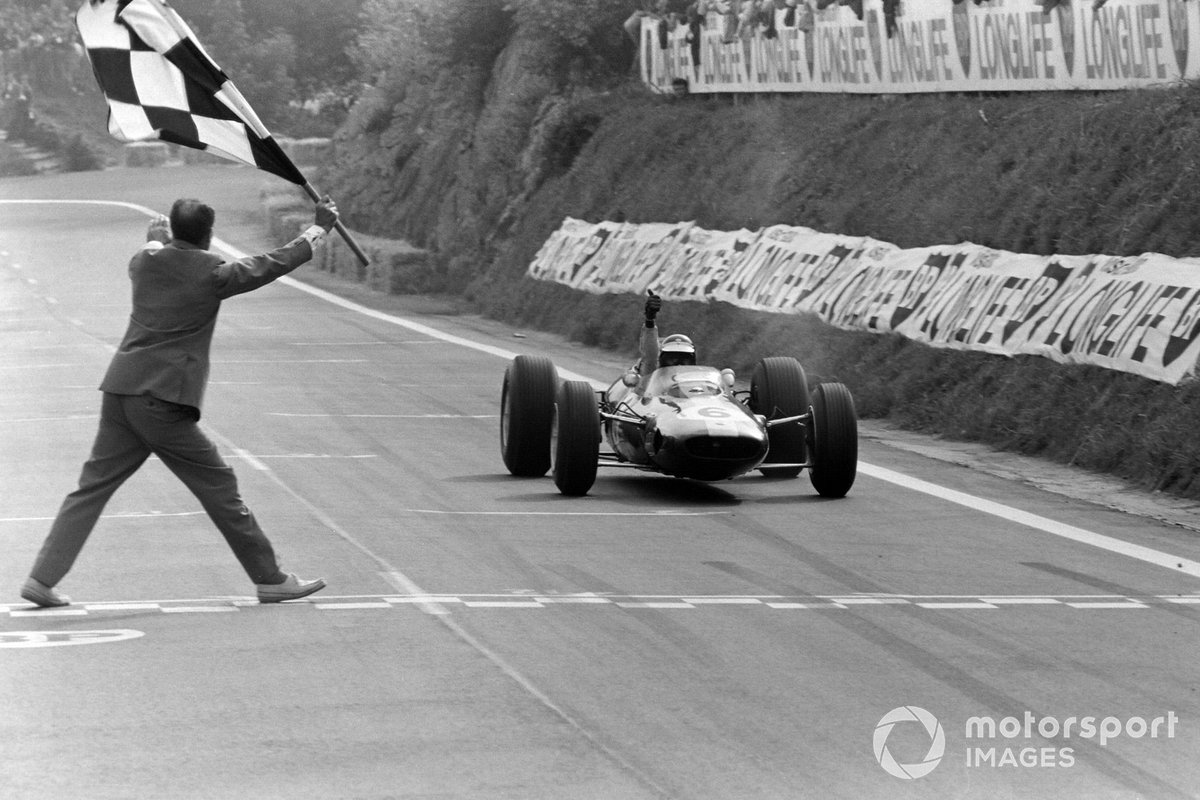
Clark's 1965 F1 title triumph for Lotus saw the slimmest supertimes advantage in a dominant season...until Verstappen went into negative numbers in 2022
Photo by: Sutton Images
Considering Clark missed the 1965 Monaco GP to win the Indy 500 and hit mechanical trouble in the other three championship races he didn’t win, his 1965 performance has to be considered one of the greatest.
Given his many F1 records, Lewis Hamilton features less than you might expect. He didn’t really get his hands on a car dominant enough to challenge this list until 2014, then had a strong team-mate in Nico Rosberg at that point and for the next two seasons. His German challenger and the clashes between the two limited the Briton’s strike rate to the 48-58% range.
Few would argue against the point that Hamilton became a better driver following his 2016 defeat, but the new rules that brought wider, faster cars also eroded Mercedes’ advantage.
The exception was 2020, when the W11 moved Mercedes comfortably clear. Its advantage was usually bigger than the 0.594% shown in the supertimes – the team stopped developing the car before the halfway mark of the campaign, allowing Red Bull to close. Hamilton still took 11 wins; 65% of the season’s events, but 69% of the races he started because he missed the Sakhir GP with COVID.
Top 10: Mercedes GP cars ranked - W125, W196, W11 and more
There were moments in 2020 when Hamilton was arguably performing at his best, most obviously in his sublime Belgian GP qualifying lap, record-breaking Italian GP pole and victory in Turkey.
But perhaps his most impressive overall campaign remains 2018, when Ferrari had a faster package for a significant portion of the season and yet Hamilton wrestled the title initiative from Vettel even before Mercedes’ upgrades moved the Silver Arrows clear of the Maranello squad.
That also raises another point – that record-breaking seasons aren’t necessarily the greatest in F1 history. Close battles or even failed campaigns need to be considered.
Aside from Hamilton in 2018, the efforts of Jackie Stewart in 1973, Alain Prost in 1986 and Fernando Alonso in 2012 have to come into the debate, even though they ‘only’ scored five (33%), four (25%) and three (20%) wins respectively. In all three cases, the drivers were fighting against a machinery disadvantage, made few mistakes and regularly maximised their results. Stewart and Prost were rewarded with titles, while Alonso lost out by three points.
There have also been some titanic battles between team-mates that would be worthy of mention, such as Nigel Mansell-Nelson Piquet at Williams in 1986-87 and Prost-Ayrton Senna in 1988-89. Senna fans would understandably point to his 1991 and 1993 seasons, too.
Verstappen has arguably made more mistakes in 2022 – the off in Spain, spin in Hungary, escape-road escapade in Singapore and clash with Hamilton in Brazil – than many of those campaigns, but that’s still impressively few over such a long season. And he is the only driver on our table with a supertimes disadvantage, even if the reality was a little different and Ferrari failed to make the most of its performance.
If not quite at the top of the tree, the Dutchman’s 2022 stands up as one of the greatest seasons in F1 history, ahead of most of the others on our table, and is a well-deserved record. The only question now is, can Verstappen reach even higher?
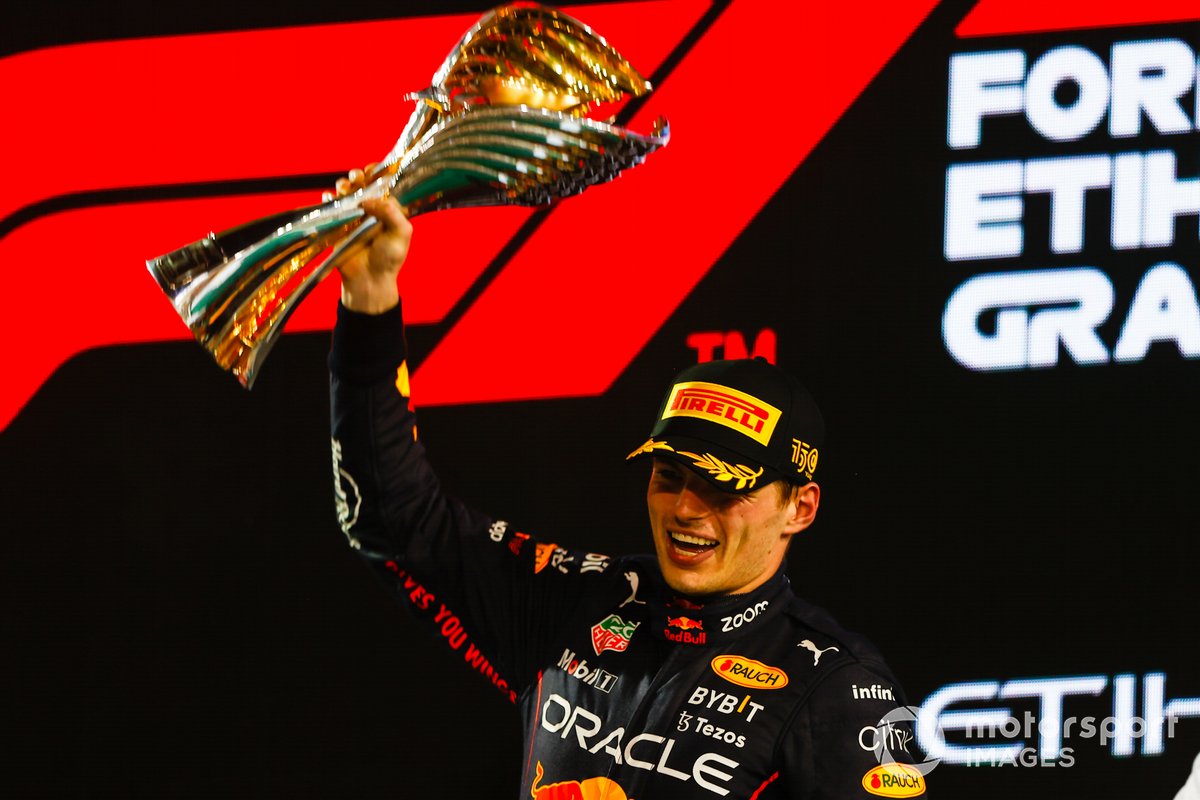
With two world titles won in very different scenarios, what can Verstappen produce next?
Photo by: Andy Hone / Motorsport Images


The greatest F1 campaigns with no wins

Top 10 F1 results changed by backmarkers – the passes

Top 10 F1 results changed by backmarkers – the clashes

Stars, cars and highlights from the 2026 Goodwood Revival

The Egal has landed – again

Autosport magazine: Antonelli and a Can-Am celebration

Top 10 Can-Am drivers

Top 10 Can-Am cars

What to expect from WEC's Barcelona debut

Acosta proposes new idea for monitoring tyre pressure in MotoGP

Horner's inside story of how Red Bull built its own F1 engine

Exclusive video: Christian Horner interview on his Red Bull exit, Mercedes rivalry and more
Subscribe and access Autosport.com with your ad-blocker.
From Formula 1 to MotoGP we report straight from the paddock because we love our sport, just like you. In order to keep delivering our expert journalism, our website uses advertising. Still, we want to give you the opportunity to enjoy an ad-free and tracker-free website and to continue using your adblocker.


Top Comments