


How two 25-year-old masterpieces shaped F1 gaming forever
Gamers today are spoiled for choice with the array of titles on offer that allow them to experience hyper-realistic representations of cars and tracks in the virtual world. Much of the credit for this should go to two 1996 titles that paved the way for what was to come

As the latest instalment of Codemasters’ Formula 1 video game franchise, F1 2021, draws ever closer, it will hit stores and download queues next month brimming with the bells and whistles which gamers have become accustomed to with each yearly release.
Since picking up the F1 franchise in 2009, Codemasters has packed its games with career modes, challenges, historical content and, as of 2019, junior categories. The 2021 edition will also include a story mode akin to FIFA’s ‘The Journey’. Admittedly, this writer would rather have a full Formula 3-to-F1 ladder to work through instead of superficial set-pieces in a fictionalised paddock, but perhaps tapping into the behind-the-scenes access that Netflix’s Drive to Survive provides is more lucrative.
Today, F1 games are exclusive to Codemasters. There’s the possibility for game developers to create fictionalised versions of teams, drivers and the like akin to Pro Evolution’s approach to filling in the dearth of licensing agreements (which Motorsport Manager did with reasonable success). But the consumer’s preference to race with their real racing heroes and favourite teams means that unlicensed renditions of F1 probably won’t fare quite as well as a Merseyside Red vs Man Blue title scrap did for Konami’s PES franchise. The allure, after all, is F1 itself – not a motley collection of corrupted names that wouldn’t be out of place in the dearly departed Auto GP series.
Before F1 signed away exclusivity, many different gaming giants had their own F1 franchises across a glut of consoles. Sony, EA, Eidos, Microprose, Ubisoft et al all had stabs at replicating the best-known racing championship in digital form, and these were usually outsourced to smaller developers to mixed success. The deluge of F1 games and the varying quality of each in the late 90s and early 2000s eventually prompted F1 to stick to awarding just one publisher with a license – which Sony held between 2003 and 2007 for its series of Playstation exclusives before Codemasters picked it up two years later.
A quarter of a century ago, Sony was one of two publishers to completely revolutionise the medium of F1 games through its Psygnosis subsidiary. In 1996, it released Formula 1 for the Playstation – the Ronseal of video games. Developed by Bizarre Creations, it was F1 in its purest form; based on the 1995 season, Formula 1 included all 13 teams of the time (including Simtek, which disappears for all of the post-Monaco races), every driver – including the mid-season substitutes – and every circuit. You could rewrite history and take Damon Hill to a title, or try to lug the lumbering Forti FG01 into positions it had no business being in – the call was yours.
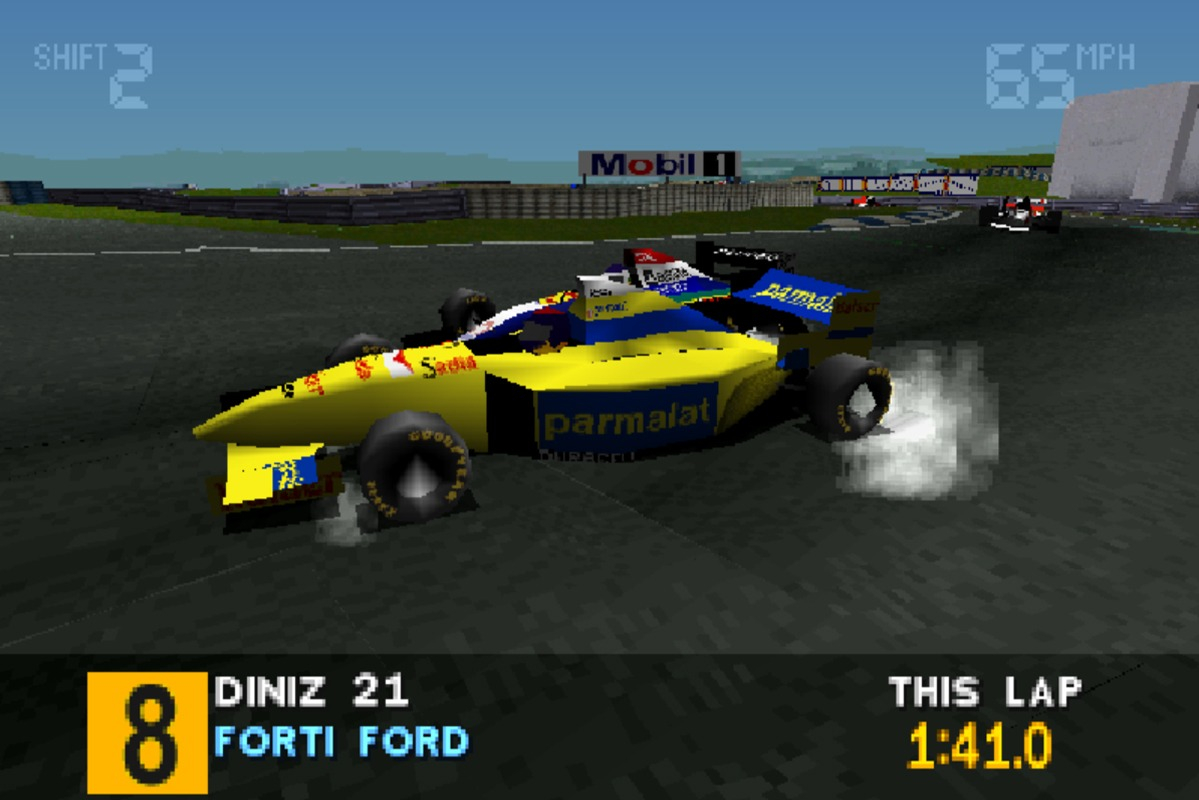
Bizarre was a relatively small team tasked with putting together an F1 game, and did so at a time when the understanding of the Playstation’s 3D graphics was in its nascency. Luckily, the cast of F1 circuits from the time were willing to provide the team with its telemetry and track data, which could be converted into the in-game circuits with some minor modifications. The team got the game together in about a year, a herculean feat given the scale of having to build an entire game from scratch within the tight timeframes for release.
It had everything one could possibly hope for in a pick-up-and-play F1 game, although Formula 1’s flagship mode was, of course, to participate in the full championship. Whether you wanted to replicate Michael Schumacher’s triumph with Benetton, or try to upset every single oddsmaker and pick Pacific part-timer Jean-Denis Deletraz (and attempt his little weave in front of Jean Alesi at the Nurburgring), there was the freedom to do so.
Naturally, the cars feel different too; the Williams and Benettons handle well and are the class of the field, while the likes of Pacific and Forti feel cumbersome and ponderous in the corners
You could hone your racing line in practice, use the 12 laps available in qualifying - as was the style at the time - to hurl your car as far as it could go up the grid, and then revel in the skirmish between 25 other brightly coloured polygonal racing cars.
Most gloriously, the late Murray Walker lent his voice to the game and provided iconic readings for every situation. He narrated wild crashes, impressive lap times, and the minutiae of Ukyo Katayama’s racing career during the quieter moments of a race – every eventuality had been covered by the commentary maestro in his recording sessions.
It’s particularly fun to hit walls and other cars to hear Walker’s excitable surprise at contact (and even more so with one of Tyrrell’s replacement drivers from that season, if only to hear his famous BTCC exclamation of “it’s Tarquini!”) The aural feast continues with the menu soundtracks, featuring the guitar shredding exercises of Joe Satriani and Steve Vai to truly kick one's adrenal glands into overdrive.
Set-ups are less involved than those offered by today’s simulator-style games, but still give you enough to marginally tailor your car to each circuit with downforce levels and the like. Naturally, the cars feel different too; the Williams and Benettons handle well and are the class of the field, while the likes of Pacific and Forti feel cumbersome and ponderous in the corners. Across the board, the cars have the turning circles of the Ever Given – the famed Suez Canal-clogger - at speed, but with deft braking this is something that can be overcome.
There’s also the opportunity to experience changeable weather; sunny, dry races can suddenly descend into the gloom as the clouds draw overhead and pelt the circuit with rain. The handling in the wet is, as expected, difficult - especially when the AI's occasional lack of spatial awareness comes into play. Spinning is not necessarily a good trick in those instances.
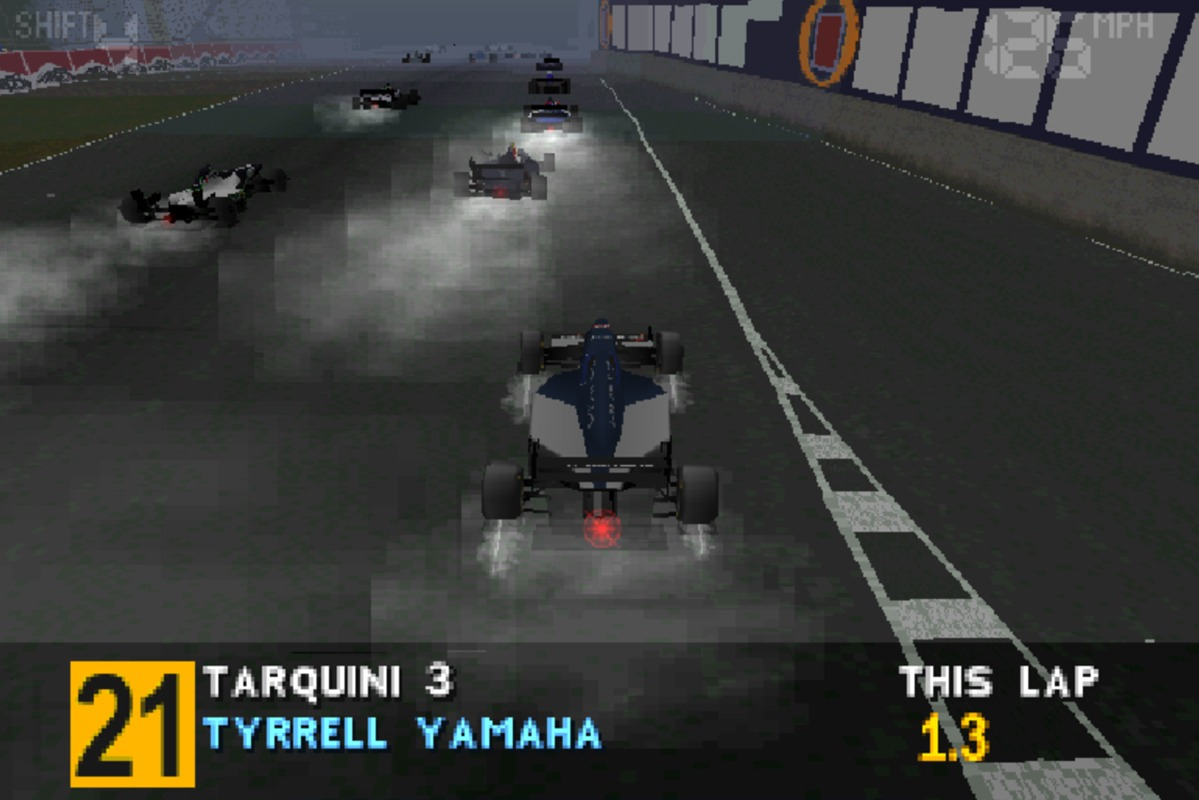
Formula 1 served as the basis for the hugely successful Formula 1 ‘97, which many still consider to be the gold standard in F1 games. With the same engine, the Bizarre team was able to expand on its first offering with a larger arcade mode, the addition of Martin Brundle’s tones to pair with Walker's in the virtual commentary box, and the new cast of circuits on the calendar for the 1997 F1 season.
Unfortunately, the good times didn’t roll thereafter; Bizarre relinquished F1 game duties to the Visual Sciences development team who wanted to use their own game engine – and the resulting Formula 1 ‘98 ended up being a bit of a dog’s dinner.
If Formula 1 was the first of two 1996 releases to change the face of F1 video gaming’s future, then the second was undoubtedly Grand Prix 2. The follow-up to Formula One Grand Prix, Grand Prix 2 was designed and programmed by Geoff Crammond – who later continued with the solid Grand Prix 3 and the still-popular Grand Prix 4. But GP2 was arguably his magnum opus, offering one of F1’s most realistic experiences that one could afford in 1996.
Like Formula 1 on the PS1, GP2 was not based on the 1996 season – but this time, on the 1994 season. Featuring all 14 teams that took part, two cars will always be destined not to qualify for the grid of 26 cars – and true to life, this usually leaves the Pacific cars out of luck come Sunday’s race.
Graphically, GP2 isn’t quite as refined as Formula 1; rather than individual car models, there are two to differentiate between the high-nose and low-nose cars of the time. The circuits are not quite as vibrant either; the 256-colour palette is quite restrictive, and the shades rendered within the game appear in rather muddy hues. But despite those limitations, the circuits are true to their real-life counterparts through the clever use of textures and sprites within the surrounding environs.
GP2 also has plenty of set-up options to get lost in too; front and rear wing settings can be played with, as can brake bias and gear ratios, but the more advanced options allow for tinkering with ride heights, springs, dampers and roll bars too to get the most out of the car. There’s also a chance to dial in your suspension set-up further with bump and rebound settings, offering the opportunity to get lost in a rabbit-hole of tweaks. These can be mapped for each individual circuit too, giving you a handy repository of set-up sheets and data – much like you’d get in a real racing environment.
If Formula 1 was a pick-up-and-play-with-your-mates kind of game, GP2 leans towards the sim aspect a little bit more. That was also evident in the failures that your car can sustain, ranging from engine failures to electrical problems, and the game even renders smoke and flames emerging from the rear of the car in the event of the former. Formula 1 has failures too, but usually result in simply grinding to a halt at the side of the road – without the fireworks display.
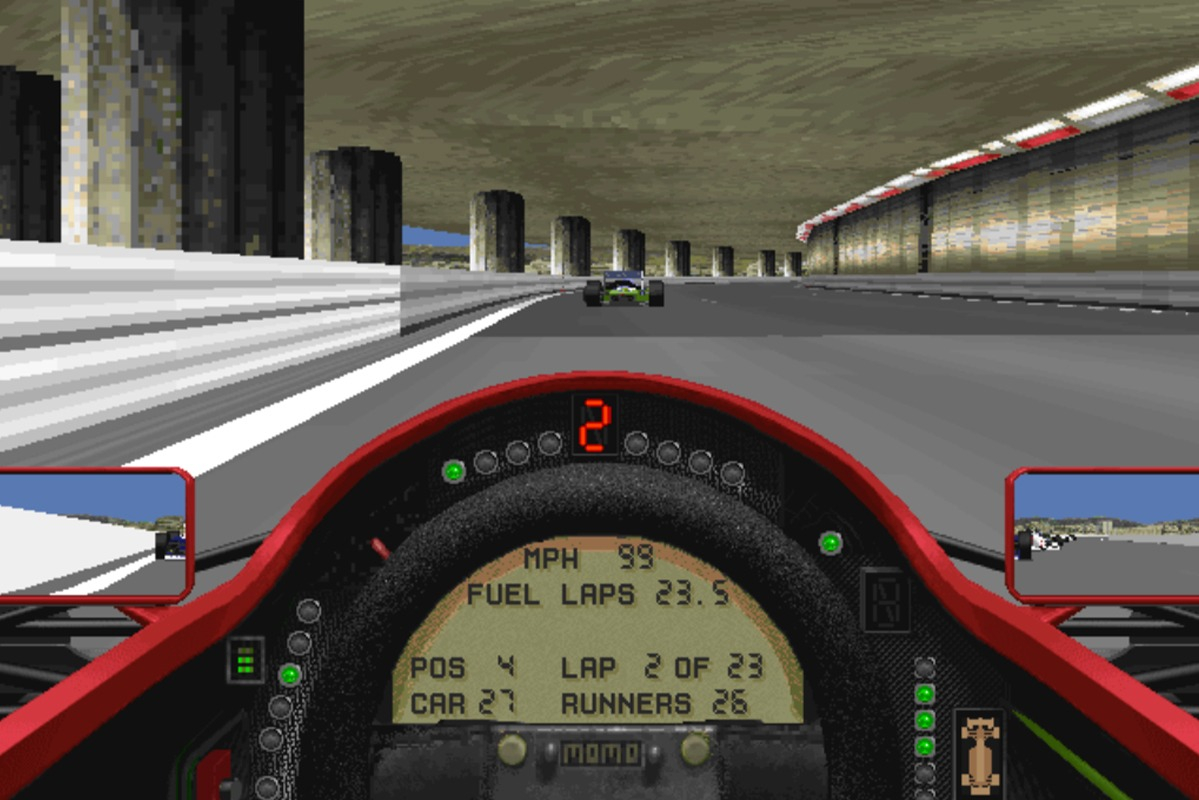
Further customisability comes through the myriad of mods available for the game, adding to its replay value. Pretty much every F1 season is available in some corners of the internet, given the simplicity of its game editor, along with replications of other championships such as CART, IRL and F3000.
But despite the customisations available, there’s no weather options. Thus, there’s no chance to recreate the 1994 Japanese Grand Prix’s heavy downpour; although an editor can once again be used to simulate wet conditions by reducing the track grip, the lack of graphical cues take away from that immersion.
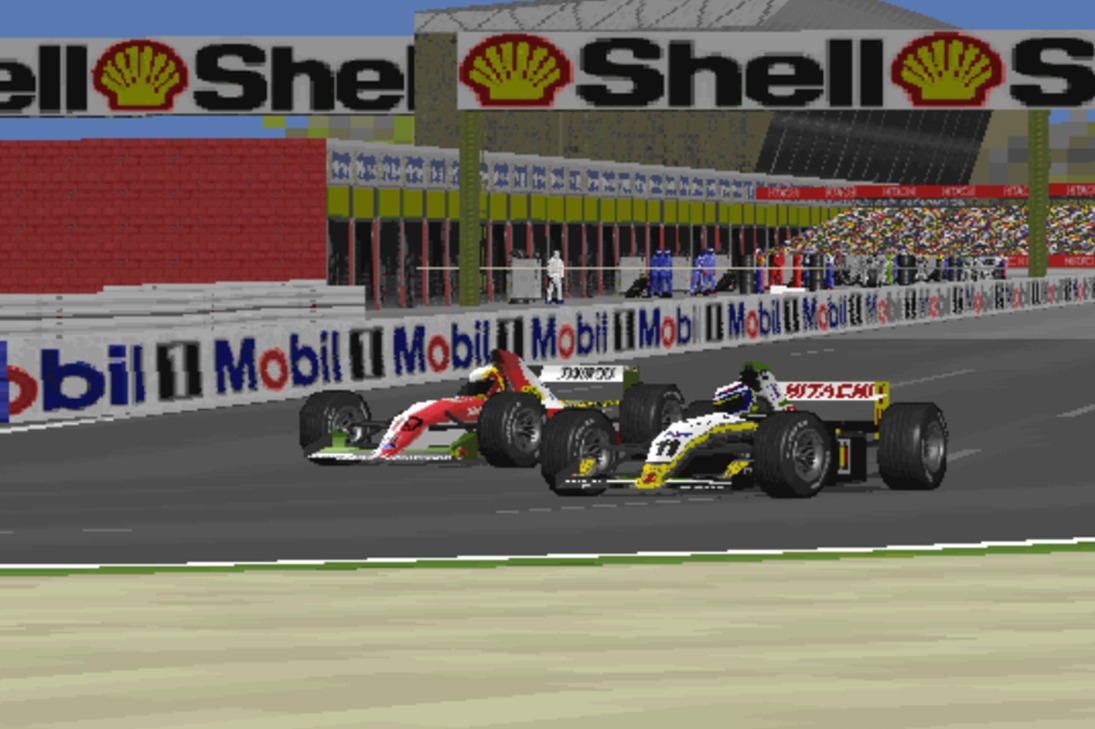
Through today’s discerning eye, GP2 looks less pretty than Formula 1, but the variety on offer means that one isn’t railroaded into experiencing just one F1 season. Both are demonstrably products of their time; the advent of 3D graphics meant that pop-in (the occasional shift in textures) and draw distance (the rendering of objects coming towards you) were common – and both Formula 1 and GP2 were no exceptions.
The then-realistic graphics and sense of immersion that the two games flaunted - both in their own differing ways – along with their accessibility made them the turning point for all future F1 games to follow
Today’s hyper-realistic graphics extend to lengthy face-scanning sessions, track scans and accurate modelling of cars – things that seemed unfathomable in the 1990s. But Formula 1 and GP2 brought F1 gaming to the masses as the popular human pastime of ‘sitting in front of a screen’ boomed in popularity. The then-realistic graphics and sense of immersion that the two games flaunted - both in their own differing ways – along with their accessibility made them the turning point for all future F1 games to follow.
And if the easy-to-grasp nature of Formula 1 eventually spawned the likes of Codemasters’ current franchise, the offering of more meticulous set-up choices in GP2 presumably gave rise to the likes of rFactor, Assetto Corsa, iRacing, et al. Gamers today are undeniably spoiled for choice.
If Formula 1 and Grand Prix 2 never had the chance to shape the industry, the world of F1 gaming would be considerably poorer without them.


The one aspect of the 2026 US GP that should be a blueprint for F1 2027

A strategic masterclass: How Antonelli put himself on the cusp of F1 title at the US GP

Leclerc and Hamilton's differing theories behind Ferrari's Austin qualifying disappointment

What we learned from Friday practice at the 2026 United States GP

The reasons behind Ferrari's US GP upgrades

Mission control: Inside the FIA and F1's remote operations centre

FIA expects F1 races in Qatar and Abu Dhabi to run as planned

Why Piastri has struggled to show his best with this year's McLaren MCL40

Morrow edges Grant as older Formula Fords entertain in Festival support contests

Is MotoGP’s title fight over after the Australian GP swing?

The one aspect of the 2026 US GP that should be a blueprint for F1 2027

Red Bull explains why Verstappen and Hadjar's 'silly' problems won't all be fixed in 2026
Subscribe and access Autosport.com with your ad-blocker.
From Formula 1 to MotoGP we report straight from the paddock because we love our sport, just like you. In order to keep delivering our expert journalism, our website uses advertising. Still, we want to give you the opportunity to enjoy an ad-free and tracker-free website and to continue using your adblocker.


Top Comments