


How the Jeddah F1 race became a one-sitting Netflix drama series
The inaugural Saudi Arabian Grand Prix was a race packed full of incident as Formula 1 2021's title contenders repeatedly clashed on track. Lewis Hamilton won out over Max Verstappen to level the scores heading into next weekend's Abu Dhabi finale, as Jeddah turned F1 into a drama series

Formula 1 is obsessed with the ‘Netflix-effect’.
It’s easy to see why. Ever since Drive to Survive premiered in 2019, the documentary series that plays fast and loose with sporting reality is credited with attracting new fans to the championship globally.
Netflix is more than a media giant. It’s a verb – and famously rather a naughty one. But ‘Netflix’ also encompasses how people consume many of the programmes on its platforms: they binge them. The shows play automatically – it's assumed one always wants ‘just one more’.
And that’s basically what happened in Saudi Arabia’s first F1 race. It was a stop/start thriller eventually won by Lewis Hamilton over his arch-nemesis, Max Verstappen. Action-packed and seemingly never-ending. It was a six-part Netflix drama series, which revealed just how much the championship’s soul has changed.
Hamilton won out in an ill-tempered contest as Verstappen's medium tyres grained, but not after multiple clashes
Photo by: Sam Bloxham / Motorsport Images
Episode one: A formula awakens
The start of the 50-lap race on the shores of the Red Sea was thematically pretty familiar to anyone who has watched one of the plethora of sporting documentaries churned out in recent years. In that it followed a simple scene-setting formula.
When the lights initially went out in Jeddah, a blast of action was followed by a period of tedium that set up what would follow – very F1 – as Hamilton and team-mate Valtteri Bottas roared away from their shared front row. They were chased by Verstappen, who’s gearbox had passed a post-qualifying-crash investigation and been assessed as healthy. But where the Mercedes duo got things wrong in defending a 1-2 start against the marauding Verstappen in Mexico, here they were perfect in “the only part of the race that was in anyway rehearsed”, according to team director of trackside engineering Andrew Shovlin.
Hamilton led comfortably into the short, 90-degree left-hander at the end of the main straight on the outside line, with Bottas positioned impeccably as rear gunner on the inside. This left Verstappen with no alternative but to slot in behind the Finn as they ran through the immediately ensuing longer right corner (Turn 2) past the pit exit. Hamilton jumped to a 1.0s lead at the end of the first tour, which he doubled over the next seven laps as the leaders quickly pulled clear of the chasing Charles Leclerc and Sergio Perez.
“We started to see as we got into that stint Lewis could push and pull out a gap as required,” Shovlin explained of Hamilton being told to up his pace here to pull clear of Bottas, which both increased his advantage over Verstappen and meant his team-mate didn’t have to slide following in as much dirty air.
Hamilton aired his suspicious views on the decision as the cars returned to the pitlane, where Verstappen was able to take the hards in a free pitstop and the fictional credits rolled
After the tension of the start, the first part of the first stint was pretty dull – much more ‘Unplugged’ than DTS. At least it lasted only about as long as an episode of Formula E’s YouTube-based attempt to launch its own DTS-inspired interest…
Because, plot-twist, on lap nine the safety car was called after Mick Schumacher suffered a heavy crash “trying too hard to get back into the DRS window [behind George Russell] and lost it at [Turn] 22” – the violently fast left kink where Leclerc had also shunted forcefully in FP2.
Mercedes called its drivers in, but Bottas dropped from 2.6s back behind Hamilton at the start of the lap Schumacher never completed to run 6.0s adrift as he entered the pits. This, entirely understandably, enraged Verstappen, who fumed about Bottas’s tactics to allow enough time for a Mercedes doublestack over his team radio.

Mercedes orchestrated the initial start well, Bottas keeping Verstappen behind, before the first red flag turned the race on its head
Photo by: Mark Sutton / Motorsport Images
But here Red Bull did something unexpected – it left Verstappen out, which meant he led Hamilton and Bottas at the head of the safety car queue. He therefore remained on his starting medium tyres, as the chasing Black Arrows ran hards that could easily reach the finish on Jeddah’s ultra-smooth and low-wear track surface.
Red Bull needed another twist and it got it, with race director Michael Masi soon stopping the race so the Turn 22 barriers could be assessed and rearranged. Hamilton aired his suspicious views on the decision as the cars returned to the pitlane, where Verstappen was able to take the hards in a free pitstop and the fictional credits rolled.
Episode two: Attack of the Bull
After a near 20-minute halt, the race resumed with a second standing start at the beginning of lap 15 – with both title contenders annoyed by separate issues on the lap out of the pits following the safety car. Hamilton felt Verstappen performed a practice start pulling away in the pitlane, while the leader was upset at the Mercedes not following closely enough.
Hamilton’s slow arrival back on the grid had a direct impact on what would happen at the second start as it meant Verstappen’s hards cooled and lost performance – something the teams had been battling with all weekend given the track’s smooth surface and long layout. It was just too easy for the tyres to fall from their best operating window.
The result for Verstappen was that when the lights went out again, he was easily beaten away by Hamilton, who surged back into the lead approaching Turn 1. But here, Verstappen made a move similar to the one that nearly ended in tragedy at Monza as he stayed on the outside line and attacked Hamilton as the left-hander unfolded. But that was always going to end with a trip through the runoff, which meant Verstappen cut Turn 2 and held up Hamilton as he rejoined.
This allowed a new character to enter the picture: Esteban Ocon. The Hungaroring winner will surely have his own episode on DTS season four, but here he was an important bit-part player in the Verstappen/Hamilton melodrama.
He’d risen from ninth at the first start, to seventh before the safety car, under which he stayed out to leap to fourth and then gained as Verstappen did with a free pitstop for hards under the red flag. After gaining from Bottas’s heavy lock-up and slide deep at Turn 1 following the second standing start, when the top two were clumsily going around Turn 2 slowly, Ocon was able to nip by Hamilton to take second.

Verstappen's decision to hang on around Hamilton's outside on the second start allowed Ocon to sneak into second
Photo by: Andy Hone / Motorsport Images
In the pack behind, chaos reigned as Perez was spun into the Turn 3 wall after contact with Leclerc, who had nowhere to go on the inside as the pair ran a staggered three-abreast with Pierre Gasly (to Perez’s right). The Red Bull was eliminated, with the following drivers having to stamp on the brakes in avoiding action. One of these was Russell, who was in-turn rear-ended by the unfortunate and unsighted Nikita Mazepin. Next chapter.
Episode three: Enter the bureaucrat
Some of the best episodes of drama series don’t contain a second of ‘action’ – be that shots fired in a modern war epic or racing laps in a fly-on-the-wall F1 soap opera. And what happened next in Jeddah fitted that mould.
With the cars formed up in the pitlane once again, Masi engaged in a series of phone calls with Jonathan Wheatley and Ron Meadows – the respective sporting directors at Red Bull and Mercedes. He proposed that Verstappen be moved back behind Hamilton for the third grid start, which would elevate Ocon to become the race’s third polesitter and avoid a stewards’ investigation over Verstappen’s start two, Turn 1/2 antics.
"We decided that if he's going to go to the stewards, he's going to get a penalty. So that's why we conceded the grid position for the restart" Christian Horner
“I immediately when I saw it happen at Turn 2 suggested to the stewards that I'm going to give the team the ability to give that place back,” Masi said of a radio exchange situation no different than recommendations to give positions back during racing laps that have occurred many times before.
“The red flag obviously ensued very quickly thereafter, and that was absolutely the priority before we got going again. Being under a suspension, [the discussion with Red Bull] was the ability to effectively correct that before we went racing again."
Red Bull team boss Christian Horner quipped that the exchange was “a bit like being down the souk”, as Wheatley asked for time for Red Bull to decide, which was granted during the second actual 20-minute race suspension.
“We decided that if he's going to go to the stewards, he's going to get a penalty,” Horner explained. “So that's why we conceded the grid position for the restart.”

Verstappen fired up the inside of Hamilton and Ocon at the third start to grab the lead, as to his right the Mercedes and Alpine make contact
Photo by: Jerry Andre / Motorsport Images
Episode four: Verstappen strikes back (legally)
Once again, fictional opening credits are clearing and another start is coming – with Red Bull’s decision having made Ocon the big winner. And again, Hamilton shot from second to race into a leading position at Turn 1 after a third standing start. But this time, without Bottas’s protection, the far inside line was vulnerable.
Here Verstappen plunged. He’d warded off any intentions Daniel Ricciardo might have had against the pitwall from fifth alongside and then eventually ahead of Bottas out of the opening corners, and then made his move: alongside Hamilton and Ocon, three into Turn 1. The move stuck, just, and was just legal – but it didn’t escape notice that Hamilton had to turn away from contact once again in 2021, which meant he and Ocon did collide.
“He got sandwiched and Esteban rode over it,” Shovlin said of the right-hand-side of Hamilton’s front-wing endplate. “We were quite lucky that it just sort of seemed to hit the road. We lost a few bits but no more damage.”
Ocon was forced off at Turn 1 and cut Turn 2, rejoining in front of Hamilton, who nevertheless easily overcame the Alpine with a rapid and simple run into the sequence the next time by to go on to chase after his main rival.
He was doing so on the same set of hards that he’d taken at his safety car stop, the sole set he’d had available for the race, while Red Bull had put Verstappen, who had the same pre-race allocation of the harder compounds, back on the mediums during the second red flag stoppage.
It’s decision to cede the restart positions had, per Horner, “in turn pushed us towards taking the mediums, because that was the only way on the first lap that we were going to be able to have the chance of passing Lewis, which Max truly did”. A tyre-offset chase was then on. Very F1 again, an engineering challenge, but also very Netflix…

Verstappen's mediums gave him the edge in sector one, but Hamilton kept coming back at him on the faster sections with DRS
Photo by: Charles Coates / Motorsport Images
Episode five: The debris menace
Another TV cliche mashed with an F1 metaphor is happening: an episode with all the main characters absent, events seen through the eyes of the supporting cast.
On lap 23, with Verstappen leading Hamilton by 1.3s and with Ocon already 7.7s adrift, the race was neutralised again. This time it was with a virtual safety car, needed so Yuki Tsunoda’s front wing could be removed the Turn 2 outside runoff. He’d punted Sebastian Vettel into a spin after trying to pass the Aston Martin around the outside in Turn 1 and then clipped its right-rear when he climbed over the Turn 2 kerbs, still behind.
Tsunoda got a five-second penalty for causing the collision, with Vettel also shedding parts after hitting the barriers backwards and then clashing with Alfa Romeo’s Kimi Raikkonen in a lap 26 incident at Turn 4 – where they’d tried to go side-by-side into the left-hander. This triggered two more VSCs – the third overall lasting over three laps from the 29th tour – as the debris was cleared. Green flag racing returned on lap 33, but a fourth VSC was needed on that tour when another piece of Aston fell off at the entry to Turn 14 – lasting just a few seconds.
Verstappen was quickly ordered to give the place to Hamilton. But engineer Gianpiero Lambiase told him to do so "strategically" – a code to make sure he was within a second at the third and final DRS detection point, which was just before the turn-in spot for the final corner
Vettel would eventually retire with floor damage from his second incident, Tsunoda headed Raikkonen as the last lapped finishers, while Ocon lost third to Bottas right at the chequered flag.
Bottas had finally won a lengthy battle to repass Ricciardo 10 laps before and after Ocon lost a chunk of his floor with two tours left – a legacy of being squeezed into the right-side wall by Tsunoda at the original start – the DRS-armed Mercedes closed in. It powered by, just as the Alpine’s engine derated in sight of the finish, Bottas rescuing his podium right at the last moment. But the battle at the front was the real climax.
Episode six: Return of the controversial crashes
Silverstone, Monza – again in Jeddah. The title contenders crashed once more. But this time both survived to finish, and it all stemmed from the final VSC restart.
All through the 19 tours that followed the third start, Hamilton had stayed in touch with Verstappen, who was using the mediums’ bite and the RB16B’s downforce might to pull clear in the technical opening sector – where Red Bull had dominated all weekend. The world champion then showed better top speed in the faster, flowing final two thirds – despite Verstappen running Red Bull’s low-downforce rear wing, which Horner put down to “the advantage of Lewis' [Interlagos-fitted] engine showing up” and apparently being worth “approximately a second on the straights during the race once he was back in the DRS”.

Verstappen refused to yield when Hamilton came around the outside into Turn 1, taking both into the runoff
Photo by: Andy Hone / Motorsport Images
When the leaders were allowed back to racing speed early in the lap 36’s second half, Hamilton closed in and shot past Verstappen on the outside run to Turn 1 at the start of tour 37. But the long-time leader did not give up and in a near repeat of his controversial Brazil Turn 4 move, stuck to the inside line and muscled back by past the apex and the pair went off in the runoff beyond the left-hander. Once again, Verstappen rejoined from cutting Turn 2 ahead.
But Masi took the same view of the earlier clash at the same spot and Verstappen was quickly ordered to give the place to Hamilton. But engineer Gianpiero Lambiase told him to do so “strategically” – a code to make sure he was within a second at the third and final DRS detection point, which was just before the turn-in spot for the final corner.
Verstappen therefore slowed through the shallow double lefts of Turns 25 and 26 that precede the last left-hand hairpin, with Hamilton given no warning of what had been instructed by Masi as he approached the Red Bull’s rear.
Verstappen was "going slower and slower" and "braking and downshifting and he just stayed super close behind me and I don’t really understand why". Hamilton "really wasn’t clear" what was happening, but he soon grasped "he was trying to let me past… before the DRS zone".
So, the Briton slowed too as Verstappen ran in the middle of the track, drifting right. Suddenly, there was contact – Hamilton’s already damaged front wing right endplate knocked off. Verstappen scampered clear but would be found guilty post-race of braking “suddenly (69 bar) and significantly, resulting in 2.4g deceleration” per the stewards’ document announcing the decision, just before the contact. This resulted in a further 10s addition that made no difference to the result, with Bottas 20.7s adrift on the road as he raced by Ocon.
Further drama and confusion followed five tours later. Just before the stewards handed Verstappen a 5s addition for gaining a lasting advantage in the lap 37 Turns 1/2 incident, Red Bull ordered him to give Hamilton the lead.
He did so, but executed the Turn 27 DRS tactic and swooped back ahead in the hairpin, then pulled clear. On the next lap, seconds after being informed of his penalty, Verstappen made a solo call to let Hamilton by in the final corner again. This time Hamilton remained ahead having missed the apex and forced Verstappen wide in a move Masi called “borderline on a black/white for unsportsmanlike-ship conduct” in a message to Meadows.

Masi warned Mercedes over Hamilton running Verstappen wide into Turn 27
Photo by: Simon Galloway / Motorsport Images
After this, Hamilton ran clear to win on the road by 6.8s – setting the fastest lap at 1m30.734s four from home despite his car damage costing him 0.4s each time around. Mercedes was in “two minds” about letting him chase the bonus point, per Shovlin, as it could see “other people struggling with the tyres”. This included Verstappen, who Horner claimed had “a couple of cuts on the tyres [that] were pretty deep” and was “in a mode of trying to get the car to the finish”.
F1 2021 has bathed in the Netflix effect and has a nearly completed title battle storyline worthy of a standalone DTS series – never mind the full one with the other 18 drivers and eight teams that currently make up this famous championship
The result leaves F1 title contenders level on points for the first time in 47 years heading to Abu Dhabi and the next episode. What a season finale – fictional drama series or actual sporting reality – awaits.
Autosport says
This race report has been glib and contained too many Star Wars references. That is a franchise famous for having ‘episodes’ but is not on Netflix. Nevertheless, it’s a trilogy of sagas – Hollywood drama.
Both ‘Netflix’ and ‘Hollywood’ are bywords for entertainment. And that is what F1 is these days. F1 2021 has bathed in the Netflix effect and has a nearly completed title battle storyline worthy of a standalone DTS series – never mind the full one with the other 18 drivers and eight teams that currently make up this famous championship.
Like it or loathe it, as Verstappen said of his first penalty in Jeddah, what modern F1 has conceptually and philosophically become “is what it is”.

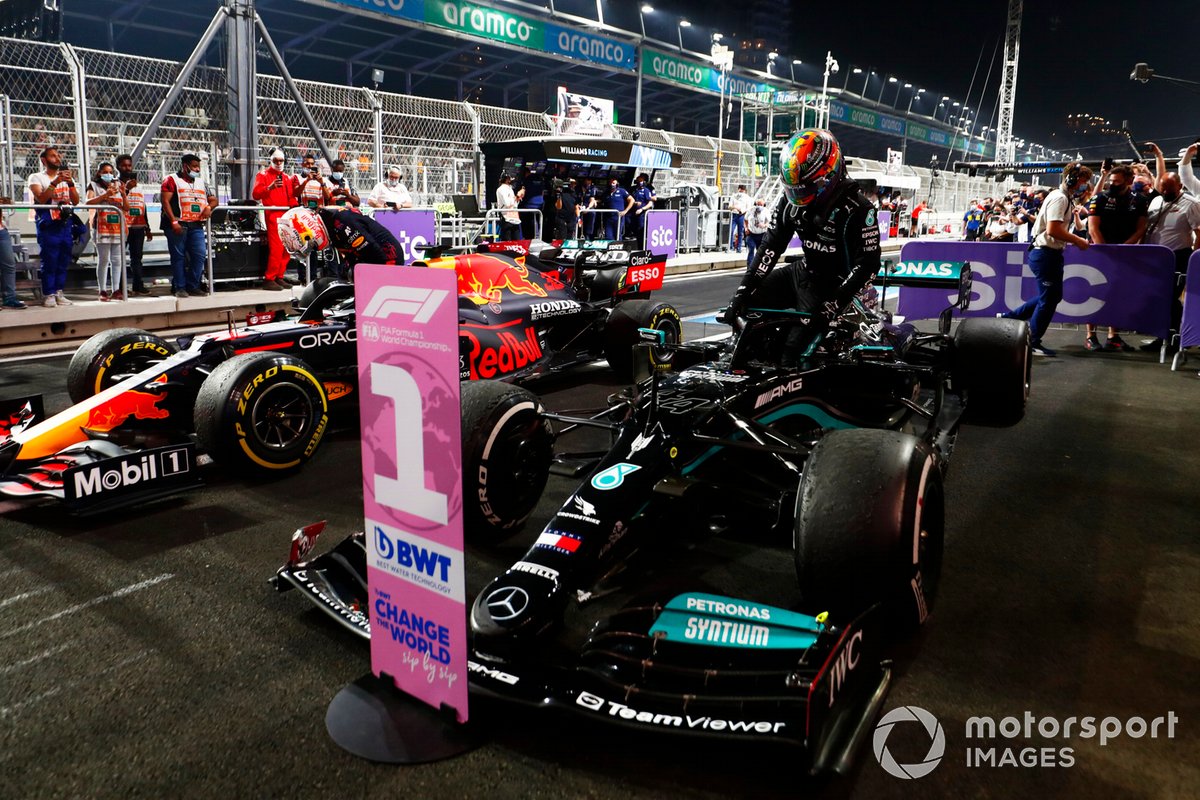
Hamilton took time to compose himself after the finish, following a dramatic race with potentially significant title ramifications
Photo by: Andy Hone / Motorsport Images


Why Britain’s role in Formula 1 endured a troubled start

Why Bottas believes his F1 reserve driver role is the fastest route back to a race seat

Why Norris is now ready for his final exam

The key advantage for Bottas vs Perez in the 2026 F1 return race

Why Ferrari's management is under pressure after its bad start to F1 2025, not Hamilton or Leclerc

Why Red Bull can’t solve its second F1 car problem with a simple paint job

Hirakawa replaces Doohan at Alpine for Japanese GP FP1 outing

How Alonso and Bortoleto can be F1 rivals in a unique driver management deal

KTM's biggest weakness exposed by Vinales contract drama

How Silverstone has proved that bigger isn’t always better

IndyCar releases renderings of new chassis for 2028 regulation overhaul

Why the contentious regulations were a talking point again in BTCC's visit to Thruxton
Subscribe and access Autosport.com with your ad-blocker.
From Formula 1 to MotoGP we report straight from the paddock because we love our sport, just like you. In order to keep delivering our expert journalism, our website uses advertising. Still, we want to give you the opportunity to enjoy an ad-free and tracker-free website and to continue using your adblocker.


Top Comments