


How the 'Great F1 Rake-Off' delivered a Bahrain GP showdown
For the 2021 F1 season, the battle of Red Bull vs Mercedes looks set to be captured in the high-rake vs low-rake philosophy clash due to this year's technical rule tweaks. While bringing the grid closer together in terms of performance, it could be the deciding factor in the race for the world title

One of The Simpsons’ most classic episodes, Cape Feare, features one of the most memorable moments of televisual brilliance. Sideshow Bob, having followed the Simpson family on its journey into witness protection, detaches himself from the underside of the car and steps onto a rake. He grumbles, before immediately proceeding to step onto another rake. And another. And another.
There’s a very tenuous link between that episode and the beginning of the 2021 F1 season, with the best laid plans for victory (or, in Bob’s case, the murder of spiky-headed ne'er-do-well Bart) put momentarily on pause by rake-instigated pain. The technical changes for 2021, those being the cuts in floor size and diffuser size, have been discussed at great length – but before running began, few were sure of the impact they would have on cars of differing rake.
For those of you who aren’t 100% sure of what rake actually is, it’s the inclination of the front of the car compared to the back. By adding more rake, you tilt the front of the car downwards towards the ground and raise the rear up to increase the effective diffuser volume – theoretically gaining more downforce.
The battle of high-rake versus low-rake has traditionally hinged on the infrequent battles between Mercedes and Red Bull. Mercedes, a purveyor of the low-rake philosophy, has tended to instead increase the wheelbase to allow the car more room to work with the oncoming airflow. Red Bull, meanwhile, is a staunch zealot of the high-rake school of thought – which can be explained by simply imagining the drivers’ celebrations on the podium; by holding your thumb over the champagne (or fizzy rosewater) bottle, the air depressurises and accelerates the flow of liquid out of the bottle.
By tilting the front of the floor closer to the ground, Red Bull can depressurise air to a greater extent underneath, building a potentially greater supply of downforce. But this comes with the caveat of greater sensitivity, as the floor is a lot more open to turbulent flow sneaking in and disrupting the air’s ecosystem underneath.

Sergio Perez, Red Bull Racing RB16B, in the pits
Photo by: Steven Tee / Motorsport Images
With fewer cuts, slots and furniture allowed with 2021’s floors, it was unknown who would win the Great Formula 1 Rake Off. The theory, again, was that Red Bull could achieve much more peak downforce but Mercedes had a more stable supply of it – but the former’s turn of pace in testing and the latter’s more muted showing left that theory unverifiable. In other words, Mercedes and Aston Martin have suffered, while Red Bull (and its similarly rake-laden rivals) looks to be quids in.
The result of the Bahrain Grand Prix didn’t quite replicate that, as Lewis Hamilton held on to win the season opener, but Mercedes’ surprise at being able to challenge Red Bull quite so strongly correlates with the acceptance of the pendulum swing.
PLUS: The calls that decided Hamilton and Verstappen's Bahrain battle
But why the sudden shift? Without the benefit of a windtunnel or a commercial CFD package, it’s hard to say definitively – but we can make our estimates.
Making the low-rake to high-rake switch is not possible either; suspension geometries are homologated, and although jacking up the rear of the car might be tempting, it could prove even worse for a car not designed around that philosophy
The lower-rake cars appear to have needed the longer diffuser strakes and the slots in the floor more, because there’s less space under the floor to make use of. The slots that previously perforated the edge of the floor were employed to create a seal, allowing everything between to stay fluid in the way that the aerodynamicists had hoped for.
By using the slots to minimise turbulence within the diffuser, it reduces the amount of blockage created by the cycling pockets of air and develops a nice, clean amount of expansion out of the back of the car. This sucks air through the floor, generating downforce. Without those perforations, the likes of Mercedes and Aston Martin have less to work with, hence developing the loss of performance over the Bahrain weekend.
It seems that dialling in a high-rake car with the new floor rules is, off the bat, easier to do. It seems that perhaps the slots and myriad devices on the floor edge were altogether less effective for those teams, to a certain degree. Now they’re gone, those high-rake teams can work within the template, but can allow that greater diffuser expansion to do much more of the heavy lifting in downforce terms.

Lewis Hamilton, Mercedes W12
Photo by: Charles Coates / Motorsport Images
Otmar Szafnauer, Aston Martin’s team principal, estimated that the low-rake teams were in arrears of one second compared to their high-rake counterparts. Theoretically, it’s time they can get back by clever floor design and interpretations of the new rules, but with teams phasing out development of the current fleet of F1 cars in pursuit of 2022’s much-anticipated rules overhaul, it’s difficult to justify doing so.
Making the low-rake to high-rake switch is not possible either; suspension geometries are homologated, and although jacking up the rear of the car might be tempting, it could prove even worse for a car not designed around that philosophy.
Ergo, it’s a bitter pill that Mercedes and Aston Martin will have to swallow – much, particularly, to Szafnauer’s discontent as the ex-Racing Point outfit looks less potent in the midfield melee. That said, Aston Martin did arrive in Bahrain with a significantly more toothy floor design (see below), having glued on an extra bank of fins to the right-angled cut-out midway along the floor’s edge. This will give the team the tools to push airflow outboard, and further use the square-edge to generate a tip vortex to help seal the floor.
Unlocking further performance from the floor will help Aston to thrust its green machines further up the order, as that midfield remains as tight as ever, but the team has kicked off 2021 with just a solitary point to its name as Lance Stroll was pipped to the finish by AlphaTauri rookie Yuki Tsunoda. So there’s work to do at the Silverstone factory.
Mercedes still factored at the front, but Hamilton was left to sweat by the rapidly charging Max Verstappen, who by all accounts can count Bahrain as a lost race win. Hamilton threw everything into keeping the Dutchman behind, as Mercedes gave him the tools to be aggressive on-track, but Toto Wolff’s bum will have squeaked upon his pit garage seat more than usual as the seven-time champion’s lead was hardly serene – further underlining Mercedes’ loss of performance.
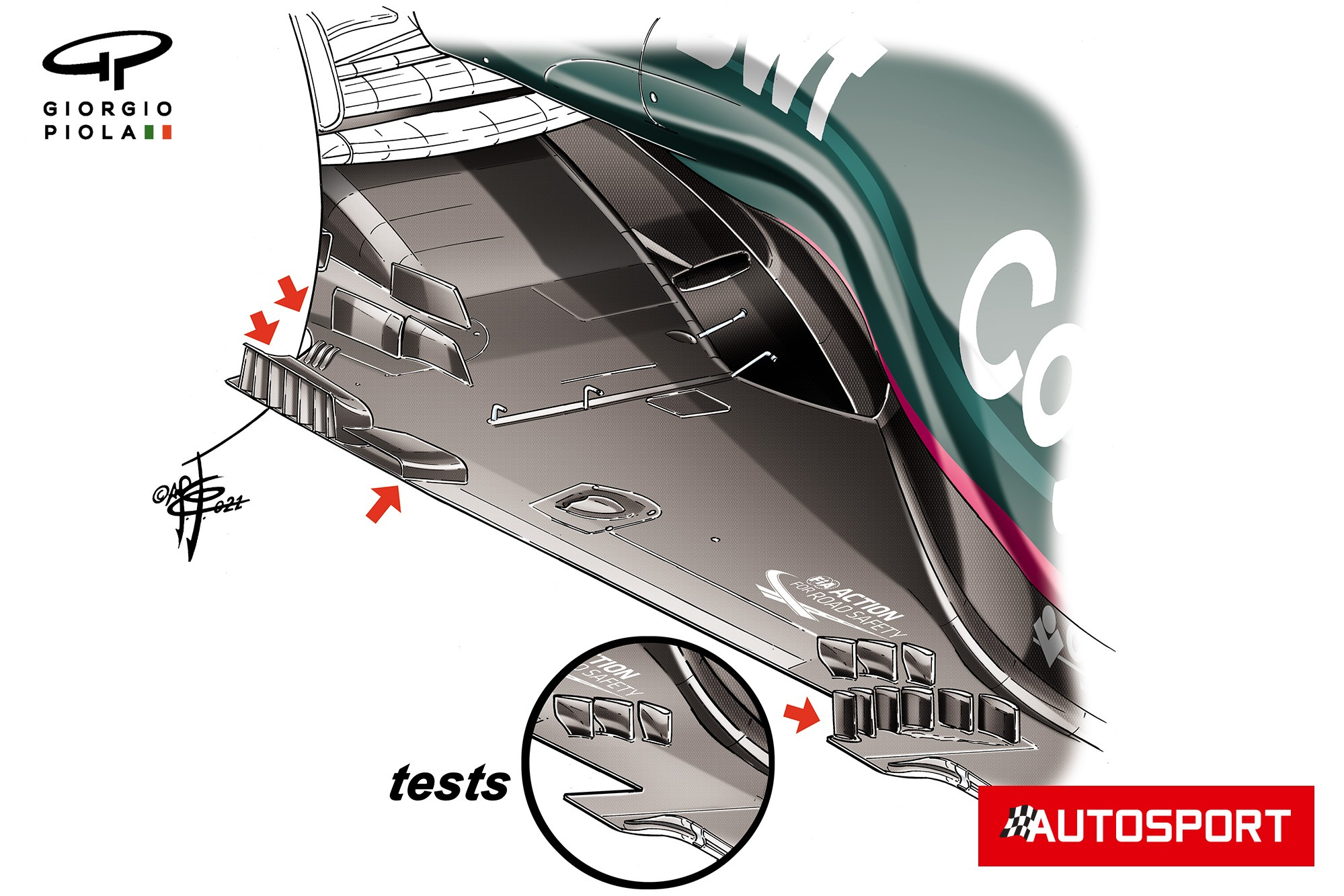
Aston Martin AMR21, rear floor detail, 2021 Bahrain GP
Photo by: Giorgio Piola
Red Bull, meanwhile, had to conduct an inquest into Verstappen’s misbehaving differential as the runner-up reported a lack of throttle response on the exit of the slower corners. The team can play with differential settings within reason, but nothing was able to answer Verstappen’s issues when depressing the throttle pedal – which arguably hindered his ability to close up on Hamilton in the dying laps of the race after handing the lead back.
But it would be remiss to suggest that Red Bull’s position at the front is solely because of the high-rake/low-rake shift in fortunes. The team put all of its resources into reworking the rear of the car, introducing an innovative multilink rear suspension to give the aero a further boost and ensure the rear was less temperamental than last year’s RB16, and both Verstappen and Sergio Perez have enjoyed a more predictable car to drive.
PLUS: Eight things Red Bull must to do beat Mercedes in 2021
Honda has poured a lot of resources into getting the powertrain far closer to the Mercedes unit – and Hamilton estimates that Honda has pulled ahead of the Anglo-German team’s power units in terms of performance.
The Red Bull vs Mercedes battle looks set to continue on and should hopefully deliver a few more enthralling encounters. It’s not solely down to the effect of rake on the new regulations – but it’s certainly helped
Although Perez had issues at the start, despite taking on a new ECU and battery, the Mexican swashbuckled his way back up to an excellent fifth in his first race with Red Bull from the back – which is becoming something of an unwanted habit for him in recent races.
Nonetheless, the Red Bull vs Mercedes battle looks set to continue on and should hopefully deliver a few more enthralling encounters. It’s not solely down to the effect of rake on the new regulations – but it’s certainly helped.

Lewis Hamilton, Mercedes W12, Max Verstappen, Red Bull Racing RB16B
Photo by: Mark Sutton / Motorsport Images


Lights, Camara, action: How Haas picked F1's latest rookie for 2027

Horner's inside story of how Red Bull built its own F1 engine

Why Mercedes' latest 2026 F1 update is no downgrade

Singapore Grand Prix Driver Ratings 2026

What we learned from the 2026 F1 Singapore GP sprint race and qualifying

The political minefield set out by F1’s recent cost-cap grievances

What caused Mercedes' pace deficit at Sepang despite upgraded W17?

Three kings: F1's generational stars shone at Sepang

Colapinto urges fans to stop online abuse: “You’re not helping me or my future”

Evans given a hero's homecoming after WRC title triumph

How an unspectacular showing in a kart race is such good reason to celebrate

Lights, Camara, action: How Haas picked F1's latest rookie for 2027
Subscribe and access Autosport.com with your ad-blocker.
From Formula 1 to MotoGP we report straight from the paddock because we love our sport, just like you. In order to keep delivering our expert journalism, our website uses advertising. Still, we want to give you the opportunity to enjoy an ad-free and tracker-free website and to continue using your adblocker.


Top Comments