


How F1's new rules really rate halfway through their first season
OPINION: Formula 1 is now exactly halfway through its first season running the new cars championship owner Liberty Media set about introducing after its 2017 purchase. So, how exactly are those major rule changes really working now the evidence has mounted up?

Ahead of this weekend’s French Grand Prix, Formula 1 is at the halfway point of the 2022 season. And this is a campaign that really matters to the championship’s owner, Liberty Media.
It may have been delayed a year by the pandemic, but the rules reset Liberty first targeted soon after it completed acquiring F1 back in 2017 is now playing out. Its impact was felt immediately when the 2022 machines were initially unveiled back in the late winter. A new look had arrived.
The early races confirmed Ferrari had achieved its ambition in returning the front of the grid after its recent fallow years, but the early chapters of Charles Leclerc versus Max Verstappen came too soon to provide definitive answers regarding the success of Liberty’s project (blessed by the FIA) on improving racing and the championship’s overall health. F1 had just had too many previous false dawns…
But with 11 races in the books this year and the same number still to come, the evidence is mounting up. So, after looking back to the 2019 US Grand Prix – where Lewis Hamilton clinched his sixth world title in a race won by Valtteri Bottas – and the aims F1 unveiled for its new rules package there, we can match those with what’s been witnessed in 2022 and assess their overall impact so far.
The presentation put before the media at Austin nearly three years ago set out five key areas for improvement: "raceability", "competitive grids", “financial sustainability", "environmental sustainability", "aesthetics/passion". These will be worth revisiting regularly as F1’s new era goes on.
For now on “raceability”, from what has been seen so far in 2022, the new rules have worked well. By switching to a ground effects formula and cleaning up chassis surfaces, the aim was to improve a car’s downforce level by 31% when following another and by doing so allow closer trailing for longer. The chasing drivers no longer encounter “weird snaps” as the turbulence reaches their front wings – per Ferrari’s Carlos Sainz – and as a result are no longer wearing out their tyres by sliding around excessively coping with that extra movement.

The early races confirmed Ferrari had achieved its ambition in returning the front of the grid after its recent fallow years
Photo by: Erik Junius
The slipstream effect has been reduced by the car profiles created by the rule requirements, but it remains significant. This continues to work with DRS to aid overtaking, with 2022’s opening rounds notable for the tactics Leclerc and Verstappen deployed over when to run behind to get the best chance of staying ahead with a rear wing open in defence or attack. The reset has not ended the debate over DRS’s place in F1.
Another much-maligned facet of modern F1 is the fragile state of controlled tyres. A concern back in late 2019 was that the drivers wouldn’t be listened to over how the rubber now fitted on 18-inch wheels needs to perform to produce better racing. While the degradation factor remains high at certain events, the latest Pirellis can generally be pushed harder for longer – witness Leclerc’s pass on Hamilton on Copse taking ageing hards against new softs.
But slow-corner understeer is hampering the drivers’ efforts when the ground effect cars are at their worst in any case and Pirelli has therefore committed to making stronger front tyres to reduce this for 2023.
Silverstone produced the best example of the multi-car, multi-team, multi-lap battling F1 wanted regularly from its new rules. While this was thrilling, it cannot be denied that the late-race safety car intervention created those events.
While the degradation factor remains high at certain events, the latest Pirellis can generally be pushed harder for longer
But the ‘multi-team’ element of the British GP battling – particularly Leclerc vs Sergio Perez and Lewis Hamilton from Copse to Village – was the main target of the "competitive grids" aim. But the current assessment of this success is more complex and the evidence isn’t as good for F1.
This is evidenced by Autosport’s supertimes calculation. By this measure, the fastest time set at each event earns a perfect score of 0.000 and the remaining nine teams earn a percentage over that benchmark. Here, we can see that over the whole of 2021, the spread between the 10 squads was 3.222%. This comes down to 2.728% so far in 2022 and while that appears to signify a win for the new rules, its actually more complicated.
If we disregard the un-developed, driven-by-two-rookies Haas from 2021, the gap from the top to ninth-placed Williams actually becomes 2.049%. Williams currently ranks 10th in the 2022 supertimes and so can be said to have slipped further off the pace. But it’s at the front where the "competitive grids" aim needs to be under closest scrutiny, because in 2021 five teams ended up within 0.909% of the ultimate pace. Right now in 2022, just Ferrari and Red Bull sits in that bracket (Mercedes is third on 1.059% back).

The ‘multi-team’ element of the British GP battling was the main target of the "competitive grids" aim
Photo by: James Sutton / Motorsport Images
So far then, the second highlighted aim from the 2019 presentation is not the hit it seems, but at least F1 can enjoy a different team taking the fight to Red Bull at the front. Ferrari’s resurgence has coincided with Mercedes’ difficulties unlocking regular pace in the W13.
Points-wise, Alfa Romeo and Haas are the big gainers looking year-on-year – along with Ferrari and Red Bull (benefitting further from its 2021 rival making strategy errors and having poorer reliability). But with just two squads taking wins so far, the hoped for success spread the rules reset heralded hasn’t happened – yet.
The success of the cost cap in getting more teams to win regularly won’t be felt for a while – if indeed it ever is. This is because the bigger teams have amassed more knowledge and skills on the art of winning than their smaller rivals. This advantage will continue to pay off in the coming seasons and can be seen in how slick Red Bull has usually been on strategy so far in 2022, while Ferrari has been left scrambling at times.
The recent agreement over increasing the cap to help with rising inflation was also a compromise deal, with arguments over team spending showing no signs of ending and indeed if a cap breach occurs this year, things will get explosive.
A secondary element to assessing the “financial sustainability" aim must also consider outside factors that sit alongside the new rules. These include another Liberty project – bringing in Netflix and the new fans of ‘Drive to Survive’, a huge success in its own right.
It all adds up to massively increasing team value and therefore boosting the championship’s financial health. It’s now a sellers’ market, which means those who bought squads in recent years – Lawrence Stroll’s consortium and Dorilton Capital – are often said to have struck ‘deals of the century’, such is the upswing on their initial investments.
When it comes to the new rules improving F1’s “environmental sustainability”, F1 has made enough progress even Porsche is on the verge of committing its might to the championship – rather unthinkable in the VW-emissions scandal wake just a few years ago. But while the E10 fuel introduced for 2022 is the start of a journey the championship is targeting for 100% sustainable fuel within the planned 2026 engine changes, F1 still has an obvious image problem in the face of the climate crisis. Plus, its surging interest levels make it a target for activists, as occurred at Silverstone.

Alfa Romeo and Haas are the big gainers looking year-on-year points-wise
Photo by: Alessio Morgese
On the final key aim of the 2019 Austin presentation, an assessment of the aesthetics of the new cars brings a major element of subjectivity. Overall, the new cars have achieved the aggressive-styling look F1 wanted, but – at least to this writer – when viewed side-on they lose this compared to their predecessors. Front-on or top-down, however, and they just look gorgeous.
It's also notable that the fears of such a tightly prescribed rulebook on cost grounds leading to all the cars looking the same did not come to pass. But this is tempered by Aston Martin and Williams adopting RB18-like sidepods with big upgrades, while Alpine took new cues from both Ferrari and Red Bull at Silverstone.
So far, no one has tried Mercedes’ zero-pod approach and it remains to be seen how much the teams converge with fresh designs next year. These will hopefully eliminate the porpoising phenomenon that has dominated the tech talk of the season so far.
There was another smaller change announced at Austin 2019 that can be assessed at this stage.
The much-vaunted three-day format has essentially been abandoned once it became clear many team employees where not getting any extra time at home within such a long calendar. Plus, the drivers pointed out they were still spending Thursdays doing so much media work it made little sense to cram all the official sessions in before Friday practice – particularly on weekends with early session start times…
The Paul Ricard race now presents the biggest test of the new racing product so far given the dullness of the first two returning French GP events Mercedes dominated in 2018 and 2019
So, overall right now, F1’s new cars can be considered a hit and that is surely big win for F1 and Liberty.
But the Paul Ricard race now presents the biggest test of the new racing product so far given the dullness of the first two returning French GP events Mercedes dominated in 2018 and 2019.
The race here last year was engaging, but this was down to Mercedes and Red Bull being so closely matched, events playing out as a tyre management affair (which badly caught out Ferrari back in the pack) and one squad having to make up for a driver error and the other underestimating the undercut’s power.
The current 0.072% supertimes gap between the red team and Red Bull after 11 races in 2022 raises hopes of another close fight this time around – but this will perhaps come down to Ferrari’s recent tyre wear improvements continuing and its rival avoiding getting things wrong in this area as it did in Austria.
But a close-racing scrap across the grid at Paul Ricard – that would be F1’s new era dream really realised.
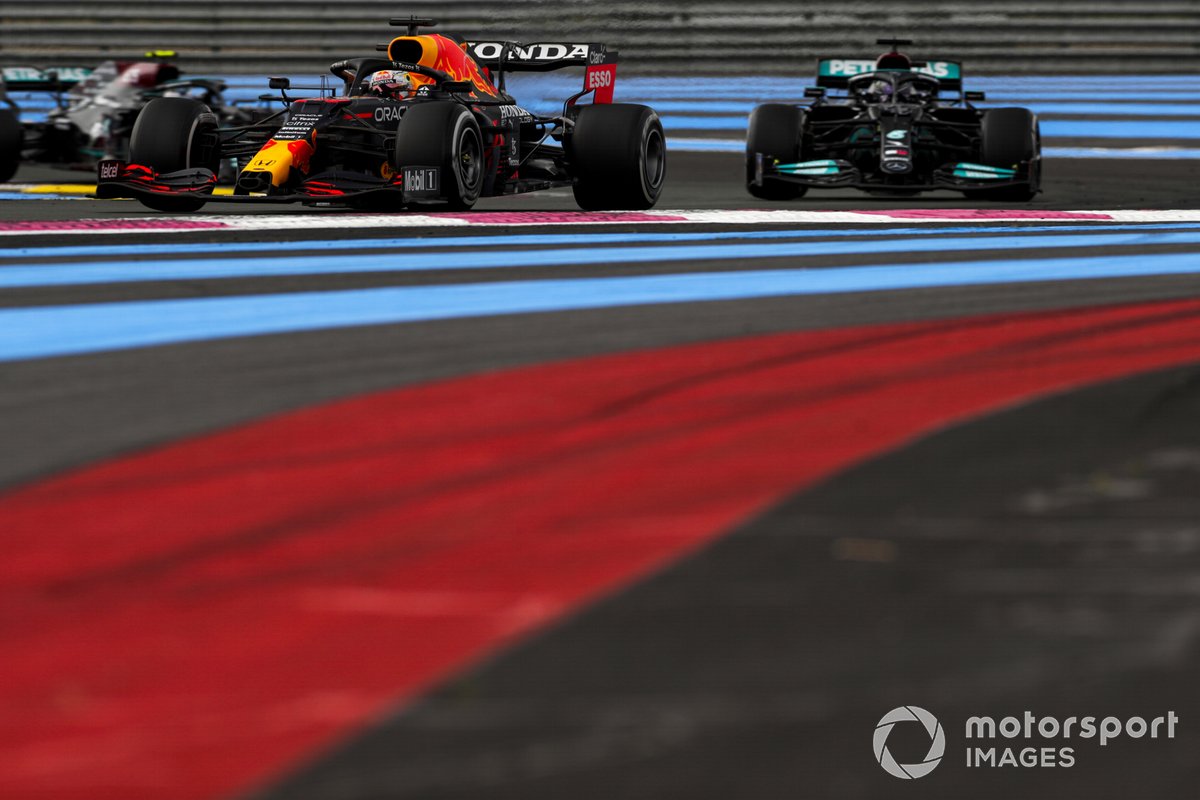
Last year's French GP was engaging as a result of Mercedes and Red Bull being so closely matched
Photo by: Drew Gibson / Motorsport Images


Why Britain’s role in Formula 1 endured a troubled start

Why Bottas believes his F1 reserve driver role is the fastest route back to a race seat

Why Norris is now ready for his final exam

The key advantage for Bottas vs Perez in the 2026 F1 return race

Why Ferrari's management is under pressure after its bad start to F1 2025, not Hamilton or Leclerc

Why Red Bull can’t solve its second F1 car problem with a simple paint job

Hirakawa replaces Doohan at Alpine for Japanese GP FP1 outing

How Alonso and Bortoleto can be F1 rivals in a unique driver management deal

Colapinto urges fans to stop online abuse: “You’re not helping me or my future”

Evans given a hero's homecoming after WRC title triumph

How an unspectacular showing in a kart race is such good reason to celebrate

Lights, Camara, action: How Haas picked F1's latest rookie for 2027
Subscribe and access Autosport.com with your ad-blocker.
From Formula 1 to MotoGP we report straight from the paddock because we love our sport, just like you. In order to keep delivering our expert journalism, our website uses advertising. Still, we want to give you the opportunity to enjoy an ad-free and tracker-free website and to continue using your adblocker.


Top Comments