


How BRM's one-off F1 double defied its rollercoaster history
It’s 60 years since BRM achieved its goal and Graham Hill led the team to a world title double. But that was just part of the remarkable story of a unique team that at times overstretched its resources and had its fair share of disappointments

Embarrassing failure, world-beating success, ambitious innovation. British Racing Motors was a little of all these things and more during its quarter of a century in Formula 1. The early and late years of BRM were ignominious but in between it achieved its original aim of winning at the pinnacle of motorsport and showing that British engineering could compete with the best in the world.
Raymond Mays and Peter Berthon had tasted some success before the Second World War with English Racing Automobiles, and even before hostilities were over ex-racer Mays had sent his ‘White Paper’ to selected firms in British industry, presenting the idea of an all-British project to build the finest grand prix car in the world.
Oliver Lucas of Joseph Lucas Ltd and Alfred Owen of the Rubery Owen engineering company were key early supporters and many others followed, with the promise of financial support and/or the supply of parts, materials and expertise. A BRM Association supporters’ club was also set up and the press, both specialist and general, soon got behind the idea of taking on the Italians in GP racing.
Famously, things went wrong almost from the start of the project, based at the Old Maltings behind Eastgate House at Bourne, Mays’s home. Berthon’s 1.5-litre, two-stage supercharged, 135-degree V16-engined P15 set one of BRM’s defining features early on: ambitious complexity.
“It was very complicated and now we realise it was over-engineered,” recalls Dick Salmon, who joined BRM at the end of 1950 and was soon promoted onto the race team as a mechanic. “It was fantastic but it was time-consuming and difficult to work on. Peter Berthon was also a difficult man – I couldn’t read him all the time I was there.”
The V16 was eventually developed into a winner in non-championship events, though there was no escaping the fact that BRM would be seen as a failure until it won in grand prix racing. The four-cylinder P25 arrived in 1955 but it would take a long time before its potential was realised
Parts delays as businesses prioritised producing things that could be profitably exported in austere post-war Britain, insufficient budget and constant reliability problems meant the exquisite and sonorous car didn’t make its race debut until the British Racing Drivers’ Club International Trophy at Silverstone in August 1950. Even then, Mays and Berthon felt the V16 was not ready, but growing pressure, from within the organisation as well as external, forced their hand. The car missed practice, started from the back and then lurched forward as the back axle output shaft sheared on the startline, in the hands of French ace Raymond Sommer.
Criticism was harsh and swift, but development continued and the V16 would be the first F1 car to run disc brakes. It was another example of the team’s innovation and readiness to push the boundaries but, as Ferrari rose to challenge Alfa Romeo supremacy during 1951, BRM missed most of the races. The V16 scored its only world championship points thanks to Reg Parnell’s fifth place at the British GP, but he was five laps behind Jose Froilan Gonzalez’s landmark victory for Ferrari. Despite prodigious power, well in excess of 500bhp, the BRM was still a long way from toppling Italian domination in F1. And it got worse.

Ken Wharton, BRM P15 Mk1
Photo by: Motorsport Images
BRM entered and then withdrew from the Valentino GP in April 1952, before any world championship races had been held that season. Alfa Romeo had already quit F1 and BRM’s consistent flakiness meant organisers felt they had no choice but to switch to F2 regulations, which would at least ensure bigger grids. The world championship thus ran to F2 rules in 1952-53 until a new F1 for 2.5-litre unsupercharged cars arrived for 1954.
BRM had no interest in F2 and many involved had lost interest full-stop. The result was Owen buying the team from the BRM Trust at the end of 1952, one of the most significant moments in the whole BRM story. He left Mays and Berthon in place, while engineer Tony Rudd, who had joined from Rolls-Royce in 1951, would thereafter play an increasingly active role.
“We got a lot of criticism from some of the press, but I don’t think it affected us,” adds Salmon.
The V16 was eventually developed into a winner in non-championship events, though there was no escaping the fact that BRM would be seen as a failure until it won in grand prix racing. The four-cylinder P25 arrived in 1955 but it would take a long time before its potential was realised. There were reliability problems, with oil lubrication issues among the early hurdles, big crashes, and the car wasn’t the easiest to drive.
“We went from the ridiculous to the sublime,” reckons Salmon. “It was basically a good car but handling was a problem. Eventually a deal was done for Colin Chapman to sort the suspension out, which he did – a coil spring at each corner. It made a terrific difference.”
Finally, after much development and testing, the P25 gave BRM its first world championship success at the 1959 Dutch GP, courtesy of Jo Bonnier.
“It was a terrific lift,” says Salmon. “I can see Raymond Mays now – I’m sure he was in tears.”

Jo Bonnier, BRM, leads at the start
Photo by: Motorsport Images
Nevertheless, Vanwall – set up by disgruntled early BRM supporter Tony Vandervell – had already put a British team at the top of F1. Rather than insist on British-built parts, Vanwall had been more pragmatic, building what it could and using British suppliers but also going elsewhere if required. It had won the inaugural F1 constructors’ title in 1958 before withdrawing, leaving the British challenge in the hands of BRM and agile firms Cooper and Lotus.
Cooper’s rear-engined revolution saw off Ferrari in 1959-60 before the Italian team struck back in the first year of the 1500cc regulations. BRM toiled with the P48, its first mid-engined machine based on the front-engined P25, complete with ‘bacon slicer’ single, mid-mounted, rear disc brake (another Berthon odyssey). Although new recruit Graham Hill finished third in the 1960 Dutch GP and almost won the British GP, BRM had still not added to Bonnier’s win by the end of 1961. The result was a sobering message from the team’s backer.
“Sir Alfred issued an ultimatum in 1962 that we win two GPs or he’d move things from Bourne to somewhere else,” recalls Salmon. Or, indeed, close things down altogether.
Fortunately, Rudd’s P57 and its P56 V8 engine meant BRM finally had the equipment to get the job done. And, in Hill, it had a top-level driver.
“The situation was hopeless, really. We cobbled the cars together by cannibalising bits off other cars.”
“It was a good car, a great little engine, and Graham was a brilliant driver – very determined,” asserts Salmon.
Having brilliantly won the BRDC International Trophy at the last corner the week before, Hill took victory in the first championship race of the 1962 campaign at Zandvoort. The season quickly distilled into a fight between Hill and Jim Clark, armed with Chapman’s monocoque Lotus 25. The Clark-Lotus combination was arguably faster, but Hill and BRM proved more reliable. And there were some fine moments along the way.
“The most significant race, and the best in my view, was the German GP,” recalls Salmon. “Graham was following Baron Carel Godin de Beaufort, who’d put a camera on his car and it came adrift. Graham collected it, spun on his own oil and crashed. It was a write-off, but we’d taken the spare car. Graham was badly shaken but we changed the seats, pedals, anti-roll bars on the spare car to Graham’s specification.

Graham Hill, BRM P57
Photo by: Motorsport Images
“On race day there was heavy rain. On the first lap he came round he was second, behind Dan Gurney’s Porsche – I can still see the German fans cheering – and on the second lap Graham overtook him in front of the grandstand and then there was silence! It was a wonderful feeling. He went on to win and it was the greatest race I’d seen.”
After eight of the nine rounds, Hill and Clark both had three wins, while Hill led the points heading to the South African finale. There was an enormous near-three-month wait after the penultimate round and BRM’s preparation did not go well, the cars struggling to finish the non-championship races at Kyalami and Westmead, both won by Lotus.
“The situation was hopeless, really,” admits Salmon. “We cobbled the cars together by cannibalising bits off other cars.”
Clark took his sixth pole for the East London decider and pulled away from the start. The title looked his, only for an oil leak to put the Lotus out at three-quarters distance. Hill picked up the pieces to become the first British driver to win the F1 world title in a British car, while BRM secured the constructors’ crown. Its mission had been accomplished – and the team had secured its future.
Lotus and Clark were unstoppable in 1963, but Hill still won two races and team-mate Richie Ginther put in a campaign of considerable consistency to give BRM a 2-3 in the drivers’ standings. Rudd’s gem of a monocoque P261 helped Hill battle Clark and Ferrari’s John Surtees for the 1964 crown, which went the way of Surtees in a dramatic Mexican GP finale. BRM took second in the constructors’ table for the third consecutive time in 1965, the P261 again Lotus’s main rival in the hands of Hill and Jackie Stewart.
There’s no doubt BRM was one of the big teams of the 1500cc era, with chief mechanic Cyril Atkin and experienced personnel, but things went downhill rapidly when the three-litre regulations arrived for 1966. After Stewart’s win at Monaco with the two-litre version of the P261 – also a force in Tasman competition – there were no more victories that season, and the arrival of the H16 engine was a disaster.
Having apparently not learned from the V16, BRM committed to another complicated and unusual engine in the quest for power. It was too big, too heavy and unreliable. Even Stewart couldn’t win with it in 1967, Hill having left for Lotus.

Pedro Rodriguez, BRM P153 in the spare 'T' car
Photo by: Motorsport Images
It was the beginning of a difficult period for BRM. The Len Terry-designed P133, powered by a V12 originally intended for sportscar racing, managed three GP podiums in the hands of Pedro Rodriguez in 1968, but BRM was being left behind – particularly by the Cosworth DFV.
“BRM had put so much into the H16,” reckons Richard Attwood, who took second place for BRM at that year’s Monaco GP. “They tried to get an advantage, it didn’t work out and that put them behind. The two-valve [per cylinder] V12 just wasn’t competitive. When I drove the Lotus 49 at Monaco the following year I thought, ‘Oh my God’. I compare it to the difference between a thoroughbred race horse and a point-to-pointer [competitor in amateur horse racing].”
A willingness to experiment remained. Peter Wright had drawings for a ground-effects ‘wing’ car at BRM, nearly a decade before he would successfully pick up that line of thinking at Lotus. But it didn’t race.
Surtees joined for 1969 but was gone before some of the changes he helped trigger started to bear fruit. Rudd left and Tim Parnell became team manager. Also key among the changes was the arrival of up-and-coming designer Tony Southgate. At short notice he penned the neat-but-conventional P153, which would evolve into the 1971 P160.
Rodriguez also returned for 1970, while Louis Stanley attracted backing from Yardley. Stanley, husband of Alfred Owen’s sister Jean, had become an increasingly important figure at BRM during the 1960s and a joint managing director. At that stage, his influence was regarded with some positivity, but his impact during the following decade would be more contentious…
With the P160, Yardley backing, the refined V12 and Jo Siffert joining Rodriguez, 1971 was BRM’s best season since the heady days of the 1500cc era
Reliability in 1970 was still suspect, but there was more promise. At Spa, with a bigger oil tank on his P153 as Southgate constantly evolved the oil system to quench the improved 48-valve V12’s thirst, Rodriguez had one of his great days. The Mexican held off the March of Chris Amon to take BRM’s first GP win for four years, then finished the season with a string of competitive outings. Southgate enjoyed working with Rodriguez, who was by now one of the world’s leading racers.
“He just drove it,” says Southgate. “He wasn’t an engineer. I knew the balance he wanted, was able to adjust the car and off he went.”

Pedro Rodriguez, BRM P160, Jacky Ickx, Ferrari 312B2
Photo by: Motorsport Images
With the P160, Yardley backing, the refined V12 and Jo Siffert joining Rodriguez, 1971 was BRM’s best season since the heady days of the 1500cc era. A frustratingly small problem – “I didn’t realise mounting the coil on the rollover bar meant there was a vibration that broke the internals of the coil,” admits Southgate – cost points early on, but Rodriguez was still in the hunt for second in the standings when he was killed in a sportscar race in July.
Siffert immediately stepped up, winning the Austrian GP from pole. Southgate believes that Siffert could also have won the Italian GP the following month but for a gearbox issue. Peter Gethin, who did win the Monza race for BRM, said the same before he died in 2011.
Siffert’s second in the United States GP finale secured BRM runner-up spot in the standings, while the Swiss was fifth in the drivers’ table behind Tyrrell’s runaway champion Stewart. Despite the momentum – and Marlboro backing arriving for 1972 – BRM now started its last downward swing.
“The V12 was meant to be a sportscar engine but in F1 of course you needed more revs and more power, and things started to get marginal,” reckons Southgate, who tried to get radical with the P180 but moved the weight distribution too far back. “By 1972 it was struggling because the DFV was developing and we were just trying to keep the V12s going.”
There were other issues. As well as losing Siffert to a crash in the Brands Hatch Victory Race at the end of 1971, Stanley had become keen on other projects and running lots of cars – up to five at some events. It spread resources too thin, as did various other projects outside of racing.
“They were trying to do too much all the time,” says Rick Hall, who joined in 1972, chiefly working on the engines. “Instead of running one or two cars, it was all this running three or five cars with Stanley. There were 110 guys making everything. If we’d had one car and a test car… We needed some time, we were always firefighting.
“It was fine for the commercial set-up but it drained resources of the racing team, there weren’t enough people, then quality goes down and the budget was disappearing. It got a bit crazy.”

Jean-Pierre Beltoise, BRM P160B
Photo by: Motorsport Images
Nevertheless, the P160B and Jean-Pierre Beltoise gave BRM one last world championship win at the 1972 Monaco GP, the Frenchman putting in a masterful wet-weather performance to beat Ferrari’s Jacky Ickx.
“He was superb, he didn’t put a foot wrong,” remembers Southgate. “Around there the V12 was a very flexible engine, smooth, which could have been an advantage.”
It wasn’t enough to stop Southgate leaving and BRM slumping to seventh in the constructors’ table, which it repeated in 1973 despite the impressive Beltoise being joined by Niki Lauda and Clay Regazzoni. Even then, ploughing its own furrow and being innovative remained in the BRM DNA. Hall recalls attempts to operate throttle slides and metering unit cam with electrics, decades before the true arrival of fly-by-wire.
The P160 was eventually replaced by the Mike Pilbeam-designed P201, and Beltoise took BRM’s 61st and final world championship podium with second on its debut in the 1974 South African GP, but it was a false dawn. The team was only heading one way and the Owen support ceased at the end of the season. Stanley tried to carry on, the squad running under the ‘Stanley BRM’ banner before finally petering out with a string of failures to qualify in 1977. Nevertheless, many of those who worked at BRM are glad they did.
“BRM was the team to go to for my first F1 season because it had a great designer and a great gearbox man,” enthuses Howden Ganley, who started 19 GPs for BRM across 1971-72. “It was a lucky break and Tim Parnell gave me some good advice.
“The P153 was a relatively easy car to drive. The P160 was quicker but a bit more of a knife-edge car. It was really good on the high-speed circuits, such as the Osterreichring and Monza. At ‘Mickey Mouse’ circuits it wasn’t so good.
“At the end of 1972 the P180 was the best of the three, but when Tony left Big Lou canned it. There were money issues and they really needed to build a new engine, but I absolutely have fond memories of BRM. It was a really friendly team.”
It’s also one that stayed true to its roots (for better or worse), embodied much of the motorsport spirit of pushing the limits (for better or worse!), and achieved the original goal set out by Mays and Berthon in the 1940s. And it played its part in the rise of the British motorsport industry. But the last word goes to Salmon, who worked at BRM for a decade and a half.
“I didn’t realise what we’d done until recently,” says the emotional 97-year-old. “It was fun and I’m very proud.”
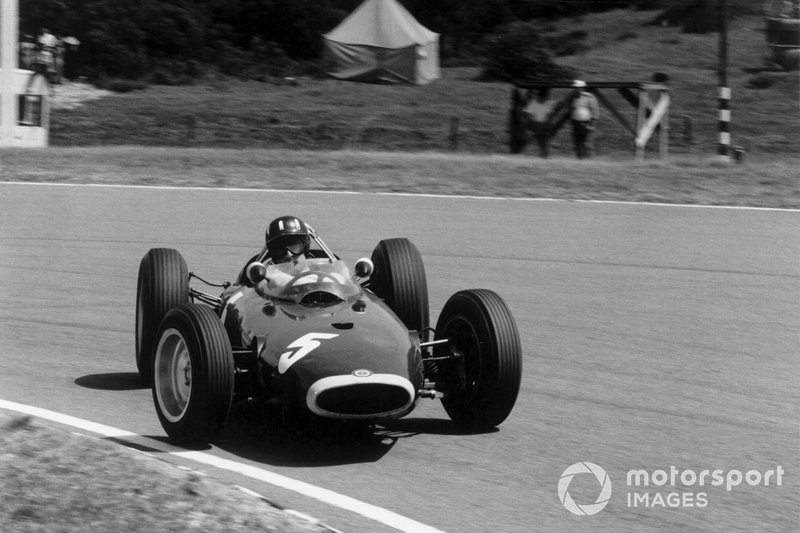
Graham Hill, BRM P57, sideways
Photo by: Michael Tee / Motorsport Images


How the M8B became the most dominant car in McLaren’s history

Employing team orders can simply be a matter of common sense

The greatest F1 campaigns with no wins

Top 10 F1 results changed by backmarkers – the passes

Top 10 F1 results changed by backmarkers – the clashes

Stars, cars and highlights from the 2026 Goodwood Revival

The Egal has landed – again

Autosport magazine: Antonelli and a Can-Am celebration

How Toyota destroyed the competition to seal the WEC crowns

McLaren retains Fornaroli as F1 reserve and hands him WEC programme for 2027

How Andrew Jordan realised his teenage rallycross dream

Inside the competition building F1’s future engineering talent
Subscribe and access Autosport.com with your ad-blocker.
From Formula 1 to MotoGP we report straight from the paddock because we love our sport, just like you. In order to keep delivering our expert journalism, our website uses advertising. Still, we want to give you the opportunity to enjoy an ad-free and tracker-free website and to continue using your adblocker.


Top Comments