


How Alonso scored ninth at Zandvoort - and how Albon lost a similar payday
There was nothing between Fernando Alonso and Alex Albon in the Dutch GP's opening stint - but an eight-lap difference in pit strategy produced a significant split between them

Perhaps the most surprising aspect of Fernando Alonso's surprise journey to ninth at the Dutch Grand Prix was that he hadn't declared it as his best-ever ninth-placed finish.
It's a little bit of a running joke in F1 media circles that Alonso is his own greatest marketeer, and not too shy to declare that an otherwise-innocuous result was his "best-ever P12" - or something along those lines, at least. On this occasion, however, the two-time champion has kept the self-praise low-key (aside from declaring himself a "very good driver", which we can't disagree with). In this instance, we'll do the praise for him.
In short, Alonso's result was possible because Aston Martin switched to a one-stop strategy. Even more impressive was that Alonso did 32 laps on the softs to get him as far as the 34th lap, then used one set of hards for the remainder. Performance-wise, there wasn't a lot between the three compounds, although the reduced longevity of the soft compound rather highlights Alonso's excellent preservation and execution on high fuel.
"I think the plan was two stops and to go more conventional. But, yeah, we need to sometimes deviate a little bit from what is the normal things," was Alonso's assessment of the one-stop decision. "When we are in traffic, we cannot use our potential. We are faster in the corners and the people in front of us, we are slower on the straights, and we're stuck behind.
"So, as soon as we have free track in front of us, we try to use it, even if it's not the optimal performance and the optimal strategy, and it's what we did today."
Much of the first stage was, in effect, waiting for others to pit. Overcut strategies seemed to be generally powerful, when accounting for traffic; if you could stay in clean air, it was possible to actually pull away from the clusters of drivers scrapping over the same piece of track.

Aston Martin converted Alonso's two-stop strategy into a one-stop with the target of running in clear air
Photo by: Alastair Staley / LAT Images via Getty Images
For Alonso, this was key; if he could pull out a gap and emerge on the tail of one of these groups after stopping, he'd be in the position where he was in effect a pitstop ahead of the drivers in front. All he'd need to do at that point was sit and wait for the waves to part - and that's pretty much exactly what came to pass.
After Alex Albon stopped on lap 26, Alonso was running in eighth and more or less on his own - over 10 seconds behind Liam Lawson, but almost another 10s clear of Carlos Sainz. It didn't matter that the gap to Lawson grew to 20 seconds on the lap before Alonso stopped, nor did it matter that Nico Hulkenberg had cleared the following pack and eating into the Aston Martin's advantage. Alonso remained nine seconds clear of the midfield train, now led by Yuki Tsunoda, and Aston Martin was looking to get him as far into that pack as possible knowing that everyone still needed to stop.
A slot opened up when Esteban Ocon started to drop back, putting Alonso back behind Albon. As the leaders had started to lap this pack, Albon was struggling to retain tyre temperature on slightly older tyres, presenting Alonso with an opportunity to move past the Williams with his advantageous tyre delta. He made the move work at the start of lap 38, offering some clear track ahead.
Tsunoda and Gasly needed to stop again, ensuring Alonso could make the step into ninth place by the start of lap 47. Once freed of Tsunoda with a pass 15 laps from the end, Gasly was catching the Aston Martin and aiming to double his reward in a race where Alpine demonstrated a step forward with its upgraded aero package. Yet, Alonso would not be moved, holding on as Gasly vacillated within the overtake mode - eventually, the Frenchman's challenge petered out.
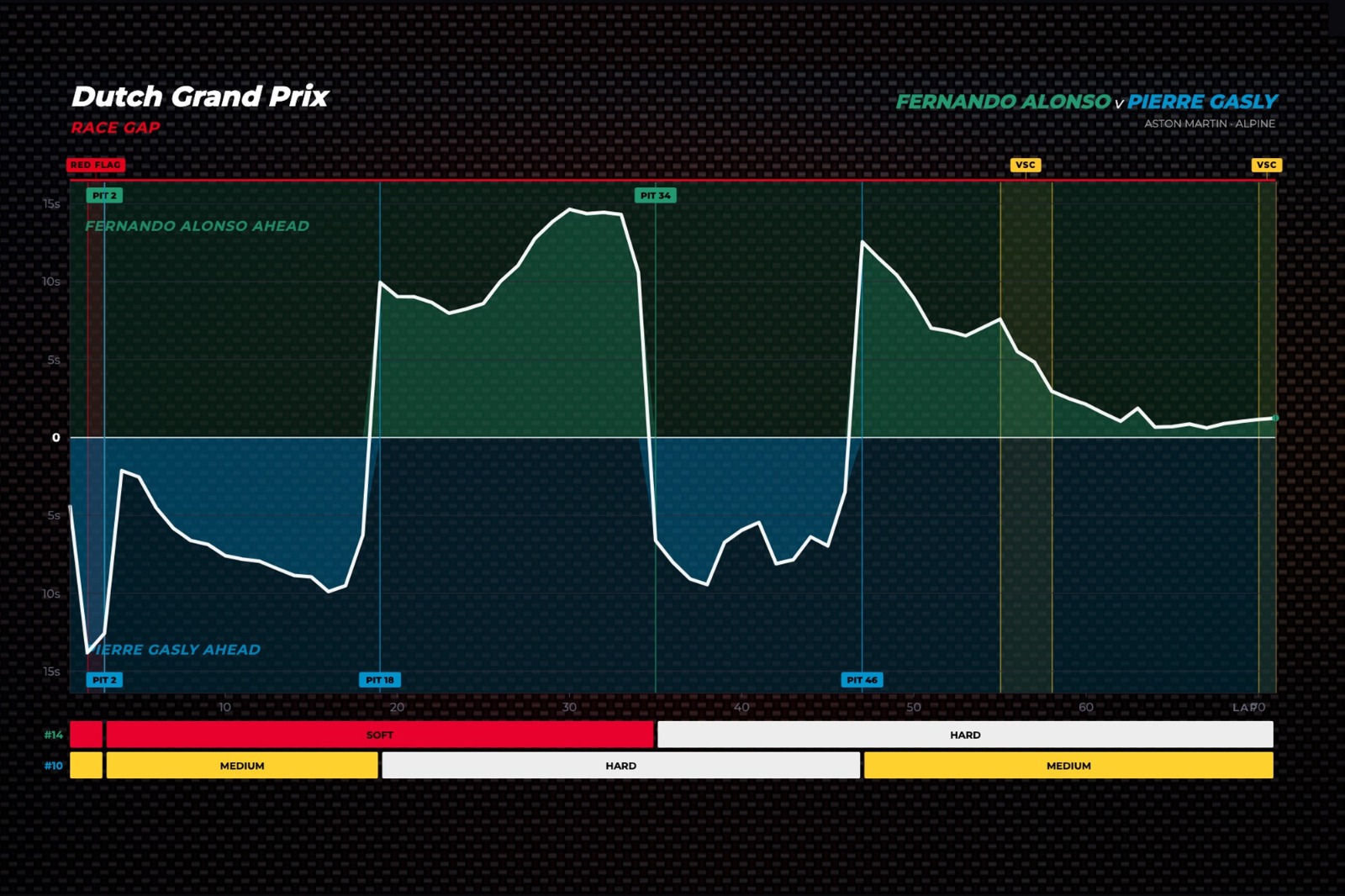
The comparison graph between Alonso and Gasly demonstrates, after the latter's lap 18 stop, the power of the fresh tyres - indicated by the decaying advantage that Alonso had been able to hold. But in the middle of that phase, Alonso's gap starts to grow once more; when Albon and Alonso had been cleared by a post-stop Lawson, they were able to start enjoying the free air - Alonso especially when Albon had pitted, which helped Alonso to grow the gap again while Gasly started getting stuck behind Lindblad.
Even with the late threat from Gasly, who was helped by Alonso losing time in being lapped by Charles Leclerc, it is to the evergreen Spaniard's credit that he was able to cope with this. It helped that Honda's upgraded power unit does appear to come with a bit more power, although perhaps at the detriment of driveability as the engine braking 'push' that both drivers had to contend with made stopping the car more difficult.
Still, Aston Martin is improving - and the likes of Haas and Williams will be very worried by the pace that the Silverstone squad has been able to uncover with its night-and-day-different AMR26.

Alonso was tracing Albon's progress over the first stint
Photo by: Eric Le Galliot
Why Williams threw away a potentially similar result
"Honestly, the biggest frustration is the race itself, because I think we were in a good race," was Albon's assessment, classified 17th but a late stopper after finding Sainz chewing at his bodywork with a Turn 1 lock-up late on.
"We were in front of Fernando for most of that race, maybe not with his pace, but I think we boxed too early. If you look at our race run, when we did box, we came out behind a group of seven or eight cars. I need to understand why we boxed so early, because we genuinely had a chance to score points today.
"If you look at our pace, it wasn't fantastic. But because of the way we started on the hard tyre, we actually gave ourselves a chance to overcut a lot of the cars behind us."
Albon's assessment is likely correct. The Anglo-Thai driver was running ahead of Alonso in that early stint, and it looked for all the world that he was set to extend his stint and that Sainz was helping him achieve a welcome points-finish by employing the Monaco hold-up trick. Except it didn't quite play out like that, as Albon stopped on lap 26 for another set of hard tyres - far too soon to make the one-stop work.
Williams could have stuck to the hards for the rest of the race; Albon used the soft tyre before the red flag and thus had already ticked the two mandatory compounds box. Staying out for another eight laps to match Alonso's pit timing would have opened the potential one-stop door.
Albon had come out behind the Lindblad-Tsunoda-Gasly-Bortoleto train anyway, and it's reasonable to assume that this would have remained the case had he kept going for eight further laps; his pace wasn't dropping off too much, and Alonso did not really find an uptick in time when released by Albon. The two were consistently in the low 1m19s, and Albon's final lap before making his stop was a 1m19.1s. Alonso stayed in that bracket, with the odd 1m18.9s sprinkled in before conducting his own stop.

Williams' strategy ensured two things: that Albon needed to stop again, and that Albon was in phase with the traffic ahead. Thus, he lost time, ended up losing even further time when getting lapped by Antonelli and Norris, which put him out of touch with the cars ahead. Alonso also lost a little time here, but he was in a position where it was not particularly consequential to his race.
And so, it snowballed. Alonso got past with fresher tyres, Albon continued to fall through a combination of losing time being lapped and being passed by Bortoleto, and then you end up in a position where there's another stop coming. Williams didn't time his stop correctly, and thus suffered a punishing bump down to earth. Conversely, the lines cleared for Alonso pretty swiftly, and he was able to press the fresh tyre into action with some good race pace. The picture changed dramatically in the eight-lap difference between them; Albon got stuck in traffic, Alonso did not.
There's a case to be made that Albon's pace was marginally slower than that of Alonso, but he's still realistically looking at a 10th-placed finish if he'd been unable to hold off a late-race charge from Gasly. He's right to feel somewhat aggrieved, especially as he'd had the upper hand over Sainz all weekend - only to be met with a broadside from his team-mate in the dying stages of the race.
It reads like the premise of an experiment to prove the butterfly effect: two drivers in close proximity on track with similar levels of pace, but with one variable - pit strategy - between them. The produced results were vastly different, as Alonso looked like a hero and Albon scored a big fat zero despite being neck-and-neck in the early stages. One flap of the butterfly's wings, or two?


Albon's race ended in less-than-ideal fashion, as Sainz locked up and made contact
Photo by: Sam Bloxham / LAT Images via Getty Images


Dutch Grand Prix Driver Ratings 2026

Norris made his own life difficult again - but his recovery was stunning in Zandvoort's swansong

What we learned from the 2026 F1 Dutch GP sprint race and qualifying

How the 2027 F1 grid is shaping up after Verstappen's Red Bull new deal

How much performance has each F1 team gained over 2026?

Mercedes explains "out of phase" developments compared with other F1 teams

FIA lifts sanctions on Russian, Belarusian drivers

100 not out: Albon on Williams’s desire to atone for its 2026 struggles

How Alonso scored ninth at Zandvoort - and how Albon lost a similar payday

Opel completes Formula E line-up with Evans signing

Plenty of Owens family success during entertaining Brands Hatch Mini Festival

Could qualifying resolve the WRC’s 2027 road order conundrum?
Subscribe and access Autosport.com with your ad-blocker.
From Formula 1 to MotoGP we report straight from the paddock because we love our sport, just like you. In order to keep delivering our expert journalism, our website uses advertising. Still, we want to give you the opportunity to enjoy an ad-free and tracker-free website and to continue using your adblocker.


Top Comments