


How a 1980s design phenomenon has trapped F1’s new rules in a tough spot on car safety
The new generation of Formula 1 cars have caused a stir in their first on-track action of 2022 in Barcelona testing this week. With a design change driven by a desire to boost overtaking, an old phenomenon has reared its head and raised concerns over safety

The epithet of choice during the lead up to the 2022 grand prix campaign has been that Formula 1 is about to embark on a ‘new era’ thanks to the regulatory overhaul. It’s ironic then that just two days into pre-season running at Barcelona, the field is being hobbled by a forty-year-old problem: porpoising.
Autosport has spent a healthy chunk of time watching the new breed of machinery hurtle down the main straight before slamming on the anchors on the approach to the Turn 1 right-hander. But what’s happening well before the braking zone is capturing the attention most of all.
PLUS: The early clues Barcelona testing offers on solving F1's overtaking problem
As Lewis Hamilton edges north of 172mph aboard the Mercedes, the car rises towards the top of its suspension travel before slamming back into the asphalt. After it has kissed it, the W13 again goes light on its feet before hitting the deck once more. This cycle happens at least 10 times in sequence and has commenced in line with the end of the pitwall - roughly 350 metres before the braking zone. It only ceases as Hamilton sheds the speed when he eventually stamps on the left pedal.
It looks violent, almost nauseating as the car bobs up and down. As well as being unpleasant for the driver, the machinery doesn’t seem too grateful for the repeated inputs either. The revs of the 1.6-litre turbo V6 peak and trough in time with the car pogoing its way down the straight as the components are rattled about.
The Mercedes is by some way the most unsettled of the 10 machines. The Williams and Ferrari bounce to a degree, but nothing like as severe. Nor is the chattering Alpine. The Red Bull appears comparatively unflappable in the same area. McLaren, too.
Hamilton’s motion also draws the attention of the Mercedes big hitters. As Autosport returns from its trackside excursion, passing in the other direction is Toto Wolff. The Silver Arrows motorsport boss is four up in an Aston Martin DBX. One of his passengers is George Russell and they stop on the approach to Turn 1. Russell gets out and begins to flap his hand to gesticulate the same porpoising phenomenon to his captive audience.
After his Thursday afternoon in the car, Russell says: “I think you can see some quite substantial issues with the cars in the straights with the bottoming. So, this is a compromise we need to find to go quickest around the lap. It’s something I don’t think any team has experienced before. We’re seeing some interesting things out there. That’s what testing is for.
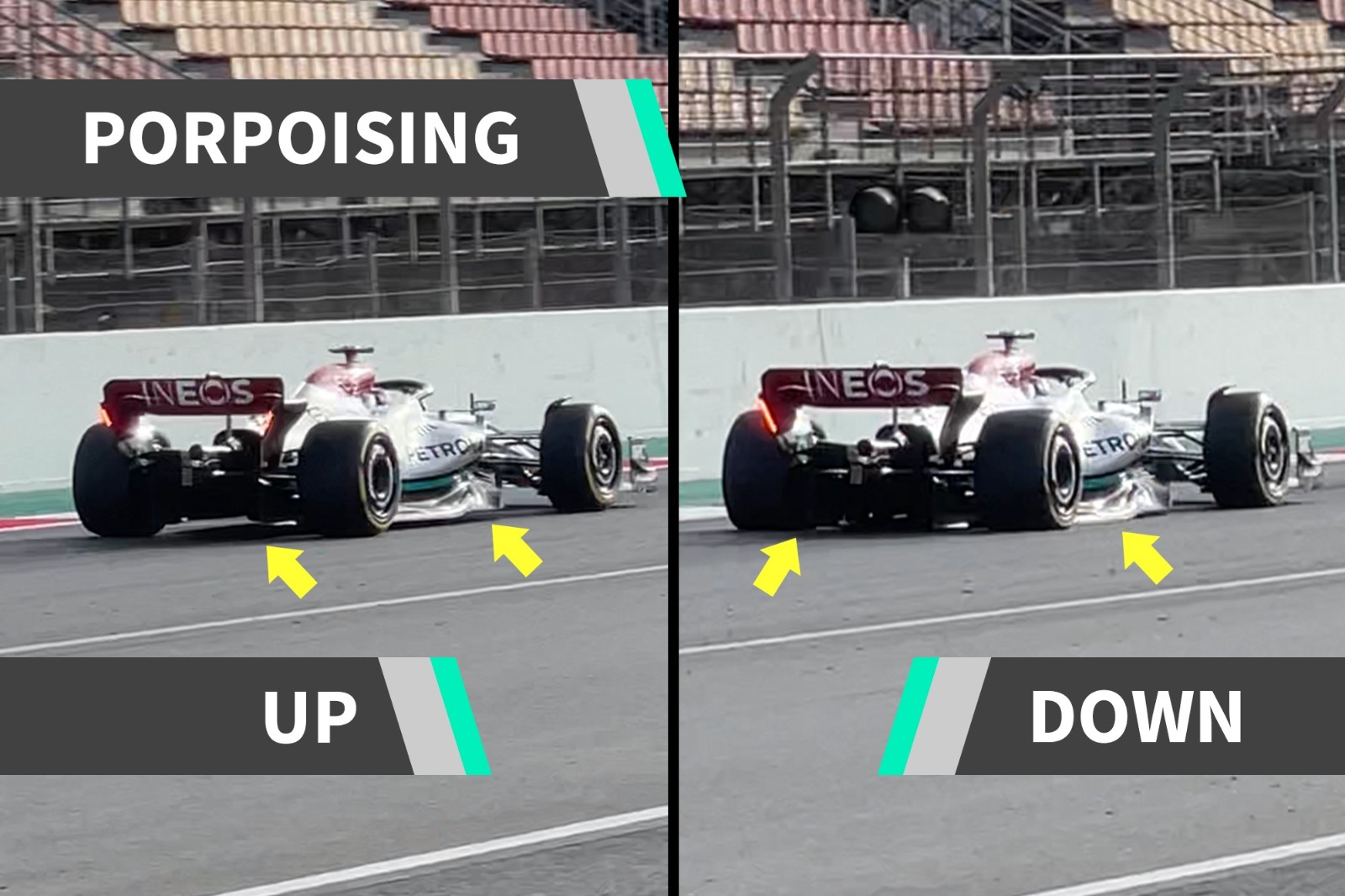
The 'porpoising' effect new F1 cars are experiencing, as displayed by Mercedes' George Russell
Photo by: Autosport
“It’s not very pleasant at all. From what I’ve seen of other teams in particular, it would be a safety concern, so that does need to be sorted one way or another. But there’s a lot of intelligent people up and down this grid, and I’m sure everyone will get on top of it sooner than later.”
What the Brit is referring to, and what he was mimicking with his hands, comes as an unintended result of the quest to boost overtaking in F1. This desire started with the cars needing to follow each other more closely, and so the technical shift has pushed for designers to produce downforce via ground-effect and move away from the dirty air-creating fiddly top surfaces of the previous generation.
As the air rushes through the new Venturi tunnels to create an area of low pressure, the car is sucked towards the ground and hunkers down. However, where the asphalt is not smooth and flat like a snooker table, a stall can occur. In this moment the seal is broken, the downforce is compromised, which leads the car to pop back up again. This cycle repeats itself and is what Autosport has witnessed consistently when seven-time champion Hamilton flies by as part of the 90 laps he has completed thus far in this so-called ‘shakedown’ in Spain.
“These new cars are very, very different so it’s sort of a ‘get to know you’ process with this new car. These ground effect cars are acting in a very different way and it’s something that’s a characteristic of the 1980s," Christian Horner
Resident technical editor Jake Boxall-Legge explains why porpoising has arisen beyond simply the move to ground-effect and is as such, hot on the agenda for the class of ’22.
“The new suspension packages are very stiffly sprung to ensure the ground effects work properly, and that's allied to much stiffer tyres owing to the shorter sidewalls of the 18-inch construction.
“Keeping the suspension stiff ensures the car is much less likely to bottom out mid-corner, which would potentially create a stall in the floor and throw the aero completely out of balance. But then you get a huge downside where the car isn't as well damped when it comes to dealing with bumps in the road down the straight.
“Driving over bumps acts as an upwards driving force through the car, and the reaction from the car in return produces an up and down motion - and that's where you get the porpoising.”

Alan Jones, Williams FW07B Ford, leads Gilles Villeneuve, Ferrari 312T5
Photo by: Motorsport Images
But this shouldn’t arrive as a shock. In the 1980 season, Williams and company had begun to run away with the first-generation ground-effect concept, which was largely pioneered in grand prix racing three years earlier by Colin Chapman and the Lotus 78 - then developed into Mario Andretti’s title-winning 79. But this new breed of racer was sensitive to porpoising, and even the most minor of upsets to the airflow under the car could completely wipe out its handling.
In 2022, F1 is rediscovering a similar issue, as Red Bull team principal Christian Horner explains: “These new cars are very, very different so it’s sort of a ‘get to know you’ process with this new car. These ground effect cars are acting in a very different way and it’s something that’s a characteristic of the 1980s.
“In the design team, it’s not something that isn’t unexpected. It’s an interesting new dynamic. Some cars will deal with it better than others.”
Back in the 1980s, to mitigate the pitching and diving in the corners specifically, engineers ran with the stiffest suspension settings available to them to essentially lock the car in place as the ride height would remain more stable. But this created unforgiving, knife-edge racers and in turn led to a rise in high-profile crashes. This trade-off is the battle the current aces must now face.
Similarly, when the stalling issue reared its head in sportscar racing, aside from stiffer springs and dampers, the LMP3 division was known to have fitted spacers to physically limited how far the suspension could travel to prevent the floor from kissing the ground.
But while granite-like tuning might benefit the straight-line credentials at the expense of cornering predictability, softening the set-up has the inverse effect. Boxall-Legge adds: “You can reduce the porpoising at close to top speed by softening the suspension to absorb the input from the bumps, but then you run into the issues of losing the efficiency of the underbody.
“Teams have highly specialised vehicle dynamics operations, where they test the motion of the car via a seven-post rig which inputs the bumps in the road - giving the dynamicists the information needed to tune the car in order to cope. So it's interesting that, despite all of that hugely expensive equipment, the cars are chattering quite so much.”
Despite the development of state-of-the-art simulations, there appears to have been a difficultly in the computers replicating real-world conditions. Porpoising has taken teams by surprise, and by extension the rule makers who initially devised the regulations but didn’t work to mitigate the phenomenon.

Valtteri Bottas, Alfa Romeo C42
Photo by: Mark Sutton / Motorsport Images
Alfa Romeo boss Frederic Vasseur explains: “Some elements are not easy to evaluate in the windtunnel and the simulator, and we are all facing the same issue. To fix the problem is not the biggest issue, but then to be efficient will be the key. How quickly the team will react will the key for the first races.”
Furthermore, it has now transpired that several squads had to pause their pre-Barcelona shakedowns to make changes because the sensation was violent enough to damage the floors as they scraped the surface. Wind on to Spain and teams have again been readily swapping floors as they wrestle with the issue.
Ferrari’s Mattia Binotto picks up the crux of the matter. “I think most of us at least underestimated the problem, in terms of [being] on track and bouncing more than expected. When you're setting these cars up with the ground [effect] floor, the situation it's different.
“It's a learning process. I think that solving it can be quite straightforward. Optimising the performance, because it should not be a compromise, you should try to avoid the bouncing by getting the most of the performance of the car. But that could be a less easy exercise.
“I am pretty sure that at some stage the team will get to the solution. How long it will take? The ones that will get there sooner will have an advantage at the start of the season.”
Until the optimum solution arrives, it’s a little awkward that porpoising has returned to F1 as the direct consequence of a major rule change. It took a major rule change to get rid of the problem some four decades ago - a technical overhaul led by then FISA president Jean-Marie Balestre that would come to create the dirty air-creating front and rear wings that have led the paddock to this moment.
Like the sensation of porpoising itself, it seems to have been a cyclical pattern.

Charles Leclerc, Ferrari F1-75
Photo by: Alessio Morgese


Marko: Perez improved F1 form because 2025 contract talks are at stake

Russell explains how low-fuel runs expose Mercedes F1 inconsistency

Leclerc: No answer for "once in a season" Japan F1 qualifying struggle

Sainz: Now time to "speed up" talks to find 2025 F1 seat

Hamilton: Vettel an "amazing option" as Mercedes F1 replacement

Sargeant to race repaired F1 car in Suzuka; no spare Williams until Miami

Pirro leaves role as McLaren F1 academy chief

The impatient pair who’d hoped to be a thorn in Red Bull’s side again

Evans: Late puncture was “harsh” but WRC title position is still "okay”

How Antonelli is proving unbeatable, even when he's beaten

F1 drivers push for Madring changes after "very poor" Spanish GP: "I almost fell asleep"

WRC Chile: Solberg seals victory as Toyota wraps up manufacturers’ crown
Subscribe and access Autosport.com with your ad-blocker.
From Formula 1 to MotoGP we report straight from the paddock because we love our sport, just like you. In order to keep delivering our expert journalism, our website uses advertising. Still, we want to give you the opportunity to enjoy an ad-free and tracker-free website and to continue using your adblocker.


Top Comments