


Haas' VF-26 demonstrates F1 2026's aero trends - and hints at Ferrari's key details
A title partnership spells a new livery for Haas in its quest to climb the grid in 2026. And, although the team is likely hiding key details on its new VF-26, it demonstrates clear trends as the new-season picture becomes clearer - and reveals a little about Ferrari's incoming car...

Autosport Explains
Our experts decode the most important stories in motorsport.
It's probably fair to suggest that Haas has crammed a lot of life experience into its decade in Formula 1: the dizzying highs of its debut year and stellar 2018, the terrifying lows that followed, eventually resolving in a strong couple of seasons under the aegis of Ayao Komatsu.
The difference in approach between Komatsu's Haas and that of predecessor Guenther Steiner was evident through 2025. In the past, the team might take a whole season to understand why its cars were lumbered with a given limitation; in 2019 and 2023 for example, the cars showed flashes of solid qualifying pace but had a crippling tendency to chew through the tyres at will in race trim, and attempts to quell that issue with updates were slow in arriving.
In 2025, however, the team encountered a severe aero deficiency at high speed - leading to a pallid performance in the Australia season opener. Yet, the team responded in brisk fashion and a floor update was put together in just days for the Japanese Grand Prix, which set the basis for continued upgrades through the season.
While Haas finished eighth in last year's constructors' championship, it spent most of the year in the hunt for sixth. The aim, of course, is to build on that and bloody some of the noses of its larger, better-funded competitors - but it remains at the behest of Ferrari for much of that. Early form will largely depend on the Italian brand's powertrain, and whether it has been able to get its head around the expanded scope of hybridisation.
Many of the components on the VF-26 renders are in-line with what we'd seen on the Red Bull and Racing Bulls imagery last week but, since we're largely in livery-launch territory, one would expect that there's a few things that have not been included and that we won't see until testing. Regardless, there's still plenty that we can glean from the images provided.
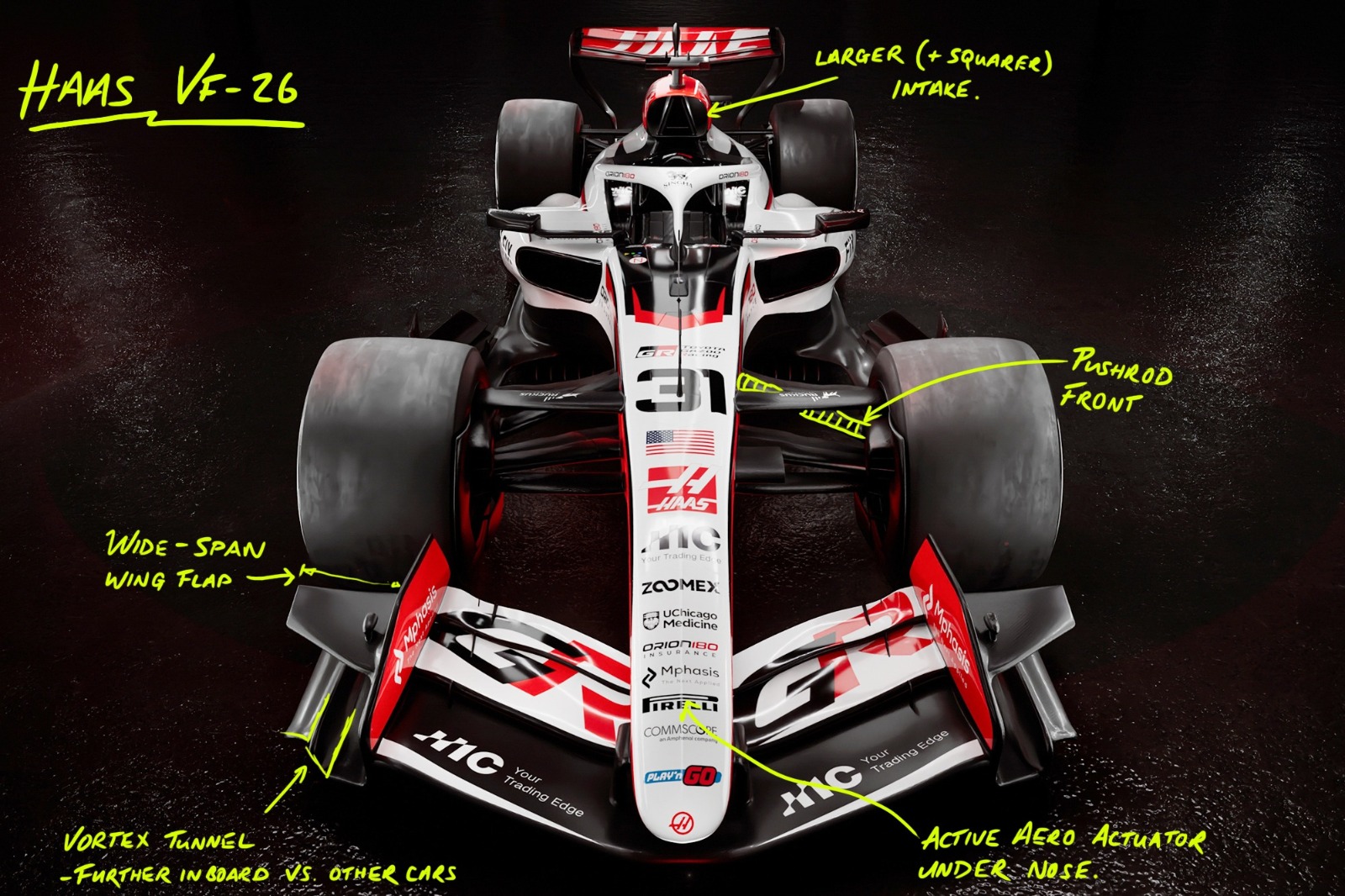
At the front wing, the team has gone for the full span in the outboard winglets mounted to the endplate, something also demonstrated in the images provided by Cadillac in its shakedown of its first F1 car. By comparison, Red Bull had shown its 2026 livery on a car with half-span winglets, while Racing Bulls had not shown its car with them at all - instead replacing the space with a little tyre sensor on the endplate.
Haas has mounted its tyre sensors top-side and, underneath, there's more complexity to the footplate. The vortex tunnel area sits further inboard, and this flattens out at the trailing edge. Since there's a small cut-out here, this might be aiming to release that vortex a bit sooner to ensure it can clear the tyre and help with managing the aero wake produced by the front wheels.
Although it's hard to see from the imagery, it also seems that the active aero device is mounted underneath the nose - rather than the twin actuators seen on the Racing Bulls car.
The car's new livery looks clean, with a reversion to using black as an accent colour rather than as the main event. The new livery rule mandating that at least 55% of the car must be painted is certainly going to help the visual appeal of the field - we won't have to put up with 2024's 50-Shades-Of-Carbon-Grey field again
Since Haas takes Ferrari's suspension, this suggests that the Maranello outfit's rumoured switch back to a push-rod front geometry is true; Haas stuck with the team's 2024 push-rod front suspension last year, rather than switching to the 2025 pull-rod, and thus the American squad continues with the same format for this year. We've seen both Red Bull-owned teams revert to push-rods here for 2026, as has Audi, while Cadillac has opted for pull-rod in its first year.
The upper wishbone retains the lowline rear leg treatment, perhaps a combination of wishing to retain aerodynamic stability under braking, and also improving the localised flow towards the bottom half of the sidepods. In this area, Haas also has a similar bargeboard treatment to that shown in the Red Bull and Racing Bulls images, with the slatted second piece to help clean up the tyre wake before pushing it inboard. And, while Red Bull showed a version of its new car with the shark-like overbite inlets carried over from the RB21, Haas has a more 'standard' approach in this area.
It differs further to those cars in the sidepod department, as the attempt to gather inwash around the bodywork is less obvious. It's a semi-similar approach to last year, in which it used a shoulder at the trailing edge to create a channel in the upper surface, letting the air taking the lower path around the sidepods wrap around and merge with the flow coming from the top.
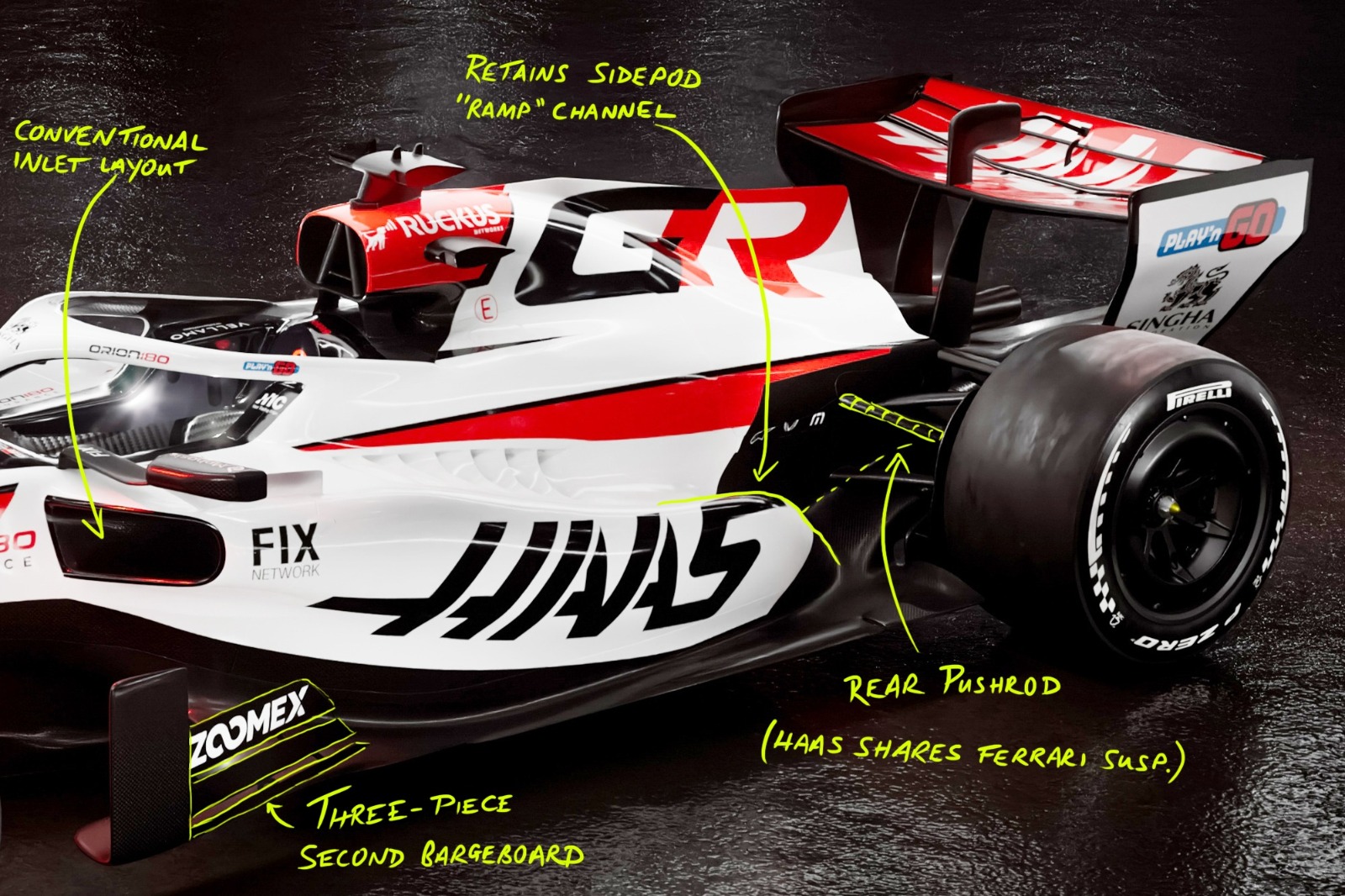
This brings the airflow along a journey around the rear suspension members, which also suggest that Ferrari by association has switched to a push-rod assembly here too. In both areas, the torsion bars are mounted on top of the chassis, rather than underneath - this offers a small centre-of-gravity penalty, but at the same time will allow the mechanics much easier access and reduce the space underneath occupied by the components.
The rear wing is similar to what we've already seen from other cars; while the original F1 concept models suggested that the mainplane might be shortened in chord length to allow the upper two elements to be made larger, all the imagery provided so far suggests the opposite and that two short-chord elements at the top would be the way to go. It largely depends on how the wing will be actuated, and whether teams lift the flaps up per the old DRS method, or push it downwards as demonstrated in F1's media content released ahead of 2026.
As mentioned, there's more that we've likely not yet seen. Changing the colour grade of the Haas renders shows a few details, like the floor slot ahead of the rear tyre, but as this stage the teams will be keeping their true designs hidden - why would it benefit them to show their hand from the get-go?
Still, the car's new livery looks clean, with a reversion to using black as an accent colour rather than as the main event. The new livery rule mandating that at least 55% of the car must be painted is certainly going to help the visual appeal of the field - we won't have to put up with 2024's 50-Shades-Of-Carbon-Grey field again...


Toyota's Gazoo Racing brand takes prominent livery space as part of Haas' technical tie-up with the Japanese auto giant
Photo by: Haas F1 Team


Haas confident of getting 2027 F1 budget closer to cap with new partner talks

F1 doesn't need to change its VSC rules despite Norris' Spain loss

Spanish Grand Prix Driver Ratings 2026

How Norris unfurled a surprising - and "unrepeatable" - Spanish GP pole lap

Audi’s long road back to the top of grand prix racing

What we learned from Friday practice at the 2026 F1 Spanish GP

Leclerc accepts blame for Italian GP clash with Hamilton: "I went too far"

Should Ferrari have pitted Hamilton under the VSC at the Italian GP?

Acosta's long road to his maiden MotoGP win

MotoGP Austrian GP: Acosta finally claims maiden win

Great debate: Which circuit should host the F1 2026 finale if the calendar has to change?

Live: MotoGP Austrian Grand Prix updates as it happens
Subscribe and access Autosport.com with your ad-blocker.
From Formula 1 to MotoGP we report straight from the paddock because we love our sport, just like you. In order to keep delivering our expert journalism, our website uses advertising. Still, we want to give you the opportunity to enjoy an ad-free and tracker-free website and to continue using your adblocker.


Top Comments