


For richer or for poorer - how track layouts will affect F1 2026's competitive order
Although F1's constructors are making advancements with their new-for-2026 powertrains, there's a certain type of circuit that's got many of them fearing a challenge...

Autosport Explains
Our experts decode the most important stories in motorsport.
Back in the days when the Formula 1 calendar was considerably less inflated versus today's monster 24-race schedule, and when only the top six scored, points were a much scarcer commodity.
This was especially true for the teams at the back of the grid. A single point could be as valuable as gold dust, and it took just one race to offer an underperforming team something of a windfall in extenuating circumstances, or a last-minute rescue amid a dismal year; attritional races or dreadful weather could present such circumstances. There's myriad examples here: Arrows and Minardi notching up their sole points of 1999 at Australia and the Nurburgring respectively, Jordan's double-point salvo at Japan in 1993, Andrea de Cesaris' fourth place for Rial in Detroit in 1988...and many more one-hit wonders in a season that got a team off the mark.
The other circumstance, and one eminently more controllable, was in designing a car for a set range of circuits. For a smaller team, this was a wise approach; although reliability could not be guaranteed, you'd potentially base your car around Spa and Silverstone to maximise performance on those circuits, and then take the hit everywhere else. Maybe other circuits might fall into that catchment area but, for an outfit with a tiny budget, the characteristics of a given track certainly mattered in the approach to the design.
Today's F1 cars, given the length of the calendar, are designed to suit as many circuits as possible - but, of course, there's going to be some degree of variation. In recent years, one might look at Williams as a team which had been able to develop a car which was good in a straight line and maybe less so on other circuits, but its behind-closed-doors infrastructural overhaul generally ensured that it could perform at most venues across 2025. The track-to-track variance has certainly been a factor for engineers to consider, although teams today generally try to keep that "operating window" relatively wide with a modular approach to aero components.
What the engineers must be prepared for is that 2026's rules should show greater delineation between the characteristics of a circuit, particularly in terms of energy deployment.
The circuits on the 2026 calendar are being categorised as either 'energy-rich' or 'energy-poor'. The energy-rich circuits (not to be confused with a certain former Haas title sponsor) are those where harvesting energy is going to be very easy, sometimes to the point where energy deployment strategy is almost beyond consideration. Conversely, the drivers racing on energy-poor circuits will have to hope that the electrical components of the powertrain demonstrate good efficiency, since there will be comparatively few opportunities to harvest energy in slow corners.

Different circuits should expose the maturity of each manufacturers' powertrain efficiency and deployment
Photo by: Guido De Bortoli / LAT Images via Getty Images
Circuits like Monaco and Singapore will make it very easy to recapture energy through a lap. Furthermore, the depreciation of energy needed before the cars can use the superclip to harvest will be smaller - at 50kW per second, rather than the standard 100kW. Other tight circuits, like Zandvoort, the Hungaroring, and potentially the incoming Madrid race should also be energy-rich circuits; while most will be satisfied that the energy management side won't be a factor, it would likely come at the cost of processional races given that most cars will be operating in the same management conditions. It's already become apparent that the overtake mode is lacking effectiveness, and it'll have a limited use case in these lower-speed venues.
In the other corner, we've got the Melbourne season opener, plus the likes of Baku, Las Vegas, Monza, and the upper-mid range circuits like Barcelona. Given their fast corners and longer straights, it will be a challenge to recuperate energy at these tracks; not only will the teams have to rely on superclipping to pull energy out of the drivetrain and pack it into the battery, but areas of the circuit will also likely be taken at less than full throttle to avoid triggering the MGU-K.
This primarily concerns the outlap, where the drivers have to approach 100% charge coming out of the final corner before a qualifying lap to make use of the deployment on the main straight. Take Barcelona, for example; after Turn 14, the driver will build up speed and select the moment to hit full-throttle, likely consuming most (if not, all) of the energy stored in the battery pack.
"There are all the conditions to make this 350kW [superclip] harvest while the driver is in full throttle, which means that the driver doesn't have to lift and coast. It will ultimately be up to the FIA to decide whether they introduce it or not, but we successfully tested it and we are happy"
Andrea Stella
Turns 1 and 2 offer some capacity to harvest, but Turn 3 will likely no longer be full throttle to avoid sinking that recently accrued energy into a less deployment-critical area. The longer radius corners do make it harder to recapture energy, especially when these have been historically taken in fourth gear; plus, saving energy out of Turn 5 and making sure there's more deployment available for the exit of Turn 9 makes this a fine tightrope to walk.
And it's not just about energy harvesting, but also tyre preparation. Haas team principal Ayao Komatsu noted that some of the approaches needed to harvest energy on an outlap will often run contrary to the approaches needed to prepare the tyres for a qualifying lap.
"I think the outlap is going to be difficult as well," explained Komatsu. "Barcelona, outlap is difficult, [Bahrain], it's easier, so again, it's really circuit dependent. I hope Melbourne's going to be alright - but imagine it through changeable conditions! That's going to be a huge challenge.

Barcelona's shakedown demonstrated to teams how energy-starved their cars could be
Photo by: Formula 1
"The circuits that come to my mind straight away, it's places like Baku or Vegas. It's very difficult to get the tyres to work as well, and the requirements of getting the battery prepared very well versus to prepare the tyres, somewhat it's conflicting. So you have this multi-dimensional optimisation issue, you've got to find the right compromise, so that will be challenging."
Certain circuits should suit different cars, beyond the aero and mechanical configuration of which we are accustomed to. Let's take Red Bull as an example, since the team's Ford-partnered powertrain has been lauded for its deployment - and, by association, its ability to harvest efficiently. At those energy-poor circuits, it'll help immeasurably to have a car that can offer those couple of extra seconds of deployment over a lap, and in being able to capture more energy through the slower portions of the circuits.
Melbourne will be an interesting test of this, as its current layout now has very few areas in which the drivers can back off and let the motor recoup energy. If the Red Bull is genuinely one of the better contenders in terms of energy deployment, rather than simply being the target of Mercedes' deflection tactics, then this could be worth a few tenths over the course of a lap simply due to the higher average speeds produced by cutting out some of the expected lift-coast areas. Think Baku, for example; if you need to lift less through the castle section and can apply full throttle earlier on along the Neftchilar Avenue 'straight', then you're picking up a tasty slice of extra lap time.

By contrast, such an advantage would be diluted on the energy-rich circuits; although teams will need to harvest, this should be paired with the cornering phases and thus energy management and topping up the battery should be less of a hassle. This should mean that the efficacy of Red Bull's purported deployment advantage, as the other outfits will be able to maintain more of their electrically derived power for longer. That gives hope to teams like Aston Martin, which is known to be struggling with its own deployment from the Honda-developed powertrain.
By the time we hit Barcelona again, the teams should have made considerable progress with their harvesting and deployment - so it should be less of a shock versus the scenario faced by the teams during the January shakedown. It may also be the case that the superclip limits are changed; as it stands, the teams can only use 250kW of the electric motor to harvest, rather than the full 350kW.
"There are all the conditions to make this 350kW harvest while the driver is in full throttle," McLaren's Andrea Stella explained on the final day of testing in Bahrain, "which means that the driver doesn't have to lift and coast to harvest 350kW. We discussed this with the FIA and it will ultimately be up to the FIA to decide whether they introduce it or not. We successfully tested it [on Friday] and we are happy."
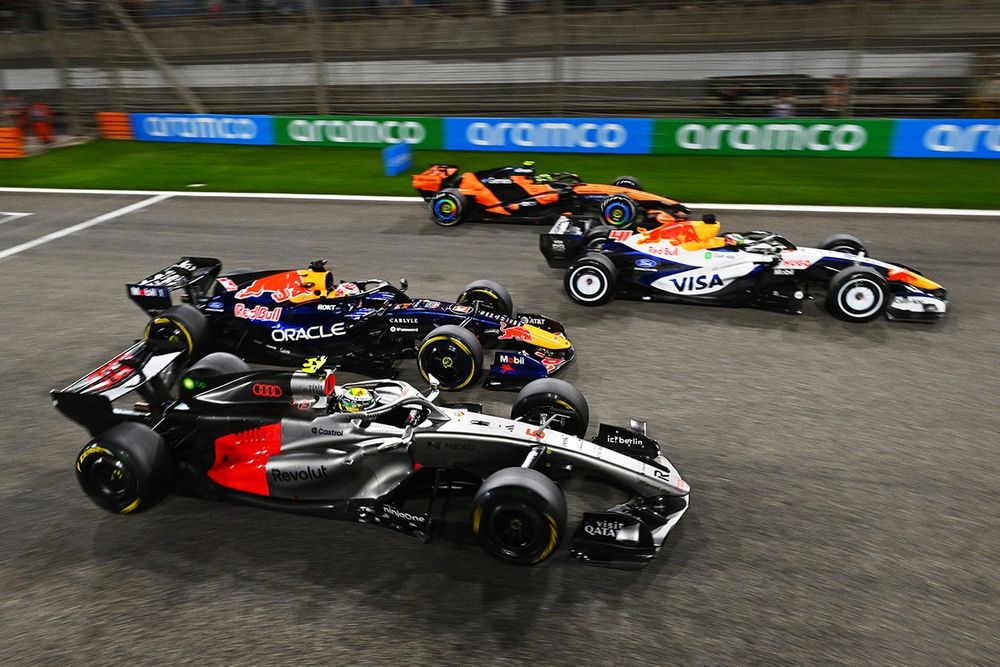
One added complication: cars need to be at less than 100% charge at starts to get the right turbo spool
Photo by: Mark Sutton / Formula 1 via Getty Images
As it stands, this is the situation - you've got the quick circuits where cars will be starved of energy, and the slower ones where they'll have a surplus. But, as seen in the final days of the Bahrain test, the picture is ever-evolving.
While the early days of the test were characterised by drivers lifting and coasting through Turn 12 and on the approach to Turn 13, some drivers were experimenting with the uphill right-hander as a deployment area in the second week. Charles Leclerc carried less speed through that corner in his ultimate headliner in day six versus Kimi Antonelli's day five time, as teams are getting a handle on being able to maximise their deployment uptime and concentrate the recovery during the less speed-critical parts of the lap.
What was interesting about Leclerc's flying lap is a little detail seen in the GPS data, where the Ferrari driver was maintaining a tiny bit of throttle through the corners to help keep the engine speeds up, and scarcely needed to lift and/or coast through any point in his qualifying lap. It'll be less easy to do that at certain circuits but, once the teams have compartmentalised the recovery points and the acceleration points, the more 'unnatural' elements in the 2026 era should be a little less discernible.
The circuits that rewarded leaden-footedness have now inspired a very different challenge. Extruding the energy deployment phase is going to be a killer attribute - at least, to anyone who can master it first...

Baku is expected to be tough on energy management
Photo by: James Sutton / LAT Images via Getty Images


F1 doesn't need to change its VSC rules despite Norris' Spain loss

Spanish Grand Prix Driver Ratings 2026

How Norris unfurled a surprising - and "unrepeatable" - Spanish GP pole lap

Audi’s long road back to the top of grand prix racing

What we learned from Friday practice at the 2026 F1 Spanish GP

Leclerc accepts blame for Italian GP clash with Hamilton: "I went too far"

Should Ferrari have pitted Hamilton under the VSC at the Italian GP?

Italian Grand Prix Driver Ratings 2026

Ferrari not yet switching focus to 2027 F1 car

The verdict on the WRC Rally Chile tyre solution

Top five roles on Motorsport Jobs this week

Quartararo explains why Yamaha relationship has strained ahead of Honda move
Subscribe and access Autosport.com with your ad-blocker.
From Formula 1 to MotoGP we report straight from the paddock because we love our sport, just like you. In order to keep delivering our expert journalism, our website uses advertising. Still, we want to give you the opportunity to enjoy an ad-free and tracker-free website and to continue using your adblocker.


Top Comments