


Following Verstappen’s path? The one lesson Antonelli must learn for an F1 title fight
Kimi Antonelli admits after taking his first pole position for a Formula 1 Grand Prix that he still needs to improve his ‘risk-reward management’ for a potential title fight

While George Russell looked back on a difficult qualifying session due to technical issues, Kimi Antonelli wore the broadest smile in the spacious Shanghai paddock. After Saturday’s on-track action, the Italian secured his place in the record books as the youngest polesitter of all time, a record Lewis Hamilton commented on by saying: “It’s a great record, and it's going to take a while for someone to ever get close to that one.”
Aside from the record, the pole position comes at a good time for Antonelli. In Melbourne, he crashed during the final free practice session, after which the youngster had a poor start to Sunday’s race and had to work hard to eventually salvage second place. Team boss Toto Wolff noted after the race Down Under that the 19-year-old Italian has to learn everything “the hard way”.

For Antonelli, it comes down to finding the right balance. Based on the first on-track action of the year, he knows he has a fast car at his disposal, meaning that in case of setbacks, he above all needs to stay calm. During the sprint race in China, things didn’t entirely work out after another difficult start, eventually leading to contact with Isack Hadjar.
The Red Bull driver was rather outspoken after the race, stating: “I don’t understand why he’s so overexcited when he has a rocketship and will make his way back up anyway.” Antonelli tried to apologise directly after the sprint race, but Hadjar was not open to it in the heat of the moment – about which Wolff told Sky Germany: “That’s not how it should be — waving him away.”
Antonelli draws a clear lesson from the first weeks of 2026
More important is what Antonelli himself has learned from these challenging moments early in the season. According to him, the experiences in Melbourne and Shanghai make one thing clear: the risk-reward calculation can still be improved. When asked by Autosport, Antonelli even mentioned it as the main lesson from the opening weeks of 2026.
“It’s not easy because definitely Melbourne was a shame, to have that hard hit, and then it put me a bit on a back foot into qualifying and then the race. It’s hard because you know you have such a great opportunity, having such a quick car, and you don’t want to miss that opportunity, so you go for it. But in my case, I’m still learning how to improve the risk-reward ratio, especially in sessions that the result doesn’t really count, such as FP3 for example,” Antonelli admitted.
“It’s about finding the right balance in order to be able to keep the momentum going. And also, in every situation, it’s about being able to put things together, even in a qualifying session, having a clean run from Q1 all the way to Q3. I’m still trying to find my way to see how I can achieve that because at the moment I feel like I do a good Q1 and Q2, and then maybe Q3 is not good enough. So, I just need to find some improvements in there.”
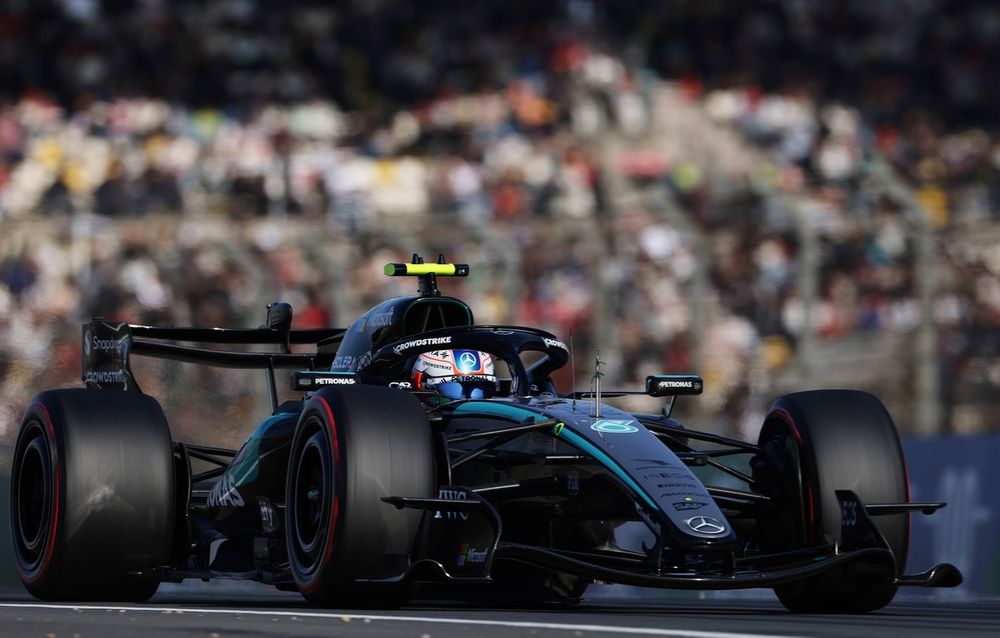
Andrea Kimi Antonelli, Mercedes
Photo by: Mark Thompson / Getty Images
A development Verstappen also went through
This has been seen with many raw diamonds in the past, perhaps most recently with Max Verstappen. Former Red Bull advisor Helmut Marko has explained how he repeatedly tried to convince Verstappen that he didn’t have to be the fastest in every practice session.It is about carefully building up a race weekend and delivering when it really matters.
According to Marko, the penny dropped for the now four-time world champion after the Monaco Grand Prix in 2018. “In his early years, Max wanted to be the fastest at every moment and under all circumstances. After that moment he learned to manage that better and to deliver when it really matters.”
Antonelli is going through a similar learning process, although an important difference is that Red Bull in 2018 did not have the car to fight for a world title. Verstappen may have missed out on a few potential race wins because of it, such as that Monaco weekend and also the 2018 Chinese Grand Prix — when the Dutchman hit Sebastian Vettel in the hairpin and teammate Daniel Ricciardo eventually triumphed.

Antonelli will have to go through a similar learning process, although this year — given the strength of Mercedes — a world title may already be at stake. By his own admission, it is the main learning point, especially as Russell showed last year that he is able to perform extremely consistently and also consistently at a very high level. For a genuine title fight, the very same will be required.
In his debut year, Antonelli had already shown glimpses of his enormous potential — for example, by claiming the sprint pole in Miami and his impressive race in Montreal — but the risk-reward assessment and overall consistency are two areas for the next step: the step towards regularly fighting at the front and truly challenging his own teammate for the biggest prizes.
Wolff: This shows our decision was the right one
According to Wolff, performances like the one in Shanghai, and Antonelli’s overall progress, show that Mercedes made the right decision last year by allowing him to debut early — and to do so immediately with the works team.
“Many said the kid was too young, the kid was too young to be in a Mercedes, you should have prepared him otherwise, and yet the kid did good,” the Mercedes team boss said after qualifying.

Toto Wolff, Mercedes
Photo by: Guido De Bortoli / LAT Images via Getty Images
“You have to imagine when you’re thrown into Formula 1 at 18 and then all that pressure comes — the whole world is watching you, everyone wants something from you, and they also drop you very quickly again if the performance isn’t there. And last year there were so many critics who said he’s too young and whether Mercedes should really have dared this experiment. And now you can see he’s starting to show real performance and deserves this seat.”
Although that is not only related to Antonelli’s own progress but also to the guidance provided by Mercedes, Wolff does not want to claim credit for that. “I’m just a tiny cog in the whole story, but his environment is part of it — the whole team that gives him support, with Bono — and that’s what’s responsible for the performance being right. But fundamentally, the driver’s personality also has to be able to withstand this pressure and have the talent to translate it into performance.”
The next step is to regularly fight at the front, ideally in a title battle. Normally, such a development takes several years, as it did for Verstappen, but the speed Mercedes has shown at the start of 2026 suggests that for Antonelli the opportunity may come earlier than for most others so early in an F1 career. In any case, the Italian shows no shortage of self-reflection — and that, alongside his undeniable talent, is a very good quality to have. Saturday in Shanghai is proof of that.


Alonso is right to sound the alarm about F1 - but history seems to be repeating itself

F1 drivers push for Madring changes after "very poor" Spanish GP: "I almost fell asleep"

The impact Madrid's "six kilometres long" pitlane will have on Spanish GP strategy

F1 drivers criticise Madrid circuit, Verstappen laughs: "I'll sort it out"

What's behind Alonso's cryptic comments about his F1 future?

The deeper meaning of Vettel’s emotional Schumacher demo run at Monza

Verstappen's "Red Bull car made out of paper" comment explained

"Gentle with the throttle pedal" – Verstappen mentally prepared for painful Monza weekend

Acosta's long road to his maiden MotoGP win

MotoGP Austrian GP: Acosta finally claims maiden win

Great debate: Which circuit should host the F1 2026 finale if the calendar has to change?

Live: MotoGP Austrian Grand Prix updates as it happens
Subscribe and access Autosport.com with your ad-blocker.
From Formula 1 to MotoGP we report straight from the paddock because we love our sport, just like you. In order to keep delivering our expert journalism, our website uses advertising. Still, we want to give you the opportunity to enjoy an ad-free and tracker-free website and to continue using your adblocker.


Top Comments