


Are we at a turning point for Verstappen – and F1?
As Red Bull struggles and concerns over the 2026 regulations remain, the four-time world champion has “life decisions” to make. But his dilemma goes beyond one driver – it reflects questions about where F1 is heading

After clinching his first world title – yes, after that dramatic 2021 finale in Abu Dhabi – Max Verstappen shouted over the team radio: “It’s unbelievable guys! Can we do this for another 10, 15 years together?” He was responding to an explosion of joy from Christian Horner and race engineer Gianpiero Lambiase – not reserve driver Alex Albon, whose voice many fans thought they recognised.
Less than five years on, however, the landscape looks very different. Of all the men who stood on the front row of the post-race team photo, only one remains. The Honda contingent has since joined Aston Martin, Adrian Newey has made the same move, Jonathan Wheatley could follow that path after a short stint at Audi, and Red Bull itself has parted ways with Horner and Helmut Marko at different stages.
Add to that the news that Lambiase will leave for McLaren, and Verstappen is the only remaining figurehead from that title-winning operation. The key question, though, is: for how much longer?
Admittedly, Verstappen’s future has become a recurring talking point every season. Last year he stayed loyal to Red Bull despite talks with Mercedes’ Toto Wolff over the summer – and regardless of the clauses in his contract – but this year the question is back on the table.
Two elements differ compared to just under a year ago: Red Bull’s competitive position, and the current state of F1.
Red Bull faces a mountain to climb – though not in the expected way
As far as the first factor is concerned, Red Bull is currently struggling under the new regulations. Many in the paddock expected the Milton Keynes-based squad to endure a tricky start, albeit for entirely different reasons than those now in play.
Ahead of winter testing, the biggest question marks surrounded the all-new power unit, with Wolff remarking that Red Bull had “the Mount Everest to climb”. Ironically, the Mercedes team boss would completely change his tone in Bahrain testing, suggesting Red Bull would be “the absolute benchmark” on the power unit side.
While Verstappen immediately saw through the political undertones of that remark – “just wait and see how fast Mercedes will be in Melbourne” – there is still a grain of truth in it.

In China and here in Japan Verstappen indicated that the RB22 failed to respond to set-up changes
Photo by: Sam Bloxham/LAT Images via Getty Images
The Red Bull Powertrains-Ford engine is not the benchmark, but it’s probably better than expected. Verstappen acknowledged as much after March’s Japanese Grand Prix. Asked whether he had learned anything from the energy deployment of the Mercedes power unit after spending countless laps behind Pierre Gasly’s Alpine, the Dutchman made clear that it was not Red Bull’s main issue.
“I think our deployment was good,” he said. “That’s also not our biggest problem, to be honest. From the engine side, yes, correlation and a few things like calibration can be better, but in terms of pure power it’s definitely not our worst area. We’re not like Mercedes – they’re super-strong – but we have a lot more work to do on the car.”
That final point was underlined by the balance issues Red Bull encountered in both China and Japan. Verstappen indicated that the car, unlike in previous years, failed to respond to set-up changes, while team-mate Isack Hadjar went even further. The Frenchman stated that the car was so “undriveable” in Suzuka that it even became dangerous at times.
More importantly, ahead of the April break the team admitted it still did not fully understand the root causes. “Certain things are going wrong, things we didn’t expect to cause any issues,” said Verstappen. “That always makes it a bigger mystery. Just things where you think everything looks OK from the factory side, but then on track they don’t show the same numbers.” Add to that the RB22’s excess weight, and the scale of the challenge becomes clear.
“When I’m in the car, I always give everything. But with how everything is at the moment – not only our own car, but also everything I’ve already said about F1 – it’s just not enjoyable for me” Max Verstappen
When Verstappen’s future was under scrutiny last year, Red Bull was also struggling for performance, but the team at least had a clear idea of the direction required – which ultimately resulted in a remarkable turnaround that almost yielded another world title. Such a scenario now feels a long way off, meaning Red Bull has far more work to do this time to turn the tide and keep Verstappen on board.
Discontent over F1’s direction
Even more significant is Verstappen’s broader dissatisfaction with the current state of F1, underlining that his frustration goes beyond just one team’s struggles. It dates back to the 2023 Austrian Grand Prix, when Autosport asked him for his first impressions of the 2026 regulations. The Red Bull driver had just completed an initial simulator run based on the draft rules – and he did not hold back.
“I’ve been talking about that with the team as well and I’ve seen the data on the simulator. To me, it looks pretty terrible. If you go flat-out on the straight at Monza, like 400 or 500 metres before the end of the straight, you have to downshift flat-out because that’s faster. I think that’s not the way forward.”
His criticism has not diminished. Last year, Verstappen informed Red Bull internally that he did not want to test the 2026 car in the simulator for several weeks, simply because he disliked the formula so much and, when the new machinery appeared on track in Bahrain, he described it as “Formula E on steroids” and “anti-racing”.

Verstappen fully embraced the need to earn his place in the Nurburgring 24 Hours
Photo by: Joerg Mitter/Red Bull Content Pool
In Australia and China the four-time world champion voiced similar concerns, after which the tone shifted slightly. Verstappen was subtly advised by both the team and Formula 1 that he had already made his point publicly on several occasions, and that it might be more constructive to address such matters behind closed doors – an approach he has largely followed since.
That, however, does nothing to change his view of the regulations or the fact that he takes little enjoyment from these cars. It has even led Verstappen to say that he has “certain life decisions” to make. “I’m not even disappointed anymore,” he said in China. “I’m long past that. I’m beyond disappointed and I don’t even know what you call that.”
In both English and Dutch, Verstappen struggled to find the right words to describe his feelings. When a colleague suggested “resignation”, the 71-time grand prix winner agreed. “Yes, maybe that’s the right word, but that’s obviously not good.”
He added that his growing involvement in GT3 racing – including his upcoming appearance in the Nurburgring 24 Hours – is to some extent a necessity to stay motivated: “With other things I try to keep it enjoyable, but at some point that also runs out.” Those “other things” refer to his GT3 outings and the running of his own racing and sim racing team, into which he has invested even more time this year.
It is commendable that Verstappen, as a multiple F1 champion, is broadening his horizons into other branches of motorsport, but it is partly driven by his dissatisfaction with F1’s current state: “When I’m in the car, I always give everything. But with how everything is at the moment – not only our own car, but also everything I’ve already said about F1 – it’s just not enjoyable for me.
“It’s probably not enjoyable for other people either, but if you are away from home for 22 races, you have to do something in your life that you enjoy.”
Like Senna? The grass isn’t always greener
For now, that enjoyment is largely found on the Nordschleife, where Verstappen has shown no hesitation in starting at the bottom of the ladder. In the GT3 paddock, he has earned praise for simply following the ‘permit’ procedure required for the 24-hour race, including going back to school and competing in a slower category to start with.
Several pundits and Nurburgring veterans felt Verstappen deserved an exemption, but the man himself had no complaints. He has since completed NLS2 and the 24h Qualifiers in preparation for the main event in May: 24 hours in the Green Hell.

A disillusioned Senna toyed with the idea of an Indycar switch – and outpaced Fittipaldi at a secret 1992 test with Penske
Photo by: Sutton Motorsport Images
Although Verstappen derives great satisfaction from this and views modern F1 as “artificial”, the paradox is that endurance racing is defined by an artificial mechanism of its own: Balance of Performance. Many in the F1 paddock believe this could become a source of frustration later on, particularly given its political nature.
When it was pointed out to F1 CEO Stefano Domenicali that endurance racing is, by definition, a Balance of Performance discipline, the Italian smiled: “Don’t ask me about Balance of Performance because you will find someone that has to respect other championships!”
On a more serious note, Domenicali added that the long-term outlook for Verstappen may not necessarily be better outside F1. “I don’t know if there is the same way of saying it in the UK, but in Italy people believe that the grass of the neighbour is greener,” he added.
“And sometimes when you go on the other side, they say, ‘Oh my God, it’s not true.’ So be respectful of what we have been able to achieve together, but also listening and being very open to any kind of remarks that we have made together.”
The parallels with Verstappen’s current situation are clear: a struggling team and a ruleset that, in his view, detracts from what F1 should be. Similar complaints, just more than 30 years apart.
Verstappen is not the first driver to look elsewhere amid frustration in F1. One of the most famous examples is Ayrton Senna’s secret Indycar test with Penske, at Firebird Raceway West. At the end of 1992, the Brazilian was disillusioned with F1, where his once-dominant McLaren team was losing competitiveness, while increasingly complex cars were reducing the emphasis on driver skill in Senna’s eyes.
In that sense, the parallels with Verstappen’s current situation are clear: a struggling team and a ruleset that, in his view, detracts from what F1 should be. Similar complaints, just more than 30 years apart.

While Senna ultimately did not make the switch to the US – despite clocking faster lap times than Emerson Fittipaldi in the same car – the ideal scenario for Verstappen may be to combine both worlds: F1 while also fulfilling part of his endurance ambitions. Red Bull would be wise to continue allowing him that freedom, particularly given its current lack of competitiveness.

The direction F1 decides to take and whether it opts for a more purist path will be key to inspiring four-time champion’s interest
Photo by: Mark Thompson/Getty Images
Can F1’s long-term future suit Verstappen?
The fact that Verstappen’s love for F1 has not entirely faded became evident during a Viaplay event in Amsterdam, where he was asked whether – if forced to choose at gunpoint – he would rather win the 24 Hours of Le Mans or secure a fifth F1 title. “A fifth world title,” he replied. “I also feel like I can still win Le Mans when I’m a little older.”
It underlines that the fire still burns, even if the 28-year-old is longing for what he calls a “purer” form of F1 – a formula he can enjoy as a driver, with his thoughts going back to the early 2000s.
In Amsterdam, Verstappen added that he was speaking not only as a racing driver, but also as a fan of the sport: “I love real F1, and right now in many ways, that is not the case. I’m trying to improve it. Even if I might stop in two or three years, it’s still for the future. For other drivers, I hope it remains a proper sport.”
Those words suggest, firstly, that Verstappen might not be retiring in the foreseeable future and, secondly, that he is actively pushing for improvements. To that end, he is not only engaging with the FIA behind the scenes, but also with Domenicali: “I think that with Max, we have spoken many, many times since the beginning. So I understand his comments and he understands the bigger picture.”
According to F1’s CEO, that broader perspective is key. He has urged drivers to respect the sport and remember where their wealth and fame originate. “What I said to them is, ‘Listen, guys, don’t forget that what we are doing is because we did the right things together. So be respectful of a sport that gave to all of us an incredible opportunity to grow, to have a lot of money, and to develop a personality in the world that in other sports you may love better, they cannot give it to you.’” The final part, of course, alludes to Verstappen’s GT3 adventures.
Verstappen sees it as a positive step that he now has a seat at the table and that his voice is being heard, although he stresses that more needs to be done: “We have certainly spoken and that is already progress. But the problem is that you can tweak these regulations somewhat, but fundamentally there is something wrong. Not everyone will publicly admit that, but it is simply the case.” By describing the situation as “fundamentally wrong”, Verstappen effectively suggests that 2026 – despite the adjustments to energy management prior to the Miami GP – cannot truly be salvaged.
This means he will have to grit his teeth this year, but over the longer term F1’s trajectory could actually align with his preferences. Domenicali has indicated that F1 cannot allow itself to be backed into a corner by OEMs again – despite their continued importance – and expects the next regulation cycle to look different: “I definitely see a sort of sustainable fuel at the centre of the future, with a different balance of what could be the electrification in the future with a strong internal combustion engine.”
Where Domenicali speaks of a “different balance”, the mood in the paddock appears to be shifting in the same direction – potentially even towards a return to V8 engines with a (smaller) electrical component. It is a concept that, among others, Ford – as Mark Rushbrook told Autosport last year – could support. It’s still early days, but the appetite for such a shift seems greater than it was a few years ago.

There’s been no lack of dialogue between Verstappen and Domenicali, who cites need for drivers to understand the bigger picture
Photo by: Marcel van Dorst / EYE4images / NurPhoto via Getty Images
If developments do head in that direction, two key questions remain regarding Verstappen’s future and that of F1 as a whole. First: if the next cycle does indeed take a different path, when will it be introduced? And second: can a compromise be found for the intervening years that even the most outspoken drivers can live with?

On the first point, it is a delicate balancing act between competing interests. Formally, the current cycle runs until 2030, meaning new power unit regulations would come into play in 2031. That timeline could theoretically be brought forward with a supermajority, but this must be weighed against the enormous investments made by teams and manufacturers for the current rules.
Precisely because these are such significant decisions, Domenicali argued that a clear path must be chosen this year: “We cannot lose too much time because the time is passing so quickly that I go back to what I said before – if we need to be robust enough to allow us not to be in a corner, we need to decide as soon as possible.”
As for the intervening years, there are also some calls within the paddock to give the internal combustion engine a slightly more prominent role from 2027 onwards – moving away from the magical 50/50 split that is, in fact, not 50/50. Theoretically, this could be achieved in several ways – for example by looking at the fuel flow – although that discussion remains in its early stages for now.
Can Verstappen live with what the FIA and F1 put in place for next year, at least until the next cycle takes F1 in a different direction? And if so, where will he be racing?
In the longer term, F1 could once again move in a direction that “purist” Verstappen would prefer. That may well make the pinnacle of motorsport a more appealing destination for him over time, although he has previously indicated that he does not intend to stay in F1 into his forties. What happens over the next few years will therefore still be crucial in his decision-making process.
With Verstappen’s suggestion that he will likely stop in two or three years, the immediate pressure surrounding 2027 appears to have eased a bit – at least for now. But that single question has quickly been replaced by two new ones: can Verstappen live with what the FIA and F1 put in place for next year, at least until the next cycle takes F1 in a different direction? And secondly, if so, where will he be racing?
To retain him, Red Bull must turn the tide quickly, but that looks a formidable challenge given the team’s current situation. Should it fail to repeat the 2025 scenario on the chassis side, the battle for Verstappen’s signature will flare up once more, and he will – not for the first time – play a central role in the upcoming silly season.
Red Bull’s results may not reflect it but, even in their absence, Verstappen remains at the centre of attention – only this time, for very different reasons. For once, it’s not just about the results on track, but even more about what F1 chooses to be.

Red Bull boss Mekies will need to mimic the team’s 2025 turnaround to keep his star driver off the market
Photo by: Mark Thompson/Getty Images
The view from Red Bull’s second seat
The only real positive for Red Bull from the opening races of the season has come from the second seat. The position alongside Max Verstappen has, after all, been a problem for years. Since Daniel Ricciardo’s departure to Renault in 2019, Pierre Gasly, Alex Albon, Sergio Perez, Liam Lawson and Yuki Tsunoda have all struggled to cope.
When the prospect of Isack Hadjar’s promotion emerged during the second half of last season, he cut a surprisingly confident figure. The youngster – who claimed his first Formula 1 podium at Zandvoort last August – suggested that the long-standing issues with Red Bull’s second seat would disappear with the reset in the regulations.
Given the team’s recent history, it sounded rather optimistic, especially as the core challenge remained unchanged: taking on Verstappen in equal machinery. Yet over the opening race weekends of the year, Hadjar has shown that his words were not empty.
In Melbourne, the Frenchman of Algerian descent did exactly what Red Bull expects from a capable second driver: deliver when Verstappen is out of contention for whatever reason. That scenario played out in qualifying at Albert Park, where Verstappen was eliminated in Q1 following a crash, but Hadjar salvaged the team’s day by placing his RB22 third on the grid.
Hadjar’s performances have not immediately translated into headline results, but that has been largely down to the team’s overall situation. In Melbourne, a potential points finish went up in smoke due to an engine failure, while in Japan he – like the entire team – struggled with severe balance issues.
Even so, Hadjar has already shown flashes of his raw speed. At Suzuka, he outqualified Verstappen on pure pace – something that has been exceedingly rare in recent years. Red Bull as a whole has a significant amount of work to do, and that, along with the ongoing questions surrounding Verstappen’s future, overshadows everything.
But the way Hadjar has handled his promotion so far stands out as the one clear positive for Laurent Mekies’s team.
This article is one of many in the monthly Autosport magazine. For more premium content, take a look at the June 2026 issue and subscribe today.
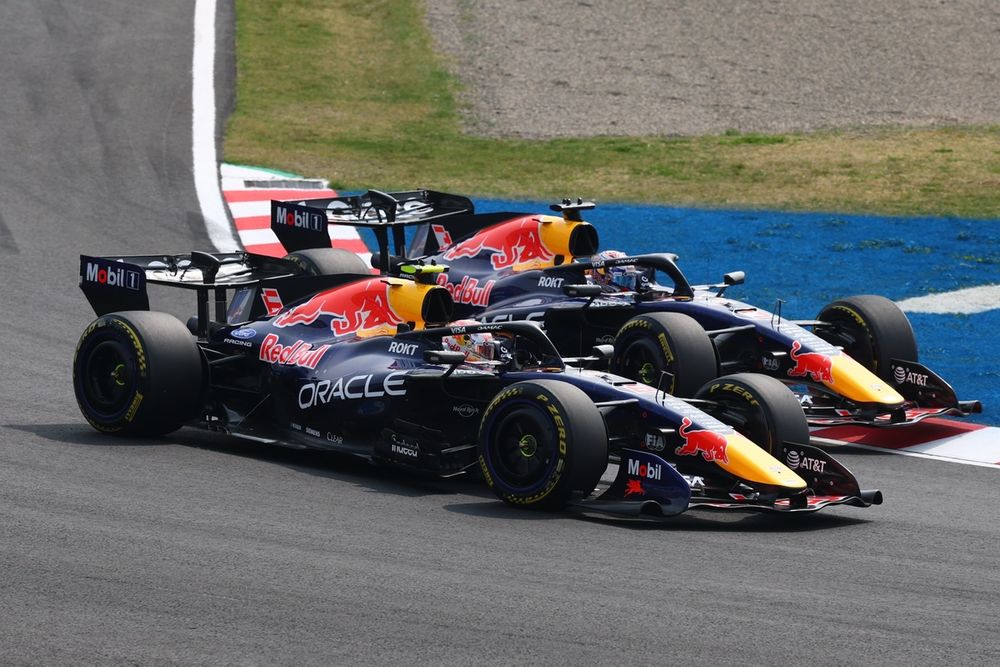
Hadjar has delivered so far for Red Bull, taking the third grid spot in Australia and here outqualifying Verstappen at Suzuka
Photo by: Clive Mason/Getty Images


Alonso is right to sound the alarm about F1 - but history seems to be repeating itself

F1 drivers push for Madring changes after "very poor" Spanish GP: "I almost fell asleep"

The impact Madrid's "six kilometres long" pitlane will have on Spanish GP strategy

F1 drivers criticise Madrid circuit, Verstappen laughs: "I'll sort it out"

What's behind Alonso's cryptic comments about his F1 future?

The deeper meaning of Vettel’s emotional Schumacher demo run at Monza

Verstappen's "Red Bull car made out of paper" comment explained

"Gentle with the throttle pedal" – Verstappen mentally prepared for painful Monza weekend

What's behind the talks between the FIA president and Alonso over ADUO?

Evans favourite to become WRC champion as Rally Saudi Arabia is cancelled

Alonso is right to sound the alarm about F1 - but history seems to be repeating itself

Ogura set to make MotoGP return in Austria
Subscribe and access Autosport.com with your ad-blocker.
From Formula 1 to MotoGP we report straight from the paddock because we love our sport, just like you. In order to keep delivering our expert journalism, our website uses advertising. Still, we want to give you the opportunity to enjoy an ad-free and tracker-free website and to continue using your adblocker.


Top Comments