


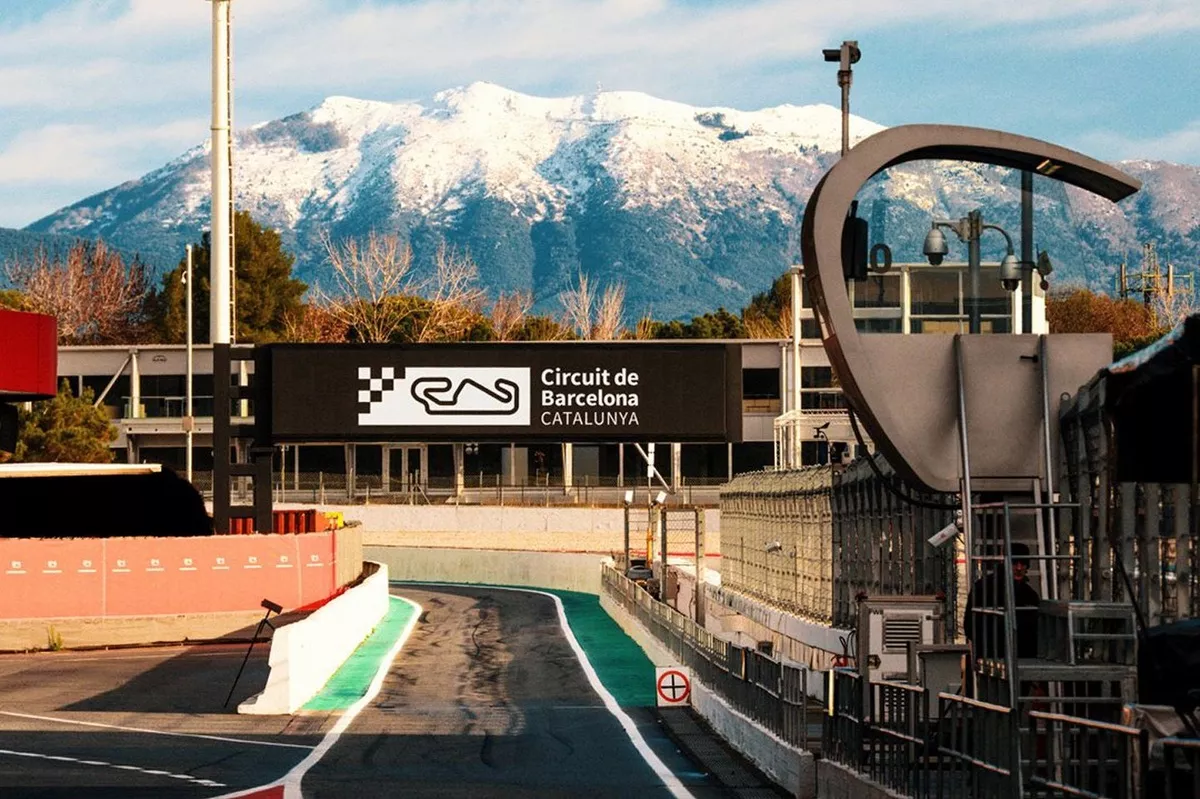


Does less testing really benefit the F1 spectacle?
OPINION: Formula 1's provision of just three days for teams to test their new cars in anger before the first race means there's precious little time to iron out problems and establish whether any issues are merely glitches or something more serious. Going back to more is not only unnecessary, but undesirable

In days of yore, testing a Formula 1 car was almost completely open. As long as a team was willing to throw some money at a circuit to handle all of the stewarding admin, it could pretty much take their car anywhere and log endless miles on the odometer in between breaks for engine failures and other fixtures falling off. As F1 became more professional, rules were implemented to ensure only FIA-certified circuits could be used to guarantee safety, but in-season testing was still nonetheless commonplace.
PLUS: From Senna's brilliance to tragedy - Tim Wright’s F1 testing tales
Then, further restrictions on mileage arrived: in 2008, a driver could not complete more than 30000km in a season, and this was then halved for 2009. This was partly in keeping with the ban on in-season test sessions, although the FIA had kept one-day straightline aerodynamic testing sessions open.
Teams took a piecemeal approach to pre-season testing in 2009, employing the in-season testing still permitted in 2008 to trial new aerodynamic concepts in their build-up to the new regulations, before embarking on their own winter test programmes - sometimes sharing with other teams before all 10 outfits convened for a three-day Barcelona collective test.
That collectivist sentiment became more widespread thereafter, as the FIA set dates for four three-day sessions across February in 2010: the first at Valencia's Ricardo Tormo circuit, Jerez hosting the second and third tests, and Barcelona capping off the test season with the fourth. The number of allotted test sessions began to dwindle thereafter; although F1 occasionally organised in-season tests, usually with a tyre-testing motive, it had settled on a formula of two four-day Barcelona tests, shrinking to three days apiece in 2020.
Over 2023 and 2024, the testing schedule has compressed even further; just three days are permitted in Bahrain before the season gets going. Teams may still employ their 200km "promotional event" mileage, but this only amounts to about two-thirds of a grand prix distance and is conducted on control tyres.
A lengthy hiatus in running, through a mechanical issue or a driver proving too over-eager on the throttle, can have major consequences on a test programme. Take McLaren last year, for example: issues with its brake components eroded its time on track, and almost certainly impacted the opening Bahrain race.

Testing was disrupted for McLaren in 2023, which didn't help its cause at the opening round
Photo by: Steven Tee / Motorsport Images
Although the idea of testing at its core is to push the car's components to the edge of their tolerance, F1 teams also have to stuff data-gathering and performance exploration into the three days. In a less limited schedule, the 'test-to-failure' aspect is probably more alluring as the time spent rebuilding the car is far less critical. Now, it can sometimes take a few races before a team truly understands if it has a reliability issue or has just suffered with freak occurrences.
Even with a six-day test schedule in 2022 (a three-day 'shakedown session' and a three-day test), it was not readily apparent that Red Bull was going to be hampered in the opening races by a fuel pump issue. Nor was it particularly evident that reigning champion Max Verstappen was going to leave Australia with a 46-point deficit to Charles Leclerc in the drivers' championship.
By shrinking down to the bare-bones three-day schedule in 2023 and 2024, the excitement factor of a new season is somewhat compressed and commodified. It used to be that the untelevised tests would command people huddling around Autosport Live for updates and lap times, which 2022's "shakedown" re-introduced as F1 chose not to broadcast it. Before that, the veiled world of private tests had their own mystique. Sure, it's only testing, but if there's people mad enough to scrabble around for a dodgy stream of Fernando Alonso's 2017 Indy 500 rookie test (this writer included), then F1's pre-season running is surely as intriguing.
In contrast to today's throwaway culture of disposable vapes and fast fashion, F1 cars are built to last
Compared to Red Bull's irrepressible dominance over 2023, the reliability factor owing to a relative lack of testing added a frisson of excitement to the early proceedings - at least, before the title race developed into one-way traffic. However, that can go two ways: had Leclerc and Ferrari been saddled with those early reliability woes in 2022, the title would have been sewn up far earlier.
PLUS: What teams lose and gain from F1’s testing restrictions
Plus, with the number of simulation tools available to engineers, it's difficult to be unreliable in modern F1. Endless days of testing in Barcelona in the late '90s might have given teams tremendous freedom to explore the car, but every single part was very much disposable and not subject to any rules governing its longevity. The growth of those rules sprouting from 2004's regulation stating that an engine must last a full race weekend, to the modern day allowance of four power unit components per year on a car, has pushed reliability testing to the forefront of F1. In contrast to today's throwaway culture of disposable vapes and fast fashion, F1 cars are built to last.
The effect of simulation tools extend into performance running. In the dull days of chugging around a circuit endlessly on a Monday morning as part of a specialised test team, engineers could not iterate their set-ups in the simulator, nor could they enjoy today's processing power for CFD simulations. Everything was far more primitive, and no substitute for lap-upon-lap of wing-angle sweeps or engine mapping runs. Teams don't need that level of testing any more, because their systems are built to overcome a lack of outright running.
If more testing was available, reliability issues could be winkled out more readily and the teams with the best infrastructure could explore more eventualities. Would the Red Bull slip in Singapore have happened if it could spend more time dialling out the inherent issues its RB19 suffered in low-speed conditions? Probably not, and then you'd be looking at a clean sweep.

Singapore was the only off-weekend for Red Bull in 2023, but more testing might have ensured its usual high standard was maintained
Photo by: Andy Hone / Motorsport Images
It's true that an expansion of the testing calendar could offer other teams opportunities to close the gap; for example, Ferrari might have happened upon a way to match Red Bull in terms of tyre management, or perhaps Mercedes might have enjoyed the greater latitude to spark its zeropod solution into life. But it feels unlikely, particularly as none of those eventualities really came to bear over the course of a full season anyway.
Conversely, McLaren was able to make great strides with its aero package and moved through the order swiftly despite needing nothing beyond the race weekend sessions to validate its progress on-track. The correlation between aero testing facilities and the real world was enough to give the Woking engineers a high hit rate with the MCL60's upgrades.
F1's spectacle is best served when unpredictability reigns. More testing might make the other teams more competitive, but in reality it only serves to strengthen the strongest, particularly with today's razor-thin margins on the timing board. Finding that final thousandth of a second has become an all-consuming pursuit, and giving the teams the opportunity to reduce the variance of a race weekend is not in F1's best interests.
To breach Betteridge's Law of Headlines and give a coherent answer to the question: reducing testing does help the spectacle, and cutting it back even further would probably weave further unpredictability into the season's narrative. At least, for the first few races.
That raises another question: why have testing at all? It's money for old rope: Aramco has sponsored this year's edition, while F1 simply needs to plant cameras around the circuit (which, in preparation for next weekend's grand prix, it was already doing) and let the teams do all the hard yards. Three days won't ever be enough for the teams but, with a 24-race calendar beckoning, it'll do just fine.

Reduced testing helps increase the anticipation of the opening rounds - so should it be limited further still?
Photo by: Steve Etherington / Motorsport Images


Horner's inside story of how Red Bull built its own F1 engine

Why Mercedes' latest 2026 F1 update is no downgrade

Singapore Grand Prix Driver Ratings 2026

What we learned from the 2026 F1 Singapore GP sprint race and qualifying

The political minefield set out by F1’s recent cost-cap grievances
What caused Mercedes' pace deficit at Sepang despite upgraded W17?

Three kings: F1's generational stars shone at Sepang

Bahrain Grand Prix in Malaysia Driver Ratings 2026

Camara over Ocon - did Haas make the correct call for F1 2027?

Camara to make F1 debut as Ocon's replacement at Haas in 2027

Mekies under the microscope: How different is his leadership at Red Bull from Horner?

Rwanda turns to F1 as it moves forward from a chequered past
Subscribe and access Autosport.com with your ad-blocker.
From Formula 1 to MotoGP we report straight from the paddock because we love our sport, just like you. In order to keep delivering our expert journalism, our website uses advertising. Still, we want to give you the opportunity to enjoy an ad-free and tracker-free website and to continue using your adblocker.


Top Comments