


British GP: Williams reveals new F1 bargeboard package at Silverstone
Williams has arrived at Silverstone with a new bargeboard package for the British Grand Prix, as it seeks to reinvigorate a difficult Formula 1 season at its home race

The team has struggled to define its development path throughout the season so far, and new parts have come as something of a premium throughout 2019.
For the British GP, the team has redefined the turning vane package around the sidepod inlet, with a new upper element (yellow arrow), as shown in Giorgio Piola's photo.
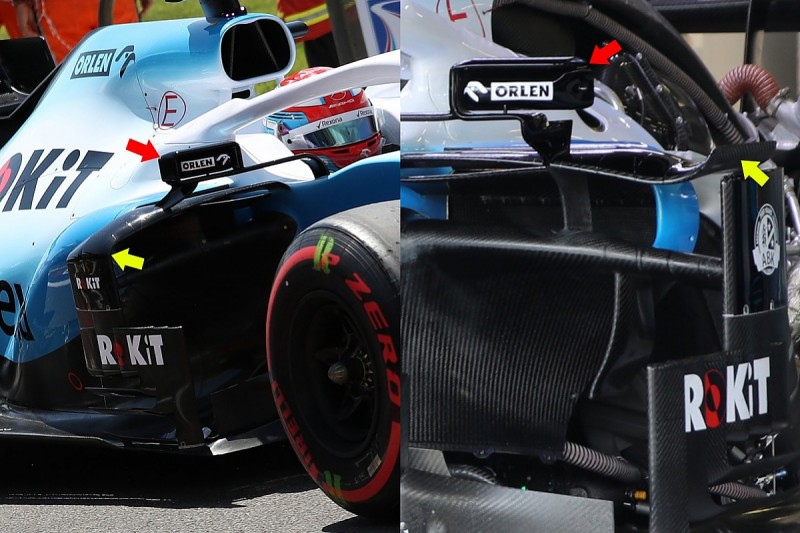
Previously, the element was of a consistent curvature, and bridged the transition to the vertical turning vane - but now, these two parts have been split.
The leading edge now sweeps downward, before curving back up towards the outboard edge, but further down the chord length it sweeps upwards more dramatically.
This suggests a more concerted effort to take airflow from lower down, closer to the inlet aperture, and working it harder to bring it over the top of the sidepod.
Meanwhile, the curved ends will generate some degree of tip vortex, but the upward curling of the outboard section can determine the placement of this vortex.
In a normal, horizontal wing element, the tip vortex is created as a result of the high pressure air on top and the low pressure air underneath coalescing, creating a larger and more unruly flow structure.
By creating that curl, the difference in pressure zones are not nearly as large, and so any vortex generated is a lot tighter-knit.
This can then wash over the sidepod and move towards the rear, where the properties of that flow structure are useful.
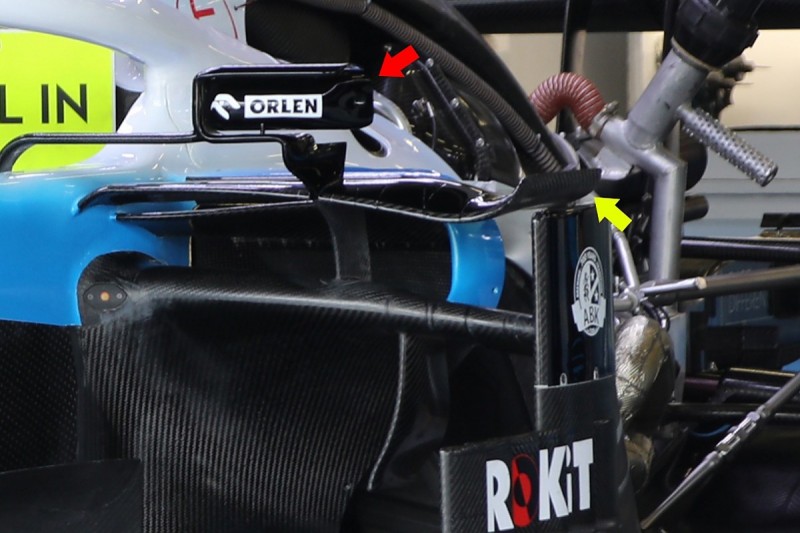
This ties in with a new mirror assembly (red arrow), which features a new aerodynamic shroud around it - not dissimilar to the shroud around the mirror design it used in pre-season testing.
Concerns over this mirror - which was curved in shape and was problematic for the drivers' rear-view vision - led to a hasty redesign for the season opener in Australia.
This has now been redeveloped, sending laminar airflow downwards to trim the low pressure region developed by the mirrors, which minimises the overall drag.
Renault, Mercedes and Red Bull use similar mirror designs to reduce their impact on the overall aerodynamics package.
Share Or Save This Story


Leclerc and Hamilton's differing theories behind Ferrari's Austin qualifying disappointment

What we learned from Friday practice at the 2026 United States GP

The reasons behind Ferrari's US GP upgrades


Sainz yet to be "convinced" that F1 2026 will finish in the Middle East

The unpredictability to expect for F1's one-off return to Sepang in 2026

How Alonso scored ninth at Zandvoort - and how Albon lost a similar payday

Pryce pips McRae in final stage showdown to win British Rally Championship

Dakar Rally moves 2027 event out of Saudi Arabia; new location to be announced

How both Verstappen and Antonelli were “surprised” in United States GP qualifying

Inside COTA's Turn 1 clubhouse and its plans to build a second track
Subscribe and access Autosport.com with your ad-blocker.
From Formula 1 to MotoGP we report straight from the paddock because we love our sport, just like you. In order to keep delivering our expert journalism, our website uses advertising. Still, we want to give you the opportunity to enjoy an ad-free and tracker-free website and to continue using your adblocker.


Top Comments