


Are we at peak F1 right now?
For many, many years Formula 1 has strived to do and to be better on all fronts. With close competition, a growing fanbase, a stable political landscape and rules in place to encourage sustainability, 2021 is on course to provide an unexpected peak

Formula 1 cannot escape the truth that the present day often struggles to match the glories of the past; nor is capable of living up to the levels of hype that surround future events.
All too often, past F1 memories get sugar coated to promote a ‘better back then’ feeling, while the imagination can run out of control when it comes to thinking up the possibilities of good things that are yet to happen.
But, despite the challenges that the present day has in matching up to what’s happened before, and what will happen next, there is a growing feeling that F1 could be in a peak state right now.
Fans are still buzzing about a stunning F1 season opener in Bahrain, where the tiniest of margins ultimately decided the outcome of the titanic battle between Lewis Hamilton and Max Verstappen.
If you kept rerunning that race, you would probably have a different winner each time. And the smallest of factors, such as the differential problem that hindered Verstappen, or the track limits advantage that Hamilton seized, were enough to swing it.
But, whichever way the Bahrain GP result went, there is no denying that it has teed up the prospect for a fantastic duel in the world championship this year between Red Bull and Mercedes. Right now, the world champion team is the hunter, but certainly cannot be written off – as its win in Bahrain showed.

Max Verstappen, Red Bull Racing and race winner Lewis Hamilton, Mercedes celebrate in parc ferme
Photo by: Steven Tee / Motorsport Images
PLUS: How crucial marginal calls will decide the Red Bull vs Mercedes battle in F1 2021
What the brilliant Bahrain race has done is put F1 in a great place in terms of viewers. Sure, COVID-19 restrictions mean the fans aren’t yet able to watch things trackside, but they certainly are tuning in back at home.
After years where F1 has had to swallow a fall in television audiences in exchange for the big bucks that only pay TV can offer, there was some incredibly encouraging signs coming out of Bahrain about a boom in popularity.
Both Sky Sports in the UK and Canal+ in France delivered their own record figures for an F1 race – while F1’s own F1 TV platform enjoyed its best weekend yet.
The benefits to F1 of Netflix do not appear to be limited to just drawing in fans. It was fascinating hearing about how the show’s influence, especially in America, had triggered something with sponsors too
In the USA, the ESPN average audience of 879,000 (the peak was closer to 1 million) was larger than any race broadcast last year – and in fact was the most-viewed live F1 race on ESPN2 since records began in 1995.
In total, 16 of the 24 markets that F1 tracks in detail showed growth compared to the 2020 Bahrain GP. Overall, 22 markets showed a combined growth of 38% over Bahrain 2020 and 33% over Bahrain 2019.
The gripping battle for the lead helped, as there almost certainly is a trigger point of people tuning in when they see on social media how exciting it is, but there appear to be other factors helping F1 right now.

Lewis Hamilton, Mercedes W12 Max Verstappen, Red Bull Racing RB16B
Photo by: Charles Coates / Motorsport Images
The impact of Netflix’s Drive to Survive series cannot be underestimated. When Series 3 dropped last month, it instantly shot to the top of the Netflix charts – delivering a profile and new audience that will have flowed through to new fans tuning in for the F1 season opener.
PLUS: How Netflix built on a successful formula in Drive to Survive Season 3
Research from Nielsen last year already pointed to Series 2 having boosted interest in F1 among 16-35 year-olds from one in four, to one in three during this period. Furthermore, the growth in this age of audience throughout 2020 was almost three million per month.
For UK audiences, seeing F1 appear this year as a featured programme on Channel 4’s Gogglebox, as the families experienced Romain Grosjean’s fiery escape, was another boom for the series in pulling in those who may not regularly tune in.
But the benefits to F1 of Netflix do not appear to be limited to just drawing in fans. It was fascinating hearing the other week about how the show’s influence, especially in America, had triggered something with sponsors too.
It is certainly not a coincidence that American IT giants Cognizant (Aston Martin) and Oracle (Red Bull) have both jumped in to F1 in a big way in the same season.
Oracle’s chief marketing officer Ariel Kelman reckoned there was a direct link between F1 on Netflix and what was happening with sponsors.
“I've personally seen a massive increase in excitement around Formula 1 in the United States, so it's natural that US technology companies are looking to get involved in a much deeper way,” he said.

Sergio Perez, Red Bull Racing RB16B, passes Lando Norris, McLaren MCL35M
Photo by: Mark Sutton / Motorsport Images
“Being good with data and analytics and machine learning is really a core competency of every Formula 1 team now. So you get this combination of this being a great platform for promoting very sophisticated technology use cases, to what's already been a massive fanbase around the world that's now becoming a very fast-growing sport in United States for a number of reasons, not the least of which is the Netflix phenomenon.
“So I think you're going to see more technology companies start to look at this as a real big part of their strategy.”
F1 itself, with its high-tech hybrid cars and the way it has positioned the championship well for a sustainable future, is in the right place to draw in more and more sponsors that can be sure it ticks the right boxes for them.
"I think Formula 1 is in a very good place for good entertainment on track, and political fighting off the track, which has always been part of the narrative in F1. It has a product that works, great teams, and great brands that are in Formula 1" Toto Wolff
On the political front, F1 is in robust shape too. The divide-and-conquer attitude that helped Bernie Ecclestone rule the roost over the grand prix paddock for decades has long gone – and the championship now has the stability it hasn’t enjoyed for years.
The Concorde Agreement has paved the way for a fairer cash structure and a more balanced governance system, whereby the smaller teams don’t feel isolated by the ill-fated old dinosaur that was the Strategy Group, which split the teams firmly into the haves and the have nots.
The presence of a cost cap this year is also ultimately a great thing for the F1 grid, even if bigger spending teams like Mercedes and Red Bull have had to go through the short-term pain of redundancies last winter, and a fine balancing act to not go over the limit this year.
PLUS: The pros and cons of F1's 2021 rule changes
Ultimately, the cost cap delivers long-term stability for all teams. Knowing what the maximum expenditure is makes it much easier to plan for the future, and get commitment from backers who know that they aren’t signing up to throw cash into a bottomless money pit over the next few years.
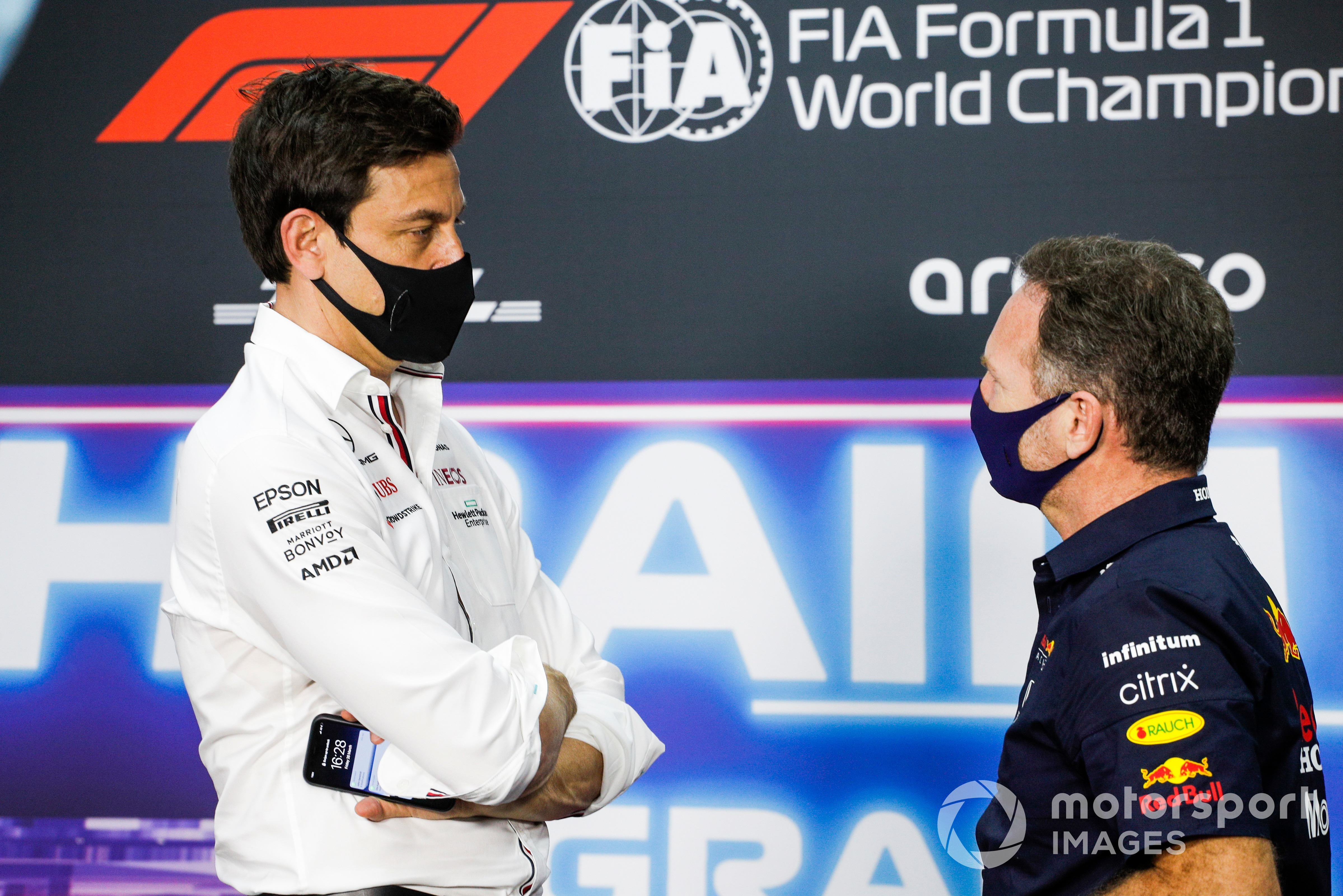
Toto Wolff, Executive Director (Business), Mercedes AMG, and Christian Horner, Team Principal, Red Bull Racing
Photo by: Motorsport Images
For a manufacturer, suddenly F1 can go from being a big cost centre on the marketing budget to an area of profit. When Mercedes added remote software company TeamViewer as its third biggest partner last week, it is understood it took its entire sponsorship portfolio to around 250 million Euros.
Yet, despite the positives, F1 is not - and can never be - perfect. There are things that can certainly be better – such as cars that are able to race each other more closely – but those issues are being addressed for 2022. Right now, things appear to be as good as they have ever been.
But the peaks in life never last long; and a run of boring 1-2s for Mercedes or Red Bull in the next few races could be enough to drag optimism levels down a peg or two. And there is a clear risk that the 2022 rules revolution will not deliver the hype and grid shake-up that it’s billed to bring.
PLUS: Is F1 set for rule revolution regret again?
For now, though, as we await the excitement of Imola, there are few huge complaints.
In fact, Mercedes boss Toto Wolff reckoned that he had never known F1 to be in as positive a shape as it was right now when we spoke earlier this week.
“I think Formula 1 is in a very good place for good entertainment on track, and political fighting off the track, which has always been part of the narrative in F1,” he said. “It has a product that works, great teams, and great brands that are in Formula 1. Plus Netflix added its part on helping us to grow our audiences outside of the traditional fans.
“So, overall, the sport is in a very good place and growing. And, from my time in the last 10 years, it's probably the best it's been.”

Lewis Hamilton, Mercedes, 1st position, pours Champagne over his team-mate on the podium
Photo by: Charles Coates / Motorsport Images


Brundle awarded OBE in King’s New Year’s honours

The new rules dilemma that will define the 2025 F1 season

Verstappen issues Red Bull title warning in push for RB21 progress

Mercedes opens up on the factors that hurt Hamilton with the W15

How McLaren faced up to the misinformation, noise and distractions of being an F1 title challenger

Why Bottas is not letting the “worst-case scenario” end his F1 career

Jon Noble: An unfair perception or a genuine concern? Lifting the lid on Red Bull’s Tsunoda scepticism

Binotto on Audi's F1 reality check after finding team "frozen" with no plans

WEC Barcelona: Genesis secures maiden series pole from Toyota
What drives Bortoleto as his junior rivals hit new heights in F1

How the M8B became the most dominant car in McLaren’s history

What Verstappen knew about Red Bull’s big upgrade when he signed his new F1 deal
Subscribe and access Autosport.com with your ad-blocker.
From Formula 1 to MotoGP we report straight from the paddock because we love our sport, just like you. In order to keep delivering our expert journalism, our website uses advertising. Still, we want to give you the opportunity to enjoy an ad-free and tracker-free website and to continue using your adblocker.


Top Comments