


How Red Bull followed McLaren's Formula 1 design lead
Max Verstappen becoming the first Formula 1 driver to take Hockenheim's first corner flat-out underlined the strength of Red Bull's chassis last weekend, and the team has continued aggressive development

At the German Grand Prix, Red Bull followed a design path that was begun by McLaren and then followed by Renault and Ferrari, as it changed the concept of its floor slots.
Rather than utilising a series of angled slots ahead of the rear tyre (inset) the team added two longitudinal slots placed on the floor's edge (highlighted in yellow) to complement the four now fully enclosed holes ahead of the tyre.
The idea is that the airflow passing through these long slots energises the vortex that is being formed on the floor's edge, helping to seal it and create a sort of air skirt, improving the overall performance of floor and diffuser.
Renault's new wing
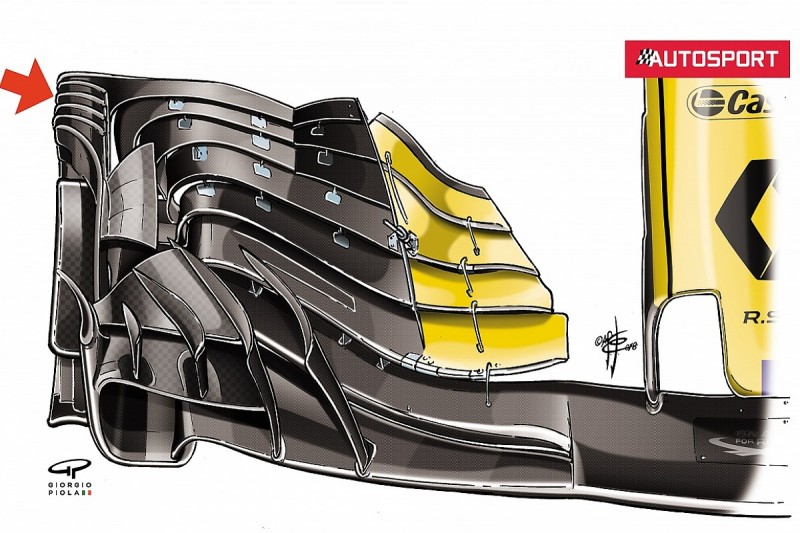
Renault has been trialling several variants of its front wing in recent races, as it tries to resolve an issue on turn-in for mid-high speed corners.
Taking the data captured during these tests and heading back to the drawing board resulted in a new front wing concept being utilised at the German GP.
The new wing retains some of its predecessor's DNA, but also has an injection of fresh ideas.
The main alterations are clear. First of all, the trailing edge of the endplate has been divided up into four acutely angled surfaces to promote outwash around the front tyre (red arrow).
The flapped region has also been altered in a way not seen before. This highlights how much of the wing is currently designated to downforce generation and controllable by flap angle adjustment, and just how much of the wing is about the tyre blockage behind and controlling the wake that is generated.
Ordinarily the outboard section of the wing is considered the static design element, controlling the direction of the airflow as it moves across the tyre's face. Then comes the wing adjuster, controlling the upper flap stack's angle of attack and, with it, the level of downforce generated. That is why we often see a change in their number or chord length, depending on the track characteristics.
This new design from Renault moves the adjuster much further outboard, changing the proportional effort of the flaps, resulting in only the outer part of the flap (painted yellow) being affected by an angle change.
Share Or Save This Story

The downforce choices that proved key at the Saudi GP

Revealed: Ferrari’s radical 2022 F1 nose idea

Piola: How new parts will influence 2020 designs


What Max Verstappen will change after Red Bull’s poor F1 starts in Malaysia and Singapore

A "better job" or more engine power? Verstappen's Singapore pole unpicked

How the Bahrain GP in Malaysia exposed Red Bull’s hidden resurgence

Why McLaren considers Norris-Piastri Singapore clash so “serious”
What Max Verstappen will change after Red Bull’s poor F1 starts in Malaysia and Singapore

A "better job" or more engine power? Verstappen's Singapore pole unpicked

What we learned from the 2026 F1 Singapore GP sprint race and qualifying
Subscribe and access Autosport.com with your ad-blocker.
From Formula 1 to MotoGP we report straight from the paddock because we love our sport, just like you. In order to keep delivering our expert journalism, our website uses advertising. Still, we want to give you the opportunity to enjoy an ad-free and tracker-free website and to continue using your adblocker.


Top Comments