
How iconic cars from each WRC era compare at the hands of Petter Solberg
As the World Rally Championship turns 50, Autosport teamed up with Petter Solberg for a very special group test at the Goodwood Festival of Speed. The 2003 world rally champion gets behind the wheel of an iconic car from across its five definitive eras to compare and map out the progress through the generations

This year the World Rally Championship chalks up its half century and in that time it has produced a plethora of iconic cars. From the Group 4 Alpine A110 that claimed the inaugural title in 1973 to the fire-breathing Group B monsters, the cult hero Group A classics, the manufacturer heavy World Rally Car era and today’s Rally1 hybrid-powered beasts.
While the technology has advanced rapidly over the past 50 years, the cars continue to have this unique ability to instantly rekindle evocative memories, just as much as the drivers that drove them. Whether it’s Hannu Mikkola and Michele Mouton taming the wild Audi Quattro or Colin McRae and Richard Burns sparking rally mania in the UK, guiding the famous blue-and-yellow Subarus to world titles in 1995 and 2001 respectively.
To celebrate 50 years of the WRC, Autosport pitched 2003 world champion Peter Solberg the ultimate track test of driving a car from each of the WRC’s definite five regulation eras to understand how the cars have progressed. Lined up for this special drive through the 2.5km Goodwood Festival of Speed’s Forest Rally gravel stage, were an Alpine A110 Berlinette (1971), an MG Metro 6R4 (1986), a Subaru Legacy RS (1992), a Subaru Impreza (1996), a Skoda Octavia WRC (2002), and the current WRC benchmark, the Toyota GR Yaris Rally1.
Still as passionate about rallying since his fresh-faced WRC debut, 48-year-old Solberg is more than qualified to tackle this unique drive through WRC history. Known as ‘Hollywood’ during his WRC career spanning 1998-2019, Solberg won legions of fans thanks to his flamboyant driving style and heart-on-the-sleeve character. The Norwegian claimed 13 WRC victories and 459 stage wins, but the ultimate success arrived when he and co-driver Phil Mills won an emotional Rally GB decider to pip Sebastien Loeb to the 2003 title by a point.
“I had a blast the whole day to be honest with you,” says Solberg. “To be driving all the different types of cars is emotional. I think many of us are impressed with the history of the championship. It is a very tough and hard sport in extreme conditions. The cars are built to drive in the Safari Rally to Monte Carlo, it is such a wide spectrum compared to other motorsport.”
First up for Solberg to tackle is an example of the car that won the first WRC manufacturers’ title in the championship’s inaugural season, the beautiful Alpine A110 Berlinette. But first a quick history lesson.
Rallying can trace its roots back to the first Monte Carlo Rally in 1911, an event designed for automobile manufacturers to demonstrate the resilience of their machines. This event quickly gathered momentum and, following two World Wars, it ultimately proved a catalyst in the formulation of the European Rally Championship in 1953. As demand from countries to host events increased, a move to create a world championship grew. In 1970 the Commission Sportive Internationale (CSI) of the FIA formed an eight-round International Rally Manufacturer Championship, which was then converted to the FIA World Rally Championship for manufacturers in 1973. And so the WRC was born, although it wouldn’t be until 1979 before the FIA organised an official drivers’ world championship.

The FIA determined its Group 4 sportscars regulations would be the base for the WRC, a ruleset that would last until 1982. The honour of being crowned the first world rally champion belonged to Alpine thanks to its rear-wheel-drive A110 1800. Powered by a 1.8-litre Renault engine mounted at the rear, producing approximately 175bhp, it weighed in at only 685kg. In 1973 the car driven by Jean-Claude Andruet, Jean-Luc Therier, Bernard Darniche and Jean-Pierre Nicolas won six of the 13-round championship to romp to the title ahead of Fiat. Aside from winning the first world title, the car’s other claim to fame is this is the machine in which Mouton would begin her WRC career driving.
Our Alpine A110 example, provided by owner Steve Ward, was driven in period by Nicolas, with future FIA president Jean Todt as co-driver. It took them to victory at Rally Portugal in 1971. Resplendent in the iconic blue Alpine livery, the car was rebuilt in 2005 by Nigel Hollier to a revised specification that was approved by then Alpine sports director Jacques Cheinisse for the rigours of the 1973 RAC Rally.
Other than its blue colour and having four wheels, it’s a world apart from the Subaru Impreza Solberg guided to glory. But what does it feel like to drive the car that is the genesis of the WRC? “Unbelievable, this is hard work!” says Solberg as he clambers out.
"I’m thankful to be able to drive it, and when you think people like Michele Mouton started in a car like this you can understand a bit about what was going on in that time. It is a completely different world" Petter Solberg
“I felt this was quite nice to drive,” Solberg later explains to Autosport after a brisk but careful run. “The front end was really nice and precise but it was missing some rear grip for my liking, but I really was surprised by the steering and the brakes that were also quite nice. The engine was quite linear and I understand the drivers at the time were after the same things as us to control traction and not have any upsets.
“I think the front end was the biggest key at that time and also the engine in the back for traction, and it was a very light car. This is actually a perfect car. I think the dampers are the biggest step of variation from the cars of that time to now. But there are a lot of basic things that are very good on this car. I’m thankful to be able to drive it, and when you think people like Michele Mouton started in a car like this you can understand a bit about what was going on in that time. It is a completely different world.”
That 1973 season was Alpine’s highlight because the A110 was quickly overtaken by the all-conquering Lancia Stratos and Fiat 131 Abarth that followed, as the WRC gathered momentum and struck a chord with manufacturers during the 1970s.

The first ever world rally champion - the Alpine A110 1800
Photo by: JEP / Motorsport Images
Impressed by how the Alpine has aged since its WRC debut, next up for Solberg to tame is an altogether different beast: the MG Metro 6R4. This pocket rocket is an example of the cars spawned under the infamous Group B regulations that followed Group 4. The WRC ushered in its most bonkers and dangerous era in 1982, which produced arguably its most powerful and sophisticated cars, as marques unlocked the potential of four-wheel drive and the art of aerodynamics. It was a period where speeds escalated along with the popularity of the championship. Crowds flocked to the stages to witness the brute power of these 500bhp turbocharged monsters on the world’s toughest roads.
It was a time that became dominated by four-wheel drive cars after Audi pioneered the concept with its Quattro that debuted in 1981, the final year of Group 4. The German car maker was joined in the arena by Lancia (037, Delta S4), Opel (Ascona 400, Manta 400), Peugeot (205 T16), Renault (5 Turbo) and Ford (RS200). Each year the cars became faster and it was only a matter of time before disaster struck. Calls to ban the ruleset had started following a series of incidents before the tragic death of Finnish star Henri Toivonen and co-driver Sergio Cresto. The factory Lancia pairing crashed their Delta S4 while competing in Corsica in 1986. That and an accident on Rally Portugal that claimed the lives of several spectators prompted the FIA to take action, banning the regulations at the end of 1986.
One of the last cars to enter the mad world of Group B was the Metro 6R4, which made its debut towards the end of 1985. The initial concept for the rally car can be traced back to 1980 when British Leyland Motorsport withdrew its Triumph TR7 from international rallying in favour of creating a new flagship rally car, and sought help from the Williams Formula 1 team to develop the car.
One of the key areas identified to steal a march on its rivals was a decision to plump for a naturally aspirated Rover V6 for the mid-engined concept, short wheelbase pint-sized rally car. It was hoped this would have an advantage over the turbocharged Group B monsters, as the Metro 6R4 wouldn’t suffer from power lag, heat and engineering problems associated with its turbocharged counterparts.
Unfortunately, the Metro 6R4 didn’t make its WRC debut until the 1985 RAC Rally and by then its Group B rivals had overcome their initial teething issues with turbocharged engines. It was at that rally the Metro 6R4 scored a commendable third, in the hands of factory Austin Rover pairing Tony Pond and Rob Arthur, while team-mates Malcolm Wilson and Nigel Harris retired with an engine problem. Ultimately that podium behind the Lancia Delta S4s of Toivonen and Markku Alen would prove to be the Metro 6R4’s best WRC result, as reliability issues plagued its short lifespan.
Fast-forward to 2023 and a grinning Solberg has been handed the keys to a factory Metro 6R4, dressed in the blue-and-white Computervision colours, that Pond drove in Portugal in 1986. The very car, now owned by competitor Stuart Larbey, featured on the front cover of Autosport in the 13 March 1986 issue.

Solberg gets to know the "perfect size" pocket rocket
Photo by: Gary Hawkins
Famed for its unique look and sound, the 450bhp Metro 6R4 doesn’t disappoint Solberg. “It’s nice to drive. That’s very good. What an engine!” is Solberg’s instant reaction.
“My feeling in terms of the step in difference from the Alpine is huge,” says Solberg, buzzing after his first taste of the Group B icon. “First of all, the engine in the Alpine was very linear. This has much more power and it is a very good engine. It has a good top end and the gearbox is fantastic. This is the type of gearbox I am used to in rallycross from 1992. It was very easy to suck itself into gear. The chassis was very nimble and nice to drive and I also had the best co-driver [Larbey].
“You can’t really compare it with the Alpine. It is just power steering – this is the only thing I must say [it needs]. It would have been so much faster if it had power steering. I must say this is the prefect size for a rally car. If you had the same engine as others in Group B it would be difficult for the opposition.”
When asked if those who drove it in period were brave, Solberg replies: “I must say they were the lucky ones to be honest, because this is a very good car. It was very nice and fun to drive.”
"There is no question it was the first real era of aero and you could really tell the difference in places like Finland with the wings and wing positions. On the aero side I think the Metro was ahead but we fell behind because of forced-induction engines" Malcolm Wilson
Solberg’s former boss at the Ford WRC team, Malcolm Wilson, was a factory Metro 6R4 driver and agrees with Solberg’s assessment, but explains that sadly the car was doomed to trail behind the 500bhp brutes from Audi, Lancia and Peugeot. “In fairness it was a nice car to drive,” Wilson tells Autosport. “If all the engines had been the same and there were no turbos it would have been fine. It was a fantastic sounding engine and had good engine braking.”
“I think the sad thing was we were very quickly overtaken by the Lancia, the Peugeot and of course the Audi with the turbocharged engines. For Rally GB with the tricky conditions it was fine, but sadly we just fell so far behind in the horsepower stakes so quickly and that was one of the main issues along with the reliability. Those were the two key things.
“There is no question it was the first real era of aero and you could really tell the difference in places like Finland with the wings and wing positions. On the aero side I think the Metro was ahead but we fell behind because of forced-induction engines.”

While the MG Metro 6R4 lacked punch to its rivals, it was still a hallmark of the Group B era
Photo by: JEP / Motorsport Images
As the Metro 6R4 found a new home post Group B in rallycross, the WRC introduced Group A regulations in 1987. The rules reined in the out of control speeds, cutting them by half with these four-wheel drive turbocharged cars producing around 270 horsepower. They were much closer to their factory showroom counterparts, which helped endear the championship to its growing fanbase. However, three years into the ruleset the cars were breaking Group B stage times thanks to their better traction and handling.
The sudden change in rules did ultimately see the decline of Audi competitiveness with the Quattro before it departed the scene, as had Peugeot. But Lancia and Ford remained, the former emerging as the dominant force. Group A also attracted a trio of Japanese marques in Toyota, Mitsubishi and Subaru that would leave a mark on the category. The latter would become synonymous with rallying, reaching cult status as the WRC entered the new millennium.
Subaru is the car maker most associated with Solberg so it was only fair for him to be reunited with the brand for the next part of our test. Awaiting the Norwegian was a true WRC icon, the Subaru Impreza that helped make the WRC appointment television viewing in the UK thanks to Colin McRae’s swashbuckling edge of the seat performances. The Scot piloted the famous navy blue and yellow Impreza to the 1995 world title as he became Britain’s first world rally champion and a household name. The Impreza Solberg climbed into was an ex-Piero Liatti car from 1996, which helped Subaru defend its manufacturers’ title.
“I think they were fantastic cars,” says Solberg when asked about the Group A era. “When myself, Pernilla [Petter’s wife] and Oliver [Petter’s son] watch rally videos it is from that era because the car is moving all the time. You can see they are easy to drive because the drivers are playing with the car all the time. You need to do Scandinavian flicks to get round corners. It was fantastic era.”
Unfortunately, Solberg was unable to ‘play’ with the car as two corners into the run an electrical fault struck, prompting a tow back to our makeshift service. But all is not lost as BGM Sport graciously offered Solberg the chance to pilot an ex-Colin McRae Subaru Legacy RS to complete this drive through WRC history.
The Legacy was Subaru’s first foray into Group A, making its debut in 1990 driven by Markku Alen, before Ari Vatanen and McRae were put behind the wheel. It scored its only WRC win in New Zealand in 1993 in the hands of McRae when the Scot claimed the first of 25 career WRC wins. The version prepared for Solberg was McRae’s 1992 car owned by Steve Rimmer.
“That is for sure one of the better cars. It was revvy, it was easy to drive and it had different dampers so it was very comfortable,” says an emotional Solberg. “When you come to these Group A cars, it is all about how easy it is to drive them. When you see them on the stages they were more than fast enough. I have driven a Legacy before and it is so easy to drive and so fun.

After some technical gremlins with the Impreza, Solberg was able to thrash around in a Subaru Legacy RS stand-in
Photo by: JEP / Motorsport Images
“Colin was such a fantastic friend and so has been the whole family. Whenever we do something with Subaru, it is about Colin, Richard Burns and myself, as we won world championships driving for Subaru. We were the three musketeers and with what has happened with Colin [who died in helicopter accident in 2007] and Richard [who succumbed to a brain tumour in 2005] it means that I have a bit of a responsibility. I always try to take care of them whenever I do something with a Subaru. I’m not alone here, I always take them with me. It doesn’t matter where we go in the world, it is incredible what Subaru has created around rallying.”
The Legacy laid the ground work for the Impreza but how does it compare to the Subaru, Solberg drove to the 2003 WRC title?
“It is so different,” he says. “The thing is this car is easy to drive but maybe not the most effective car to drive. I want to have a neutral car that is simple to drive with the suspension and everything, and be easy to drive in a different way.”
"You could see it going so fast on the stages and then you could go to the shop and buy one. This is rallying. It looks very similar [to the road car], so I think this is the connection between motorsport and road cars. Rally cars should never be too far from a road car" Petter Solberg
After a quick debrief it’s time to prepare for the next chapter in WRC’s history. To entice more manufacturers, the championship adopted World Rally Car regulations in 1997, a package that would ultimately run until its move to Rally1 hybrid rules in 2022.
The World Rally Car era was based around front-engined, four-seater mass production cars, at least four metres in length and limited to around 300 horsepower. It was a formula that worked, leading to as many as eight manufacturer teams competing in 2000, as Mitsubishi, Subaru, Ford, Toyota, Peugeot, Seat, Hyundai and Skoda all fielded entries. Over the years Citroen entered the fray, the French brand dominating with Sebastien Loeb who racked up nine consecutive titles, before Sebastien Ogier and Volkswagen took over the mantle, scoring four titles in a row from 2013-2016. From 2017 the cars spawned eye catching aero packages as speeds rapidly increased.
It was during the World Rally Car era when Solberg was at the peak of his powers, culminating in the 2003 title. That year he came up against the car lined up for his next challenge, the Skoda Octavia WRC. A quick glance at the record books confirms the Octavia, which made its debut in 1999, wasn’t a pedigree machine of the WRC era, scoring only one podium finish, a third at the 2001 Safari Rally in the hands of Armin Schwarz. The car was superseded by the shorter wheelbase Fabia during the 2003 season.

While the Skoda Octavia wasn't the class of the field, it contested in arguably the most competitive era of the WRC
Photo by: Gary Hawkins
“The engine I must say is very strong, very impressive and the gearbox is good,” says Solberg after putting the ex-Kenneth Eriksson and Toni Gardemeister Octavia through its paces. “I think for that driving style, and I don’t know about that set up, it is a little bit too difficult to drive when it is twisty and narrow, but that can be fixed. It is set up a little bit too difficult with the front, this was more like a front-wheel drive car and you lose time, but on fast, wide roads this will be okay. The engine and torque was very impressive. But the throttle pedal, if you move two millimetres everything comes straight away. This mapping of this generation is not linear enough. It is too aggressive.
“You can adapt to every car, it is no problem. The thing is when you are doing a 25 or 30-kilometre stage where you need to take care of tyres, and maybe you don’t know the stage so well, you need a forgiving and easy car to drive to get the times. It is good fun to drive but the time wouldn’t have been as fast as the Subaru.”
According to Solberg the car – this version owned by Steve Rockingham – could have been more successful had it been developed more. “One hundred and ten percent [it could have been more successful]. I think a bit of work on the differentials and the dampers and stuff like that [would have helped]. It is small details but it can make a big difference.”
It’s lack of success on the stages hasn’t diminished the car’s appeal having developed a cult following among rally fans, which Solberg understands.
“I think it was because it was a car you could go and buy and drive on the road,” he says. “You could see it going so fast on the stages and then you could go to the shop and buy one. This is rallying. It looks very similar [to the road car], so I think this is the connection between motorsport and road cars. Rally cars should never be too far from a road car.”
The stage was now set for the final part of this ultimate track test with a chance for Solberg to experience the current benchmark in the WRC: the Toyota GR Yaris Rally1. The Japanese brand offered up a current version of its hybrid-powered weapon that has already taken wins in Monte Carlo, Mexico, Croatia, Portugal, Kenya, Estonia and Finland this year, and has put Kalle Rovanpera in the box seat to defend his 2022 title.

Solberg "sitting on a sofa" in the Toyota GR Yaris Rally1
Photo by: Gary Hawkins
The GR Yaris is an example of the cars built to the WRC’s latest Rally1 regulations introduced last year. The car is powered by a 1.6-litre turbocharged engine married to a control 100kW hybrid unit, running on 100% sustainable fuel. When both are engaged it can produce 500 horsepower in short bursts, making these cars the fastest and safest in WRC history, thanks to a new tougher spaceframe chassis.
To understand the car’s full capabilities Solberg jumped into the passenger seat beside Toyota team principal and his 2012 Ford team-mate Jari-Matti Latvala. It is soon clear what the fuss is about when it comes to Rally1 cars.
“The suspension is fantastic and the traction is incredible,” says Solberg. “The Rally1 is so advanced with high level technology. The traction and the suspension, it is like sitting on a sofa back home, it is so comfortable.
"The Alpine was an incredible car, it was really nice to drive and of course I can say the Subaru was also really good fun to play with. But the MG Metro… the size of the car, the drivability of the engine, it was nimble and powerful, but it was missing power steering" Petter Solberg
“The speed you can take through the corners because of the aerodynamics is a new dimension that you don’t have in any of the other cars. I remember at Subaru when we got the rear spoiler with the fins on the back we were two tenths fast per kilometre when we were testing in Finland, and you look at the aero the drivers have now? You really have to get used to the speed you can take through the corners to know what is happening.
“Jari-Matti drove really well when I sat with him. The Toyota is a very impressive car, it has a good front turn in, but again when the hybrid cuts in, it is like a rocket. When you don’t have that [hybrid power] it goes down a good step. If you had this hybrid power all the time it would have been proper, and the car would be more impressive in slow corners with that power and you play with the car.”
The unique drive through WRC history is complete and it time for reflections. For Solberg, there is one area that has progressed more than any other across the last 50 years.
“The most impressive part is the progression of the suspension over the years, to be now almost sitting in a sofa in the Toyota, but still we drivers want more suspension travel, so it doesn’t matter how comfortable it is,” he smiles.

The MG Metro with power steering, now there's a thought...
Photo by: JEP / Motorsport Images
“The Alpine was an incredible car, it was really nice to drive and of course I can say the Subaru was also really good fun to play with. But the MG Metro… the size of the car, the drivability of the engine, it was nimble and powerful, but it was missing power steering. That was maybe one of the coolest things.”
The big question is has this whetted the appetite for a Petter Solberg rally comeback? “If you put power steering on the Metro, yes,” he says. “But the future is about young drivers. Older drivers like myself and many others have to take care of the sport and help promote it and help build up the young drivers for the future. I think the WRC can have a very exciting future.”
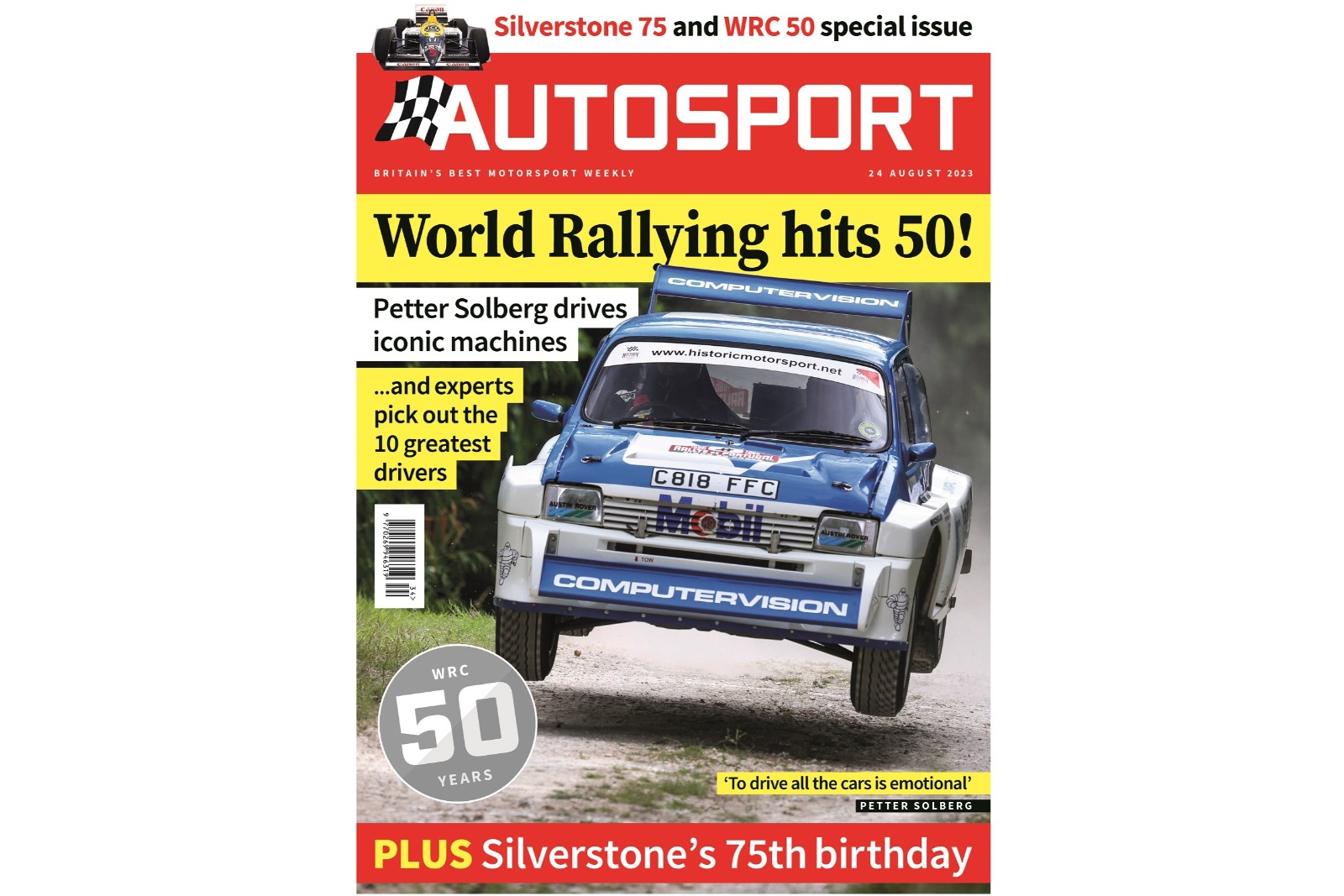
For more on 50 years of the World Rally Championship, including a selection of the top 10 drivers and a glimpse at the future, and our celebration of Silverstone’s 75th birthday, look out for the 24 August 2023 issue of Autosport magazine. Why not get Autosport magazine delivered to your door each week? Subscribe today and never miss your weekly fix of motorsport.


The verdict on the WRC Rally Chile tyre solution

How Solberg lit up WRC title fight in Chile

Evans: Late puncture was “harsh” but WRC title position is still “okay”

WRC Chile: Solberg seals victory as Toyota wraps up manufacturers’ crown

WRC Chile: Penultimate stage puncture dashes Evans’ Chile podium bid

Pajari to take "deeper look" to understand lack of speed at WRC Chile

WRC Chile: Solberg saves best until last to pull away from Evans

WRC Chile: Solberg maintains lead as Neuville and Armstrong suffer rolls

Ogura set to make MotoGP return in Austria

Bezzecchi still confident of MotoGP title glory despite error-prone 2026

Smith on the move in Autosport National Rankings

Former Mercedes F1 tech chief Elliott joins Alpine as CTO
Subscribe and access Autosport.com with your ad-blocker.
From Formula 1 to MotoGP we report straight from the paddock because we love our sport, just like you. In order to keep delivering our expert journalism, our website uses advertising. Still, we want to give you the opportunity to enjoy an ad-free and tracker-free website and to continue using your adblocker.


Top Comments