
How 1971's benchmark Le Mans team lost with the best car
The JW Automotive Engineering team won twice at the Le Mans 24 Hours with ageing Fords and were considered heavy favourites to add more victories to its tally after partnering with Porsche. But despite being armed with the all-conquering 917, this formidable combination was never as successful in real life as on the big screen

There is some great real footage from Steve McQueen’s film, Le Mans. But, aside from the dubious wheel-to-wheel ‘racing’ in the closing stages, one thing that really stands out is that a Gulf Porsche 917 wins.
In real life, the JW Automotive Engineering Gulf squad had won Le Mans with the ageing Ford GT40 in 1968-69 and was the team to beat in the world sportscar championship once it joined forces with old rival Porsche for 1970-71. But Le Mans success with the iconic blue-and-orange 917s eluded John Wyer’s team.
An engine failure, a crash and a missed shift by Jo Siffert had robbed the team in 1970, the year in which the film was set, but JWA looked strong again the following year, when the film was released. Porsche’s work on the long-tailed version of the 917 had turned it from a wayward beast that only Rolf Stommelen and Vic Elford had wanted to drive in 1969 to the car to have in 1971.
PLUS: Is this the greatest racing car of all time?
Jackie Oliver, drafted in alongside JWA’s Pedro Rodriguez to replace Leo Kinnunen for 1971, knew the car was good when he drove it at the test day in April.
“Helmut Flegl [Porsche engineer] was worried about instability at anything over 300km/h [186mph], so when I got up to that speed I would zig-zag to see if there was an imbalance,” recalls Oliver. “I did five laps and did a 3m13.6s – Flegl was so relieved! Even the White House curves were flat, apart from perhaps the last one.”

JWA's attack collapsed in 1970. Pictured is the crashed Hobbs/Hailwood car
Photo by: Motorsport Images
Oliver’s time was more than six seconds faster than Elford’s pole lap in the 1970 Langheck the year before.
Accounts of just how fast the car was down the Mulsanne Straight vary, but Oliver recalls being told it was 247mph. There can be no doubt that it was the fastest Le Mans car until Group C in the late 1980s.
“We believed we had the best cars and the best drivers and that nothing could stop us winning,” wrote Wyer, who died in 1989, in his famous book The Certain Sound.
For the race, the Porsche effort was astounding. JWA, having spurned the long-tailed 917s the year before, this time ran two (prepared at the Porsche factory), with a back-up 917K (prepared at JWA’s Slough base) driven by 1970 winner Richard Attwood and Herbert Muller.
PLUS: The ‘slow’ Porsche that started a Le Mans legend
The Martini team had a long-tail for Elford/Gerard Larrousse, a one-off magnesium-chassis short-tail for Helmut Marko/Gijs van Lennep, plus the infamous 917/20 ‘Pig’, which attempted – not entirely successfully – to combine the straightline speed of the long tail with the short-tail’s handling.
Despite opposition from nine Ferrari 512s and a works Matra MS660, the only car likely to upset the Porsche steamroller was Penske’s immaculate Ferrari 512M, which had outpaced the 917Ks at both Daytona and Sebring. Mark Donohue outqualified all the short-tailed Porsches again, but even he was 4.6s slower than the best of the 917Ls, which qualified 1-2-3.
PLUS: When Penske built the world's fastest Ferrari
“I am satisfied with practice results and I don’t think there is any reason not to think about triumph, unless I suffer some mechanical incident or a crash,” polesitter Rodriguez told the daily newspaper Ovaciones. “It’s well known in these races the car is the most important thing; it is what has to stand the hardest effort and it is difficult for it to keep a fast pace during 24 hours without getting tired. Anyway, I am enthusiastic about the car and I think there will be no problems.”
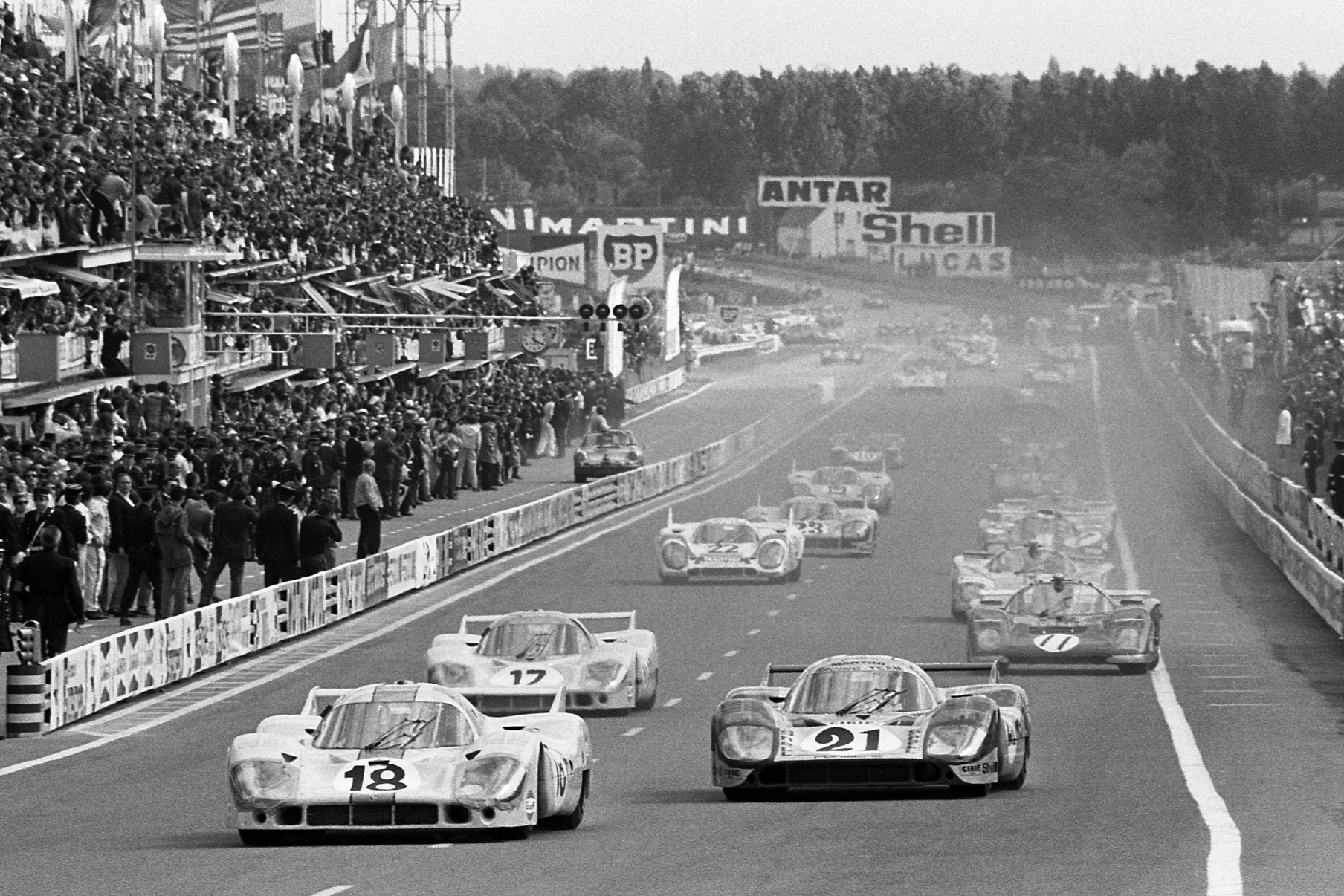
Rodriguez let away at the rolling start, but he and Oliver's car would be plagued by misfortune
Photo by: Motorsport Images
Rodriguez duly led from the rolling start – the event’s first – and typically quick JWA pitwork at the first round of stops helped Siffert secure second. Siffert’s second stop was faster than Rodriguez’s and he took the lead, but the Mexican soon caught the Swiss and the two circulated together at the front of the field.
A minor electrical issue then struck Siffert/Derek Bell, leaving Oliver and Rodriguez a lap ahead of the pack after three hours. As others hit trouble, JWA’s position looked strong. At quarter distance it held first, second and third, Attwood/Muller running two laps behind the leaders.
Then the fastest car in the race suffered an oil pipe failure, covering the cockpit in hot oil. Rodriguez somehow got it back to the pits but the engine was done
But handling problems for Siffert during the night were traced to a rear hub bearing failure, and then Oliver suffered the same problem shortly before half distance.
“My belief is that the total enclosure by the long tail – on the 917K the whole of the back of the car was open to atmosphere – caused overheating of the transmission and driveline assembly,” argued Wyer.
The rear corner was rebuilt more quickly the second time around and the #18 car resumed in fourth, Rodriguez beginning one of his characteristic charges. Such was the combination’s pace, victory was not yet out of the question.
Then the fastest car in the race suffered an oil pipe failure, covering the cockpit in hot oil. Rodriguez somehow got it back to the pits but the engine was done.
“Pedro’s and Jackie’s fine drives were finished,” reported Autosport. “They had comfortably dominated the first 10 hours of the race.” All they had to show was Oliver’s new lap record of 3m18.4s, an average of nearly 152mph.

JWA boss Wyer, with Bell, was left frustrated by the failure on the Oliver/Rodriguez car
Photo by: Motorsport Images
“The hose was of German manufacture, supplied by Porsche, whereas on the cars prepared at Slough we fitted British hoses,” wrote a frustrated Wyer.
“It should have been the car to win,” reckons Oliver, who had won the race in 1969 driving the same Gulf GT40 that Rodriguez had used to win the year before. “Pedro and I were quick in that car at Le Mans. It was phenomenal. It was so disappointing the oil cooler line broke and sprayed Pedro with oil. It would have been great to get a second win.”
PLUS: Remembering Mexico's greatest F1 driver
The Siffert/Bell car never got back into contention and eventually succumbed to a smoky engine but, even with the two long-tails out, Wyer’s squad could still have won, thanks to Attwood and Muller. They had qualified 11th – four places higher than Attwood had the year before – but had no intention of trying to set the pace, and gradually moved forward.
“When I had learned my co-driver was Herbert Muller, a bit of a boy racer who had crashed his car during filming for Le Mans, I thought he might not be the ideal partner,” recalls Attwood. “I was a bit concerned so I gave directions as to how we should run the race, but he drove absolutely perfectly.
“We thought we’d pedal it along and see where we ended up. There wasn’t a thought of winning because the long-tail cars had a 30mph advantage on the straight. But the long tails always had problems at Le Mans.”
Penske’s Ferrari, having climbed as high as second, had also gone out with engine failure, while the Martini long-tail 917 had lost its cooling fan, resulting in a cooked flat-12. And so it came down to a fight between the Gulf 917K and the Marko/van Lennep car. Not for the first time, Wyer was battling a second factory Porsche team.
“Wyer had done a deal with Stuttgart at the end of 1969 to be the works team, and I think he was flabbergasted to see [factory-supported] Porsche Salzburg cars in 1970 and then Martini cars,” says Attwood, who had taken his Le Mans success with the Salzburg team. “But there wasn’t much he could do about it. I think he knew he could do a good job and he did.”

Attwood didn't have high hopes pre-race, but he and Muller made strong progress as others dropped out
Photo by: Motorsport Images
But the crucial moment had already come, just before the halfway mark, when the Gulf 917K lost fifth gear and required a gearbox change, taking anything from 27 minutes to 45 depending on accounts (though we’re inclined to go with the studious Wyer’s 37 minutes). It was the only time Wyer had decided to run the five-speed gearbox instead of the four-speed and he paid the price.
“In the 917 transmissions the synchronising clutch body was threaded into the free-running gear,” explained Wyer. “Depending upon the direction of rotation, the synchronising torque tended to screw up or unscrew the clutch body in the gear. If the clutch body became unscrewed it blocked the gearbox and it was then impossible to select any gears. This is exactly what happened to Muller at Le Mans.”
Wyer also claimed that JWA chief engineer John Horsman had suggested a solution rejected by Porsche.
"John Wyer didn’t win Le Mans [with the 917], but that wasn’t his fault. Two of his cars in 1970 went out through driver error, but that’s how Le Mans is. It either comes to you or it doesn’t" Richard Attwood
Attwood/Muller had been running ahead of the Martini car when the gearbox problem struck and they gradually whittled away the disadvantage afterwards, closing from around five laps down to two at the finish, but van Lennep/Marko simply didn’t spend enough time in the pits to be caught. The winners covered 397 laps, setting a Le Mans distance record that would stand until 2010.
And so the JWA team was beaten by a factory 917K run by essentially a rival works team, using an experimental chassis not offered to Wyer.
“By finishing second with a normal 917K, we were able to demonstrate we could have won without it,” said Wyer.
“There’s no doubt we would have won the race without the gearbox problem,” says Attwood. “John Wyer didn’t win Le Mans [with the 917], but that wasn’t his fault. Two of his cars in 1970 went out through driver error, but that’s how Le Mans is. It either comes to you or it doesn’t.”
And only in the fictional world did Le Mans victory come to a Gulf-liveried 917.
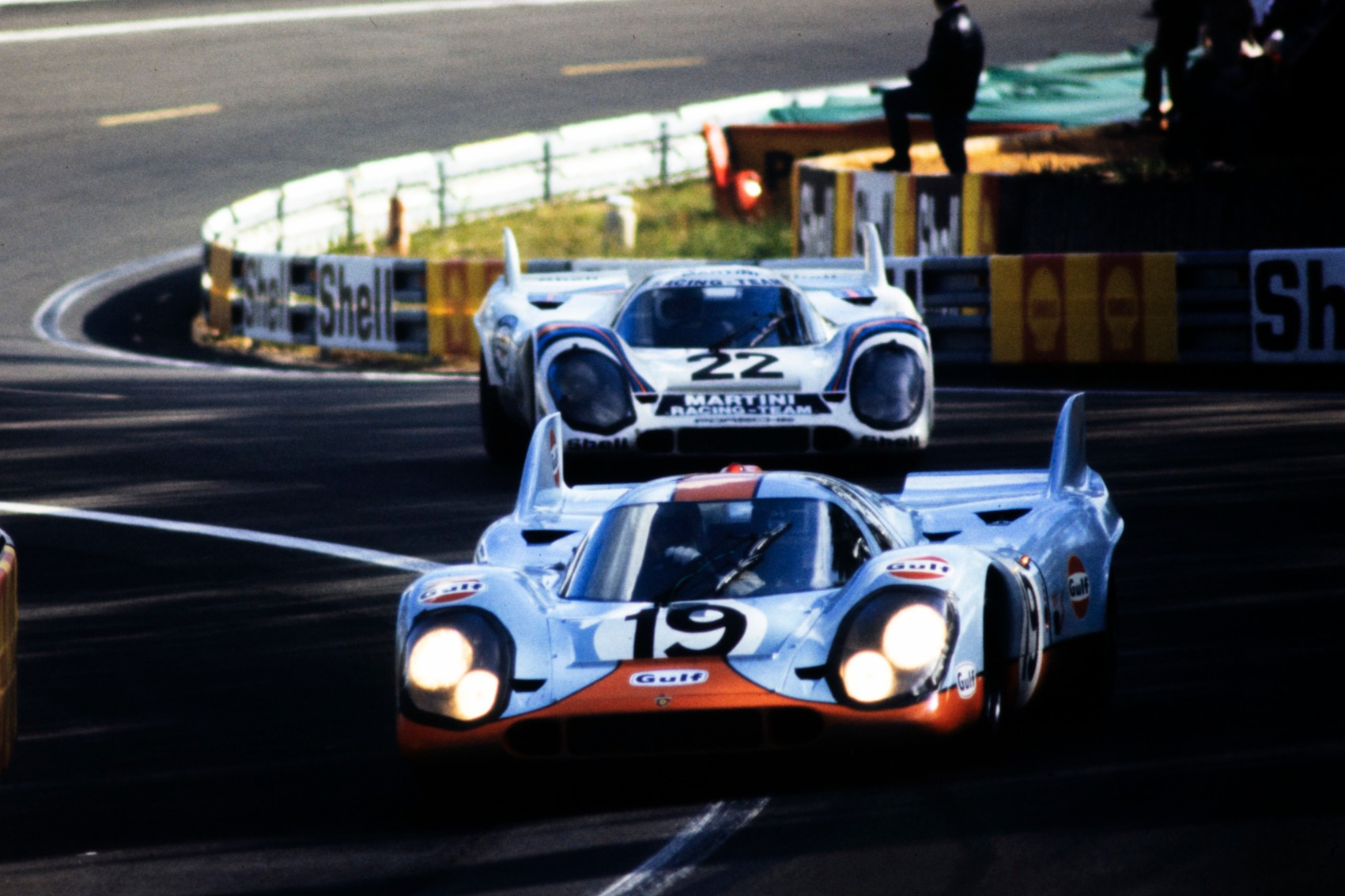
Delay caused by gearbox repairs for Muller and Attwood (19) allowed Marko and van Lennep (22) to capitalise
Photo by: Motorsport Images


How the M8B became the most dominant car in McLaren’s history

Employing team orders can simply be a matter of common sense

The greatest F1 campaigns with no wins

Top 10 F1 results changed by backmarkers – the passes

Top 10 F1 results changed by backmarkers – the clashes

Stars, cars and highlights from the 2026 Goodwood Revival

The Egal has landed – again

Autosport magazine: Antonelli and a Can-Am celebration

FIA expects F1 races in Qatar and Abu Dhabi to run as planned

Top five roles on Motorsport Jobs this week

Champions crowned at incident-filled Donington Park 750 Motor Club meeting

Why Toyota’s 2026 WEC triumphs have put it into the all-time greatest endurance racing team debate
Subscribe and access Autosport.com with your ad-blocker.
From Formula 1 to MotoGP we report straight from the paddock because we love our sport, just like you. In order to keep delivering our expert journalism, our website uses advertising. Still, we want to give you the opportunity to enjoy an ad-free and tracker-free website and to continue using your adblocker.


Top Comments