
The Indycar season that proves Michael Andretti is better than F1 showed
Often unfairly characterised as a car-breaker, judged for his lack of an Indianapolis 500 win and a disappointing part-season of Formula 1 in 1993, Michael Andretti was highly respected by his rivals and only thwarted greater success by ill-fortune. When it all came together in 1991, he was a truly formidable force

This May will represent the 30th anniversary of Rick Mears joining the four-time Indianapolis 500 winners’ club, after a stunning outside pass on Michael Andretti at Turn 1 on lap 188 of the 200. It will therefore also be the 30th anniversary of Andretti losing the Indy 500, despite making a stunning outside pass on Mears at Turn 1 just one lap earlier…
During Long Beach weekend a few years back, at the Legends night in the Petersen Automotive Museum in Los Angeles, Andretti was asked what the Indy 500 means to him. Of course, he’s won it as a team owner five times, with Dan Wheldon, Dario Franchitti, Ryan Hunter-Reay, Alexander Rossi and Takuma Sato but, despite being several years retired from the cockpit, Andretti’s response saw him automatically default to racer mode.
“If you’re an Indycar driver [Indy] means everything to you,” he said. “Growing up, it was a big part of my life. I spent many years there at the Speedway. It’s something that every driver wants to compete in. It’s a truly special place. It’s our sacred ground.”
And yet that ground kept shifting for Andretti at precisely the wrong time – each Memorial Day Weekend, in fact. Famously, he led two more laps than Mears around Indianapolis Motor Speedway over the course of their respective careers, yet never the last.
“Indy is frustrating because it was one of my best race tracks,” recalls Andretti. “More laps led there than Rick… and he won it four times. With my eyes closed, I could have won it four times. And then I go to Toronto and win there seven times. Like, what?! No rhyme or reason. Just the way it goes.”
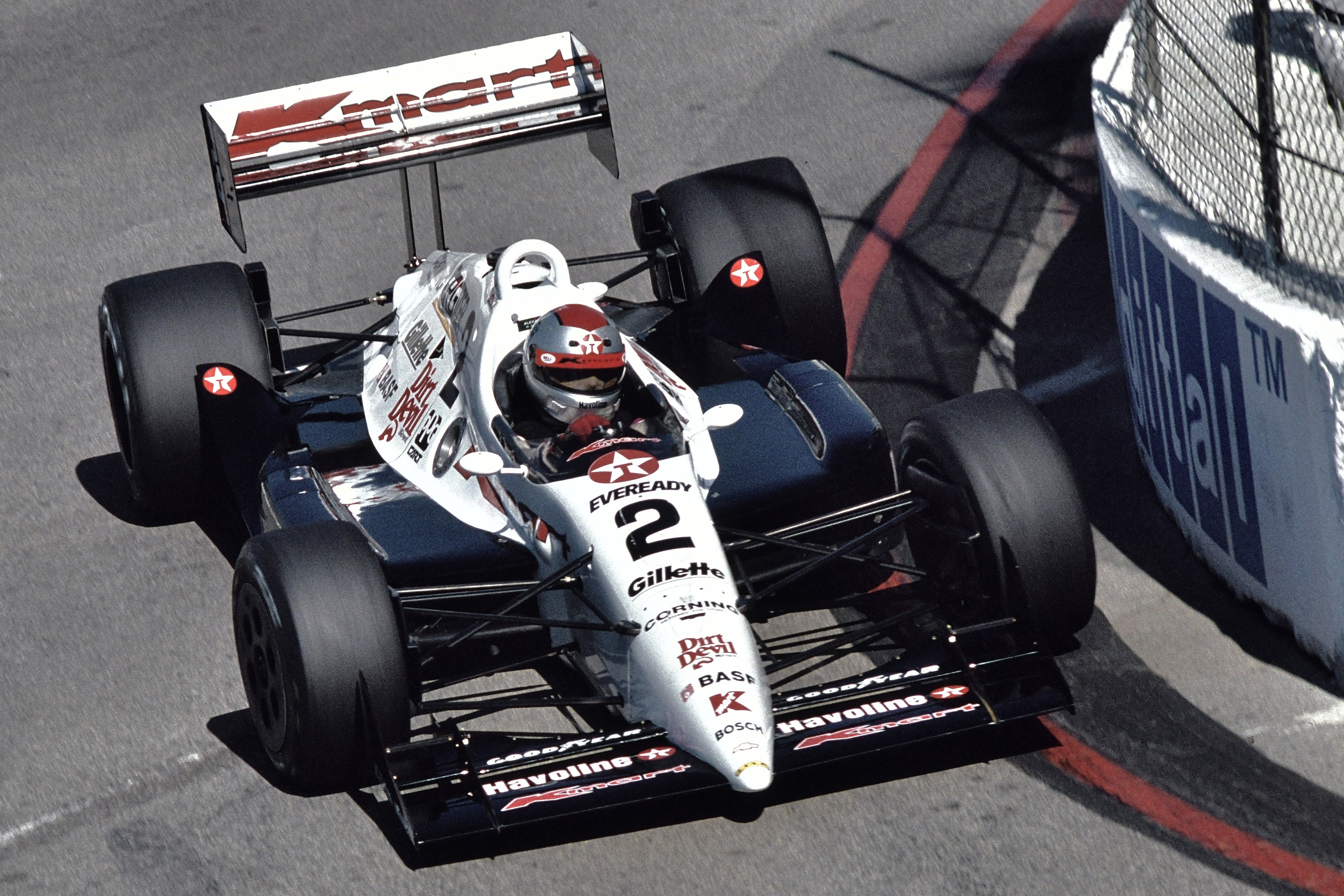
Michael Andretti Indycar Long Beach 1991
Photo by: DanR Inc Archives
That 1991 Indy miss was cruel for another reason, too. It tends to overshadow the greatest achievement of Michael Andretti’s driving career: namely, winning the CART Indycar championship. That’s another accolade he should have won multiple times but instead he finished second five times, third twice, fourth three times. And despite 42 race wins – fourth in the all-time Indycar history books behind only AJ Foyt, Michael’s father Mario Andretti and Scott Dixon – he is remembered by some as being ‘too fast for his own good’. Too hard on his car, in other words.
"People would say, ‘Michael pushes too hard, breaks his cars.’ Pfffff, whatever. Like I’m going to push the belt of my motor to break? Come on…" Michael Andretti
“Yeah, yeah, I know,” he shrugs. “That’s how they remember it because they were saying that or writing that at the time. And that’s because Bobby [Rahal] beat me on reliability. All three times he won the championship, I was second, but I don’t remember him actually beating me in any races! Hmm… OK, maybe one or two.
“But generally he had more points at the end of the year because he got to the finish more often. People would say, ‘Oh, that’s because Michael pushes too hard, breaks his cars.’ Pfffff, whatever. Like I’m going to push the belt of my motor to break? Come on…
“Then they’d say I take too many risks because they’d see I was hard on the gas straight out of the pits even in practice. I mean, that’s a good thing because you learn how your car behaves on cold tyres. Remember in Formula 1 how Michael Schumacher used to come flying into the pits all through practice sessions and qualifying so he got as good as he could at maximising his in-laps and learning how late he could brake for the speed-limit line on pitroad? He knew that was gonna pay off in the race, might jump him to the front if he wasn’t there already.
“Well, for me, going hard on cold tyres even in practice was the same deal. It’s all about knowing how far you can push the limits. That’s massively important in a series with no tyre warmers, when out-laps after a pitstop are so important. And it also means you’re totally on it from the start of a race.
"I think it was 1992 when I led the first lap in 13 of the [16] races, even when I didn’t start on pole. I remember being amazed at how slow everybody was going into Turn 1, all lined up. I’d just flick it to the outside into clean air, get more aero grip and just drive around them and into the lead. I used to love that.”

Michael Andretti 1991 Indycar Detroit
Photo by: DanR Inc Archives
And so did the spectators. Andretti’s reputation as a car-breaker was ill-deserved, but there’s no doubt he danced on the precipice more often than most of his rivals, and those who take chances tend to win the hearts and minds of onlookers.
Andretti’s great rival and fellow second-gen superstar Al Unser Jr emulated his father – smooth steering inputs, letting the race come to him, working over the guy in front and trying to pressure him into mistakes while making none of his own. Michael, meanwhile, followed the style of his father Mario – he was in a hurry to get to the lead, to stamp his authority on a race. If there was a car in front of him, neither Andretti would delay in attacking their prey.
For Michael, it had been this way since making his Indycar debut at the end of 1983 in Kraco Racing’s March, which was running the Cosworth DFX. He finished in the championship top 10 the next two years, before becoming a winner and a championship contender in 1986 and 1987.
The following year was winless and his last with Kraco, but that year the team switched – mid-season – from March chassis to Lola. It would prove to be a useful heads-up for 1989, when he joined Mario at Newman/Haas Racing, running Lolas but with Chevrolet engines.
With the team expanding from one to two cars, and Penske having better cars than NHR’s Lolas in 1989, things weren’t smooth initially, yet Andretti Jr scored two wins and finished third in the championship. Then in 1990 he was on song again, leading more laps than anyone, but was beaten to the crown, this time by Unser Jr’s similar Galles-run Lola-Chevy. But in 1991, Andretti was damn near unstoppable after a shaky start.
“The year as a whole was awesome,” he recalls, “but what was really interesting was that it started so bad. I was dominating [the opening round] at Surfers Paradise, just cruising, and then a bolt came undone on my brakes; I lost the rears. The only good part about it was that it gave my cousin John the win. Then at Long Beach we were running second behind Little Al, and we got taken out in the pitlane [by Emerson Fittipaldi].”
At Phoenix he finished fourth, and therefore headed to Indianapolis in eighth place in the championship, 34 points off the lead. But after wisely focusing on his race set-up, from fifth on the grid for the 75th Indy 500, Andretti hit the front on lap 34 and appeared to have the car to beat. He led 97 of the 200 laps before becoming the victim of Mears’s high-line, high-wire pass.
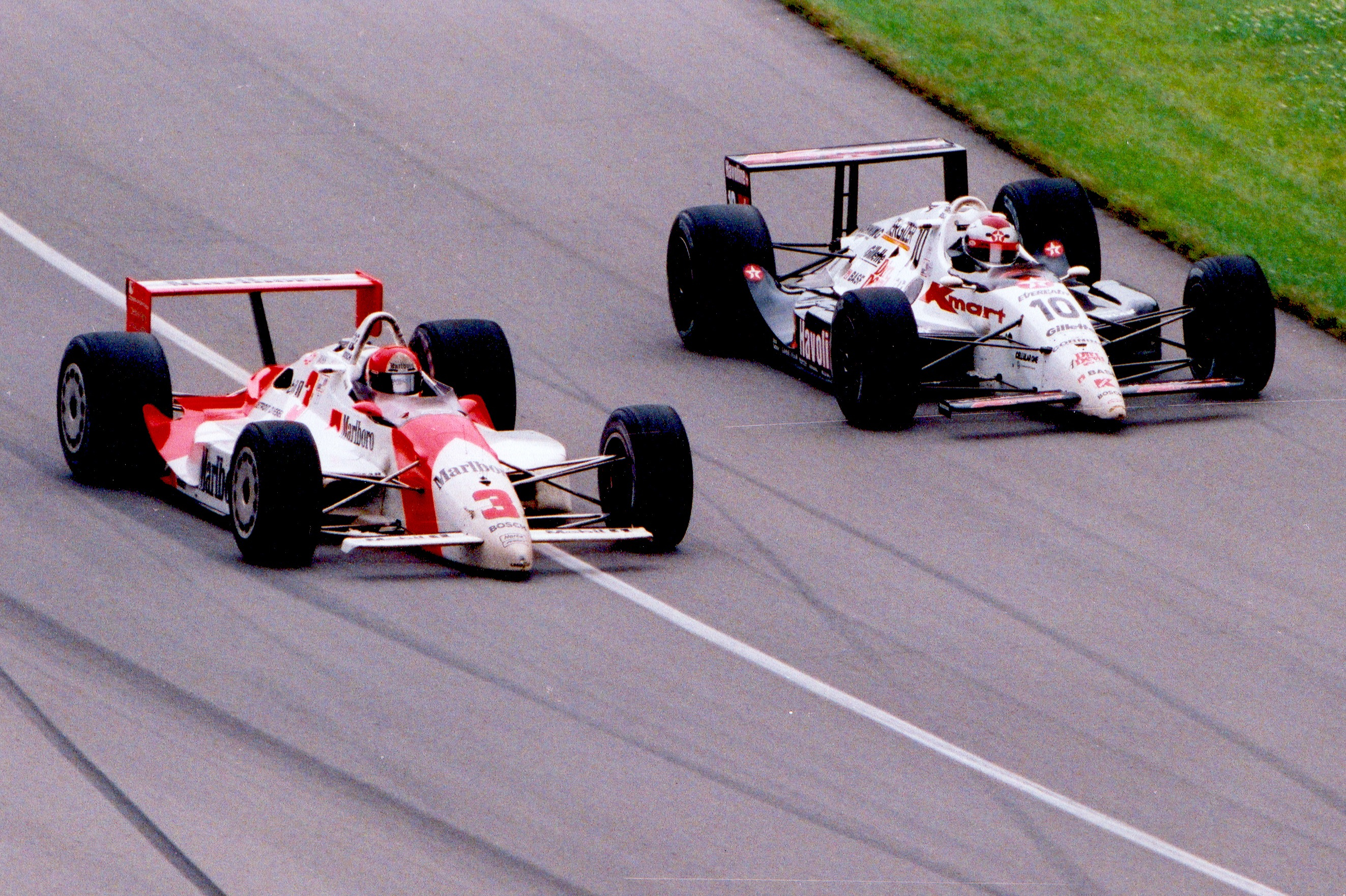
Rick Mears Michael Andretti 1991 Indianapolis 500
Photo by: IMS
“I was coming up to lap Rick at one point,” says Andretti, “and right as I was catching him, I started to get a flat tyre, so I pitted. That’s what saved him from going a lap down and ending his chances. But that ultimately changed the whole race. He was nowhere all day, and then all of a sudden I was thinking, ‘What in the world…?’
“Once he was by me, I couldn’t even stay in his draft. I was thinking, ‘How is this possible?’ I still look back and scratch my head at how Rick found all that speed – a bit like in 2006 with Sam Hornish against [Michael’s son] Marco.”
"To my mind, Michael is one of the best there’s ever been, and the fact that it never came right for him at Indy doesn’t change that an ounce" Rick Mears
Michael got over the crushing disappointment and scored his first win of the year just a week later at the Milwaukee Mile, where he headed an Andretti 1-2-3 – Michael, John, Mario. Seven more wins – on the streets of Toronto and Vancouver, point-and-squirt Portland, the runways and taxi-ways of Cleveland, and the sweeps of Mid-Ohio, Road America and Laguna Seca – ensured Michael was well clear of his nearest opponents in the final standings.
He failed to finish five of the year’s 17 races, but he led just over half of the race laps he completed, spending an incredible 965 laps in front, when no one else led more than 300. He had also won on a short oval, street course and road course, and almost won at a superspeedway (Indy), although perhaps the stat that best conveys his ability across all types of track is that in only one of the 17 races did Andretti not hold the lead at some point. It was one of the most impressive season-long performances in the history of Indycar racing.
The man who beat him to the Indy 500 win that year, Mears, once told this author: “When Michael Andretti retired, I remember being asked something along the lines of, ‘Does the fact that Michael never won the Indy 500 lessen his status in your eyes?’ I wanted to say, ‘No. That might lessen him in your eyes, if that’s the way you want to think about it…’ To my mind, Michael is one of the best there’s ever been, and the fact that it never came right for him at Indy doesn’t change that an ounce.”
Incredibly, Michael found a way to be even more dominant in 1992, and yet still missed out on the title.
Despite winning the 1991 championship with the Chevrolet unit, Michael was eager to switch to the Cosworth XB powerplant that he and father Mario tested at Road America in September.

Michael Andretti, Paul Newman Mid-Ohio Indycar 1991
Photo by: DanR Inc Archives
“I was pushing for that change,” says Michael. “I remember, we’d just won the championship and, while everybody was celebrating, we were sitting in the motorhome planning for the Cosworth already. I was fully focused on that. We knew the potential of the motor so I desperately wanted it because basically it gave us what we’d had in 1991 but with more horsepower. Almost made it easy. I just didn’t expect the reliability problems…”
The most heartbreaking of these, perhaps predictably, came in the Indy 500. Andretti led 160 of the 200 laps, yet retired with 13 laps to go when the fuel pressure dissipated.
“That’s the 500 I look back on as the definite one that got away,” he remembers with a sigh. “That hurts even more than 1991.
“And it’s funny how that 1992 season looked like it was going to be the same as 1991 – bad start, then missing out at Indy, and then we start winning Milwaukee, Toronto [of course!] and so on…”
Engine failures while leading Michigan and Mid-Ohio ended his chances of retaining the title – he lost out to Rahal again – but Andretti’s statistics from that year are astonishing. The 16 races that comprised the 1992 season added up to 2110 laps, of which Andretti led 1136, or 54%. Unfortunately, he only completed 1771 laps, but that meant he led an astounding 64% of the laps he completed. The problem was that in this instance, five wins couldn’t make up for five DNFs.
“We knew next year, with the reliability issues fixed, we were gonna win every race,” says Andretti. “I really feel that, honestly.
“Instead, I went to Formula 1 and left the car for Nigel [Mansell] to benefit. With what was happening to me over there, and Mansell cruising to the championship here… Man, that was so frustrating!”
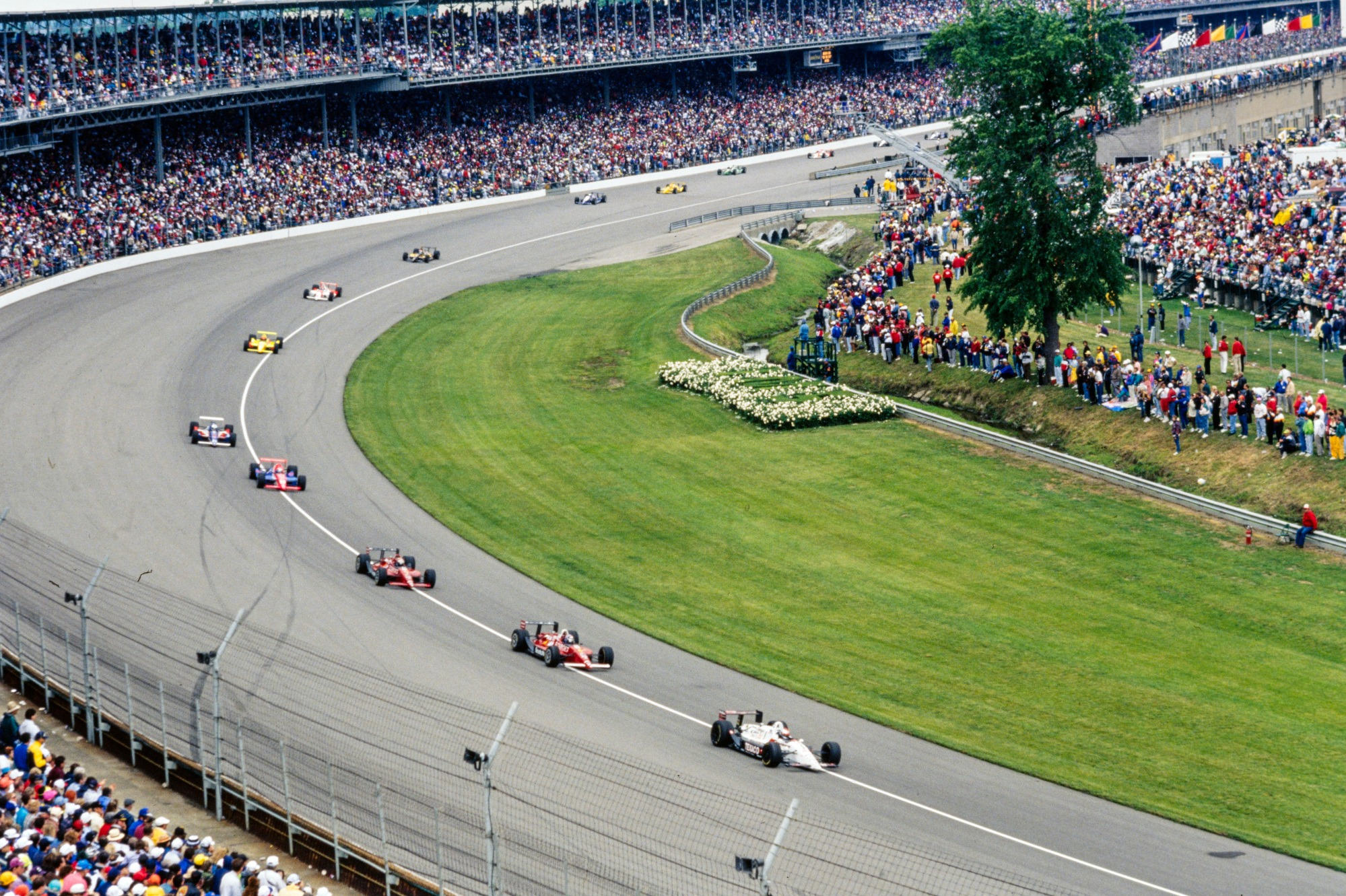
Michael Andretti 1992 Indianapolis 500
Photo by: Motorsport Images

The long evolution of Dallara's Indy 500 winner

How to be an ace engineer: Leading IndyCar race engineer Michael Cannon

IMSA Laguna Seca: Ganassi Cadillac holds off Tandy Porsche for victory

Palou surprised IndyCar rivals didn’t use his winning tyre strategy in Indy GP

IndyCar Indy GP: Palou beats McLaren drivers to claim points lead

Lundgaard: I can call Indy GP track "home” after maiden IndyCar pole

IndyCar Indy GP: Lundgaard beats Rosenqvist, Palou for first pole

IndyCar Indy GP: Palou tops second practice, Rahal Letterman Lanigan shines again

Live: MotoGP Austrian Grand Prix updates as it happens

Great debate: Which circuit should host the F1 2026 finale if the calendar has to change?

The year the legendary Daytona 24 Hours ran to six hours

The Pirelli test row shows why MotoGP riders need a stronger voice
Subscribe and access Autosport.com with your ad-blocker.
From Formula 1 to MotoGP we report straight from the paddock because we love our sport, just like you. In order to keep delivering our expert journalism, our website uses advertising. Still, we want to give you the opportunity to enjoy an ad-free and tracker-free website and to continue using your adblocker.


Top Comments