
Why IMSA glory for Mazda would be a bittersweet ending
Mazda believes it has never had a better chance of clinching the title in IMSA's Prototype division. Achieving this goal would be the bittersweet culmination of an achingly hard struggle, after which the brand has decided to quit

Nine months ago, there was some optimism that Mazda would give the green light to a new prototype for the hybrid era of the IMSA SportsCar Championship beginning in 2023. As a logical extension to this, with the LMDh rules allowing IMSA manufacturers to enter cars in the World Endurance Championship, the marque might even go transatlantic to try and recapture the Le Mans 24 Hours crown it last earned in 1991 with the shrill rotary-engined 787B.
But others, including those inside the Multimatic-run sportscar team, spotted the shadow from the sword of Damocles over the handsome RT24-P, noting the marque didn't need a halo car to sell MX-5s or SUVs.
The problem seems to be that at the top level of any motorsport category, Mazda appears to revel in the underdog role, the satisfaction coming from occasionally besting those who plow far more dollars or yen into their programme. The Group C sportscar programme of the late 1980s and early 1990s produced that Le Mans victory was proof of the old blind squirrel theory, for Mazda-powered cars had for several years chronically underperformed in the prestigious All-Japan Sports Prototype championship.
PLUS: Meet the creator of Japan's first Le Mans winner
The ‘day late, a dollar short’ routine could also be seen in the World Rally Championship. Right after the Group B cars were banned, everyone got a do-over with Group A cars, and Mazda had an oven-ready 323 that should have been a gem. But it got dusted by Lancia, before compatriot brands Toyota, Subaru and Mitsubishi came along to show them how it should be done.
In the case of the current Mazda Prototype, of course the pessimists were right: even IMSA’s decision to delay the LMDh rules introduction until 2023 couldn’t stop Mazda from not only cutting down to one car for 2021, but also declaring this as its final year at this level. After years of hardship and three different custodians running the cars, things had just had started to look good, having ended 2020 on a high by winning the Sebring 12 Hours.
As Jonathan Bomarito, who along with Harry Tincknell scored the RT24-P’s first win and its most recent win, puts it: "I’d say we’re there at last. We can’t be counted out of any race, on any track. The pitstops are good, the strategies are good, the engineering is good. But at the end of the year, that’s it, all over. Pretty sad.”

Bomarito, Tincknell, Hunter-Reay celebrate 2020 Sebring 12 Hour victory
Photo by: Michael L. Levitt / Motorsport Images
Bomarito, who has been reduced to a part-time role as the third man alongside full-timers Tincknell and Oliver Jarvis for the four endurance races, has been part of the Mazda sportscar setup since 2015. That wasn’t a great time for Mazda, as SpeedSource was grappling to make the 2.2-litre 4-cylinder Mazda turbodiesel engine powering its ageing but capable Lola chassis into a competitive proposition. Up against turbocharged petrol V6 opposition from Acura/HPD and Ford, as well as GM’s dependable normally-aspirated V8s, Mazda had stumbled into a sword fight armed with a Q-tip.
Switching from diesel to gas – an AER-prepared turbocharged 2.0-litre four-pot – fortunes improved in 2016, proving the efficacy of the Multimatic-modified Lola chassis. SpeedSource scored three poles and a podium that year, while Multimatic busied itself converting the Riley Mk.XXX for IMSA’s new-for-2017 DPi regulations, which allowed car manufacturers to clothe Riley, ORECA, Onroak or Dallara chassis with bodywork that reflected the styling on their street cars, improving their marketing opportunities by creating family resemblances.
Mazda's effort was a great disappointment, not helped by flaky reliability and compromised aerodynamics. It mustered three podiums over the first seven races of the season, but the Dallara-based Cadillac DPi-V.R won all seven between Wayne Taylor Racing and Action Express Racing. So Mazda withdrew from the rest of the season, ditched SpeedSource and brought in the legendary Team Joest operation that had run Audi's Le Mans programme.
"There was nothing wrong with the work [Joest] did. It’s just they were leaving the country after each race and were up against teams that left a race and went back to their shops to work on the cars for three weeks" Larry Holt
As Multimatic's chief technical officer Larry Holt recalls: “It was not a particularly good birth. The two Mazdas were junk in that first race at Daytona [in 2017], and we reached about halfway through the season, and we were saying, ‘This car’s just not right’.
“My aerodynamicist Mark Hanford had a pretty good idea of what the main problem was. But truly, there was no finger-pointing – no, ‘Oh, Riley screwed this up.’ It just turned out to be that the front underwing didn’t work worth a shit. There was probably one ride-height on one day and one particular barometric pressure where it might have been useful!
“I said to Bill [Riley], ‘We’re going to have to go and fix this thing’. He asked what it would take, and I said ‘Looking at the windtunnel work we’ll have to do, I reckon we’ll have to drop half a million bucks on it,’ and he said he couldn’t partner with us. That’s when they switched to the AMG Mercedes deal in GTD.
“So I stepped into this half-a-million dollar investment to get it right – but I was wrong: it was a million! That’s how much it cost to fix that car, with no invoices sent to Mazda. To this day, they’re kinda like, ‘You’re a good guy…’

Larry Holt 2019 IMSA Detroit
Photo by: Michael L. Levitt / Motorsport Images
“Anyway, that million included 20 days in the Lola windtunnel with a 40 percent model, and we verified the problem on the fourth day. But when you’ve got an aero team in there and 20 days booked, they think they’ve gotta use them. I love them to death, but man, an aero team can spend money at an Olympic level! But they’re great and they got it sorted, we changed 72 parts on that car, and for sure those changes lit it up and it became competitive in 2018.”
Mazda’s struggles were put in perspective that year by the arrival of Acura. Based on an ORECA chassis, the Team Penske-operated ARX-05s from Honda Performance Development won in only its fourth outing at Mid-Ohio, and both Acuras would beat both Mazdas in the end-of-year point standings. Holt admits to being bemused by their continued struggles - "I’m standing back and wondering how the hell you can go wrong by hiring Joest" - but concedes it was hurt by not moving its operational centre to North America.
"Everyone went home to Germany after each race," says Holt. "They needed more money to get it done properly – more money than had been done in their deal with Mazda. We were doing the performance engineering, the work done on the car between races on our simulator, and Joest brought in their own engineers for the races.
“We watched all that for a year. And we concluded that yes, the over-the-wall teamwork from Joest was significantly better than SpeedSource. They never really fumbled the pitstops, even if they occasionally made some bad strategy calls from not being as familiar with IMSA rules as they had been with WEC rules, but there was nothing wrong with the work they did. It’s just they were leaving the country after each race and were up against teams that left a race and went back to their shops to work on the cars for three weeks before the next race.
“Also, we were still suffering with the engine pretty badly. So in 2018 the results still weren’t up to the level Mazda was expecting, but to get it up to that level was going to take more money. Mazda said they didn’t have that money… and using contract race engineers wasn’t working out for them, so I said for 2019, ‘We’ll do the race engineering.’”
Ex-Joest engineer Leena Gade, who race engineered the winning car in three of Audi’s 24 Hours of Le Mans triumphs, ran the #77 car for Oliver Jarvis and Tristan Nunez at Daytona, with Dave Wilcock on car #55.
"It went well… but we hit more engine problems," says Holt. “So I asked Michael Wilson, who used to run HWA’s team in the DTM – an engine guy through and through – if he wanted to go and help AER sort out the Mazda engines. He did and the outcome is what you see today. No one else should take credit for it. He took an engine that was making good horsepower but struggled to make it through 12 hours and turned it into a reliable high-performance engine.
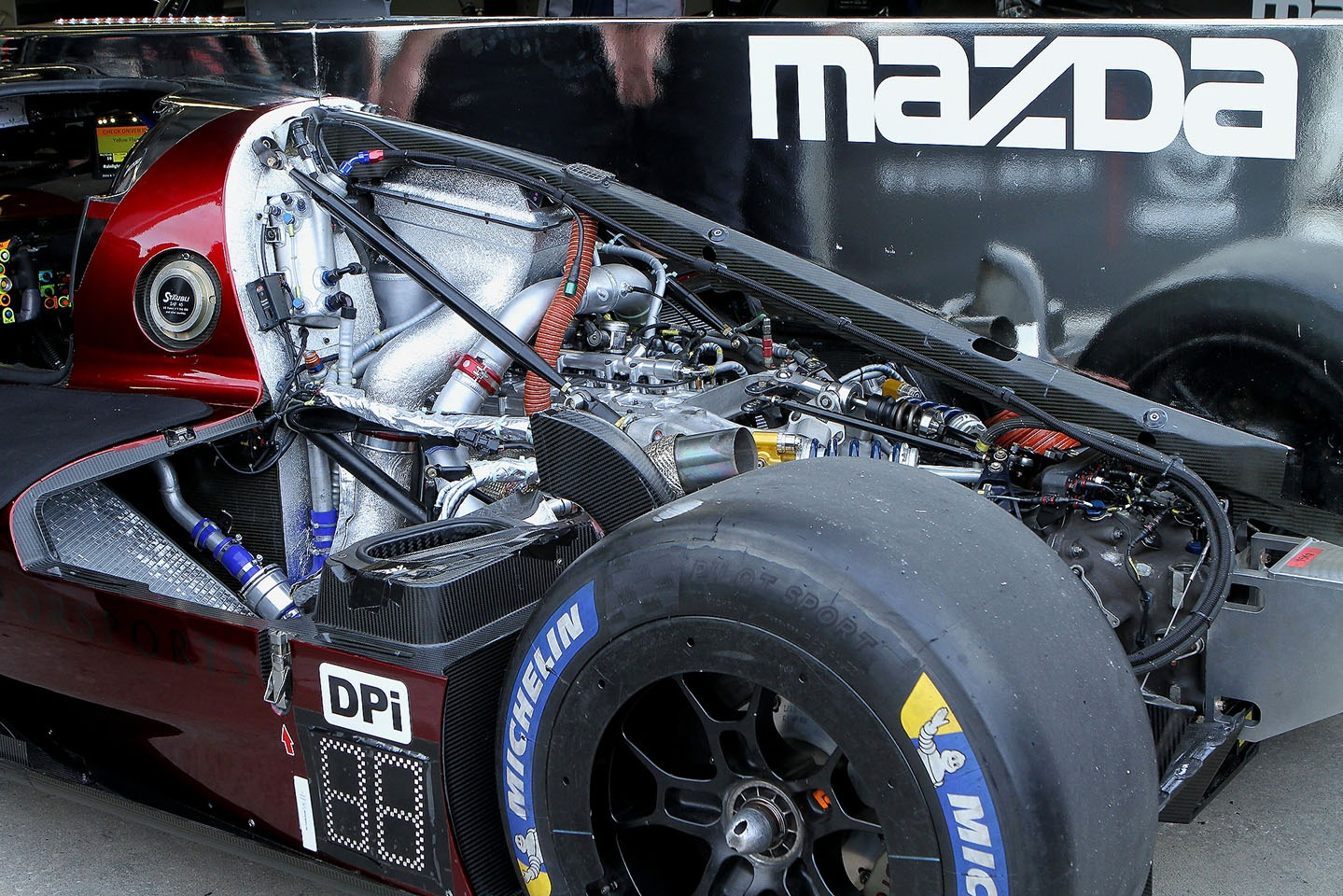
#77 Mazda Team Joest Mazda DPi, Dpi engine detail
“Backing up a bit, we were still struggling at the beginning of 2019, and then went to Sebring and Dave Wilcock had to go back on the Ford GT project and the contract guy we got to sub for him didn’t work out. So I came out of retirement and race engineered the #55 for a couple of races. And at Mid-Ohio, we finished 2-3 and things were looking good – although Leena’s car beat my one!"
The breakthrough came at Watkins Glen, with a 1-2 finish headed by the #55 of Bomarito and Tincknell. The following race, at Mosport, yielded another 1-2 with Oliver Jarvis and Tristan Nunez, before Bomarito and Tincknell won again at Road America.
"Winning three in a row… that’s the way to get the monkey off your back,” says Holt.
But while all involved in the Mazda project publicly appeared to be floating on a fluffy cloud of euphoria, from underneath that cloud assumed a darker hue.
"It's making all the power we need it to make, and it’s lasting 24 hours. In the old days, we used to have to turn the engine down a bit for racedays to try and make it last; we never have to do that now" Larry Holt
“There was a falling out between Mazda and Joest – I don’t truly know what that one was about,” is all that Holt will say on the matter, but its ramifications he quickly took on board. “By then we were race engineering as well as prepping the cars between races, as we always had, so Mazda asked if we wanted to take on the whole operation once the Joest contract expired after last year’s Rolex 24. Obviously we said yes.”
In the final race under the Team Joest banner, Jarvis, Nunez and third man Olivier Pla finished second in the 2020 Daytona 24 Hours and when the COVID-19-disrupted season started again in July with Multimatic in full charge of the RT24-Ps, Bomarito/Tincknell and Jarvis/Nunez delivered a 1-2 in the Daytona 240.
“We then had a shitload of bad luck – leading the race at Road America and then the heavens opening so everything turned to chaos, brake rotor failure at Road Atlanta too," says Holt. "But then the Sebring 12 Hours happened and it all came right and we won.”

Bomarito, Tincknell, Pla score Mazda's first DPi win at Watkins Glen in 2019
Photo by: Jake Galstad / Motorsport Images
The result clinched third in the championship for the #55 Mazda’s full-time drivers, but there was a poignancy in the air. Six weeks beforehand, Mazda had announced it was cutting back to one car for 2021, leaving Nunez cast into the purgatorial obscurity of ‘brand ambassador’.
Third place at Daytona and a runner-up finish at Sebring mean Mazda sits just eight points off the summit. Having satisfactorily "answered the question about ‘Is Multimatic capable?’" in 2020, Holt is clear that "this year was all about going after the championship".
"I’m willing to take seconds and thirds everywhere because we no longer have to prove that we can win races," he says.
"Credit to Michael Wilson – that engine is so reliable now I don’t even think about it anymore. It’s plug ’n’ play, making all the power we need it to make, and it’s lasting 24 hours. In the old days, we used to have to turn the engine down a bit for racedays to try and make it last; we never have to do that now.
“We have a great simulator working well in Detroit. Leena’s a superstar, doing a great job as race engineer, as you’d expect. We have a good performance engineer based up in our Toronto engineering centre. I’m doing strategy. Our over-the-wall guys are great because Charlie Cadieux [team principal] has built a great team of people. And we certainly haven’t cut our IMSA team in half just because we’re running only one car. It’s probably three-quarters of the team that we had running two, even though they don’t all come to the track. We’re putting all we can into this.”
One aspect of the season that Multimatic and Mazda don’t need to question is their driver line-up. Tincknell and Jarvis are two of the fastest drivers in IMSA, their significant mistakes are minimal and they seem to know when to be aggressive and went to temper their enthusiasm and race with their brains rather than egos. In Bomarito, they now have a third driver of similar speed who is also fully au fait with the car, and so can be helicoptered in for the enduros and expect to be on the pace with minimal practice time. Tincknell says that 2021 "is our best chance ever of winning the championship".
“That said, we’re only two races in, so there’s a long way to go," he continues. "The switch to one car does mean we only have one bullet to fire, but all the same people are still working on the car so it feels pretty seamless. As a duo or a threesome, I think we’re strong.”

Jarvis, Tincknell, Bomarito 2021 Daytona 24 Hours
Photo by: Richard Dole / Motorsport Images
Compatriot Jarvis earned his sportscar reputation in Joest-run Audis until the Ingolstadt marque's withdrawal from the WEC in 2016, and won the LMP2 class at Le Mans in 2017. Joest was wise to sign him up for the Mazda programme in 2018, for his experience, pace and perspective – Jarvis is now 37 – have made a real difference.
“There were a couple of people in the team who were disappointed with second place at Sebring this year,” he says, “because we’d led a lot of laps and it was all very close at the end between the top four or five cars. But I told them, ‘Look, given the pace that we had – or didn’t have! – and the issues we’d had in the race, like the radio not working, just two years ago we’d probably have ended up sixth and a lap down. This time we ground out a second place, losing out by only 1.4sec with a car that was definitely not the quickest on the track.’
“That for me is the real difference in the team this year. We got a great result in less-than-perfect circumstances, just like at Daytona, when we came from three laps down with various issues and got third. I’m now much more positive coming after those two races because our collective performance shows the growth of the team. To win a championship at this level, you’ve got to be able to pull results out when things aren’t in your favour, and that’s exactly what we did.”
Like Tincknell, Jarvis describes the team’s progress since 2018 as being on an “upward trajectory”, pinpointing the upturn in reliability as a crucial element in its form.
"We weren’t a consideration because people assumed we weren’t going to finish the race. Now we are a factor and so our rivals have to respond to what we’re doing, and that starts to force their hand" Oliver Jarvis
“In terms of the championship, in 2018 and ’19, we would be on the back foot from the third round because we’d dropped so many points to our main rivals in the two big races at the start of the year, Daytona and Sebring, due to reliability issues. I think this season, having already completed a 24-hour and a 12-hour race and finishing on the podium in both with no mechanical issues, just shows the progress the team has made with the whole product – from the big stuff like the engine down to every little detail.
"The whole Multimatic Mazda team is as good as anyone out there. I remember in 2019 when I put the car on pole for the Rolex 24, and no one even talked about us as potential contenders for the win; we weren’t a consideration because people assumed we weren’t going to finish the race. Now we are a factor and so our rivals have to respond to what we’re doing, and that starts to force their hand.
“For example, if we pit early, our rivals have to decide whether to pit early or, in order to keep track position, tell their drivers to run flat out before their next stop so they don’t lose track position. Applying that extra pressure can force mistakes. That’s why I say reliability has been key to our improvement. Our rivals have to take us on for the whole race.”

Jarvis, Bomarito, Tincknell Mazda 2021 Daytona 24 Hours
Photo by: Richard Dole / Motorsport Images
The quality of Mazda’s IMSA competitors means the title battle could come down to who has the fewest weak points, rather than who has the most strengths. There is still a question mark over the car’s street course performance, and of course it’s not to do with how the RT24-P handles bumps; Multimatic’s status in the world of racing is founded on its damper technology.
Rather it’s the nature of the engine and the electronics of the car - Holt admits "the ECU in the Mazda doesn’t quite have the capacity to do all the fancy stuff that we want to do" regarding traction control - that could cause the car to struggle against the 5.5-liter V8 Caddys.
“They’re not ahead of us from the technology perspective but ahead of us because they’ve been able to implement it," he explains. “So when traction control is needed, they’re tough: they kick our ass in the wet, and then they have that inherent torque advantage in the dry off tight corners on street courses, and a really sophisticated system to control the application of that torque.
“We could be that good, but we’d need a different engine management system, which would be a huge commitment… No one’s going to spend $750k on making that happen at this stage.”
Especially so given how much change has already been made to the car.
“The bodywork, from the outside, looks the same but every single component underneath it is different,” says Bomarito. “Even the cockpit layout, the ergonomics of it – the functions, the switches – are all different. Even things that you’d expect wouldn’t be improved have been improved – like the headlights, for instance.

Bomarito, Tincknell 2019 IMSA Detroit
Photo by: Jake Galstad / Motorsport Images
“Multimatic have completely redone the whole car, and it’s been a constant evolution – and in the right direction. Every step has been an improvement.”
All involved can take pride in the fact that their struggle has brought tangible results. If there’s a crown waiting for them at season’s end, that’s no less than their efforts deserve
Mazda’s decision not to enter IMSA’s LMDh era is a deep disappointment for anyone who likes the brand, or just supports an underdog… even if the marque’s own decisions often ensured that status. But still more puzzling is the decision to pull the plug on the RT24-P a year early.
Multimatic, with the aid of others including AER and Joest, turned the late and compromised initial product into a championship contender, and all involved can take pride in the fact that their struggle has brought tangible results. If there’s a crown waiting for them at season’s end, that’s no less than their efforts deserve.
But whatever the outcome, when the chequered flag falls at Petit Le Mans this October, there will be heartfelt sighs of exasperation from many within and without the squad that Mazda could watch its truculent mule evolve into a racehorse, only to put it out to pasture before its time.

Bomarito, Tincknell 2019 Mid-Ohio IMSA
Photo by: Richard Dole / Motorsport Images

The long evolution of Dallara's Indy 500 winner

How to be an ace engineer: Leading IndyCar race engineer Michael Cannon

IMSA Laguna Seca: Ganassi Cadillac holds off Tandy Porsche for victory

Palou surprised IndyCar rivals didn’t use his winning tyre strategy in Indy GP

IndyCar Indy GP: Palou beats McLaren drivers to claim points lead

Lundgaard: I can call Indy GP track "home” after maiden IndyCar pole

IndyCar Indy GP: Lundgaard beats Rosenqvist, Palou for first pole

IndyCar Indy GP: Palou tops second practice, Rahal Letterman Lanigan shines again

WEC Barcelona: Genesis secures maiden series pole from Toyota

What drives Bortoleto as his junior rivals hit new heights in F1

How the M8B became the most dominant car in McLaren’s history

What Verstappen knew about Red Bull’s big upgrade when he signed his new F1 deal
Subscribe and access Autosport.com with your ad-blocker.
From Formula 1 to MotoGP we report straight from the paddock because we love our sport, just like you. In order to keep delivering our expert journalism, our website uses advertising. Still, we want to give you the opportunity to enjoy an ad-free and tracker-free website and to continue using your adblocker.


