
Masters Degree: Eddie Cheever Jr
In a special series of features, autosport.com talks to the drivers of the GP Masters series - about the old days, the new series and their love of motor racing. This week: Eddie Cheever's unfinished business at the Indy 500
"All the racing I have done in the last four months has been to ready myself for Indy. Every lap in a car or mile on a bicycle. Every glass of wine I could have drank but didn't. Every skirt I could have chased but didn't. It's all been aimed at having a good, strong Indy 500. I want to be in that top group of five or six drivers in the last 20 laps."
At 48, Eddie Cheever Jr has returned to top-flight racing. And he is quite sure about not being there to swell the IRL's dwindling grids. He wants to win.
Three seasons on from apparently hanging up the helmet from his second career in IRL IndyCar racing, where it was thought he would go on to just focus on team management, the American is returning to the cockpit to have one more go at repeating his famous 1998 Indianapolis 500 victory.
He has been busy getting himself back in the groove with races in Grand Am sportscars, Grand Prix Masters and the early rounds of this season's IRL IndyCar series.
His motivation for his return is the belief that technically, he won't be at a disadvantage and this year he has a genuine chance of victory that hasn't been available until now.
Cheever stopped IndyCar racing just when Toyota and Honda started to dominate the series. But because of a by-product of Toyota's defection to NASCAR, this year's Indy 500 will be the first race with just one engine supplier powering the entire field.
That unique level of parity in the race has led Cheever to think that this race is worth one more go. Plenty of other former IRL racers, such as Al Unser Jr and Michael Andretti, think so too and have also come back from retirement.
"The race will be different this year because everyone has a Honda," Cheever insists. "I have a much better chance than I would have had for three years. Honda have had an enormous advantage in previous years, and you had a lot of fairly average race car drivers having some exceptional results due to the horsepower advantage. But this year it is all equal - in the first test, we were up to seventh."
Cheever took five wins in his seven-year IndyCar career, but his 1998 Indy 500 victory was understandably one of the greatest moments of his career. The modern era of IRL races, with the field predominantly made up of Dallara-Hondas, reminds him of the infancy of the category, when he first was involved.
 Eddie Cheever wins the 1998 Indianapolis 500 © IRL
|
"The early days of the IRL was an opportunity where lots of teams had parity. We were racing against Meynards, which had ten times the budgets we had, but the way the rules were written, it was possible to compete. Like it is again."
However, just getting the budget together to compete in the 1998 race was an effort for Cheever, who had to resort to some good old-fashioned buying and selling to ensure he was on the grid.
"We were sponsored by a potato chips company," Cheever recalls, "and three days before the start of the race I sold 600,000 dollars worth of potato chips trucks just to cover the salaries of the team. It just had to be done.
"At the start of the race, I got hit from behind, spun in Turn 1 and flat-spotted the tyres. I had to come in and change tyres, but from that point on we had the fastest car on the circuit and it was serendipity.
"I spent the day battling with Arie Luyendyk - probably the greatest oval driver that ever lived - and I had a great battle with him throughout the race.
"But he had a clutch failure, and so him dropping out stopped a great battle between us. Buddy Lazier, who had won the race the year before, was the guy I was fighting with at the end. It was a very gratifying victory.
"It was a very bizarre period in the IRL. It was different technically, but you could do more with less."
Cheever made his name prior to his US career with his 11-year stint in Formula One, but ended up just short of achieving a Grand Prix victory. His sweetest result was finishing second in Detroit in 1982, but his experiences were tainted by the disparity in technical equipment that still exists in the pinnacle of motorsport.
"I did have the desire, but I became very demoralised with Formula One. It's very difficult to enjoy something like that if you know you start from a level of a great disadvantage. You cannot give someone a ten-horsepower advantage, never mind a 50-horsepower advantage.
"The wing angles of the other cars meant that they had 45kg more downforce than you, yet with their engines they would still be passing you on the straight.
"I'm not crying or whining, but I was given some good cars at certain points. And I also got to meet Ross Brawn, who was definitely the best engineer I ever worked with. A lot of the stuff I learnt from Ross I use now. I still debrief exactly in the same way, with everything having a scale of one to five."
In preparing for this weekend's Indy 500, Cheever has raced in two of the opening three races of the IRL series. He finished tenth - and four laps down - in the opening oval race of the season at Homestead, Miami, where the aftermath of Paul Dana's death rendered the rest of proceedings little value. Things were better on the streets of St. Petersburg, with an eleventh-placed finish, this time only a lap behind the lead.
"The Homestead race was the longest race I had ever had. It was horrific. I turned into the first corner and hadn't done any full tank testing due to the tragedy of the morning, and the car just shot right up the banking. Any time anybody got in front of me I had no balance.
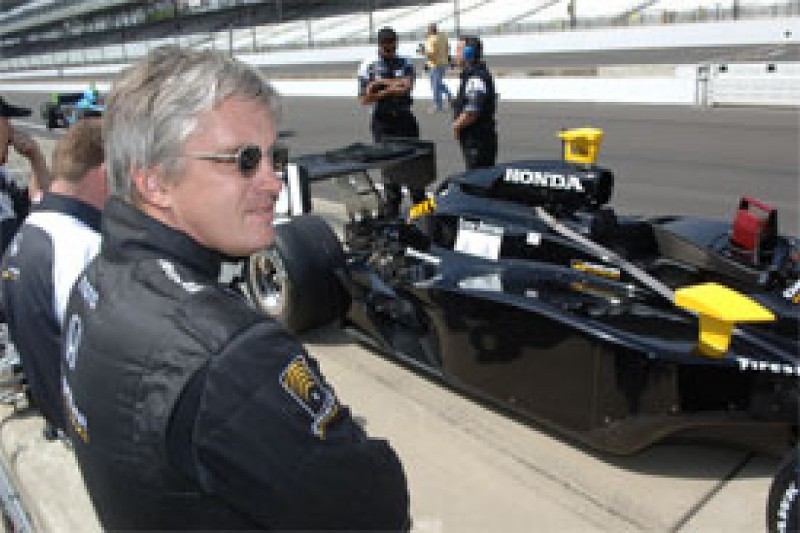 Eddie Cheever preparing for the 2006 Indianapolis 500 with his Cheever Racing Dallara-Honda © IRL
|
"Then, at St. Petersburg, it was difficult all weekend until about 20 laps into the race, and then I had balance and everything felt right, and I could work on everything. The first Indy test was good too."
The rest of the build-up to this weekend's race has been with a solid, if not front-running practice pace. However, he always made clear that because of budgetary concerns he would not have the resources to throw money at a qualifying set-up early on anyway, and he will start 19th. Everything Cheever has done, including recruiting teammate Max Papis, has been to give him the best possible chance on race day.
"It will be one of the closest Indy 500s ever, although the Penskes are going to be very difficult to beat. They have had a lot of resources in the last two years and not had a Honda engine to go with it. They could very easily be a mid-field Formula One team. In six months, they could do that.
"But I've got a shot at this. I've never been 48 years old before. I've never stopped racing. Every time I've come back in the car, I'm that little bit better.
"I don't know when I'll get to the point where I won't make any improvements, but I will know that. I'm not the sharpest tool in the shed, but I'm not an idiot."
If things fall into place for Cheever, this weekend could be his fantastic Indy 500 swan song.

Andrea de Cesaris on his F1 career

Allmendinger to do two Truck races

Loeb: I'm not the greatest ever
Top 11 could make the Chase

Kahne takes California victory

Germany fastest on final day

Kerr confident of maiden win

Unser to be 'very engaged' with USA

Red Bull no longer falls away on difficult days: What Austin qualifying reveals about its progress

Verstappen responds to COTA boss and proposes drastic measures to tackle bumps

Supercars Gold Coast: Feeney converts Race 2 pole to win after Saturday defeat

MotoGP's final Australian GP at Phillip Island cancelled due to poor weather
Subscribe and access Autosport.com with your ad-blocker.
From Formula 1 to MotoGP we report straight from the paddock because we love our sport, just like you. In order to keep delivering our expert journalism, our website uses advertising. Still, we want to give you the opportunity to enjoy an ad-free and tracker-free website and to continue using your adblocker.


Top Comments