


Why Red Bull's 'evolutionary' RB19 does not disappoint
As Formula 1 pre-season testing kicked off on Thursday in Bahrain, Red Bull unveiled what's been labelled as a 'soft evolution' with its 2023 challenger, the RB19. But it's the car's finer details that really make it stand out

Red Bull had notably failed to show off its latest Formula 1 challenger at its glitzy launch in New York a few weeks ago. Instead, despite hyping up the unveiling of its RB19, the team actually just showed off a version of last year's title-winning RB18 with a 2023 livery.
This wasn't really much of a surprise as the team has a history on this front. Few can forget it trying to pass off a FOM show car as its RB18 at last year's launch. Having kept its new 2023 design secret up until the start of testing, there was a great deal of intrigue about exactly what Red Bull would unveil when it finally had to run the car in public.
REPORT: Verstappen shades Alonso to top opening day of testing
And, as the car was finally spotted being wheeled back to the team's garage following the traditional pre-testing official photoshoot on Thursday morning, it did not disappoint. While it's clear that the RB19 owes much of its design to its forebear - even team boss Christian Horner called it 'evolutionary' concept - it's in the fine details where it really stands out.
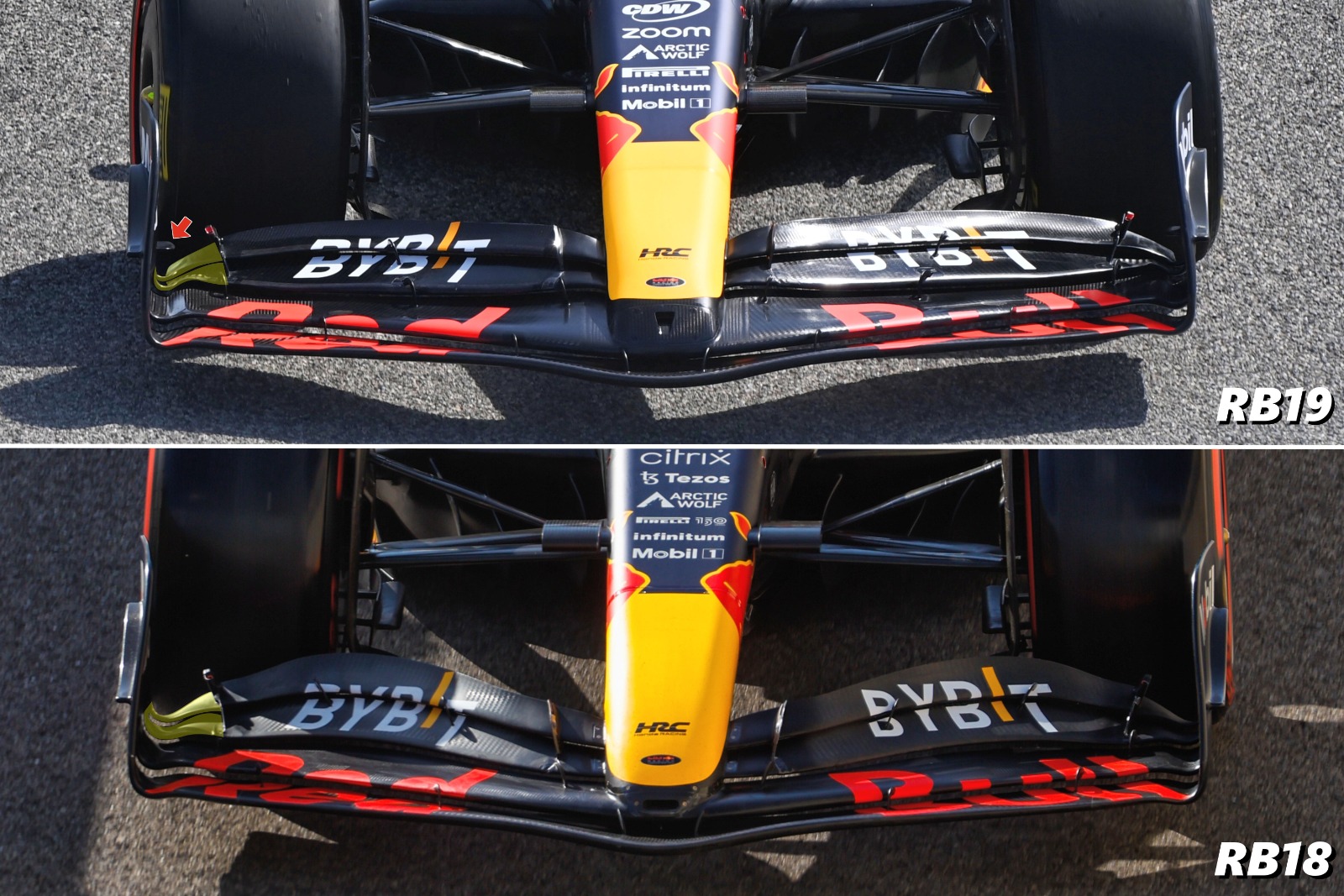
Red Bull front wing comparison between 2023 (above) and 2022
This starts out front, as the RB19's nose is wider and squarer around the tip than its predecessor, which has a bearing on the front wing's architecture and also alters the flow field. Meanwhile, there's now a NACA duct (a low-drag air inlet) in use for driver cooling, rather than the oval design employed last season.
You can imagine this detail has been lifted directly off the pages of Adrian Newey's famous red notebook as being a solution that was noticed on the grid last season on the Ferrari F1-75 which had utilised a similar arrangement.
The RB19's front wing slot separator brackets have also been oriented to help with flow conditioning, just as they were last year. However, it must be noted that the innermost ones that connect the two lower elements have been moved to accommodate the wider nose tip.
The big changes revolve around how much tighter the bodywork is, which has resulted in a significant increase in the length and depth of the undercut
The front wing flap design has also been changed for 2023, with the arched upper elements seemingly swapped for something much more relaxed. Meanwhile, there's a new trick to be found on the inboard lower rear portion of the front wing endplate, which has also been seen on the Mercedes and Haas.
There's a winglet that will undoubtedly help with the challenge of creating outwash (red arrow). The regulations aim to reduce this effect but the teams will continue to search for ways to overcome those challenges owing to the performance it offers downstream.
You can also see how the introduction of this winglet has resulted in changes to the outer portion of the flaps and their connection with the endplate, with the two rearmost elements more tightly wound, while also presenting more flaps in the portion next to the adjuster (highlighted in yellow).
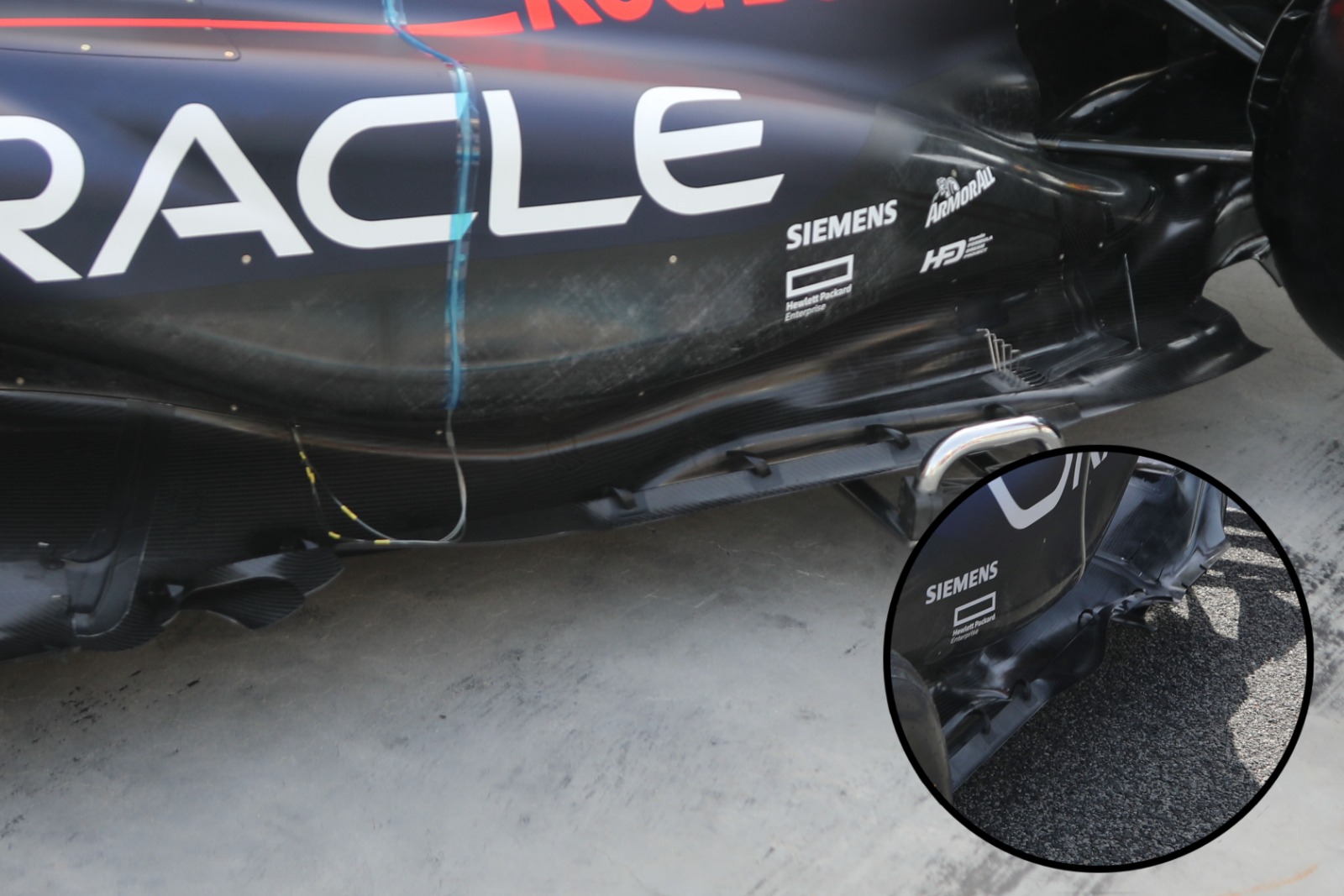
Floor detail on the Red Bull RB19
Moving down the car, it is the sidepods and engine cover that have created the most design division in the field under these new regulations. As expected, there was a great deal of convergence in this respect last season, but there's more as we head into 2023.
Red Bull was one of the trendsetters in this respect, with its downwash ramp solution now found on over half the grid. That said, many have actually taken the concept a step further, following in Alpine's footsteps which developed the sunken central section for the bodywork to help keep the various flow streams from converging on one another.
Red Bull's focus has been on optimising all of the surfaces that shaped the RB18, with it retaining the open-topped inlet with underbite. It has also kept the general shape of the sidepod bodywork, including the swage line that was introduced on the sidepod's flank at the second test in 2022.
The big changes revolve around how much tighter the bodywork is, which has resulted in a significant increase in the length and depth of the undercut. Like the RB18, this extends under the sidepod's flank to create an underbelly and fuses with the ramped section at the rear.
On the RB19, the depth of this cut-out has increased significantly, which should help boost the aerodynamic performance of the sidepod but also help free up potential from the floor edge too. It's here where Red Bull has perhaps made the most obvious changes, with the team reacting to the alterations in the regulations that require the outermost portion to be raised.
This has resulted in changes to both the floor's edge and a new architecture when it comes to the edge wing.

Red Bull's RB19 set the pace on the first day of pre-season testing in Bahrain
Fans of the tiniest of details will note the miniature perforated Gurney mounted between the floor fences that sit above the floor, while rearward of that we find a C-shaped cut-out that's arched upward at its trailing edge to create a wing profile.
The cut-out is accentuated by the edge wing, which is similarly shaped in this region to create a pair of winglets that will work in conjunction with one another.
Interestingly, it appears that the stacked bi-plane beam wing arrangement that it used during 2022 has been replaced by a more conventional solution
The edge wing continues to follow the edge of the floor towards the rear tyre, with both tapering inwards before they end.
The tall, twisted horseshoe-like brackets connecting the two surfaces are also angled in a way that will be beneficial from an aerodynamic perspective.
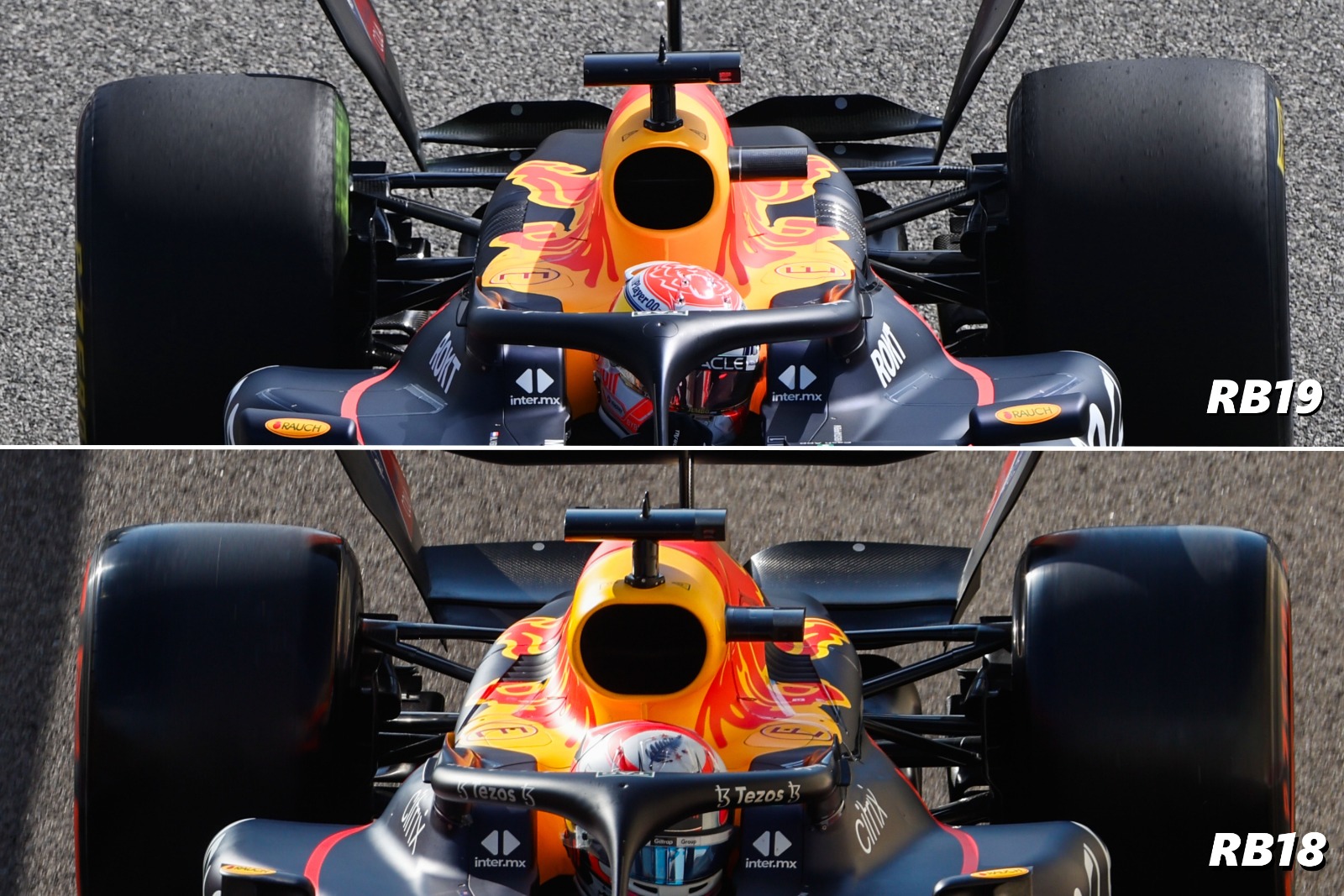
Airbox comparison between Red Bull's 2023 challenger and 2022 machine
Red Bull has also made changes to its airbox for 2023, reducing the size of the inlet which has the net benefit of reducing bulk along the car's centreline and results in an optimisation to the shelf-like section of the engine cover.
The cooling gill panel has also been repositioned as a consequence, with the panel now draped over the shelf's corner, rather than on top of it. This allows the airflow passing by to be less affected by the heat being rejected by the internal components.
Interestingly, it appears that the stacked bi-plane beam wing arrangement that it used during 2022 has been replaced by a more conventional solution, albeit a couple of iterations of this new solution have also been trialled along with different rear wing configurations.
Notably, the one seen below is a low-downforce version, with the lowermost element connected to the side of the crash structure, while the upper is short chord too.
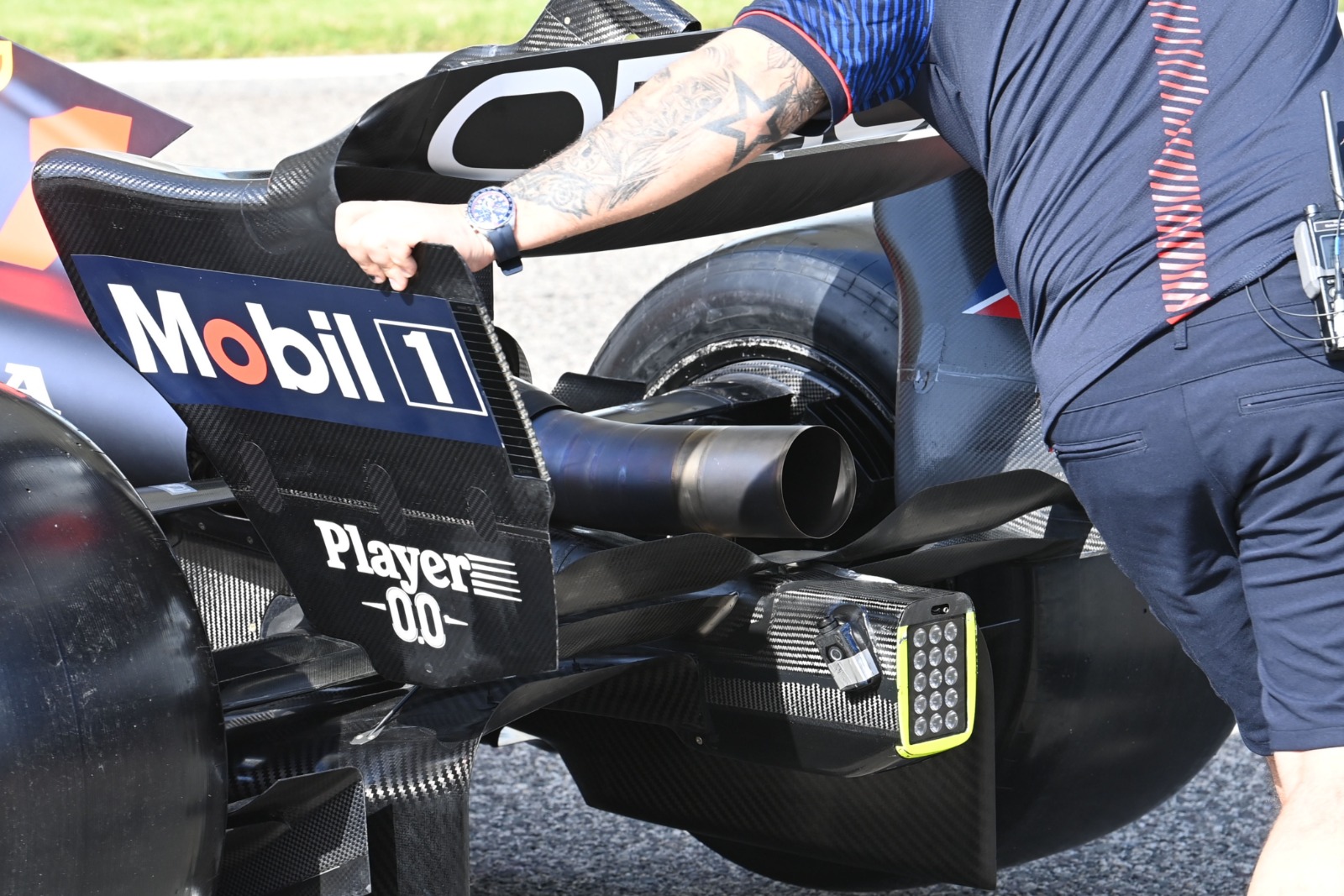
A view which could become a familiar sight for Red Bull's challengers this season

Gallery: How F1 tech evolved during the 2024 season

How McLaren’s rear wing push changed the game in F1

How 2026 F1 rules will help avoid identikit designs

The 2025 design ideas behind RB's last update of 2024

Why Ferrari changed plans with its experimental F1 floor in Qatar

How grooved brake discs are making an F1 return

How McLaren adapted to life post ‘mini-DRS’

What controls the frontline in the latest F1 design tech battles

Antonelli pole shows Mercedes is 'finally seeing the results' of car upgrades

Leclerc and Hamilton's differing theories behind Ferrari's Austin qualifying disappointment

Norris frustrated after United States GP qualifying: "I did a very bad job"

F1 United States GP: Antonelli beats Verstappen to pole with Russell only sixth
Subscribe and access Autosport.com with your ad-blocker.
From Formula 1 to MotoGP we report straight from the paddock because we love our sport, just like you. In order to keep delivering our expert journalism, our website uses advertising. Still, we want to give you the opportunity to enjoy an ad-free and tracker-free website and to continue using your adblocker.


Top Comments