


Why Norris was “surprised” to claim Dutch GP pole position
Lando Norris felt he’d had his “worst Turn 1 of the weekend” so he doubled down on commitment for the rest of the lap – and it paid off

Television has the effect of flattening many of Zandvoort’s subtleties – not least Tarzan, the first corner, where the track drops away in the last 50 metres or so before assuming a banked curve with positive camber. It takes before it gives.
Judging that entry to the lap has been rendered more perilous this weekend by regularly changing grip levels, courtesy of intermittent rain, along with a gusting wind. During grand prix qualifying, it was whipping up and slightly across the front straight, maybe helping with the braking effort, maybe not. You wouldn’t know until you got there.
That’s why a bemused Lando Norris declared himself “surprised” after claiming pole by 0.102s from Mercedes’ George Russell. He thought he’d got Turn 1 completely wrong on his final push lap – but the remainer of his lap was a study in commitment that earned the pole after Russell aced the first sector.
“Only my Turn 1 was pretty shocking,” said Norris later.
“[It] was probably my worst Turn 1 of the weekend. Otherwise, it wasn’t a lap that felt mega. It was just one where I just had to commit through everything because I knew how close it was going to be.
“We saw how close it was, but it’s one where I just kind of committed a lot more through moments and almost made more mistakes. But because I committed a lot more through some of these mistakes, I kind of seemed to gain more than I seemed to lose at times.”

Kimi Antonelli briefly occupied pole position
Photo by: Sam Bloxham / LAT Images via Getty Images
Championship leader Kimi Antonelli briefly occupied provisional pole, but felt he paid the price for not attacking Tarzan hard enough.
“In the last lap I did a mistake in Sector 1,” he said. “Took it a bit too easy seeing the rain on the visor and just, yeah, it was a really poor Sector 1. And a shame because I think we had a shot for pole.”
The rain factor
The imminent arrival of rain, expected in the final minutes of Q3, was a complicating factor given the peculiar circumstances of a weekend where heavy showers between F1 track sessions have, in effect, reset the surface. Track evolution had therefore been pronounced in sprint qualifying and it continued to be obvious on Saturday afternoon.
That added to the uncertainties of Q3, where there was an obvious incentive to get a good lap on the board in the first run in case the track became too slippery once the rain made itself felt. But if it was just a few drops, as so often this weekend, it might have little or no effect on the ramp-up of the circuit.
Norris was on top after the first runs with a 1m11.344s, 0.151s ahead of sprint race winner Russell, with Antonelli 0.331s adrift in fifth – mere thousandths quicker than Max Verstappen’s Red Bull. The second runs began slightly earlier than usual, mindful of the prognostication that rain was due to hit with five minutes to go. Antonelli was among the first to exit with six and a half minutes left on the clock, followed by Norris and Russell, who dodged past the second McLaren of Oscar Piastri at the pit exit to better his chances of an unimpeded run.
Particularly when the track temperatures have dipped, the frontrunners have found it more optimal to have a prep lap on top of the out lap before embarking on the push lap. That helps to bring the tyres on both sides of the car into the right temperature window, not just those on the more heavily stressed left side. Even then it could be hairy into Tarzan, the first corner.

Lewis Hamilton opted for a prep lap
Photo by: Simon Galloway / LAT Images via Getty Images
“Do an out-lap and a prep lap, and the tyres are still not ready for Turn 1,” said Lewis Hamilton. “It's just nuts – you just don't have the confidence to attack Turn 1.”
By the time Antonelli was rounding the banked final corner at the end of his out-lap, a ripple was running through the crowd as those not under cover began donning their ponchos. No time for a build lap: it was this or not at all.
Antonelli duly tripped the timing beam at 1m11.296s to set provisional pole. In most Q3s, the final run would be set after the clock had run down but here there was just shy of four minutes to go. Mere seconds later, Norris flashed across the line in 1m11.163s – robbing Antonelli of pole by 0.133s. Russell then bumped his Mercedes team-mate down to P3 with a 1m11.265s.
Not as close as the margins in sprint qualifying but still intriguing. Russell had gone fastest of all in sector one, set a personal best in the second sector, but then it melted away at the end of the lap. Norris set personal bests in the first and third sectors, but it was in the middle portion of the lap where he made his mark.
Ferrari took a risk committing Hamilton and Charles Leclerc to prep laps, which meant they started their push laps later – if the spits of rain had turned into a full-on shower, as it had just after the chequered flag in the sprint race, they might not have improved. As it happened, the rain petered out and both Ferraris banked faster times, just not enough to displace the McLarens and Mercedes ahead.
Where Antonelli lost out
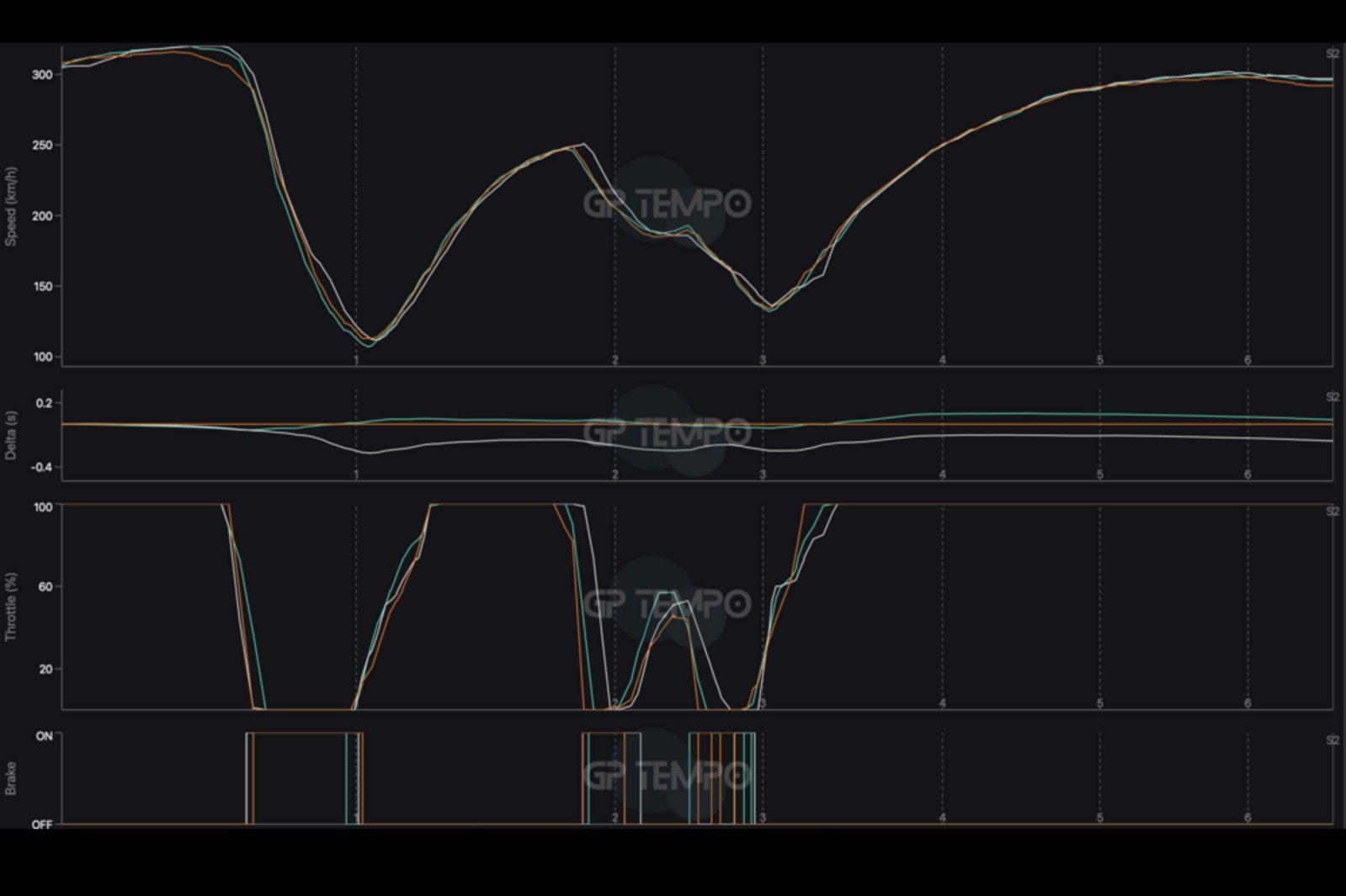
The data and onboard footage clearly illustrates what went wrong for Antonelli and Norris at Turn 1. Though Antonelli felt that he didn’t try hard enough, actually he (blue telemetry trace) carried more speed towards the apex than Norris (orange trace). But Russell (white trace) blended out of the throttle later and was able to carry more speed than both.
While Norris was last off the throttle and later on the brakes, he was already losing speed compared with both Mercedes on the approach to the corner at full throttle. A small dip in the revs at this point suggests a mild amount of clipping. Norris took a much wider line and had to make two sharp steering corrections to brush away some oversteer, but his apex and exit speeds were slightly higher than Antonelli, who hugged the apex much more tightly.
Antonelli got off the brakes earlier than both, before the apex, suggesting he had realised his mistake at this point. The net effect of all this was for him to be over two tenths down on his team-mate before his lap had properly got going. Russell also carried more speed into Turn 2, the cambered bend on the approach to the banked Hugenholtzbocht (Turn 3, or “Hugenwoofwoof as the Russell and Norris called it while rolling their tongues around the Dutch argot in the pre-event press conference three years ago). Antonelli attacked that harder but rode up onto the slippery Aramco branding on that corner’s periphery, forcing him to feather the throttle.
Norris was neater through this section and that enabled him to pick up the throttle earlier, trimming some of the gap to Russell and building some margin to Antonelli
Norris overturned Russell in sector two
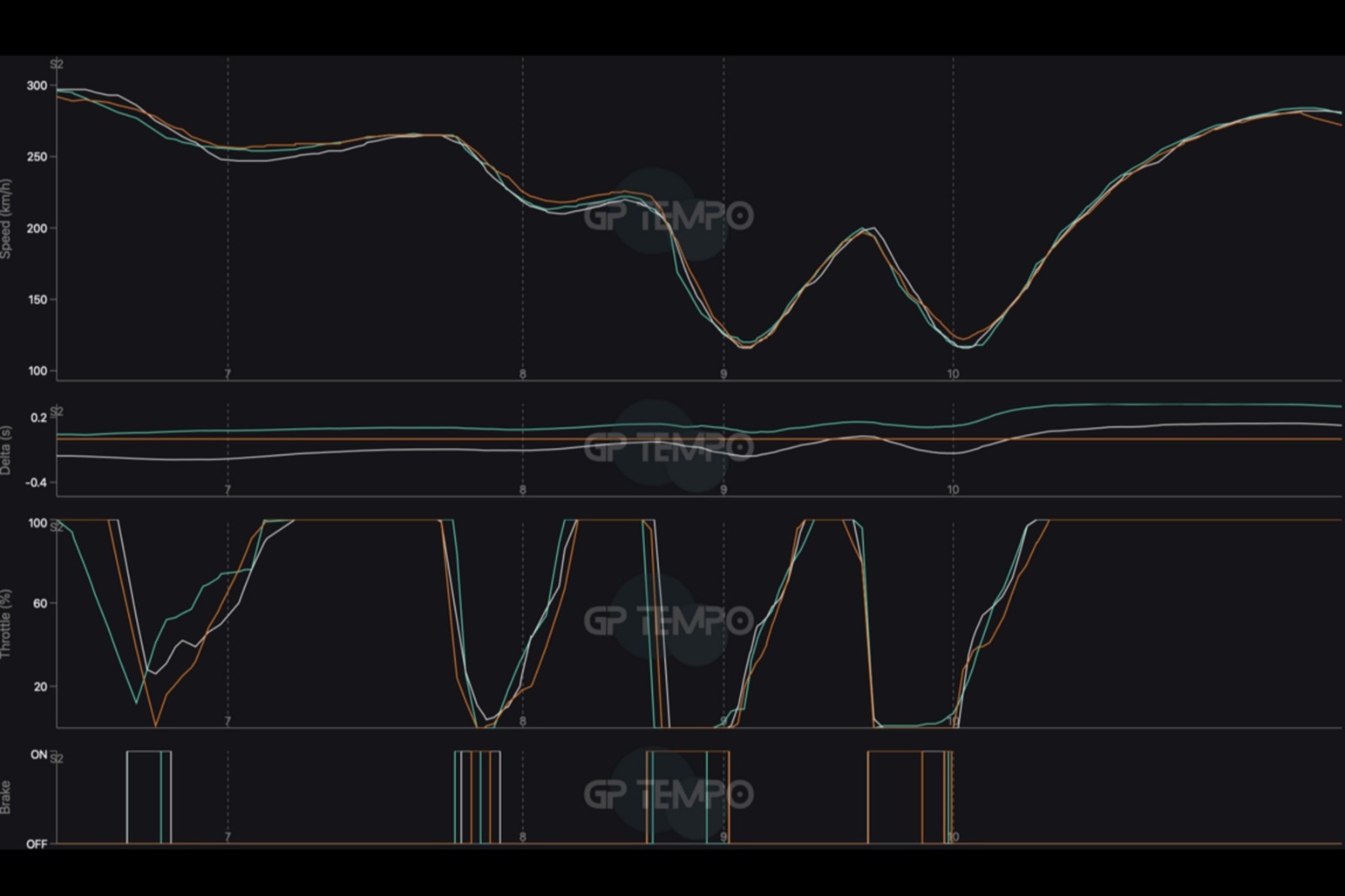
While Antonelli and Norris were both more cautious through Scheivlak, the plunging, blind-entry right-hander so notorious it has its own YouTube channel devoted to track day fails, Russell’s aggression at the apex forced him into a steering correction that sapped momentum and speed, enabling Norris to close in again.
Carrying more speed through the tight Turn 9 – where again Russell was more aggressive and had to correct – tipped the laptime balance in Norris’s favour but both Mercedes came back at him on the following straight.
Mercedes deployment couldn’t make the difference
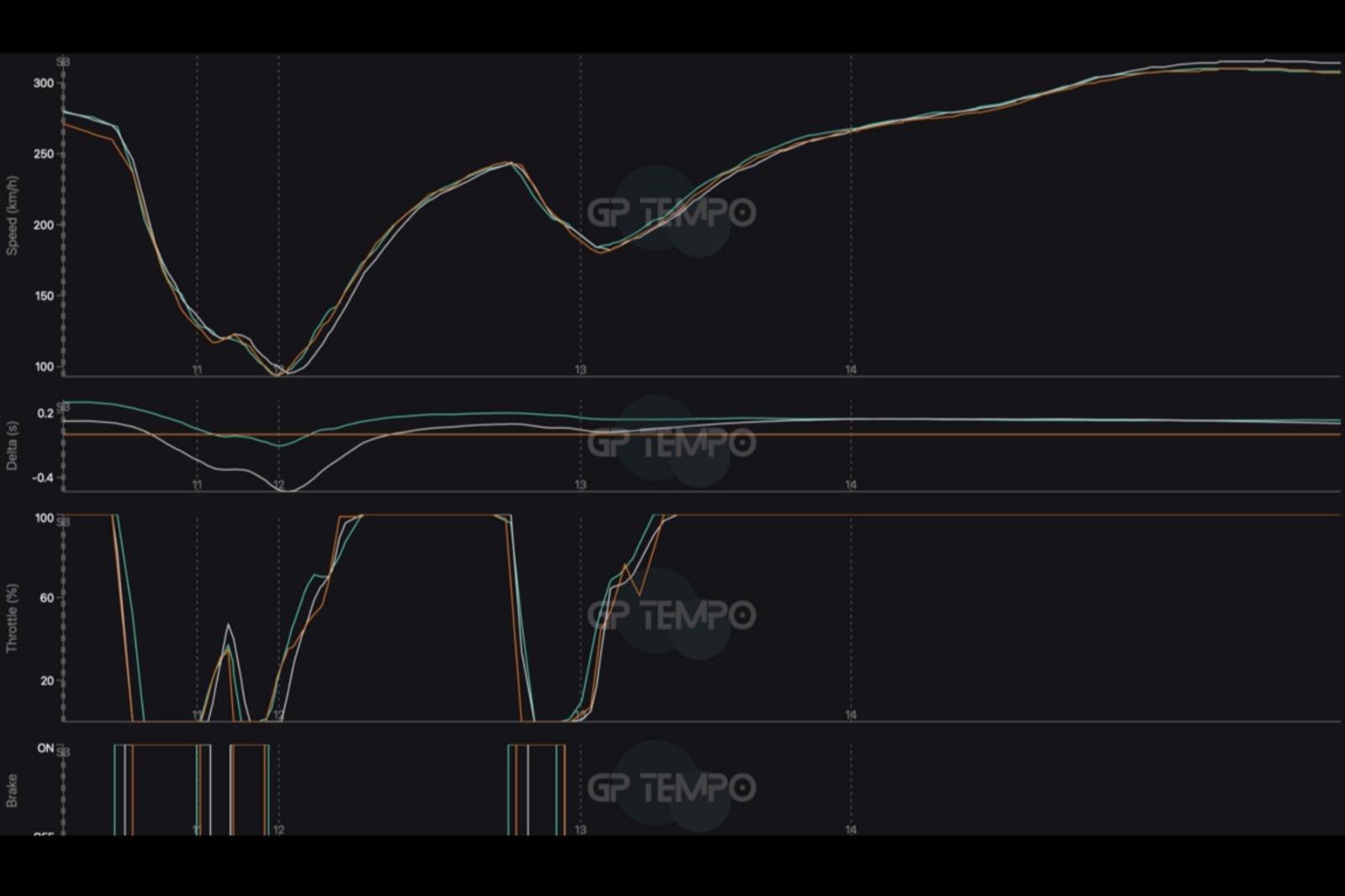
In the short straightline mode zone between Turn 10 and the chicane at Turn 11, again there was an intriguing difference in electrical deployment as Norris’ McLaren began clipping at the end of the straight, costing him around 10km/h and enabling both Mercedes to invert the laptime delta at the entrance to the chicane.
But, again, Russell’s aggression didn’t quite pay off and in trying to carry more speed through the second apex, he was forced into more steering corrections and a later pick-up of the throttle. Norris then got to full throttle earlier than both Mercedes and it’s here – likely as a consequence of having more electrical energy available because of the different approach to the chicane – that he was able to invert the delta again in his favour on the short dash towards Turns 13 and 14.
If Norris seemed slightly downcast for one who has claimed pole position, it was perhaps because his McLaren had laboured with tyre degradation during the earlier sprint race. In recent years McLaren chassis have generally been kinder to their tyres in race trim but less effective at switching them on in qualifying. For this year’s car the team has endeavoured to nudge the characteristics slightly towards better quali performance, but in some instances this has made race pace challenging.
“The positive is that we confirmed the car performs very well in qualifying trim,” said team principal Andrea Stella.
“You know, pole position in Hungary, pole position here in Zandvoort, so definitely in these high downforce circuits it looks like our upgrades are working well and the car can be the best car, even if the gaps are very, very small. At the same time, we saw in the sprint race that not necessarily we were the best car in terms of consistency and tyre degradation.
“So, the main focus now shifts on to making sure that we can do a bit better using our tyres than what we have done in the sprint race.”


How F1 let a golden opportunity slip at Sepang

How the Bahrain GP in Malaysia exposed Red Bull’s hidden resurgence

How Verstappen’s two subtly different laps beat Hamilton in Bahrain GP in Malaysia qualifying

Why Mercedes' upgrade is still a "big question mark"

F1 Bahrain GP in Malaysia: Leclerc leads second practice from Hadjar

LIVE: F1 Bahrain GP in Malaysia updates - FP3

F1 Bahrain GP in Malaysia: Verstappen dominates for pole from Hamilton

LIVE: F1 Bahrain GP in Malaysia - Verstappen wins from Antonelli, Russell DNFs after late engine failure

No denying it now – the one reason why F1’s ‘horrible’ start in Malaysia could be a good thing

Inside Alonso's decision to contest the 2027 Dakar Rally with Aston Martin

The greatest F1 campaigns with no wins

MotoGP to introduce sprint qualifying amid 2027 format changes
Subscribe and access Autosport.com with your ad-blocker.
From Formula 1 to MotoGP we report straight from the paddock because we love our sport, just like you. In order to keep delivering our expert journalism, our website uses advertising. Still, we want to give you the opportunity to enjoy an ad-free and tracker-free website and to continue using your adblocker.


Top Comments