


Cadillac retaining Bottas for F1 2027 is the logical move
Keeping Valtteri Bottas in the fold for 2027 signals an understanding that the car remains a problem, and developing it is the priority over cheap PR gains


Valtteri Bottas, Cadillac Racing
Photo by: James Sutton / Formula 1 / Formula Motorsport Ltd via Getty Images
The longest-running contract saga of the Formula 1 season is now at an end. Not that it has been blockbuster material, since it revolves around a team struggling to lift itself from the back of the grid.
Still, the easy option for Cadillac F1's stakeholders would have been to throw Valtteri Bottas under the bus after a year in which he has been outqualified by team-mate Sergio Perez 11-9 – and finished behind the Mexican in five of the six races where they both reached the chequered flag. The optics of falling off Perez to the tune of up to two seconds a lap in Azerbaijan and Singapore were conspicuously bad.
While Bottas is liked and respected within the team, the delay in coming to a decision to trigger the extension clause within what's understood to have been a "one plus one" contract is very telling.
It's been known since the summer that there is a significant disparity between the team's own assessment of its progress and that of its ultimate owners. In common with the majority of the F1 paddock, former team principal Graeme Lowdon was wont to opine that getting two functional cars to the grid in the season opener was a tremendous achievement, given the compressed timescales involved in setting Cadillac up from scratch.
But the cars haven't always been functional and certainly haven't looked like escaping from Q1 regularly. Owner TWG Motorsports and its partner, General Motors, clearly expected much more than this, hence the summer decapitation exercise in which Lowdon was axed in favour of Marcin Budkowski, the former aerodynamicist who has latterly held senior management and technical roles with Alpine and the FIA.

Although there have been outlier DNFs caused by engine issues and ‘finger trouble', such as the cross-threaded wheelnut that eliminated Bottas from the Sao Paulo GP, a statistically significant cluster of reliability and performance problems relate to managing brake temperatures. While these have resulted in retirements through failures in the brakes and adjacent components (such as the suspension), they have also compromised performance in races the drivers actually finished (ie through having to lift-and-coast).

Valtteri Bottas, Cadillac Racing, Sergio Perez, Cadillac Racing
Photo by: Mark Thompson / Getty Images
While Lowdon often described the brake-temperature issues as symptomatic of the challenges a ‘new' team faces, this clearly didn't wash with his ultimate bosses. But here we run into the knowledge gap between experienced engineers and armchair experts. It would be very easy, with the wave of a pen or some clattering on a keyboard, to say the solution to excessive brake temperatures is to fit bigger ducts.
The actual science is rather more complicated than that, since the aerodynamic detailing required to optimise brake cooling has to consider management of the airflow and temperatures across both axles, and factor in the tyres as well. It's a delicate interplay of compromises which defies easy answers.
Bottas has also frequently alluded to unexplained fluctuations in performance the team has yet to understand.
With all this in mind, keeping faith with an experienced driver line-up makes rational sense, although it is understood to have been the topic of much debate behind the scenes. One only has to witness the usually eloquent Budkowski's tongue-tied responses to questions on the subject to realise there have been significant differences of opinion at senior level.

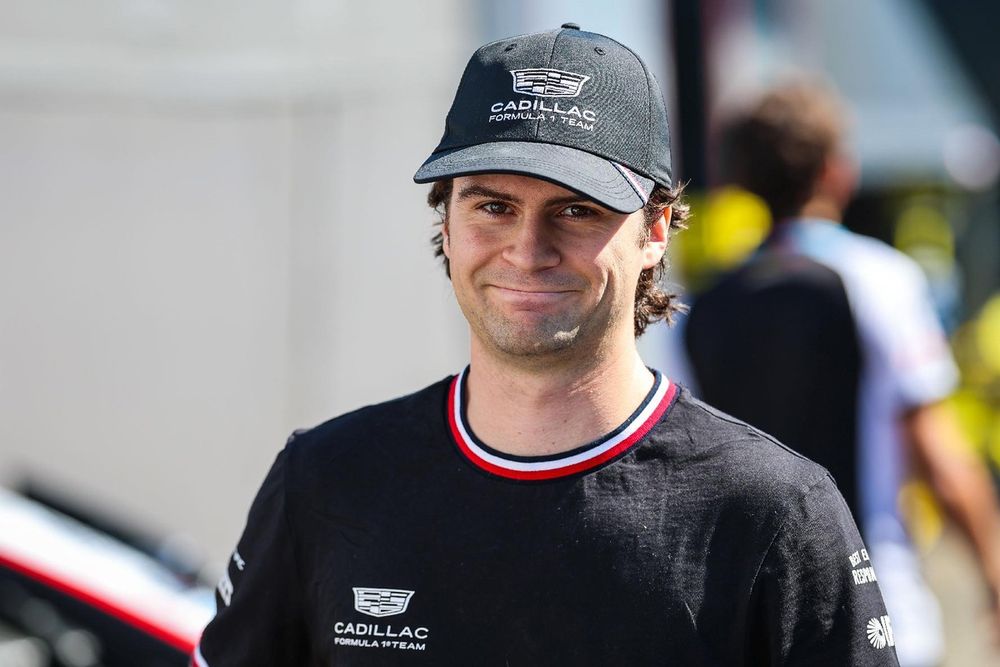
TWG Motorsports CEO Dan Towriss has invested a great deal of energy in supporting Colton Herta, the team's test and reserve driver, through the transition from IndyCar to Formula 2.
Cadillac's stated aim is to bring an American driver into Formula 1.
"I back myself 100 percent on everything," Herta said after his FP1 outing in Mexico. "I can be as quick as anybody. I think I have the capability of learning very quickly too, and picking up on things. So 1000 percent, I back myself in being able to do this [getting an F1 seat].
Colton Herta
Photo by: Kym Illman / Getty Images
"Whether that means next year or the following year, I really don't know what the plan is at the moment. We'll have to wait and see. I think some decisions will hopefully be made within the next month."
That prognostication came true, but the result was that Herta will remain in a holding pattern for now. It's understood that Mercedes test and reserve driver Frederik Vesti entered the conversations regarding 2027, since he is known to TWG Motorsports on account of racing for Cadillac in IMSA.
Realistically, though, Vesti is on the glide path to a career in sportscars having not competed in single-seaters since 2023, when he was Oliver Bearman's stablemate in F2 and finished runner-up to Theo Pourchaire. Mercedes insiders describe him as a safe pair of hands, but two or three tenths off the team's full-time F1 drivers.
Likewise Jak Crawford, who would tick the US-born driver box and is currently Aston Martin's reserve, wasn't considered a meaningful performance upgrade on Bottas. Esteban Ocon, fresh on the market after being dropped by Haas, wasn't even a fringe candidate given his previous bad blood with Perez, along with his well-known tendency to be spooked by the kind of technical poltergeists to which the Cadillac seems prone.
In the longer term there is Ugo Ugochukwu, who is moving up to F2 next season after taking the F3 title this year. Ugochukwu's stock has risen again after a difficult rookie F3 campaign in which he appeared caught up in the wider issues afflicting the Prema organisation, and was dropped by McLaren from its driver-development programme. But doubts remain over whether his 1.92m frame can be accommodated in an F1 car without compromising performance, given the inherent packaging limitations of the current formula.
For 2027 at least, there will be no change in the line-up. What this makes very clear is that a consensus has been reached, however uneasy, that car performance remains Cadillac's biggest shortcoming – and sacrificing Bottas won't fix that.

Share Or Save This Story


The factors behind the abortive 2030 F1 rules announcement

What has Cadillac got to lose by picking Herta?

What the Brazilian GP revealed about F1's ability to cope with rain


Cadillac completes F1 2027 driver pairing

Herta qualifies for F1 superlicence as Bottas remains bullish on 2027 seat

You Ask The Questions: Valtteri Bottas


Liverpool FC owners emerge as potential buyers of Cadillac F1 shares amid TWG uncertainty

Herta to contest FP1 for Cadillac in Brazil to obtain final superlicence point

Why Sergio Perez shows vote of confidence in Cadillac despite mixed 2026 debut

Cadillac retaining Bottas for F1 2027 is the logical move
Cadillac completes F1 2027 driver pairing

Formula E Jarama test: Mortara tops day two of Gen4 running

F1 to showcase driver health data in new partnership
Subscribe and access Autosport.com with your ad-blocker.
From Formula 1 to MotoGP we report straight from the paddock because we love our sport, just like you. In order to keep delivering our expert journalism, our website uses advertising. Still, we want to give you the opportunity to enjoy an ad-free and tracker-free website and to continue using your adblocker.


Top Comments