


Why new Madrid F1 circuit will be a "challenging" test of cars and engines
High loading through the track's signature banking will put unprecedented stresses through the suspension and potentially cause oil starvation
Autosport Explains
Our experts decode the most important stories in motorsport.
While the idea of a street track around an exhibition centre wouldn't ordinarily set the juices flowing, the architects of Madrid's new F1 circuit have incorporated a bold feature which has become a key talking point in the past few months. A recent Formula 3 test at the Madring proved chaotic, with 19 red flags and a casualty list of three damaged chassis.
'La Monumental' isn't the steepest banked corner in the history of the world championship but, at 550m, it is the longest. At 13.5 degrees it's steeper than the banked 'final' corner at the Indianapolis 'roval' which hosted the US GP between 2000-07, but shallower than the 18-degree turn that ends the lap at Zandvoort.
However, Zandvoort's final corner is much shorter and, since it leads onto a relatively long straight, the effective limit in a 2026 F1 car is power rather than outright grip.
Simulations have predicted cars will be at full throttle through 'La Monumental' for over four seconds. Tyre supplier Pirelli has said that grip will be the limiting factor here rather than power, and it will put savage lateral loads through the tyres and chassis.
The loadings will also affect the mechanical functions of the car: unusual stresses through the suspension members, along with the hydraulics, cooling and lubrication systems. For performance reasons, F1 cars run at the margins of both cooling and lubrication: teams work with suppliers to find the minimum possible viscosity levels for the oil, for instance, to reduce internal power losses. Anything that interrupts the flow can therefore be highly damaging.
High lateral loads can push oil in unusual directions within the engine, affecting the pump's ability to scavenge it from the usual sources. The lubrication system also has an interdependent relationship with the cooling architecture, and therefore the aerodynamics, because cutting friction also reduces heat, enabling the sidepod apertures to be as small as possible.
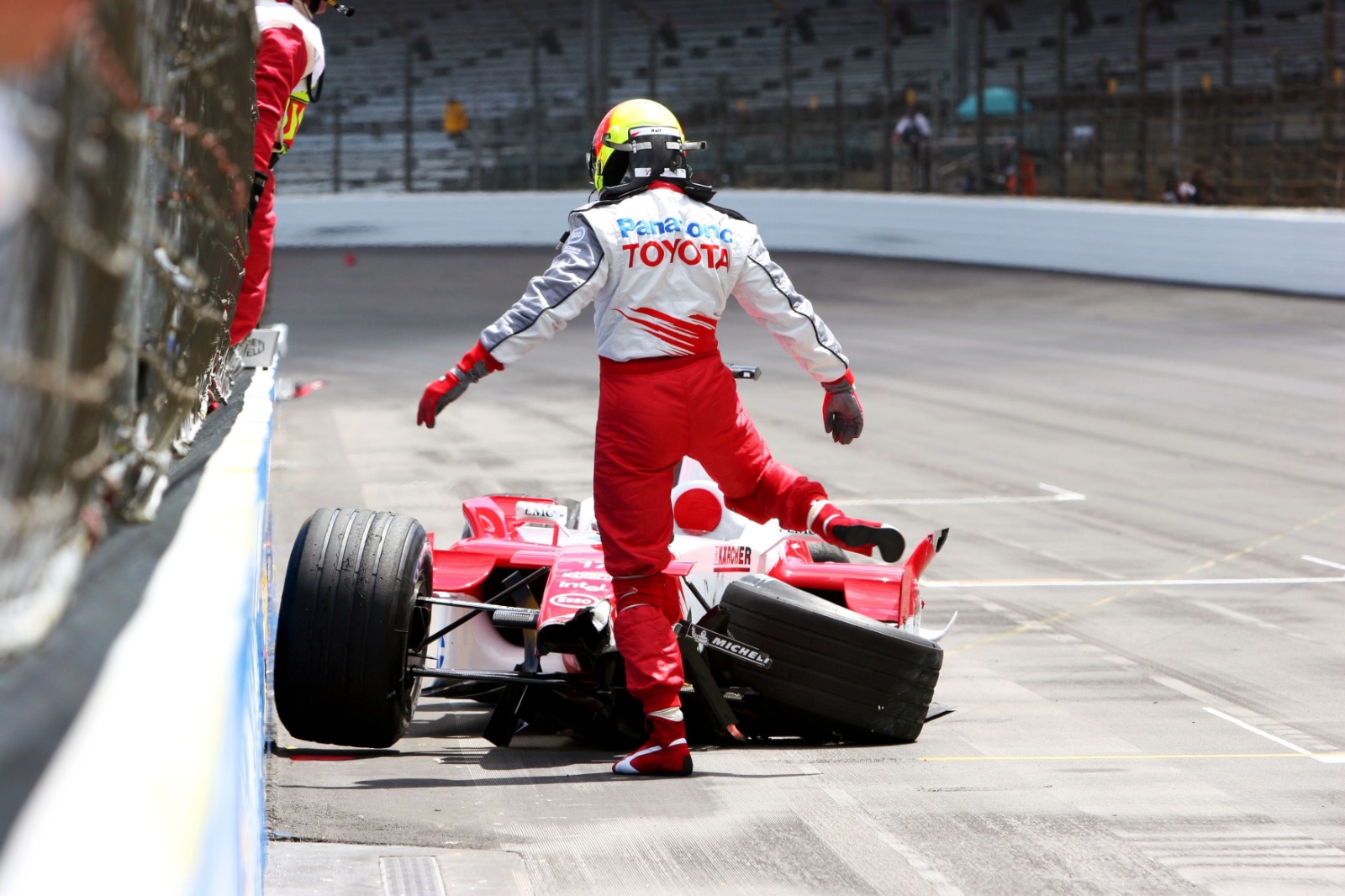
High g-loadings through the banked corner at Indianapolis caused a spate of tyre failures for the Michelin runners in 2005, prompting this Basil Fawlty moment for Ralf Schumacher ahead of a wider political meltdown
Photo by: Getty Images
"Yesterday I did track running and I saw the banking corner," said Honda chief engineer Shintaro Orihara.
"And that is quite challenging and interesting, the main point is the lubrication system, we have G [loadings] for the lateral side and also vertical side, so it is quite challenging for lubrication system. We may start from conservative setting for lubrication and then we will see where we are and then we will reduce margin step by step for the cooling."
When asphalt is freshly laid, some of the liquid bitumen used to bind the aggregate tends to rise to the surface as it cools, leaving an oily residue. After the incident-strewn F3 test at the Madring, the organisers jetwashed the track surface to improve grip levels.
So although all the teams have had the opportunity to do simulator running of the circuit, the exact levels of grip will be uncertain until the cars start running. This will inevitably ramp up throughout the weekend, presenting a changing picture.
"I think the most important for all of us, and this applies to every team, including competitors, is that we need to have the wheels turning in FP1 and FP2, so that we can optimise the car," said Aston Martin's chief trackside officer Mike Krack.
"We can get a good feeling of the grip, we can get a good feeling of the track, how it is developing. And we must not forget also, it's the same for the tyres – we need to find what are the best tyres for Sunday.

A general view of the circuit
Photo by: Simon Galloway / LAT Images via Getty Images
"So I think a good level of conservatism to start driving, not only on the set-up side, on the engine side, on the lubrication, more conservative. This applies also to the car, you cannot run the car on the ground [low ride height] to start with, because maybe you put them out somewhere and the driver loses it, and you lose the session.
"I think everybody will go a bit conservative to start with, and then build step by step. I always say the wheels need to turn, and even if there is a yellow, even if there is a red, come back, calm down, not panicking. And even if you lose some time, it's really important to keep a cool head.
"There might be something on the track that happened, or the FIA might have to change something. Obviously we don't know, so there is a lot of unknown at the moment – and I think conservatism to start with is key, and then go from there."


How both Verstappen and Antonelli were “surprised” in United States GP qualifying

The intrigue caused by Cadillac's F1 boss dodging driver market question

McLaren's aims for its final F1 2026 upgrades amid decline in form

"It's pretty bad" – Why Norris needs headache tablets for bumpy Austin circuit

Why it's now Bearman versus Camara for the next Ferrari vacancy

Why Hamilton’s return to form is not straightforward

'Senior moment' or breakdown of trust? The implications of Hamilton's Singapore GP meltdown

Why Verstappen's dominance left rivals scrabbling for alternatives in Singapore

Pryce pips McRae in final stage showdown to win British Rally Championship

Dakar Rally moves 2027 event out of Saudi Arabia; new location to be announced

How both Verstappen and Antonelli were “surprised” in United States GP qualifying

Inside COTA's Turn 1 clubhouse and its plans to build a second track
Subscribe and access Autosport.com with your ad-blocker.
From Formula 1 to MotoGP we report straight from the paddock because we love our sport, just like you. In order to keep delivering our expert journalism, our website uses advertising. Still, we want to give you the opportunity to enjoy an ad-free and tracker-free website and to continue using your adblocker.


Top Comments