


McLaren's aims for its final F1 2026 upgrades amid decline in form
Slow-corner performance remains a problem for the "knife edge" MCL40, so McLaren has been working towards a revised suspension geometry as well as a different aerodynamic philosophy

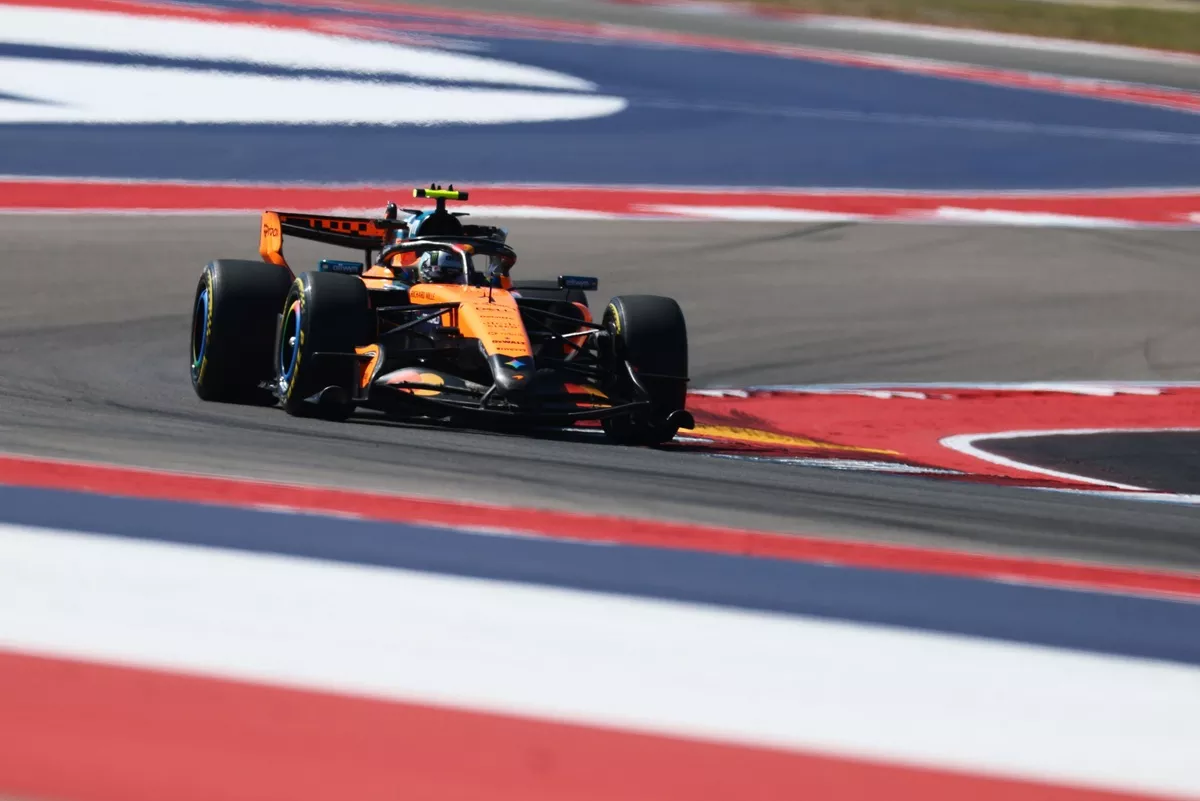
Lando Norris, McLaren
Photo by: Clive Rose / Formula 1 via Getty Images
"To get the car to be quick, we just have to try so hard to be perfect, and you cannot be perfect," said Lando Norris after practice for the Formula 1 United States Grand Prix in Austin.
"We're just a step behind."
Two mid-season wins for Norris now appear to be a 'purple patch' rather than harbingers of a competitive renaissance for McLaren after a troubled start to the 2026 season. At the US GP it introduced the first elements of what will be the final upgrade package of the year, due to be introduced in stages between this event and the Las Vegas GP.
Although by mid-season McLaren had developed the MCL40 to the point where it was among the fastest cars through quick corners, straightline speed and slow-corner performance have continued to be problematic, as has its nervous demeanour. Development has had to balance the process not just of creating theoretical performance, but also of making the car benign enough for the drivers to tap into that potential.
"It's just on a knife edge on every single corner," said the reigning world champion in Singapore. "You've just got to drive it within an exact percent, and you have to force the car in every single way. You can't let the car do any work. You can't just let the front do the work, or the rear do the work. You have to force the front; you've got to force the rear.
"You've got to drive it in a way that takes so much concentration and so much ability. It's just full-on and mentally draining because of how hard you have to work behind the wheels.
"It's just too difficult and it makes it impossible to put laps together in qualifying, which just shows how good of a job we were able to do when we were getting on pole [in Hungary, the Netherlands and Spain], and how rewarding that felt."

Lando Norris, McLaren
Photo by: Angela Weiss / AFP via Getty Images
Slow-corner performance isn't just a function of aerodynamics. Although Norris has a more adaptable style than many other drivers, even this requires the car to have a certain set of virtues. He takes a shallower approach to the apex than others, overlapping throttle and brake to a higher degree. His strength is a tremendous feel for where the front tyres pick up lateral grip mid-corner, which he exploits to help rotate the car.
What operates against him is the trend towards running a high degree of anti-squat, anti-dive geometry in the suspension. Although this stabilises the car's aerodynamic platform, it smothers the transmission of 'feel' about the changing state of grip at each axle. Shorn of this, Norris can't trust either end of the car – which is why, last year, his performances picked up dramatically after a slow start when McLaren developed an alternate front suspension geometry suspension for him.
In that context it's no surprise that McLaren has led with a revised front-end geometry for this latest update in Austin, along with reprofiled diffuser furniture. It's understood that the next phase of the upgrade will be applied in Brazil, with more arriving for Las Vegas depending on manufacturing timescales.
The new components McLaren will bring to the car in the coming races were signed off between the Dutch GP in late August and the Italian GP in the first week of September, and have been making their way through the production process. McLaren's design resources have been fully focused on the 2027 car ever since.
Insiders say the team identified a new aerodynamic direction during the April interregnum caused by the cancellation of the Bahrain and Saudi Arabian grands prix. The belief was that it would ultimately lead to a higher performance ceiling than the concept with which the team started the season.
This is a relatively typical occurrence in F1, especially during a new rules cycle. But it is very easy to leap to the conclusion that an upgrade package has somehow been a failure if it doesn't deliver an immediate and significant lap time uplift. From an engineering point of view it is simply establishing a new baseline.

Lando Norris, McLaren
Photo by: Simon Galloway / LAT Images via Getty Images
McLaren introduced the first iteration of its new aerodynamic concept in the Azerbaijan GP weekend, centring around a dramatically different sidepod profile, along with heavily revised geometries for the flow conditioners in and around the diffuser, the leading edge of the floor, and the rear suspension fairings. The team was careful to manage expectations, emphasising that it wasn't expecting a major improvement in lap time straight away.
Circumstances then combined to make the new configuration appear, superficially, to be ineffective: Norris was stymied by a fuel injection problem while Oscar Piastri laboured to keep the Red Bulls of Max Verstappen and Isack Hadjar behind him in the early phase of the race, then dropped out of the points after locking up at the second safety car restart. Later the team admitted that at least some of the straightline speed deficit was a consequence of not getting the most out of its Mercedes power unit.
"We will be having some more upgrades coming for the final part of the season, which is the kind of upgrades that follow the foundation set with the upgrades we delivered in Baku," said team principal Andrea Stella after the Singapore round.
"The step in Baku wasn't expected to be big, but it was foundational for some stuff that we will start taking trackside as of Austin and for the coming races. So what's most important for me is that I look forward to seeing our competitiveness from the next race. And hopefully we will be back to being in condition to score podiums and hopefully, once the full package is delivered, to compete for the victory."
McLaren isn't the only team to find itself combatting instability as it tries to add performance to its car. Mercedes went to the extent of running two different car specs in Singapore to try to understand the behaviour of its latest upgrade – but, notably, it has opted for the latest spec in Austin. As Norris explained ahead of the US GP weekend, upgrading an F1 car isn't a predictable and linear process.
"Upgrades are not always just you put them on and things work," he said. "They're not always easy to get the full potential out of. I think we've had a car which has just been still so, so difficult to drive. Yes, we won two races and I had a couple of podium positions, but it was by tiny margins. With a car like that, you'll not be able to do that consistently.
"We need to also improve the car in terms of ease of driving and ease of extracting performance."

Share Or Save This Story


"It's pretty bad" – Why Norris needs headache tablets for bumpy Austin circuit

Why it's now Bearman versus Camara for the next Ferrari vacancy

Why Hamilton’s return to form is not straightforward


Norris promises to make "better decisions" following fresh talks over Singapore GP clash

Why McLaren cannot fix its F1 car handling until 2027

F1 doesn't need to change its VSC rules despite Norris' Spain loss


Why Piastri has struggled to show his best with this year's McLaren MCL40

McLaren retains Fornaroli as F1 reserve and hands him WEC programme for 2027

Employing team orders can simply be a matter of common sense

McLaren's aims for its final F1 2026 upgrades amid decline in form

What would you like to ask Jack Miller?

F1 United States GP: Leclerc pips Antonelli to top FP2 while McLaren struggles

F1 United States GP live commentary and updates - Leclerc leads FP2
Subscribe and access Autosport.com with your ad-blocker.
From Formula 1 to MotoGP we report straight from the paddock because we love our sport, just like you. In order to keep delivering our expert journalism, our website uses advertising. Still, we want to give you the opportunity to enjoy an ad-free and tracker-free website and to continue using your adblocker.


Top Comments