


Why Mercedes is now F1's fifth-greatest team
Mercedes is closing on a new F1 history milestone after its fifth constructors' championship, and it's now among the all-time greats not just on statistical grounds but for the template it's set for how to create a modern F1 powerhouse

Who won the 2018 Formula 1 world championship? Lewis Hamilton, most would reply. Not Mercedes. Perhaps Lewis Hamilton for Mercedes, but few would simply say Mercedes.
F1 is, in the public perception, the drivers' championship, with the constructors' championship a secondary prize. That was certainly how many felt when Mercedes wrapped up that title in Brazil last weekend. It was a postscript to Hamilton's title victory in Mexico two weeks earlier.
Yet the constructors' championship is crucial to teams, not only because it dictates how much 'Column 2' cash they get paid out of F1's revenues, and there are bonuses available for winning it, but also because it proves that over a full season, with two cars, you have been the best. It means everything to those working for teams, and so it should.
Just look at the reaction to Hamilton's Interlagos victory, which secured the constructors' crown. The swell of team members congratulating him led to the parc ferme fence being knocked over under sheer weight of enthusiasm.
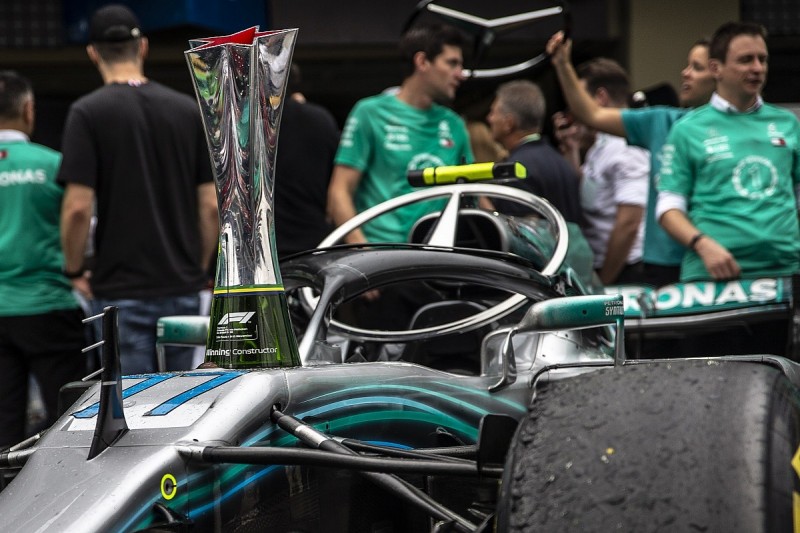
And rightly so, this is an incredible achievement and the vast number of people who have contributed, most of them names you will never know, deserve to revel in what they have done. Congratulations to every single one of them.
This disconnect in perception outside and inside is unavoidable, for people engage more easily with flesh and blood than they do with nuts and bolts.
But that's no excuse to overlook the significance of what Mercedes has now achieved in Formula 1. Amid the endless lively debates about F1's greatest drivers, we must make time to consider the greatest teams. Mercedes has now forced itself into that debate.
The logical place to start is with the numbers. Mercedes has now climbed to fourth place in the list of victories by constructors, ahead of Lotus. This is a remarkable feat given it was outside the top 10 just six years ago.
F1 wins by constructor
| 1 | Ferrari | 235 |
| 2 | McLaren | 182 |
| 3 | Williams | 114 |
| 4 | Mercedes | 86 |
| 5 | Lotus | 81 |
| 6 | Red Bull | 59 |
| 7 | Brabham | 35 |
| 8 | Renault | 35 |
| 9 | Benetton | 27 |
| 10 | Tyrrell | 23 |
In terms of constructors' championships, Mercedes is now fifth overall having moved clear of Red Bull this year and would likely be equal with Lotus on seven had the constructors' championship existed in the mid-1950s.
On top of that, it has carried Juan Manuel Fangio, Hamilton and Nico Rosberg to a total of seven drivers' crowns - putting it behind only Ferrari and McLaren and level with Williams on that front.
Constructors' championships
| 1 | Ferrari | 16 |
| 2 | Williams | 9 |
| 3 | McLaren | 8 |
| 4 | Lotus | 7 |
| 5 | Mercedes | 5 |
| 6 | Red Bull | 4 |
| 7 | Cooper | 2 |
| = | Brabham | 2 |
| = | Renault | 2 |
You cannot dispute that Mercedes is now one of F1's great constructors and teams (which are slightly different things), and that would have been difficult to argue just a few short years ago. But exactly where it should rank is muddier.
Treating the success of 2014-18 as a self-contained run, the obvious comparison is Ferrari's supremacy at the start of the century.
Mercedes has now equalled Ferrari's once-unique record of five consecutive drivers' and constructors' championship doubles. To that, we must add the footnote that Ferrari actually won six constructors' titles in a row, and but for his broken leg Michael Schumacher would surely have won the 1999 crown Eddie Irvine came close to taking.

So if Mercedes does the double again next year, which is entirely possible, that will definitively eclipse Ferrari's achievement and set a new standard for success. No team has completed a sextet of double titles in F1.
But we aren't talking just about a single run of success, formidable as it is. And a prerequisite of being one of the true great teams is to have multiple periods of success, which is where the history of Mercedes in F1 comes into play.
When things go well, Mercedes does not get carried away with how well it's doing, and when things go badly there is no panic
Mercedes is arguably one of eight teams that have had multiple spells of success in F1 along with Ferrari, McLaren, Team Lotus, Williams, Brabham, 'Enstone' (including success under the Renault, Benetton and Lotus banners) and Tyrrell.
Five years ago, I made the argument that Red Bull had moved to the front of the chasing pack, making it F1's eighth greatest team but still needing a 'second coming'. That stands to this day given it has spent the past five seasons sniping only for occasional victories.
So Mercedes has now moved ahead, meaning we just have to decide where it should stand in that top eight.
The idea of 'Mercedes' as a grand prix team is more complicated than it might first seem. The victories credited to it in the above list were secured in two stints, the first in 1954-55 when Fangio won it a couple of drivers' titles. The constructors' championship didn't appear for the first time until 1958, by which time Mercedes was long gone in the aftermath of the '55 Le Mans disaster.

The first nine of the F1 victories credited to Mercedes were taken during this period, in a span of just 12 races. The subsequent 77 wins have been taken by the current incarnation of the team, which came into being at the start of 2010.
So immediately, we have two distinct teams contributing to this success. And while the Ferrari of the mid-1950s is undeniably the same team as the one that races today, given the continuous history, this Mercedes team has no direct line connecting it to the 21st century version other than the parent company.
Now things start to get more complicated. What we should call 'Team Brackley', in deference to the town in the UK where it's based, has previously existed under three different names: Brawn in 2009, Honda from 2005-08 and BAR from 1999-2004.
Add to that the fact that it's the same company (registered number 00787446) as Tyrrell, thanks to its original incarnation as Tyrrell Racing Organisation Limited from 1964-98, and it becomes ever-more difficult to tie down exactly what we are talking about by 'team'.
Mercedes could technically lay claim to all of that history (an additional 42 victories along with four drivers' and three constructors' championships) given it is the same legal entity. That, of course, would allow it to add wins with Matra, March, Tyrrell and Honda machinery and move ahead of Williams to third in the victories list.

It would be absurd to let Mercedes claim so much success it had nothing to do with. And when BAR arrived in 1999 it was, to all intents and purposes, a start-up that did draw from the old Tyrrell team but basically rebuilt it having demolished all that once existed in order to get a place on the grid.
But it would be perfectly legitimate to take the Brackley era, so from 1999 as BAR to today, and consider it a single, successful, entity. You would then have to wipe out the earlier Mercedes success as you are focusing on a team entity rather than a manufacturer entry. Tricky.
So which version of the team are we going to focus on? It's most logical to consider the period that runs from the start of BAR in 1999 through to the present day, although it takes in four separate identities, as one 'team history'.
There is continuity of facilities and some staff, even though this slight oddly means it's a mash-up of Mercedes, Honda and British American Tobacco ownership. But to this, we do have to add the success in 1954-55 with Mercedes' original works team - giving us Mercedes (1950s) + BAR + Honda + Brawn + Mercedes (2010s) as one line of history, but not including Tyrrell.
The Mercedes Brixworth engine base wasn't involved with Brackley until the Brawn season, and this also throws into stark focus the job it's done in making the team so successful.

The BAR/Honda version of the team is remembered by some who worked there as an underachieving political minefield, despite the success it enjoyed with Jenson Button spearheading it to second in both championships in 2004 and then winning the '06 Hungarian GP.
By the time Honda withdrew, Ross Brawn had made significant progress in turning things around and it was under his name that Brackley reaped the rewards of his decision to play the long game and focus on 2009 and the new aerodynamic regulations.
Brilliantly, Brawn and his comrades in the management buyout of the team (that basically led to them being given the team and a running budget for 2009), then sold it to Mercedes as a turnkey world championship-winning operation.
Realistically, it wasn't quite that as the cuts necessitated by the Honda withdrawal meant it required significant rebuilding. But Mercedes doubled down, upped its investment and emerged as a race-winning force in the two seasons before the all-important 2014 regulation changes that introduced the V6 turbo hybrid engines.
The remarkable work Mercedes did on those new engines was key to the dominance of 2014. But even more impressive is what it has done since, repeatedly seeing off Ferrari's attempts at resurgence and doing something unique in F1 history - maintaining its place at the top through a major rule change from '16 to '17.

Mercedes also has a special culture. When things go well, the team does not get carried away with how well it's doing, and when things go badly there is no panic. There's simply honesty, self-analysis and, crucially, a response.
That's reflected in its attitude towards fans and media, regularly offering full and frank explanations of what's going on.
Contrast this to Ferrari - Maurizio Arrivabene's team outwardly projects itself as fearful and politically ravaged, and it tells you a lot about what might be preventing it from realising its potential.
Perversely, this appears to happen not because Ferrari has contempt for the media and public, but because it's in thrall to its perception in Italy. Think back to the early days of Ferrari's 1990s revival, when Brawn put a stop to press cuttings being distributed to departments within Maranello, and it tells you something very important about culture.
That's also reflected in the fact that Mercedes has sent up a varied cast of personnel onto the podium over the years, recognising that all parts of the team contribute to its success. It's that virtuous circle that allows it to respond to extract its maximum potential.
Nonetheless, Ferrari is close. Perhaps doing something to correct that pressure-cooker, public perception-based environment should be high on Arrivabene's wish list for next year.
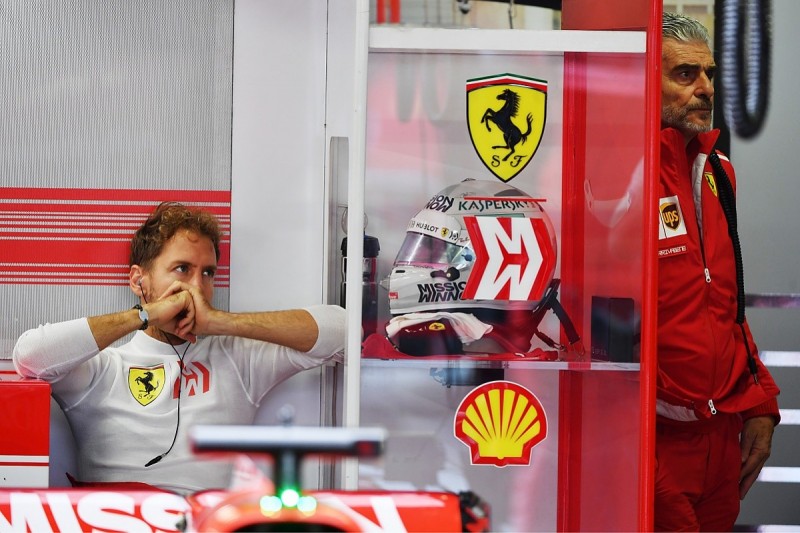
If Ferrari carries out such a change, perhaps it will make good on its flirtations with winning a title. Esteban Ocon described Toto Wolff as a "psychologist" in terms of his treatment of people during the Brazilian GP weekend. That's something Arrivabene is, by all accounts, not. Perhaps this culture has also contributed to Sebastian Vettel's run of errors?
But to beat Mercedes - and Mercedes will eventually be vanquished by somebody, whether it's Ferrari or Red Bull - Ferrari needs to take another step. That's what makes Brackley so strong today. Yes, budget is important - but it isn't the only team with big money and great facilities.
Mercedes now arguably stands behind only Ferrari in terms of its contribution to F1
The performance of a car on track is the sum of your resources, facilities, drivers and personnel. All serve to get the most out of each other, and Hamilton's performances on track in the past couple of years are symptomatic of a team in harmony. That's what makes it so good.
While 'Brackley' hasn't got the history for innovation of a Team Lotus, a McLaren or a Williams, that's more down to the era it has operated in. Gone are the days when you could make conspicuous innovations obvious to all.

But in recent years what the team has done is set new standards for what a grand prix squad can be and how well a massive organisation can be integrated.
That elevates it above Enstone, Brabham and Tyrrell into the top five. The long history of Ferrari and the impact on F1 over a longer period means, for now, Ferrari, McLaren, Williams and Lotus have to stand above it - leaving Mercedes fifth for the time being.
But the fact that Mercedes, defined as the Brackley incarnation, is now at the front of the pack chasing the four most famous names in F1 history, tells you everything you need to know.
Of course, to measure the true impact of Mercedes in Formula 1 you must also factor in its success as an engine supplier and co-owner of McLaren.
That adds another 87 victories, three drivers' titles and one constructors' crown. Then there's the prodigious success Mercedes achieved in the 1930s and before. But this isn't about evaluating its overall impact on grand prix racing.
It was 25 years ago this month that Autosport ran a story headlined 'Mercedes enters F1 and Indy' detailing a three-pronged motorsport attack for the marque that already included Class 1 Touring Cars.
Since then, it has gone on to achieve so much and, as a manufacturer, now arguably stands behind only Ferrari in terms of its contribution to F1. That's worthy of celebration, even if you are a Ferrari fan.
And there is still time for it to break into the top four teams. But even if it doesn't, Mercedes is now unquestionably one of the very greatest F1 operations.

Did Bianchi have potential to become F1 world champion?

Autosport 75: Kubica's road to recovery and beyond
Autosport 75: When Red Bull had its own intra-team fight like Norris vs Piastri

Autosport 75: Why Verstappen was ready for F1 at 17

How the Senna myth has been transformed

Archive: When the French GP almost produced F1's greatest shock

Autosport 70: How Scheckter instigated Silverstone's most famous F1 incident

Autosport 70: The lost F1 team that launched Newey

How the M8B became the most dominant car in McLaren’s history

What Verstappen knew about Red Bull’s big upgrade when he signed his new F1 deal

Colapinto urges fans to stop online abuse: “You’re not helping me or my future”

Evans given a hero's homecoming after WRC title triumph
Subscribe and access Autosport.com with your ad-blocker.
From Formula 1 to MotoGP we report straight from the paddock because we love our sport, just like you. In order to keep delivering our expert journalism, our website uses advertising. Still, we want to give you the opportunity to enjoy an ad-free and tracker-free website and to continue using your adblocker.


Top Comments