


Did Bianchi have potential to become F1 world champion?
Thursday (17 July) marked 10 years since the death of Jules Bianchi, who died following a crash at Suzuka. As a tribute to him, Autosport has reprinted an article from 2015 reflecting on what he might've been capable of had his career not been tragically halted

In a happier moment in the Suzuka press room on the morning of Sunday 5 October 2014, a few hours before the accident that would lead to Jules Bianchi's death, I was considering the top 10 ranking for Autosport's end-of-season Formula 1 review.
This was just one moment in a lengthy process that usually lasts several months. But among the names being considered for a place in my provisional list of the best performers of the season was Bianchi.
In the end, he just missed out on a place thanks to a shaky first few weekends as he adapted to the new demands of the 2014 cars. But he had still made a big impression.
He had scored only two points and his efforts towards the back of the field would not have shown up on most people's radars, his wonderful drive to ninth in the Monaco Grand Prix excepted, but even in limited machinery his class showed through.
It is too easy to declare anyone tragically cut down early in their career as a future world champion. For me to do so unreservedly would be a cop out. It would be insulting to his memory not to offer an honest assessment.
So I'm not going to declare with absolute certainty that Bianchi was going to be a world champion. But nor am I going to say that he wouldn't have been.

The F1 world will never know if Bianchi had world champion potential - but all the raw materials were there
Photo by: Sutton Images
Make no mistake, Bianchi was a seriously good grand prix driver with enormous potential still to be realised.
He could have become a great one, and that's something you can only say about a select group of drivers.
What was most exciting about Bianchi was that, had he survived, he would have had the chance to pursue that dream as far as he could have done thanks to his status as a Ferrari protege.
He was one of those drivers who seemed to be controlling the car, rather than it controlling him. His default style wasn't about improvising
The Scuderia certainly saw how good he was and on the day of his crash, he was close to securing a drive with the Ferrari-powered Sauber team for 2015 as an interim step to give him the chance to prove beyond any doubt that he could thrive for the prancing horse. Had that Sauber move happened, there's no doubt he would be sitting on a healthy batch of points by this stage in the season.
The speed was certainly there. This is the first prerequisite of any great driver and it was in evidence throughout his car-racing career.
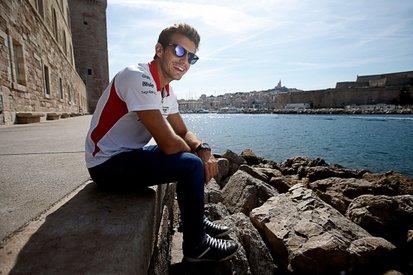
He transferred that pace effortlessly to the top level when he was given his unexpected chance to race for Marussia in 2013.

The Frenchman immediately caught the eye during his rookie F1 season in 2013
Photo by: Sutton Images
What was most encouraging is that the pace wasn't fleeting. Bianchi could usually be relied on to deliver in qualifying trim, with the bite of fresh rubber under him, but he could string those laps together in race situations as well.
From trackside, he was one of those drivers who seemed to be controlling the car, rather than it controlling him. His default style wasn't about constant tiny corrections, improvising from corner to corner.
Instead, he set up the car to do what he wanted under braking and on turn in, delicately shifting the weight around and producing good lap times with as much smoothness and style as the Marussia, a car not blessed with an over-abundance of downforce, would allow.
The fascinating question is whether he had the mental strength to express this speed in the white heat of competition at the front of the F1 grid. That is what would have dictated whether he was a driver 'only' capable of winning races, but of stringing together a whole championship campaign.
During his junior career, as well as many classy wins, there were a few rash moments under pressure when fighting at the front of races and for titles.
These concerns played a part in him missing out on the Force India drive to the experienced Adrian Sutil in 2013. There were memories of the occasional error, such as shunting the new 2012 car at Jerez and costing the team a valuable day of testing.
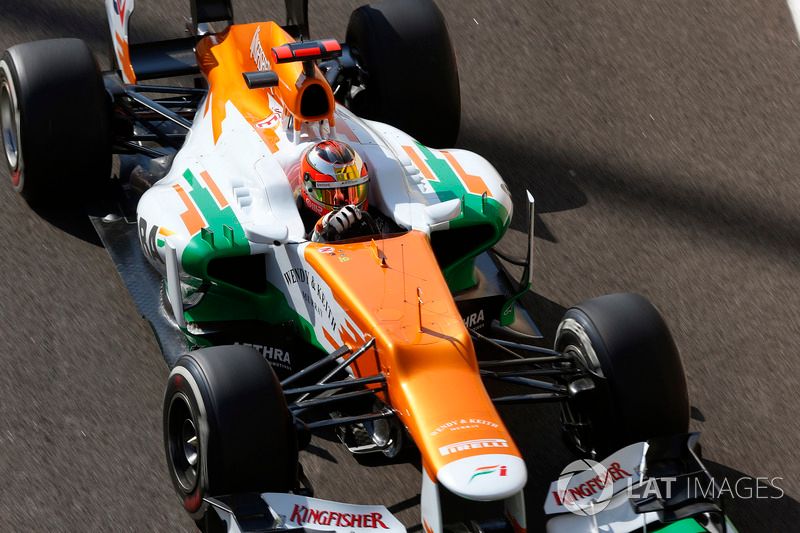
Bianchi had been in line to join Force India from 2013, but missed out having been considered too much of a risk
Photo by: Charles Coates / Motorsport Images
In that regard, a graduation with Marussia was probably the ideal place for him to learn the ropes in F1 with a low-profile rookie team with little pressure of expectation. And he took the opportunity superbly.
Thrown into pre-season testing when it was already well under way, he slotted in effortlessly. Soon, he was impressing the team with his precise and reliable feedback, giving honest, accurate information that made the jobs of his engineers much easier.
There were a few times when the team found him a little noisy over the radio when things weren't going well, such as in Singapore in 2014 when he ended up running behind team-mate Max Chilton on track, but he took criticism on board.
There is no doubt that Bianchi was tackling his weaknesses and becoming a driver to be reckoned with
But even those complaints were minor. From the moment he stepped up to an F1 race seat he came across as a more together driver.
"I'm totally different to what I was like in GP2," he told me in an interview in mid-2014. "The speed is still there, but in GP2 I would struggle with tyre management.
"I also struggled to stay calm and made a few mistakes, it was the downside of my driving.
"I have improved a lot since. In the races this year, I am sometimes able only to one-stop because I am looking after the tyres. As soon as I reached F1, I went up a step."

Points at the 2014 Monaco GP truly announced Bianchi in F1
Photo by: Sutton Images
It was always likely to be Bianchi that seized the opportunity to score points when it arose for Marussia. There was only one real chance, at the 2014 Monaco Grand Prix, and he drove immaculately even when things were going wrong.
The key moment of that race was his pass on Kamui Kobayashi at Rascasse. It was forceful, but it also showed Bianchi's steel and determination to get the job done - and his elbows out if necessary.
The 2013 version of Bianchi might not have come out of that race with a points finish. There is no doubt that Bianchi was tackling his weaknesses and becoming a driver to be reckoned with.
He was patient too, resisting the temptation to shout from the rooftops about his credentials as a future Ferrari driver and instead focusing on the task in hand. And that allowed him to get good results even for a minnow team.
How that would have translated into 2015 and beyond, it's impossible to say. But as he hinted with his test for Ferrari at Silverstone last July (pictured below), were he in a completely red car in 2014, rather than a red, black and white one, he would have been consistently in the top six in what was not a great year for Ferrari.
Even in a decent midfield car, there's no doubt he would have been capable of regular points finishes. And had he done that, then a place at Ferrari a few years down the line was likely.

Bianchi tested for Ferrari just months before his accident
Photo by: Sutton Images
Then, it would have come down to how he reacted to the intensity of a title fight. The unknowable answer to that question is central to whether he would have fulfilled his full potential.
None of this really matters now, certainly not to his family and friends who will feel his loss intensely for the rest of their lives.
But for the wider F1 world, we've all lost the chance to watch a driver of very real promise enjoy the career that he deserved. And he was someone who you always felt deserved his success.
Would he have become world champion? Nobody can ever know that now. But the raw materials were certainly there
He was always a pleasure to deal with and it's with regret that when I caught up with him after qualifying at Suzuka the day before his crash, all I asked him about were the mundane details of his qualifying session - delays during Q1 meant that he wasn't able to complete his planned third run after the clock ran down - and his thoughts on the relative merits of GP2 and Formula Renault 3.5, both categories in which he was a winner.
You always feel that an interview in such situations should cover something of real substance and significance, but it was just another pleasant, informative chat in which I had the chance to learn a little more about what he was about.
But I do feel incredibly fortunate to have been able to attend every single one of Bianchi's grands prix. During those 34 races, he showed tantalising glimpses of what he might be capable of in a better car.
Would he have become world champion? Nobody can ever know that now. But the raw materials were certainly there. For the rest of my life, memories of what he did do in F1, and thoughts of what might have been, will remain.
It was a privilege to watch you in action, Jules. You will be remembered.
This article is a reprint from 2015

17 July 2025 marked 10 years since his passing
Photo by: Charles Coates / Motorsport Images

Autosport 75: Kubica's road to recovery and beyond

Autosport 75: When Red Bull had its own intra-team fight like Norris vs Piastri

Autosport 75: Why Verstappen was ready for F1 at 17

How the Senna myth has been transformed

Archive: When the French GP almost produced F1's greatest shock

Autosport 70: How Scheckter instigated Silverstone's most famous F1 incident

Autosport 70: The lost F1 team that launched Newey

Why Haas's shocking 2019 should have F1 worried

Supercars at The Bend: Mostert wins for Walkinshaw TWG Racing

Pajari to take "deeper look" to understand lack of speed at WRC Chile

WRC Chile: Solberg saves best until last to pull away from Evans

How Norris unfurled a surprising - and "unrepeatable" - Spanish GP pole lap
Subscribe and access Autosport.com with your ad-blocker.
From Formula 1 to MotoGP we report straight from the paddock because we love our sport, just like you. In order to keep delivering our expert journalism, our website uses advertising. Still, we want to give you the opportunity to enjoy an ad-free and tracker-free website and to continue using your adblocker.


Top Comments