


Why Honda can’t kick its Formula 1 habit
Honda has conceded “perhaps we will struggle” as its latest F1 partnership begins – but its entire history in grand prix racing has been characterised by embracing risk

When Honda Racing Corporation president Koji Watanabe unveiled its latest Formula 1 power unit in mid-January, he was studiously careful to manage expectations, saying “the 2026 regulations are technically extremely challenging, and perhaps we will struggle”.
There are compelling grounds for such caution – not least the fact that this is in effect a new project, with different staff, rather than a seamless continuation of the programme that delivered so much success with Red Bull in recent years. The reasons for this cut to the essence of Honda’s approach to F1, a philosophy it has cleaved to since it prepared its first grand prix car in 1964.
Marque founder Soichiro Honda took his company into motorcycle racing to test its products against the best in the world. When it expanded into car manufacture, Mr Honda saw grand prix racing not just as a great marketing tool for his new line of business, but also as a technological incubator and a proving ground for young engineers.
Like any large corporation, Honda is saddled with layers of career middle-managers and such, with all the deadening effect on creativity that entails. But it is also an engineering-led organisation to its core, with a compulsion to innovate.
Hence whenever commercial circumstances have driven Honda away from F1, it has been irresistibly drawn back, like nocturnal lepidoptera to a light fixture.
First hard lessons
Soichiro Honda himself was fascinated by mechanical objects from an early age. His mindset married a compulsion to tinker and improvise with machinery to hard-headed ambition; he was a notoriously stern taskmaster.

Honda’s first F1 car failed to make the finish on its 1964 German GP debut
Photo by: LAT Images via Getty Images
His eponymous motor company was therefore permanently in fast-forward after its foundation, going from hand-assembling improvised motorbikes in a small shed to entering the Isle of Man TT in a little over a decade. In the early 1960s he decided to expand into four wheels and the F1 project followed rapidly in the wheeltracks of Honda’s first car.
The prototype was named RA270 as a reminder to the staff that Mr Honda wanted the engine to produce 270bhp – a bold target in the 1.5-litre era. Honda shuffled engineers over from his motorcycle racing programme and bolstered the numbers with recent graduates, many of whom had precious little notion what an F1 car was – they would learn from a Cooper T53 chassis acquired for the purpose.
In the end the boss would be satisfied with 210bhp, achieved by using 12 rather than eight cylinders and targeting high rotational speeds. The development period had been painful, protracted, and sucked in more resources than expected – a pattern that would become familiar – and so Honda briefly entertained the notion of diluting his objective, entering tentative negotiations with Lotus in the winter of 1963 to supply engines.
When Lotus boss Colin Chapman nixed the deal – it’s said that his dalliance with Honda was purely to apply leverage to existing partner Climax to improve its own engine – the Japanese manufacturer reverted to Plan A.
Heads swivelled in the Nurburgring paddock as the Honda mechanics disgorged their first F1 car from the truck at the end of July 1964. Painted off-white with a rising sun decal on the nose, the RA271’s monocoque chassis was clearly more than a little inspired by the 1963 championship-winning Lotus 25, but much of its detailing was technically ambitious, particularly the transverse mounting of the tiny V12 engine and its six-speed gearbox.
The first race was cut short by steering failure, and the RA271 – and its successors – proved too heavy and too ponderous to be regularly competitive, though after Honda expanded to a two-car entry Richie Ginther registered a win in Mexico in 1965, where the V12’s sophisticated fuel injection shrugged off the thinner air.

Technical ambition evident in RA271’s transverse-mounted V12 and six-speed ’box
Photo by: David Phipps / Sutton Images via Getty Images
Honda was an absentee for the next world championship grand prix, the season opener for the ‘return to power’ in 1966, on account of development delays in its new three-litre V12. Its most notable four-wheeled achievement that year would be its F2 project with Jack Brabham.
John Surtees joined for 1967 and it was a mark of his championship-winning clout that Honda was persuaded to (temporarily) swallow its corporate pride and outsource design of a new car, mid-season, to Lola. The Indycar-based RA300 was still overweight, but less so than Honda’s in-house predecessor, and Surtees contrived to win on the car’s debut at Monza, snatching the lead from Brabham by 0.2 seconds in the lunge to the tape on the final lap.
That would be the sum total of Honda’s victories in the first chapter of its F1 story. Lola prepared the more developed RA301 for 1968 but Soichiro Honda yearned for a proper in-house design. Just as significantly, the boss had become consumed with the idea that water cooling was fundamentally inefficient, dictating that not only should the road car range convert to air-cooled engines, but so too should the F1 effort.
Having tested it and found that the unusual layout delivered none of the handling advantages expected, Surtees flat-out refused to drive the RA302
The result was the ultimately catastrophic RA302, powered by an air-cooled V8 enclosed in a chassis skinned in magnesium, with the driver shifted well forward in the chassis frame so the engine and gearbox would sit more centrally.
How much of the weight saved by shedding the engine’s water jacket and radiator was offset by fins and other air-cooling apparatus is open to question; what is without doubt is that magnesium, besides being light, is highly combustible in the presence of oxygen.
Having tested it and found that the unusual layout delivered none of the handling advantages expected, Surtees flat-out refused to drive the RA302. To save face, having trumpeted the arrival of the project, Honda recruited Jo Schlesser to give the car its debut in the 1968 French GP at Rouen.

Surtees’s last-gasp effort at Monza in 1967 secured victory on RA300’s debut
Photo by: Keystone / Hulton Archive / Getty Images
On just the third racing lap, the RA302’s unhappy balance conducted Schlesser off the track at Six-Freres, a fast right-hander, where the car rolled, spilled fuel ignited, and the ensuing fireball could not be extinguished as molten magnesium flowed in flaming rivulets down the track. Schlesser died a ghastly death.
Undeterred, Soichiro Honda dictated that a replacement RA302 be built. Presented with it at Monza, ‘Big John’ let his feelings be known once more. The negative publicity that ensued moved Honda to quit grand prix racing, not to be seen again until the 1980s.
The second coming
Few hardy souls enduring the typically bracing conditions on an April weekend in Kent for the 1983 Race of Champions at Brands Hatch would have realised they were witnessing history in the making. Not only would this be the last of the quirky non-championship F1 races, but it provided the backdrop for Honda’s back-door re-entry to the world championship, five years after announcing its return to the racing scene in F2.
Shoehorned into the back of a Spirit F2 chassis (designed by McLaren M23 architect Gordon Coppuck) was a 1.5-litre turbocharged V6, the next step of a collaboration between Spirit and Honda that had proved fruitful in F2. It was an inauspicious start: Stefan Johansson qualified the mule car last but one – 12th – and 19.7s off the pace of polesitter Keke Rosberg’s Williams-Ford. After five laps a turbo seal blew and the Spirit departed in a haze of smoke.
Ultimately Spirit lacked the resources to develop at the speed Honda wanted – Soichiro, though technically retired, maintained a strong influence – and the partnership was terminated in favour of an allegiance with Williams for 1984. Desperate to join the turbo league, Williams was prepared to wear the inevitable teething problems that accompanied a new engine project.
Park a Williams-Honda FW09 next to a McLaren-TAG MP4/2 with the engine covers off that season and the differences would be obvious, even to a layperson. The McLaren was conceived as a complete package by John Barnard, who would flay the Porsche engineers with his tongue if the outline of their V6 and its plumbing deviated from his plan. Williams, at first, just had to take the Honda V6 as it came and accommodate it somehow.

Williams-Honda on top in 1987, the drivers’ crown going to Nelson Piquet
Photo by: Rainer Schlegelmilch / Getty Images
As before, Honda’s F1 project was staffed largely by young and inexperienced engineers who were expected to learn quickly through failures. Aside from the high point of Rosberg’s 1984 win in Dallas, there were too many piston failures, too much turbo lag, and insufficient power; Williams would never admit it, but the FW09 chassis wasn’t its finest work either.
Late in the 1984 season Honda swapped out the senior management of the programme, though new leaders Yoshitoshi Sakurai and Katsumi Ichida stuck with the philosophy of leaning on younger engineers with fresh ideas.
An entirely new design for 1985 with a stiffer block and a revised bore-stroke ratio provided the impetus for the Williams-Honda package becoming the fastest on the grid, even though the team couldn’t quite get the drivers’ championship over the line until 1987.
Only Honda had the ambition and the willingness to spend on building an all-new engine for use in just one season
Another ruthless chop ended that relationship, and Honda allied with McLaren (and Lotus) from 1988 onwards. Against a background of the FIA curbing power outputs through boost limits and restrictions on fuel, Honda had evolved its V6 to be among the most efficient as well as the most powerful in the field. For 1988, boost pressures were reduced from 4bar to 2.5bar ahead of turbo engines being outlawed entirely the following year.
Only Honda had the ambition and the willingness to spend on building an all-new engine for use in just one season, based on a substantially lowered crank height, made possible by a new small-diameter clutch. McLaren won all but one of the grands prix that year and Ayrton Senna was crowned champion.
McLaren-Honda’s dominance continued into the era of naturally aspirated V10s, but for 1991 Honda quietly insisted on building a V12. Greater weight and frictional losses were an obvious disadvantage, but Honda was going into competition with Ferrari on the road with its new NSX sportscar.

Honda persisted with V12 in 1991, although in private Senna was unimpressed with power shortfall
Photo by: Ercole Colombo / Studio Colombo / Getty Images
For marketing reasons it wanted to trounce the Prancing Horse in terms of its holiest of on-track holies: the V12. Its engineers also fervently believed a V12 could be persuaded to develop more power than a V10, enough to offset the disadvantages.
Senna clearly enjoyed driving the NSX (not a V12), as period footage of him demonstrates. There can be no better advert for a road-going sportscar than the sight of it being thrashed around Suzuka by the greatest driver of his generation, with inset ‘footwell cam’ of his feet, bedecked in white socks and brown loafers (acceptable in the 1980s) dancing on the pedals.
But in private, Senna, like Surtees before him, made it very clear to Honda’s engineers and management what he thought: in this case, the engine wasn’t powerful enough.
Early failures for the initially more competitive Williams-Renault package enabled Senna to build a points buffer he could defend, aided by more car and engine development by McLaren and Honda during the season. It was the first – and, so far, the last – time a V12-engined car won the world championship.
Thereafter McLaren was well beaten by the sorted (and now actively suspended) Williams through 1992 and, during the Italian GP that year, Honda CEO Nobuhiko Kawamoto confirmed what had been widely rumoured: the company was ‘suspending’ its F1 programme.
“The most positive impact over the last decade has been that the intensive challenges of F1 competition have helped to train many engineers who are essential in developing our products,” he said. “Having achieved our goal over a decade, we have decided to suspend our F1 racing activities.”

Yoshino (right) wielded the broom after manoeuvring Kawamoto out of the door
Photo by: Toru Yamanaka / AFP via Getty Images
Kawamoto had been one of the young engineering graduates assigned to the F1 programme in the 1960s and been one of the driving forces behind Honda’s racing return. But he could no longer stem the tide of internal politics and external economic forces: Soichiro Honda had died in 1991, just as the country – and the rest of the world – was sliding into recession.
There was talk of a hostile takeover by Mitsubishi. Nothing stems the appetite to spend on a racing programme like a corporate crisis.
A confused return
Under Kawamoto, Honda’s products became more customer-focused and less of an engineering exercise – a significant pivot in terms of corporate culture. He envisioned the company returning to F1 at some point, but that opportunity did not arise until he was close to retirement age despite his blessing of several ‘outside office hours’ single-seater design studies.
Hence the peculiar scenario that eventuated in 1998, when Honda began developing its own F1 car with a handful of Tyrrell personnel (led by Harvey Postlethwaite) who were, in effect, moonlighting.
Kawamoto had wanted to buy Tyrrell but was too late to head off British American Tobacco’s purchase of the team’s entry. Instead Honda embarked on a clandestine chassis development programme with those Tyrrell personnel who would not be joining the new ‘British American Racing’ set-up in the Reynard campus in Brackley.
Its engine would be a new project, as before staffed mainly by young engineering graduates on a ‘sink or swim’ basis to prove themselves before being redeployed elsewhere in the company. This was already ticking over, thanks to Honda taking a greater role in the customer engines being supplied to teams such as Ligier and Jordan by its Mugen affiliate – to the point that Honda was actually building the engines by 1998.

Postlethwaite-led chassis programme was canned in 1999
Photo by: Sutton Images via Getty Images
But Honda’s senior management in the late 1990s was wracked by factional warfare and Kawamoto was pushed into retirement by Hiroyuki Yoshino, the first head of the corporation not from a racing background. Yoshino and his cohort wanted Honda to be an engine supplier only, not a whole-package constructor like Ferrari.
It is a trope of corporate politics, like the hurly-burly of the animal kingdom, that the new head of the pride kills the offspring of the old; Honda duly cancelled the chassis programme within weeks of Postlethwaite’s death from a heart attack in April 1999. By the end of May a deal had been announced to supply BAR with engines.
By the time Yoshino relinquished the presidency to Takeo Fukui in 2003, BAR had proved such a liability that its owner had shifted the existing management aside and brought in Prodrive chief David Richards to oversee a competitive turnaround – with a view, given the imminent ban on overt tobacco sponsorship in most territories, of selling up.
Honda’s retreat from F1 in the global financial crisis meant it missed out on enjoying the benefits of hiring Ross Brawn to run the team
Fukui came from a racing background and under him the Honda engine programme returned to some semblance of its previous incarnation of the 1980s, with development steps arriving at virtually every race.
In tandem, with Richards at the tiller, BAR’s competence and competitiveness ramped up. It was enough to persuade Honda to become the buyer – but as it expanded its corporate influence over the team afterwards, the shortcomings of placing engineers in unfamiliar scenarios in order to challenge them became manifest.
New technical director Shuhei Nakamoto’s prior experience was all in motorcycles; downforce was an alien concept. The 2007 and 2008 seasons were a disaster, and Honda’s retreat from F1 in the global financial crisis meant it missed out on enjoying the benefits of hiring Ross Brawn to run the team.

Relationship with McLaren after reuniting in 2015 went downhill
Photo by: Dan Istitene / Getty Images
Painful dawn to the hybrid era
Honda’s return to F1 with McLaren in 2015 should have been the glorious reuniting of an old partnership. Instead it was humiliating for both parties. Honda underestimated the challenge of engineering the complex hybrid V6 power units introduced in 2014, particularly the MGU-H component that both harvested energy as heat from the turbo and redeployed it to spin the turbines, reducing lag. Its high rotational speeds made it difficult to engineer bearings of sufficient resilience.
McLaren’s approach contributed to the issues, initially demanding a tiny engine to accommodate its “size zero” aerodynamic philosophy. In subsequent seasons the two sides began to blame each other for the underperformance.
Honda’s stated reason for its return was the opportunity to incubate a new generation of engineers to face the challenges of pivoting towards electrification. And indeed it threw young engineers into the project as well as plenty of money – to the detriment of investment in other programmes such as touring car racing. But in the boardroom the price of several years of failure was high.
It’s claimed that no less an eminence than Ron Tauranac, the engineer behind Brabham’s early success and the Ralt marque, quietly took Nobuhiko Kawamoto aside late in the 1980s and advised him to quit while he was ahead. Kawamoto’s successors did just that late in 2020, just as the partnership with Red Bull Racing was netting regular race victories and concreting Max Verstappen as a future world champion.
At heart, Honda sees itself as an engineering-led company. That’s what separates its identity from Toyota, an organisation defined by ruthless attention to the bottom line
At the time, Honda said it would leave F1 at the end of 2021 and never come back, preferring to focus on full electrification and the road to carbon neutrality by 2050. It struck a deal with Red Bull to exit gracefully by transferring its IP to a new UK-based entity run by the team, but the timing of its official exit couldn’t have been more unfortunate, coinciding with Verstappen claiming his first drivers’ title.
Although Honda tapered its withdrawal rather than pulling out abruptly, providing design and manufacturing support through 2022, the personnel who brought the hybrid programme to its winning peak were gradually redeployed elsewhere.
So although Honda announced its volte face as early as May 2023, by then Red Bull had committed to a partnership with Ford for the next-generation powerplants. The engine Honda will furnish in this year’s Aston Martin will be all new, the product of another set of fresh engineers.
At heart, Honda sees itself as an engineering-led company. That’s what separates its identity from Toyota, an organisation defined by ruthless attention to the bottom line. And that’s why it can’t stay away from F1, despite all the corporate machinations. Its chosen path of using racing to entice and challenge the brightest young engineers will likely bring short-term pain – but that’s always been the way.
This article is one of many in the monthly Autosport magazine. For more premium content, take a look at the March 2026 issue and subscribe today.
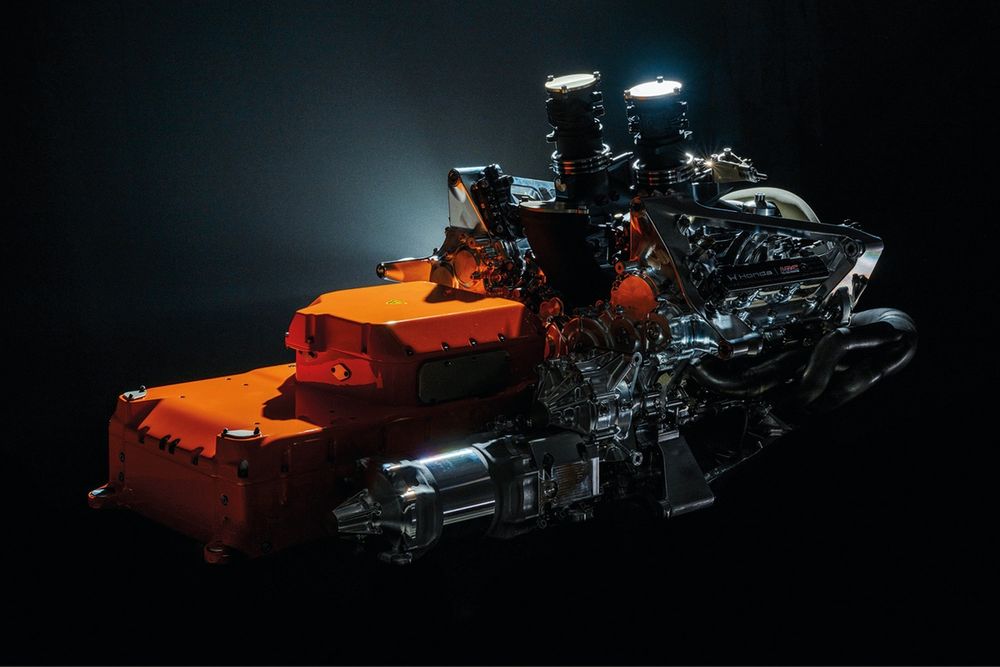
Fresh set of engineers has been responsible for Honda’s all-new power unit
Photo by: Take Itoh


'Senior moment' or breakdown of trust? The implications of Hamilton's Singapore GP meltdown

Why Verstappen's dominance left rivals scrabbling for alternatives in Singapore

A "better job" or more engine power? Verstappen's Singapore pole unpicked

FIA reveals "human error" caused latest software glitch in Singapore sprint qualifying

F1 Singapore GP live commentary and updates - Verstappen takes sprint pole

F1 Singapore GP live commentary and updates - Verstappen wins sprint while McLarens collide

F1 Singapore GP live commentary and updates - Verstappen on pole

LIVE: F1 Singapore GP - Verstappen dominates to victory from Leclerc, nightmare for Hamilton

The not-so-obvious chance Leclerc missed to usurp Verstappen

Cheshire cats de la Roche and Musgrave grin after Silverstone Historic F3 thrillers

Dramatic Mini fight goes to the wire as Ovenden wins title by a point at Brands Hatch

How Ingram made his mark on the 2026 BTCC campaign – before going out with a bang
Subscribe and access Autosport.com with your ad-blocker.
From Formula 1 to MotoGP we report straight from the paddock because we love our sport, just like you. In order to keep delivering our expert journalism, our website uses advertising. Still, we want to give you the opportunity to enjoy an ad-free and tracker-free website and to continue using your adblocker.


Top Comments