


Why F1 must get rid of the point for fastest lap
Opinion: It’s been a flawed concept since its reintroduction to Formula 1 in 2019. But with every passing week, the evidence mounts to underline that awarding a point for the fastest lap is a bad idea and should be dropped

Autosport Plus content
The best content from Autosport Plus, our subscription service. Subscribe to get access to all the features
Fastest lap statistics have always been fraught. Not quite pointless (pun intended) but requiring lots of caveats. For example, the fact arch-rivals Alain Prost and Ayrton Senna scored 41 and 19 fastest laps respectively tells us something about their different approaches to a race weekend but is merely one small part of a much bigger picture.
Similarly, Kimi Raikkonen sits third in the all-time fastest laps list. Partly that’s thanks to his genuine speed at McLaren, but more than half of his tally of 46 were scored at Ferrari, often late on in races when they were largely irrelevant to the grand prix.
So why did F1 reintroduce the point for fastest lap in 2019, 60 years after it was last part of the championship scoring system?
When the move was announced in March 2019, F1 sporting boss Ross Brawn said: “Together with the FIA we have been committed to evaluating ideas and solutions that can improve the show whilst maintaining the integrity of our sport.
“We have been considering this solution – which represents a response to detailed research carried out with thousands of our fans around the world – for a number of months.
“How many times have we heard the drivers on the radio ask the team about who holds the fastest lap? Now it will no longer be only a matter of record and prestige, but there will be a concrete motivation that will make the final part of the race even more interesting.”

Lewis Hamilton receives the 2020 DHL Fastest Lap award
Photo by: Mark Sutton / Motorsport Images
It wasn’t the worst idea in the world, but it was inevitable that it would change the way the teams and drivers went about their business. And perhaps the most obvious example of that was at the recent Portuguese Grand Prix, when two of the top three made late, extra stops in an effort to secure the bonus point.
Max Verstappen set the quickest lap, only to lose out due to track limits, handing the point to Valtteri Bottas. Leader Lewis Hamilton – who had defeated his two rivals and had recorded the quickest tour until Sergio Perez made his late (but planned) stop – sensibly decided not to risk another tyre change. Pretty much the same thing happened in the Spanish GP a week later.
Of the 42 GPs that have been held since the fastest lap point returned, 16 – more than a third – have been taken by a driver who made a late stop probably for that purpose
This is not to criticise the teams and drivers who did make those late stops. It makes sense for them to chase the extra point if the gaps behind are big enough.
But surely one of the F1 ideals is that it’s meritocratic. The fastest lap often doesn’t go to the driver who deserves it. Thanks to the way races evolve and the need to look after the cars in the past or ‘turn them down’ now that’s always been the case but the current situation exacerbates it.
As an aside, the fastest lap record, held by Michael Schumacher on 77, is probably one of the only benchmarks Hamilton won’t move. He is only second on 54.
It is sometimes hard to determine when a late stop is purely aimed at gaining the fastest lap – Red Bull boss Christian Horner suggested Perez’s strategy in Portugal was actually aimed at giving him a better chance at the extra point even though the Mexican didn’t make an extra stop – but generally it is possible to make a call.

Sergio Perez, Red Bull Racing RB16B, makes a pit stop
Photo by: Glenn Dunbar / Motorsport Images
Of the 42 GPs that have been held since the fastest lap point returned, 16 – more than a third – have been taken by a driver who made a late stop probably for that purpose. And that doesn’t count another half a dozen or so set by drivers making late stops for other reasons, such as punctures.
Interestingly, that doesn’t include Lando Norris’s fastest lap in the 2020 Austrian GP, which must be put down to a superb effort on the final tour with everything turned up to maximum as he successfully chased his first F1 podium.
That’s not to say that all of the late-stopping fastest lap setters were undeserving. In the 2020 Hungarian GP, Hamilton was so dominant he was able to make a late stop, grab fastest lap and still win. But that’s the exception rather than the rule.
Both of Pierre Gasly’s fastest laps for Red Bull in 2019 came because he wasn’t able to keep pace with the frontrunners but was far enough ahead of the pack to make a stop. In other words, he was rewarded for not doing a very good job.
You could argue it’s simply become another part of the game, but it tends to hinder the drivers most likely to deserve the point. That doesn’t seem an entirely fair or pure way to try and keep a championship close, which seems to counter Brawn’s point about “integrity”.
Only drivers who finish in the top 10 score the point too. Presumably this is to stop those out of the points from stopping and going for the point (though why this is any less meritorious than a ‘failed’ frontrunner doing so is anyone’s guess). But it can also deny genuine fastest lap-setters.

Pierre Gasly, Red Bull Racing RB15
Photo by: Glenn Dunbar / Motorsport Images
Bottas scored a legitimate fastest lap at the 2019 Brazilian GP but then retired, becoming one of only two drivers (the other being Kevin Magnussen in Singapore the same year) since the start of 2019 not to get a point despite the fastest lap on their CV.
Had Charles Leclerc’s Ferrari failed him completely following his spectacular drive in the 2019 Bahrain GP, the same would have befallen him, despite that effort being much more worthy than some of those mentioned above.
And imagine if someone were to lose a race because of a problem – such as a loose wheel – experienced during an extra, ‘fastest lap’ pitstop. Dramatic yes, but what F1 should be about? Highly debatable.
It’s also worth mentioning that, had he not made a late stop for fresh rubber, Verstappen probably would have beaten Hamilton to victory on the final lap of last year’s British GP…
You could argue it’s simply become another part of the game, but it tends to hinder the drivers most likely to deserve the point
Even worse, though, is that it has the potential to change the outcome of the world championship. It’s not as bad as the Abu Dhabi GP double points finale idea in 2014, but there is a precedent.
Stirling Moss misread his pitboard while dominating the 1958 Portuguese GP. He therefore didn’t respond to title rival Mike Hawthorn’s fastest lap. Hawthorn’s Ferrari thus took its fifth fastest lap of the season.
At the end of the year, Moss had four wins to Hawthorn’s one but lost the championship by a single point in a result that all but the most diehard of Hawthorn fans consider one of the great injustices of F1 history.
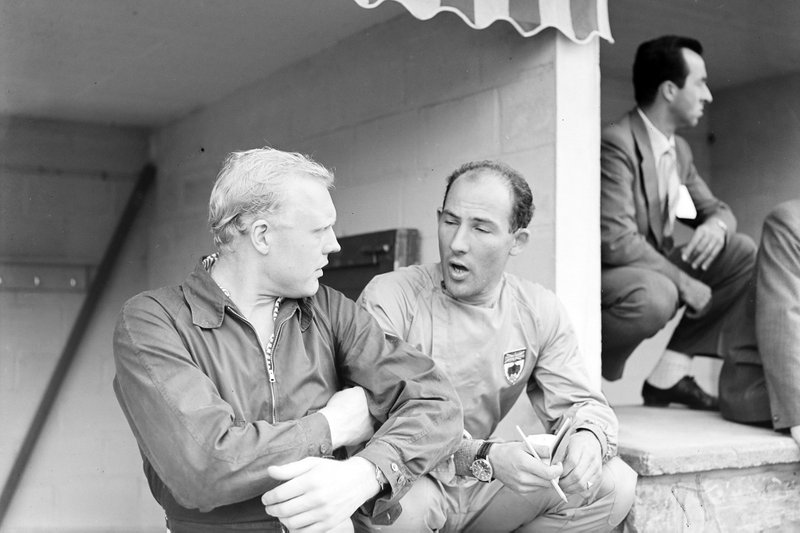
Mike Hawthorn and Stirling Moss
Photo by: Motorsport Images
It obviously also tends to favour those with the fastest car. Great drivers can sometimes make a difference over a GP distance or season with racecraft and error-free consistency but they are unlikely to overcome the technical disadvantage for a fastest lap.
Jackie Stewart (in arguably the season’s third-fastest car) and Prost (also in the third quickest) took just three and two fastest laps respectively in their successful 1973 and 1986 seasons, rightly regarded as two of the finest F1 campaigns in history.
The true test of speed comes in qualifying, for which the reward is a favourable grid position for the main event. The elements that are needed for victory are much more complex. Fastest race laps fall awkwardly between the two.
The point for fastest lap was an interesting experiment. But it doesn’t reward those it should, skews the troubled statistic even further, and can create scenes that are more farcical than interesting at the end of a GP. Time for it to go.

Kimi Raikkonen, Ferrari SF71H
Photo by: Glenn Dunbar / Motorsport Images


How the M8B became the most dominant car in McLaren’s history

Employing team orders can simply be a matter of common sense

The greatest F1 campaigns with no wins

Top 10 F1 results changed by backmarkers – the passes

Top 10 F1 results changed by backmarkers – the clashes

Stars, cars and highlights from the 2026 Goodwood Revival

The Egal has landed – again

Autosport magazine: Antonelli and a Can-Am celebration

How Toyota destroyed the competition to seal the WEC crowns

McLaren retains Fornaroli as F1 reserve and hands him WEC programme for 2027

How Andrew Jordan realised his teenage rallycross dream

Inside the competition building F1’s future engineering talent
Subscribe and access Autosport.com with your ad-blocker.
From Formula 1 to MotoGP we report straight from the paddock because we love our sport, just like you. In order to keep delivering our expert journalism, our website uses advertising. Still, we want to give you the opportunity to enjoy an ad-free and tracker-free website and to continue using your adblocker.


Top Comments