
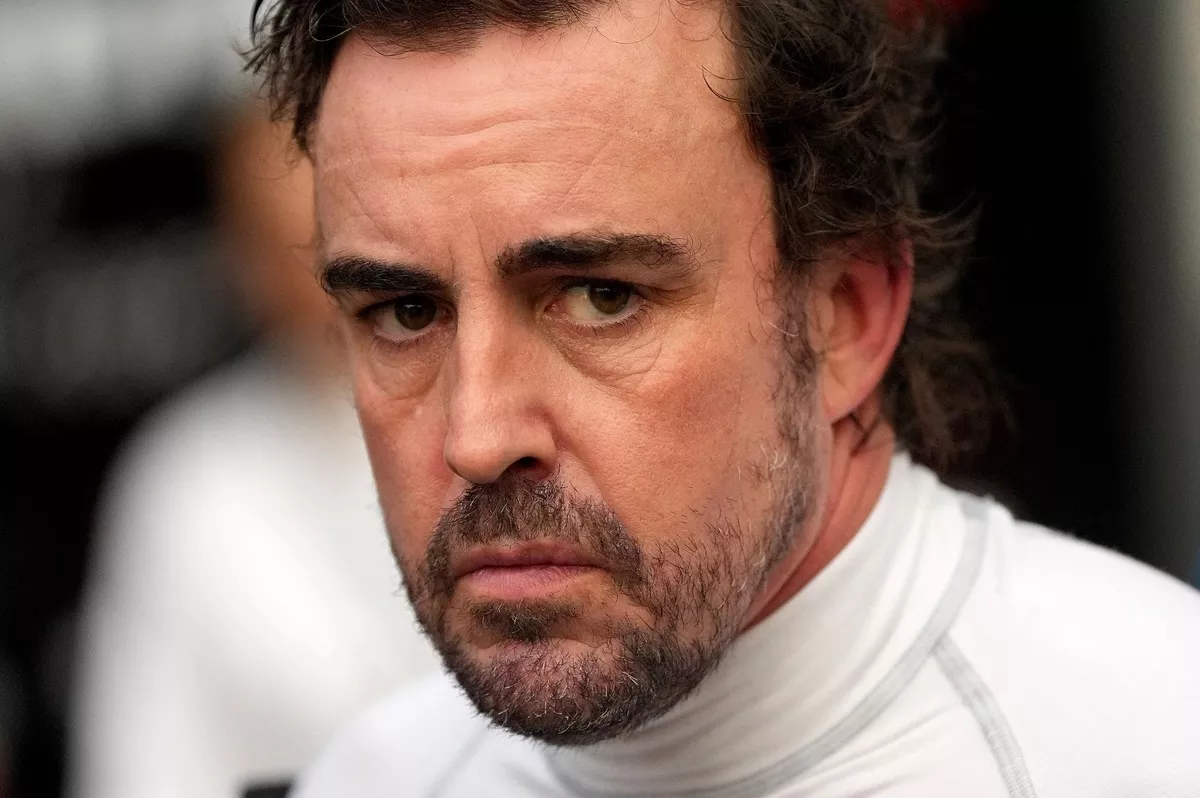


Why Alonso will not win another F1 title
What will Fernando Alonso will do for 2018? The answer's unlikely to have a bearing on next year's title battle. In fact, chances are the Spaniard will never fight for a championship again

Fernando Alonso won't win another world championship. That's not to say he doesn't have the ability to, because he does, or that he doesn't merit one, because he does, but the odds are increasingly stacked against him.
Predictions are a mug's game and time might prove this statement to be spectacularly wrong. But let's look at the overwhelming supporting evidence.
The great truism of motorsport is that to win a world championship, you first must be in a world championship-winning car. Alonso is out of contract at the end of this season, and barring some unexpected and seismic shift in the driver market, he's vanishingly unlikely to end up at any team in the top six or seven of the constructors' championship.
Chances are, he will end up at McLaren again either with Honda or Renault propulsion. If we take his stated objective of being in a winning grand prix car in 2018 as absolute, he might even have to sit out the season.
So, what are the chances of McLaren giving him the package to win the championship next season? With Honda power, it's inconceivable unless there is a step forward of the magnitude we have yet to see a hint of in the Japanese manufacturer's three years back in F1.
With a Renault package, it's not impossible but that would require both the engine supplier to unlock the potential of the power unit package (and that means it must do so reliably) and for McLaren to produce a car capable of making more of it than Red Bull and the improving factory team.

The same would apply for any subsequent seasons of a possible McLaren-Renault relationship. In a way, the McLaren/Alonso relationship is an apt one, because both team and driver are worthy of a more illustrious station but find themselves having to make the best of a bad job.
Precedent isn't on Alonso's side, either. Ten-and-a-half seasons have passed since he won his second world championship, and no driver has ever had such a big gap between titles. At least 11 seasons will have passed if Alonso ever manages to win it again. But no driver has even won their first world championship after so many seasons in F1. If it takes this long to get a title, history suggests the title isn't coming.
But Alonso is a remarkable case. Comparisons could be drawn with Emerson Fittipaldi, who spent five seasons with brother Wilson's team after leaving McLaren with two world titles under his belt. Or Jacques Villeneuve, who gave away victory at the 1997 European Grand Prix, where he clinched the crown, like there were scores more to come, but never won an F1 race again.
Alonso, with all the baggage he carries, is far lower down the list of potential targets than he would have been a decade ago
There are so many what ifs. What if his first stint at McLaren hadn't gone catastrophically awry, a situation that Alonso himself contributed heavily to? And even if that still happened, but for a few points here and there, that third title could have been secured with Ferrari either in 2010 or 2012.
What if he had kept the faith with Ferrari? Would he now be in the position Sebastian Vettel is in? It's very likely, and that will not have escaped Alonso's notice, no matter how positive he tries to be in public.
The other driver who stands comparison with Alonso is Michael Schumacher. Like Schumacher, as a double world champion Alonso realised that the nature of what might best be called 'the Enstone team' (Benetton in Schumacher's time) meant it would struggle to dominate.

Both moved on, but while one formed the keystone of the most dominant team/driver alliance in F1 history (six constructors' titles and five drivers' titles in six seasons from 1999-2004), Alonso has proved somewhat itinerant. He hasn't been able to replicate the Schumacher team-building strategy.
The other factor that works against Alonso, and one that is generally overlooked, is the era he is operating in. Winning world championships is difficult, there have only been 33 drivers achieve it, and many more have squandered title-winning machinery than capitalised on them. Those that don't should be considered as 'gold standard' drivers. Alonso is unquestionably one of those.
Back in 2006, when he won his second world championship, Alonso was part of a very small club. Schumacher was unquestionably another, as was Kimi Raikkonen, but in terms of reputation that was about it.
With the highly rated Juan Pablo Montoya having walked away mid-season, Jenson Button's star about to wane with two years of terrible Hondas, Felipe Massa yet to have hit his Ferrari heights and erratic performers like Ralf Schumacher and Jarno Trulli still able to rake it in, it was a seller's market as far as top drivers were concerned.
Today, things are a little bit different. In 2006, Alonso was one of three active world champions, one of which was Villeneuve - who was seen very much as damaged goods by then. Today, he's one of four (five if you include his brief Monaco stand-in Button), with Daniel Ricciardo and Max Verstappen both rightly regarded as dead-cert title winners in the right car. Then we also have Valtteri Bottas establishing himself close to that stratum this year, and still hanging on to the world championship fight.
That means a top team has a relatively long list of potential targets if it wants to sign a top gun. And that means Alonso, with all the baggage he carries, is far lower down the list than he would have been a decade ago.

While publicly he doesn't rule out returning to Ferrari, it's hard to see the current regime welcoming Alonso back. Red Bull is known to see Alonso as a potentially disruptive force, and Mercedes would never consider bringing in the Spaniard while it has Lewis Hamilton.
And even if Hamilton were to walk away from F1 - which is not impossible, although, at 32, he still has plenty of years left in him - Alonso wouldn't be its first choice to replace him given the younger alternatives.
Key decision-makers in leading teams are not afraid to express this position in private, even though they know never to rule out a driver like Alonso publicly because there is the chance they might one day have to turn to him.
"He leaves himself without options. We've been talking about how clever he is, well in life he's not that clever..." Pat Symonds
While Alonso is a likeable, intelligent character and a brilliant driver - one who is capable of calling race-winning strategies from the cockpit as well as executing races as well as, if not better than, anyone else on the grid - he has proved something of a timebomb within teams.
Those unconvinced would do well to look back at the August 20 2015 issue of Autosport magazine with Ben Anderson's outstanding article on Alonso, which offers a remarkable insight into the duality of Alonso's character.
In this article, Pat Symonds - who worked with Alonso in the Spaniard's two stints at Renault - sums up the reasons for Alonso's predicament wonderfully.

"He's a bit of a loner; I don't think the team is important to him other than what it can bring him," said Symonds. "There are times in life when you don't necessarily do the best thing for the day, you do something for the long game. I don't think that comes onto Fernando's radar at all.
"When he came back to Renault in 2008, he'd got himself into a position where the only thing he could do was come back, which is something he does time and again; he leaves himself without options.
"We've been talking about how clever he is, well in life he's not that clever..."
The fact that so many of his team relationships have ended with at least a degree of acrimony proves this to be true. Yet very often things start extremely well. When Alonso contested the Indianapolis 500 in May, the Andretti Autosport team very much took to him, the rigorousness of his approach, his speed, his dedication.
But plenty of teams have gelled well with Alonso initially, only for things to disintegrate when the ground got bumpy. This hasn't happened in his second stint at McLaren, but ironically that could be because of the fact results haven't been there. Were he to be fighting up front, might things have got more political? History suggests it's possible.
Alonso certainly is insistent on a team being built around him and getting behind him - you just have to ask Felipe Massa about what that is like. And there's not necessarily anything wrong with that. After all, it didn't do any harm for Schumacher or, at times, Ayrton Senna.

But Alonso appears to go too far with his exacting standards and very clear vision of what is required - including that he be the unquestioned focal point. That's the ruthless nature of a world champion. And some of those who have worked with him will defend his approach to the hilt.
That single-mindedness is something that should be respected and, ultimately, has delivered one of the great grand prix careers. But things do go wrong. It's just that they don't necessarily go wrong in a desperately uncompetitive, pressure-off McLaren environment - hence what is said to be a decent atmosphere inside the struggling team.
But whatever the reason, there is one thing that Alonso clearly lacks: options. And that's the thing that will prevent him from winning another world championship.
And if the unexpected happens and either McLaren gets back to the sharp end in time, or one of the current superteams is forced to call on his services, then it's not impossible that the statement at the top of this column will be proved wrong.
Having watched Alonso turn in some extraordinary performances over the past 15 years, I'd certainly be very happy to be proved wrong in order for justice to be done by him winning a third world title.
But much of the story of Alonso's grand prix career is already written and it would take an unexpected and dramatic plot twist to change that narrative. Rivals Hamilton and Vettel have three and four world titles respectively to Alonso's two, and 57/46 wins to the Spaniard's 32. No matter what happens in the next few years, the statistics will never do Alonso justice.
The die is cast: he is the driver who simply ran out of options. And how much of that was down to his own decisions and approach and how much down to bad luck is going to be something that will be debated for as long as people care about the history of grand prix racing.


Did Bianchi have potential to become F1 world champion?

Autosport 75: Kubica's road to recovery and beyond

Autosport 75: When Red Bull had its own intra-team fight like Norris vs Piastri

Autosport 75: Why Verstappen was ready for F1 at 17

How the Senna myth has been transformed

Archive: When the French GP almost produced F1's greatest shock

Autosport 70: How Scheckter instigated Silverstone's most famous F1 incident

Autosport 70: The lost F1 team that launched Newey

No denying it now – the one reason why F1’s ‘horrible’ start in Malaysia could be a good thing

Inside Alonso's decision to contest the 2027 Dakar Rally with Aston Martin

The greatest F1 campaigns with no wins

MotoGP to introduce sprint qualifying amid 2027 format changes
Subscribe and access Autosport.com with your ad-blocker.
From Formula 1 to MotoGP we report straight from the paddock because we love our sport, just like you. In order to keep delivering our expert journalism, our website uses advertising. Still, we want to give you the opportunity to enjoy an ad-free and tracker-free website and to continue using your adblocker.


Top Comments