


What we learned from the 2025 F1 US GP sprint race and qualifying
Max Verstappen secured a crucial sprint race win and grand prix pole, as McLaren endured a dismal day at the Circuit of the Americas. Will the Dutchman's advantage hold? Can Lando Norris turn his luck around? And can Ferrari claim a first podium since Spa?

Shifting sands and soil isn’t just a literary device to describe the swing of momentum in the Formula 1 championship race; it’s a tangible feature of the Circuit of the Americas, where the clay strata underneath the track tend to contribute to seemingly new bumps every year. Think Whac-a-Mole, but on a grander scale.
Despite the challenge of the bumps in the opening sector, which can unsettle the 20 F1 cars that dare to tackle them (as Isack Hadjar found in qualifying), Max Verstappen seemed to glide effortlessly through the esses.
Conditions changed from the sprint race into qualifying. Since the Austin circuit is so open, the swings in wind direction have a very real and immediate effect; Verstappen noted the change in wind through that opening sector, and the difficulties presented by the tail wind through that part of the lap.
The Red Bull does not appear to be a car that is quite so dramatically affected by gusts, and nor does the Ferrari - while it seems to hit the McLaren a bit harder. Perhaps that was evident in Hungary, when neither McLaren improved on their second Q3 laps, opening the door to a Charles Leclerc pole.
Indeed, that was Lando Norris’ assertion – stating that the near-0.3s gap to Verstappen’s pole time was down to his McLaren presenting him with something of a handful. “It’s almost a surprise to be P2,” he noted after qualifying.

“Every bump, every kerb, lap to lap different, it’s just a handful, which is not the most common thing we say about our car, but it's clear that we both were struggling today with it quite a bit.”
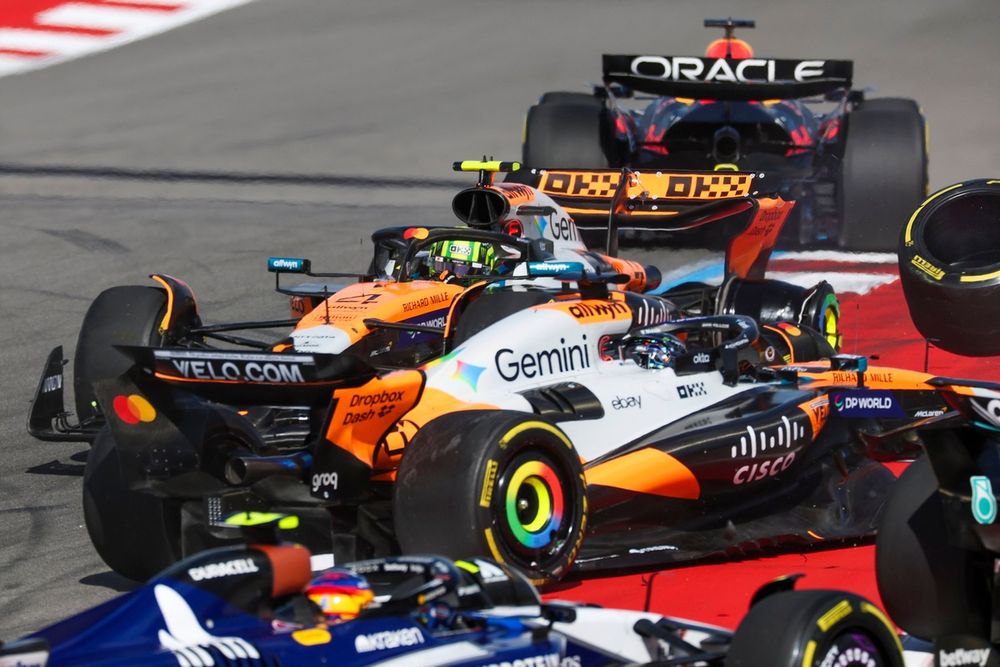
Norris and Piastri dropped points to Verstappen after the sprint race skirmish at Turn 1
Photo by: Sam Bloxham / LAT Images via Getty Images
Indeed, it had been the case for both drivers; championship leader Oscar Piastri could only slot his car into sixth on tomorrow’s grid. “It’s a track that is tough and you need a lot of confidence on - and there's a lot of corners to make you pay for it if you don't have that feeling,” the Australian mused, knowing that he’s got work to do on Sunday.
But what can McLaren do? That is, indeed, the multi-million-dollar question...
Sprint race contretemps a shot across McLaren’s bow
The good ship Woking has been in choppy waters of late. It hasn’t won since Zandvoort and, since Red Bull has been hard at work unchaining swathes of performance from its prisoner blocks, McLaren has been hit with a broadside from Verstappen’s now-rapid vessel.
There have been many suggestions, even those precipitated by Verstappen himself, that McLaren ought to have been a contender for the sprint race win
What it didn’t need was what transpired in the opening lap of the sprint race. Norris and Piastri were side-by-side up the hill into Turn 1, and Norris dropped deep into the first corner to cover that and collect the outside line. When Piastri attempted the switchback, he found the side of Nico Hulkenberg’s Sauber and the two made contact – and the change in momentum of Piastri’s car left Norris a passenger.
As such, McLaren has no real data on the race ahead. Sprint races are designed to be a fun little appetiser for fans, but they also double as a starter for engineers to feast on as it neatly replicates a race stint. Having gone without the first course, it’ll be a journey into the unknown for McLaren.
There’s a little snippet of data available from practice, but not anything particularly material; Norris did a five-lap stint on the hards, while Piastri did six consecutive tours; the McLaren could sit in the high 1m36s/low 1m37s on the C1, which will be a faint glimmer of hope.

The US GP front row is a copy of the sprint race - but can Norris make it further than Turn 1 on Sunday?
Photo by: Simon Galloway / LAT Images via Getty Images
That’s comparable to the lap times that Verstappen was setting on the mediums during the sprint; for reference, the Dutchman’s FP1 times on the hard were not particularly on a par with McLaren. But Red Bull has gradually unlocked more through the weekend, so the near two-second deficit in the direct compound comparison is going to have been expunged.
And let’s consider set-up differences between the sprint and grand prix sessions, as the teams will have raised their ride heights to mitigate the effect of plank wear over the myriad bumps around the Circuit of the Americas. Still, those times Norris set in FP1 will at least provide a benchmark for the race.
There have been many suggestions, even those precipitated by Verstappen himself, that McLaren ought to have been a contender for the sprint race win. This all boils down to the advantage that the team has enjoyed with its tyre management, particularly at the rear end. When it comes to continued loading of the tyres, which the cars will experience through the first sector and Turns 16-17-18, the elastic deformation of the tyre will generate a lot of heat – thus contributing to thermal degradation.
McLaren’s early season advantage tended to fall in that area, but Red Bull’s recent form does suggest that it can at least present McLaren with a stern challenge here. If this race was to take place in the opening months of the year, you’d predict Norris to reel Verstappen in at the end of the first stint and make the pass – but it’s difficult to do that with any degree of certainty now. Verstappen is too good, and in a much better car, to be written off in such cavalier fashion.
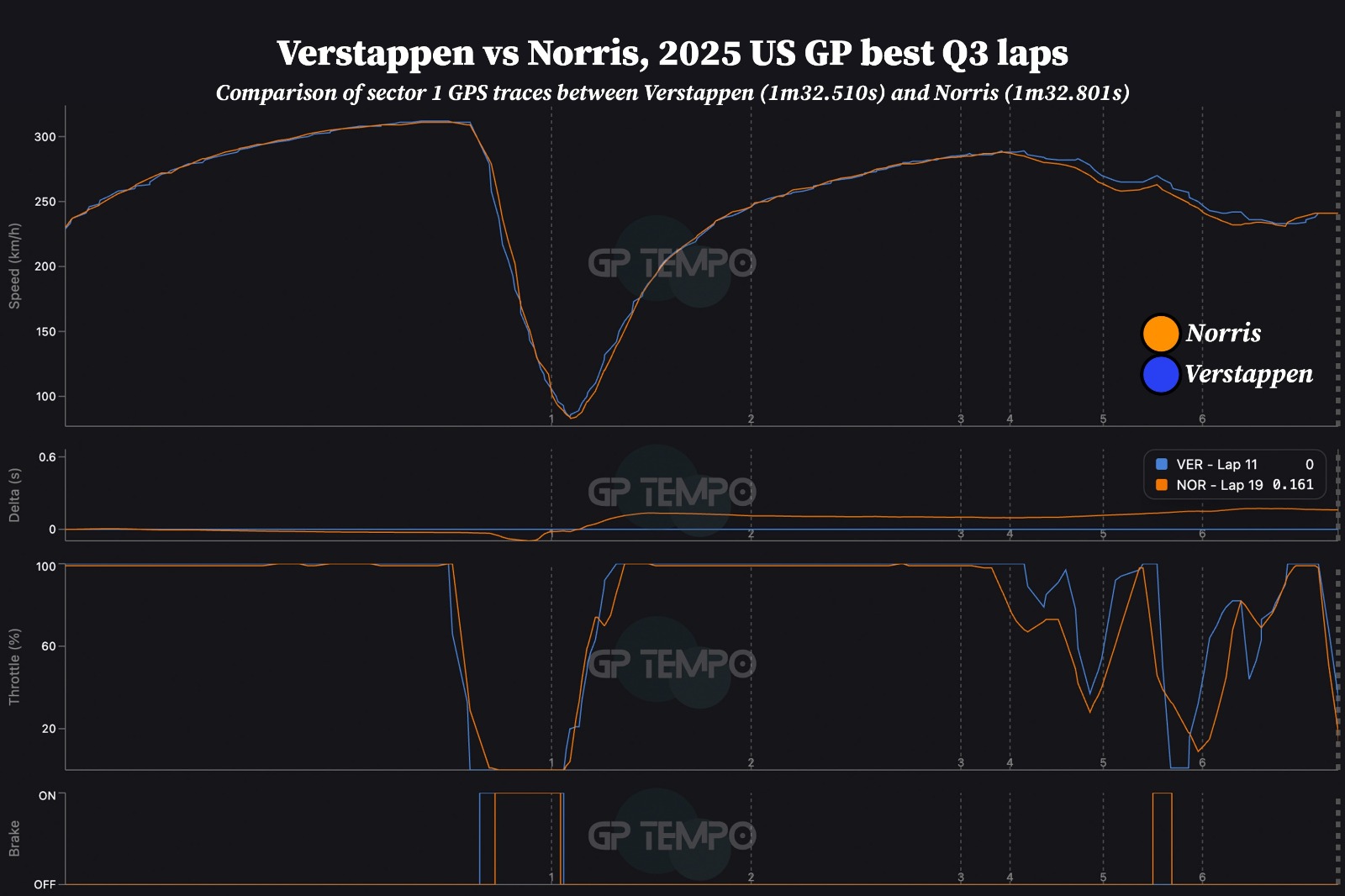
On a quick note about Verstappen’s pole lap: most of his eventual 0.291s advantage at the flag was built on his more decisive approach to the first sector. Norris was unsteady on the throttle as he rolled out of Turn 1, leaving Verstappen more acceleration time at the top of the hill.
Verstappen then used more throttle through the opening part and didn’t even touch the brakes again until Turn 7 – instead, letting his full lift on the Turn 6 entry steady the car. As such, he carried much more speed through the esses; Norris, with the “handful” at his disposal, perhaps didn’t feel as comfortable doing so.
Can Ferrari clinch its first podium since the Belgian Grand Prix?
Take that discussion of McLaren’s tyre management capabilities, and reverse it when one discusses George Russell’s chances of bagging a third podium on the trot. The Singapore Grand Prix winner starts the Austin race sandwiched between two Ferraris, and with far fewer hopes of mounting a victory challenge given Mercedes’ Achilles heel.
Pirelli’s suggestion that the degradation of the medium is higher than expected may well not only open the door to strategic variance, but can also bring the hard tyre into play
The rear-tyre overheating issue didn’t really surface in Singapore because there’s little prolonged loading in the plethora of 90-degree, short-radius corners. But it’s more likely to hit Russell at some point in the US, which should be of interest to Messrs Leclerc and Hamilton throughout the race.
Ferrari has been in a spot of bother with its recent form, but has managed to dig something out of the SF-25 - Leclerc grabbed third in qualifying, after recovering from a spin after his opening lap of Q3. Plus, the trio of Leclerc, Russell, and Hamilton were very close on pace in the sprint, barely separated by a tenth per lap as the race reached its second half. Yet, the impact of safety cars perhaps ensured that Russell didn’t meander towards the danger-zone with his tyres.
As such, Ferrari’s uptick in pace post-sprint and the longer stints involved in the grand prix might allow the race to come to the two Prancing Horses. Pirelli’s suggestion that the degradation of the medium is higher than expected may well not only open the door to strategic variance, but can also bring the hard tyre into play.

Leclerc was pleased to see progress in his route to third on the grid
Photo by: Sam Bloxham / LAT Images via Getty Images
“We ran again the simulations with the new numbers for degradation for the medium,” explained Pirelli chief Mario Isola. “And clearly, it is true that the hard is slower. Yesterday, we were discussing this with Simone and the other engineers - [we thought] the hard is not really an option for the race because they want to be quicker.
“But because you have a level of degradation of the medium that is higher than expected, then maybe you accept to have a slower compound that in a race condition should be probably less than one second per lap, but very consistent.
“Today I was checking some degradation numbers and the medium was 0.2 per lap or something like that, it means that you have a crossover between the two after six, seven, eight laps. And then the hard becomes an interesting option for a longer stint.”
Strategic variance will offer an interesting plot point, if that indeed comes to bear. Much of it will depend on what conditions permeate the Austin air, and if the changing winds have one more surprise on offer for the Sunday afternoon parade.
And if there’s another ruckus at Turn 1, that might change the face of the grand prix once more...

Does Turn 1 have another sting in its tail?
Photo by: Mark Thompson / Getty Images


FIA expects F1 races in Qatar and Abu Dhabi to run as planned

Why Piastri has struggled to show his best with this year's McLaren MCL40

Lights, Camara, action: How Haas picked F1's latest rookie for 2027

Horner's inside story of how Red Bull built its own F1 engine

Why Mercedes' latest 2026 F1 update is no downgrade

Singapore Grand Prix Driver Ratings 2026

What we learned from the 2026 F1 Singapore GP sprint race and qualifying

The political minefield set out by F1’s recent cost-cap grievances

How Antonelli levelled up his character to be F1 2026's world champion-elect

FIA set to close F1 cost cap loophole with new rules

Norris promises to make "better decisions" following fresh talks over Singapore GP clash

FIA expects F1 races in Qatar and Abu Dhabi to run as planned
Subscribe and access Autosport.com with your ad-blocker.
From Formula 1 to MotoGP we report straight from the paddock because we love our sport, just like you. In order to keep delivering our expert journalism, our website uses advertising. Still, we want to give you the opportunity to enjoy an ad-free and tracker-free website and to continue using your adblocker.


Top Comments