


Inside the competition building F1’s future engineering talent
As hundreds of students from around the world competed in Singapore at the STEM Racing World Final, the long-running engineering competition is gaining relevance as a potential pathway into Formula 1 and motorsports

Autosport Business
Covering industry news and insight into the business of motorsport
Six Saudi Arabian high school students, four boys and two girls, are excitedly pacing around the Singapore Formula 1 paddock.
They are known as Team Lynx Racing, the recently crowned winner of the annual STEM Racing World Finals, which was held in Singapore during the week leading up to the grand prix. Coming out on top of an international, four-day engineering competition, Lynx Racing received the 2026 trophy on the actual grand prix podium as they met the likes of two-time world champion Fernando Alonso and enjoyed an Aston Martin garage tour.
Some of them are hoping that it's not the last time they see an F1 garage up close - the next time, donning a team kit.
Since its inception in 2000 under the F1 in Schools moniker, STEM Racing has aimed to offer opportunities to talented children to pique their engineering curiosity and hone their skills through a demanding series of competitions.
Groups of three to six students are tasked with designing and manufacturing a miniature F1 car, powered by CO2 cartridges. The goal is to launch the car across a 20-metre track as quickly as possible, some reaching speeds of up to 70km/h. Winners of the regional and national competitions claim a place at the annual world finals to take on the best teams from around the world.
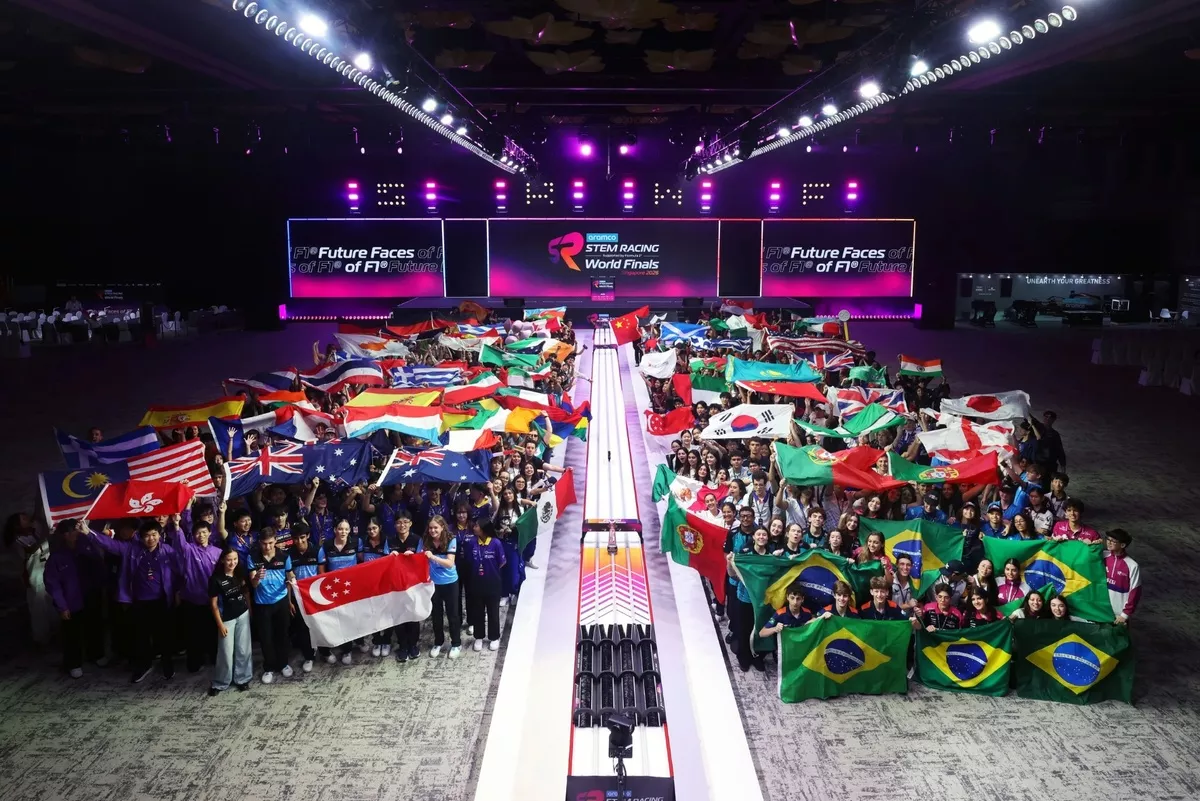
The 2026 edition in Singapore was the biggest one yet, with 91 student teams from 36 different countries represented, competing for a number of different awards judging their prowess.

STEM Racing World Final 2026 Singapore
Photo by: STEM Racing
Despite the cars' miniature sizes, the competition itself bears more than just a passing resemblance to F1. Teams are free to design and manufacture the cars themselves using professional CAD software, putting their knowledge of aerodynamics to the test as they shave drag off their cars.
The end product is manufactured on a CNC router, with the front and rear wings being 3D printed before being assembled, painted and finally raced. Adhering to a strict rulebook, cars must all pass scrutineering like a real race car would.
But they are also judged on off-track skills. Teams have to build a marketing portfolio and sponsorship plan, create a brand, hold verbal presentations to judges and build a pit booth display to combine all of that into an impressive product. And with a maximum of six students per team, there is no place to hide.
The question of marketing and funding becomes especially pertinent for teams who make it to the World Final and face a trip to Singapore, which is not an inexpensive undertaking for a group of up to six members plus their teacher or adult guide.

STEM Racing World Final 2026 Singapore
Photo by: STEM Racing
Strolling around the large ballroom of the Resort World Sentosa, where the 2026 finals are held, it's hard not to be taken aback by the level of competition, creativity and passion on display.
"I think it's important to gain experience, but I also love the competition element," says Noah of German team Spectrum, which would go on to take the third podium spot. "You really learn to work under pressure as a team."
Elsewhere, Aarav, team leader and design engineer at team Nebula from Singapore, said he enjoyed meeting and learning from his international peers. And like a true F1 designer, he was already stealing with his eyes as he checked on the competition. "The level here is so high," he said. "It is really interesting to see how other teams solve the same problems."
While there is no direct path to F1 given the age of most competitors, the initiative is supported by F1 and many of its teams. Many STEM Racing alumni have used the competition as a springboard to a relevant university degree and subsequently a place on an F1 team.
Greece's Kyriakos Theofanidis won the event in 2016 and is currently a mechanical engineer at Red Bull Ford Powertrains. James Mitchell from Australia competed at the World Finals as recently as 2023 before being snapped up by Aston Martin. Fellow STEM Racing alumnus Britain's Laurence Vines now works at Williams as a structural design engineer and still works for the event itself as a pundit, mentor and judge.
"I wanted to work in F1 and when I was 15 I wrote letters to all of the teams applying for work experience," Vines told Autosport. "Not having any connections in the sport, I just had no clue what the way in was until I discovered the competition by coincidence. In partnership with what was then called F1 in Schools, Williams ran its engineering academy where they'd support you through your studies, and I knew that was my way in."
Vines says the competition helped him because it familiarised him with tools and methods like CA, CFD and FEA simulations much earlier. "Before I took part I didn't know what those things were. I wouldn't have touched them until university," he said. "At 15, I'm doing my first CAD, designing this miniature car. Under regulations which set you up so well to work in something like Formula 1. They're over 70 pages long with lots of detail.
"Since then, I've gone on to study Mechanical Engineering at University College London, which sponsored the competition and awarded me a full scholarship. I then did a placement at Williams."

STEM Racing World Final 2026 Singapore
Photo by: STEM Racing
Amy Martin used the competition to pursue an engineering degree, before switching to the financial world. Those passions eventually collided as she joined Mercedes High Performance Powertrains as a financial controller.
"At the start I wasn't really that interested in F1," she said. "I just got my friends together in school and we were one of the few all-girl teams at the World Finals that year. After we won the Marketing Award, I got selected for the Williams Engineering Academy in 2016. They took us into the paddock where I met Nico Rosberg. That was when I decided I would do anything to get into F1.
"For a 16-year-old girl, it was genuinely electrifying to be there and look at what my future could look like."
When asked what she felt she got out of the competition, she replied: "Confidence is the main thing. When you're asking someone who's 15 or 16 to hold a presentation in front of world-class F1 engineers and judges, that's pretty tough. It instils a level of fearlessness.
"And the standard of some of the kids who compete... wow. They are not just so incredibly intelligent, but to be able to articulate themselves on a world stage, it's honestly great. It has created some really good all-rounders."
STEM Racing isn't just a boon for the students taking part, though, but it's also growing in importance for F1 teams themselves. In a budget cap world, identifying and attracting the next generation of engineering talent has started earlier and earlier, and it's no coincidence the majority of teams have established their own engineering academies, graduate schemes and other placement programmes.
"All teams realise the importance of young talent in the team. New ideas and people contribute so much," McLaren's racing director Randy Singh told Autosport. "We have a very established graduate scheme at McLaren and many of the people who've come off that scheme are here at track this weekend, like Oscar's performance engineer and our lead strategist. It's a really good way of getting super talent into the team.
"Things like STEM Racing are super useful for kids of that age because it teaches you a lot about how a Formula 1 team works. There's design, there's research, there's marketing and commercial aspects as well. That's all really useful experience."

Randy Singh, McLaren Racing Director
Photo by: Peter Fox / Getty Images
When asked what his advice is to teenagers aspiring to work in F1 or the wider motorsport world, Singh replied: "As long as you're involved in some kind of deep technical endeavour where you work as a team, whether it's STEM Racing, Formula Student, rocketry, or even doing sports to a very high level can be in itself fairly technical, then I think that really equips you well to work in a fast-paced team environment like F1.
"I certainly wouldn't limit people to one route or another, but these kinds of things make a big difference to people's applications. Sometimes, dealing with the dysfunctions of a team is a key thing that you don't really experience at university until you get to a professional environment, so that's super useful."
Despite the event's long affiliation with F1 into its 26th year, founder Andrew Denford feels STEM Racing is only now starting to turn a corner following its 2024 rebrand. "You've got to educate people on why they need to teach STEM in school," said Denford, who is also the CEO of the family-run Denford company which supplies CNC tools to the education sector.
"We started this in 2000 to get kids interested in engineering and manufacturing, first as Jaguar F1 in schools and when they pulled out of F1, Bernie Ecclestone allowed us to keep using the F1 name. It's just consumed my life, really. We've now got 77 countries who are involved in the programme. The level keeps getting higher. I've got to be careful I don't start talking technical terms, because they'll just blow me out of the water."

STEM Racing World Final 2026 Singapore
Photo by: STEM Racing
F1's popularity boom post-Netflix has also seen the programme's numbers go up, with STEM Racing now adding several entry-level school programmes to its pathway for children as young as six, with varying degrees of complexity.
When asked what he wants children to get out of STEM Racing, Denford said: "We want them to find out what their skill set is. If you look at all the job roles; team principal, aerodynamicist, manufacturing engineer, marketing or project manager, they'll find within that team of six what they want to do.
"Then they can develop what they've learned and take it into the wider world."
Wherever the future may take any of the 2026 finalists is up in the air. Some will make it to the F1 paddock, the aerospace industry, or take a wildly different and unrelated career path that hasn't even emerged on the horizon yet.
But whatever that path may be, they will take on the future supercharged by their Singapore experience and the skills they honed along the way.
Share Or Save This Story


Rwanda turns to F1 as it moves forward from a chequered past

Five key takeaways from F1's big African Grand Prix reveal in Rwanda

F1 signs historic 10-year Rwanda deal to host African Grand Prix

Inside the competition building F1’s future engineering talent

WEC Barcelona: Toyota scores dominant 1-2 to clinch manufacturers’ title

When Can-Am made its controversial comeback

Mercedes explains why its upgrade made its F1 car harder to drive
Subscribe and access Autosport.com with your ad-blocker.
From Formula 1 to MotoGP we report straight from the paddock because we love our sport, just like you. In order to keep delivering our expert journalism, our website uses advertising. Still, we want to give you the opportunity to enjoy an ad-free and tracker-free website and to continue using your adblocker.


Top Comments