

What we learned from Thursday practice at the 2026 Las Vegas GP
Wet running in FP2 (and a lack thereof in FP1) meant that teams had discovered little about this year's Las Vegas GP. Still, we think there's a few points of note...

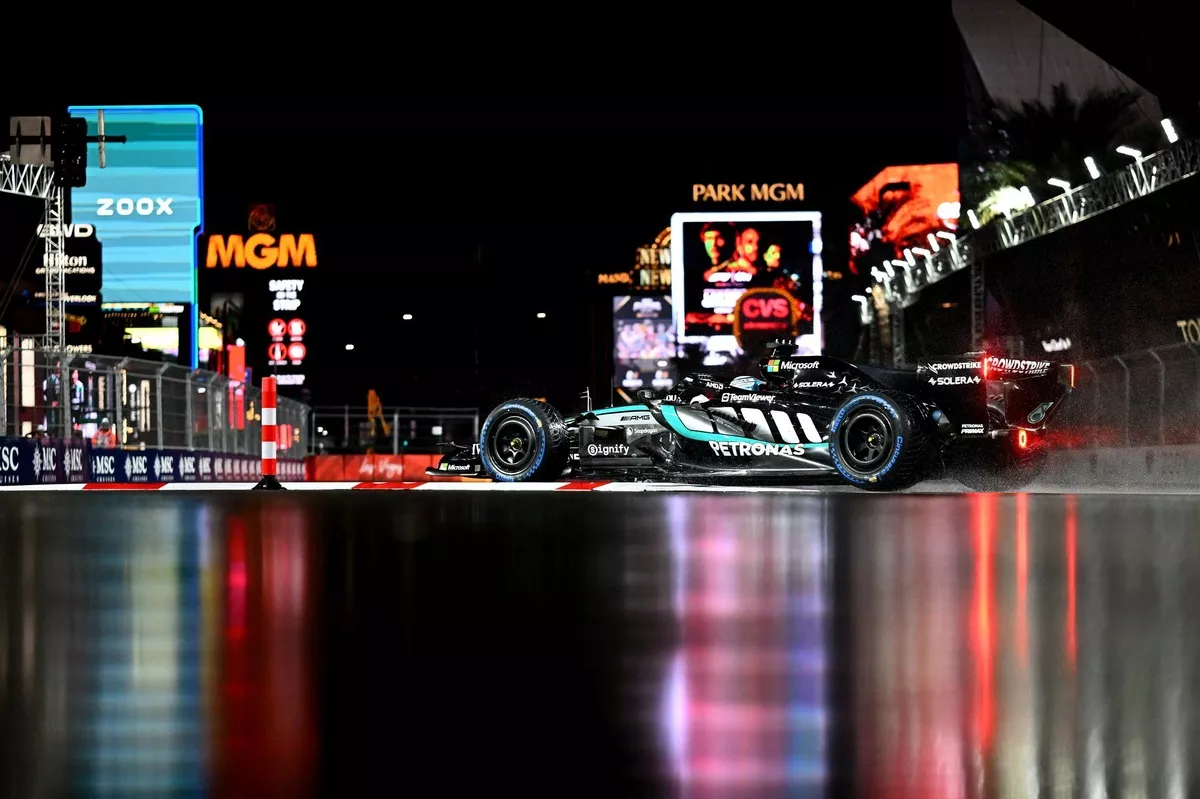
Sergio Perez sat atop the leaderboard when the opening practice session of the Las Vegas Grand Prix weekend came to a close: not because the Cadillac driver had set the fastest time, but simply because he left the pitlane first. Only one driver registered more than one lap in FP1, this being Haas rookie Rafael Camara, as the circuit was just too wet to conduct any meaningful running. Folk love to gamble in Vegas, but doing anything beyond an installation lap was far too much of a punt.
The rain had cleared up by the time FP2 had rolled around, but The Strip was still damp - and cold, which probably prolonged the use of the full-wet tyre as the FIA had sanctioned a 20 degrees C increase in tyre blanket temperatures for the most extreme of the Pirelli compounds. Both Lando Norris and Oscar Piastri ventured onto the intermediate about 20 minutes into the session, the circuit having cleared enough of its puddles for McLaren to sanction the switch. But nobody dared touch the slicks throughout FP2, even when a dry line began to form around the majority of the course; it remained too greasy to take the risk.
George Russell ended the session quickest, less than a tenth over Pierre Gasly, but this was largely the result of them being the last drivers to set meaningful times at the end of the hour. "I think realistically we probably were not the fastest today," Russell surmised after an hour of splashing about Nevada's largest city. "McLaren looked exceptionally fast; Charles looked very fast at points. We just got the lap in; the track was at its driest, and Norris didn't run."

And, if the rest of the weekend is going to be dry, there's not really a lot that the teams can learn from the Thursday night sessions. The parameters remain the same: track temperatures will be cold, it'll be difficult to load heat into the tyres during qualifying, and the tyres will be susceptible to graining through long runs as the drivers experience sliding around the low-grip track surface.
What we don't know is the extent of this. The inclement conditions of FP1 and FP2 will leave drivers scrabbling for grip across the Friday sessions, as very little rubber will have gone down onto the circuit, and the teams will have to pack a lot of work into FP3 to get a read on qualifying pace and their high-fuel runs on the harder tyres.
"We'll be out from the beginning, trying to get a long run in," Russell said of FP3. "I think nobody knows how the graining is going to be for [the race]. Last year it was an easy one-stop, but the year before there was lots of graining and it was a two-stop. So, there are questions that we want answered, but we probably won't get an answer until race day."

Red Bull didn't have a chance to test its minor front wing update
Photo by: Alastair Staley / LAT Images via Getty Images
For the viewer, this should be a bonus; although the race is expected to be a blanket one-stopper given the low tyre wear, it'll be much harder to zero in on the qualifying-race set-up balance and thus should produce two somewhat different sessions in terms of the competitive order.
This is complicated by teams being unable to explore updates. McLaren was one of a handful of teams to bring an update package to Las Vegas, this being the next part of the changes it had made for the Brazilian GP last time out. Having flown over a new floor package ahead of the final triple header, which included a new bargeboard arrangement, floor edge, and rear floor corner pieces, the team declined to put in on the car across FP1 and FP2 rather than risk damaging it among the wet conditions.
Whether the team will consider running it in FP3, or just run as-is and save the new parts for Qatar, remains to be seen. Red Bull was in the same boat with a minor change to the front wing endplate, but will aim to try it out in the final practice session to at least develop an understanding of it.
Friday's sessions could be a very mixed bag. Snap warm-up on the soft tyres will prove decisive in qualifying, as some of the topsy-turvy qualifying orders in Las Vegas has proved, while the race will primarily hinge on heat retention and on maximising battery harvesting
The balance that has to be struck here is this: does a team spend time doing data acquisition when potential dry running remains so scarce, and when there's a race on the line? If it ends up being wet again, these teams - Racing Bulls and Mercedes having also brought a smattering of updates - will perform a definitive kicking of the can down the road to the following race weekend.

Overall, Friday's sessions could be a very mixed bag. Snap warm-up on the soft tyres will prove decisive in qualifying, as some of the topsy-turvy qualifying orders in Las Vegas has proved, while the race will primarily hinge on heat retention and on maximising battery harvesting as we trend back towards Monza with regards to energy consumption.
Further mixed reviews of wet tyres
Since the two 2026-spec Pirelli wet tyres got another workout across FP1 and FP2, it presented another chance for the drivers to present their feedback and potentially angle for any redesigns for next season. It's known that Pirelli took a moderately conservative approach for its range of 2026 tyres, essentially having to extrapolate the performance of the 2022-25 compounds into the narrower dimensions.

Despite an increase in wet-tyre blanket temperatures, Albon believed this was still too low
Photo by: James Sutton / LAT Images via Getty Images
General feedback is that the tyres are quite hard, and this partly extends to the intermediate tyre as well. The full wet (or x-wet in F1 parlance) is softer and the tread blocks move around more, which makes it easier to generate the heat required for track conditions bearing standing water. The rise from 40C to 60C blanket temperatures helped the drivers out slightly more, but even the fire-up time for the blue-walled tyre seemed to vary around the grid.
Nico Hulkenberg stated that "I thought it was okay. I think the x-wet is quite a soft compound, and it's not bad to get it going," while Alex Albon stated that he found it very difficult to get performance out of the two wet compounds and that the circuit was far too cold to get them in the window. Without the right level of temperature, the tread blocks struggle to form the correct level of adhesion with the road, and thus the tyre is much more prone to sliding. Albon suggested that the blanket temperatures needed to be even higher.
This might not be too relevant over the rest of the weekend, and certainly shouldn't be relevant to either the Qatar or Abu Dhabi races, but it should be good data for Pirelli for next year and beyond.
Much of the feedback from Brazil was that the intermediate was a bit too stiff to work with, and it only started to come to the drivers over the latter part of FP2 in Las Vegas as the dry line started to form and presented a chance for the tyre to actually build heat. And even so, Carlos Sainz suggested after last weekend that the front intermediate tyres drop off much quicker than the rears, his feedback being that "by the time [the rear] warms up the front is gone".
It does feel like the suite of wet compounds have seen quite a bit of action in the latter half of this year, and it is the hope of the drivers that this isn't too late for their feedback to factor into the design of the 2027 compounds. Primarily, their desire is to see an 'x-wet' tyre that is able to break the surface tension of standing water more easily, and an inter that is more malleable and has less sidewall rigidity.

The drivers have asked Pirelli for improved wet tyres
Photo by: Manuel Eletto


Why tyre warm-up will be the defining challenge of F1's Las Vegas Grand Prix

The last time two Brazilians raced at home in F1 - and the battle over a point

Haas sticks with Camara for Las Vegas GP, Hirakawa in for FP1

How seizing every chance – and making it happen – keeps Gasly’s fire burning

Why Camara should take heart from a tough F1 debut in Brazil

Brazilian Grand Prix Driver Ratings 2026

Antonelli explains "weird" spin and car instability which cost F1 Brazilian GP win

The wet-weather challenges thrown up by Brazilian GP qualifying
What we learned from Thursday practice at the 2026 Las Vegas GP

F1 Las Vegas GP: Russell fastest in damp FP2 from Gasly

Cadillac ditches plan to produce own V6 hybrid engine ahead of F1’s V8 push

LIVE: F1 Las Vegas GP updates - Russell nicks top spot in damp FP2
Subscribe and access Autosport.com with your ad-blocker.
From Formula 1 to MotoGP we report straight from the paddock because we love our sport, just like you. In order to keep delivering our expert journalism, our website uses advertising. Still, we want to give you the opportunity to enjoy an ad-free and tracker-free website and to continue using your adblocker.


Top Comments