


The themes to watch for the rest of F1 2025
Formula 1’s summer break is now over. With the final 10 races of the season about to unfold, these are the key plots to follow

Formula 1 is back from its summer break at the Dutch Grand Prix with 10 races of the 24-strong calendar left to run.
McLaren duo Oscar Piastri and Lando Norris will do battle at Zandvoort this weekend with nine points separating them in the fight for the drivers' title.
But that's not the only theme to look out for across the final 10 rounds - here are the key storylines to follow.
Championship battle will be decided by who makes the fewest mistakes
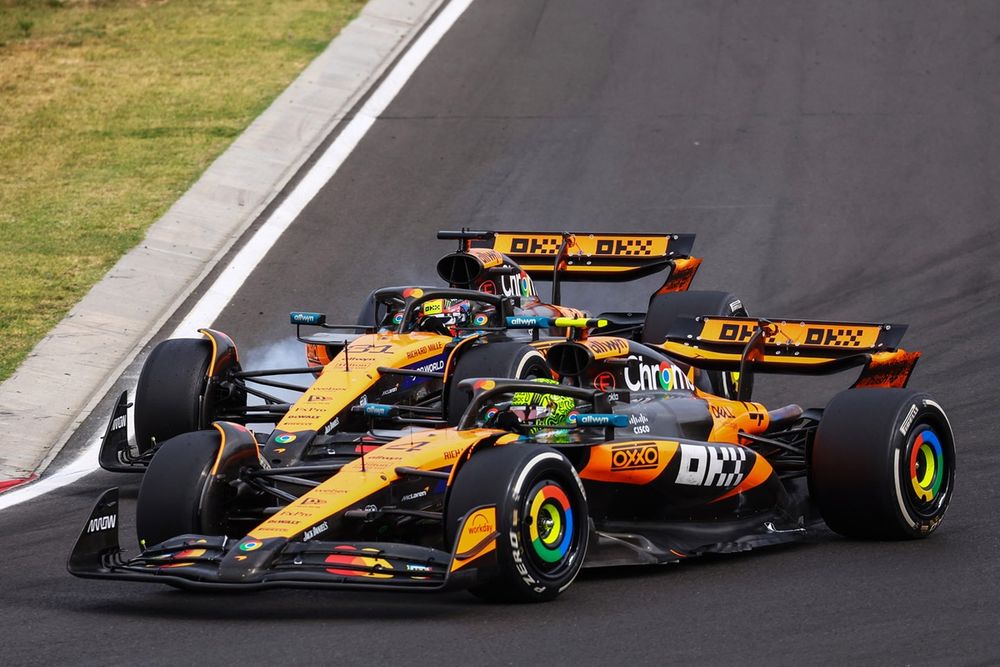
Norris and Piastri battle for the race lead in Hungary, both emerging unscathed
Photo by: Joe Portlock / LAT Images via Getty Images
“It’s probably down to who does the least mistakes, I would say, more than anything. Not necessarily who’s outright the quickest or who can simply race better or who makes the best overtakes. I think it’s just – yeah, I have some of my strengths, he [Piastri] has some of his.”
That was Norris’s extended musing over the drivers’ championship situation ahead of the Hungarian Grand Prix, the last race weekend before the summer break, and just over the halfway point of the season.
To some extent it’s a statement of the bleedin’ obvious; who else is there to challenge the two McLaren drivers, who sit first and second in the standings nine points apart?
Not third-placed Verstappen, now an increasingly distant figure in the rear-view mirror, nearly 100 points off Piastri. While he is one of just two non-McLaren drivers to have won a grand prix this season, Verstappen conceded during the Hungarian weekend that he is out of contention unless something drastic changes to make his Red Bull more competitive – this despite his sprint-race win at Spa.
“We’ve tried a lot of different things, but at the moment nothing is working,” he said at the Hungaroring. “Of course, I have some ideas, but I can’t always talk about them publicly. We’ll just have to wait and analyse everything after the weekend.
“In the end, it doesn’t hurt that much now because we’re not really fighting for anything anymore.”

Norris made a pig’s ear of his pursuit of Piastri in Montreal and was characteristically swift and candid with his mea culpa
Photo by: Sam Bloxham / Motorsport Images via Getty Images
Fourth-placed George Russell, the winner in Canada, is also increasingly distant in terms of points tally. In Hungary, Mercedes gave up on the new ‘anti-lift’ rear-suspension geometry it introduced in Montreal after an initial trial at Imola.
Having to row back on this, and by association, other upgrades designed to work in harmony with it, is an indicator of how lost Mercedes has become in terms of development.
That makes it a battle between the two McLaren drivers, Norris and Piastri, and the trend is ominous for Norris since he is the one who has made the most high-profile and costly blunders, particularly in qualifying for the early rounds.
Since adopting a different front suspension geometry in Canada, he has made slightly fewer mistakes in qualifying, but there have still been failures of execution – such as when he drove into Piastri in Montreal.
Spa was perhaps a more representative indicator of how small mistakes can compound into bigger losses: Norris misjudged the rolling start and lost out to Piastri on the opening lap, then his alternate strategy was undone by a slow pitstop and some more mistakes in the remainder of the race.
Equally, though, after a poor start in Hungary, he made the best use of the unfavoured one-stop strategy into which he was forced, ultimately emerging the winner. Wouldn’t it be remarkable if the championship went to the driver who had arguably made the most mistakes?
Gloves come off in the presidential election battle

Ex-steward and now presidential hopeful Tim Mayer has a tough fight on his hands
Photo by: James Moy
We’ve come to the end of a protracted opening bout in what appears to be a battle for the heart and soul of the FIA. And what a fascinating game Mohammed Ben Sulayem’s opposition has been playing so far.
It’s now obvious that Carlos Sainz’s putative candidacy was never serious, and he was acting as a ‘stalking horse’ to lure Ben Sulayem into deploying some of his munitions. That came in the form of a ‘support letter’ from a number of (predominantly Spanish-speaking) member clubs, published ahead of the Spanish GP.
Seasoned watchers of UK politics may recall how the downfall of Margaret Thatcher was initiated by a challenge to her leadership in November 1989 by 69-year-old Sir Anthony Meyer, the little-known MP for Clwyd North West. Meyer lost by a substantial majority, as expected, but emboldened Thatcher’s opposition and a year later her enemies toppled her.
The mechanics of the FIA election are underpinned by an outwardly Byzantine system of mathematics which has its own logic. It is also littered with obstacles placed by former presidents – as well as the current one – to make a challenge more difficult to mount.
Even before we get into the serious voting business (245 member organisations across 149 countries, each organisation generally getting one vote), presidential candidates must assemble a team (or ‘list’) that includes a potential president of the senate, a deputy president and seven vice-presidents for sport, and a deputy president for automobile, mobility and tourism. The vice-presidents must be drawn from all seven regions of the global membership.
That makes the ‘support letter’ such a key piece of ammunition, since an incumbent can block opposition by securing the total support of one region.

FIA supremo Mohammed Ben Sulayem is an adept political operator
Photo by: Rudy Carezzevoli / Motorsport Images
The question now is what Ben Sulayem will deploy against Tim Mayer, the former steward who has formally declared his candidacy.
Mayer says there is no connection between his bid and Sainz’s ultimately abortive one, but he appears to enjoy the support of Robert Reid, who resigned as Ben Sulayem’s deputy president for sport ahead of April's Bahrain Grand Prix.
For now, Mayer has been doing the majority of the running, publishing part but not all of his manifesto. As expected, it explicitly targets Ben Sulayem’s record in office, outlining a means of transforming the FIA’s governance into a more democratic, transparent and accountable structure.
What he has yet to do, at the time of writing, is publish his ‘list’ or those sections of the manifesto that tackle issues such as mobility. This latter issue is more likely to chime with the member clubs rather than high-minded matters of governance.
Ben Sulayem has done little beyond give briefings to selected media outlets. But he is a canny operator and the battle ahead will be fascinating – and, probably, nasty.
More questions asked of Hamilton at Ferrari

Hamilton failed to make it out of Q2 in qualifying at the Hungaroring
Photo by: Simon Galloway / LAT Images via Getty Images
Lewis Hamilton has always been a driver who wears his heart on his sleeve. His successes and failures come writ large on his face when he emerges from the car.
After being eliminated from qualifying in Q2 in Hungary, he walked back to the Ferrari garage, then on to the motorhome, with his crash helmet still on and his gloves shielding the view of his face through the visor.
Meanwhile, team-mate Charles Leclerc took a pole position that might have owed something to changing track and weather conditions and the McLaren MCL39’s sensitivity to crosswinds, but which was pole nevertheless.
“Useless, absolutely useless,” was a disconsolate Hamilton’s verdict later, the subject being himself. “The team has no problem, you’ve seen the [other] car is on pole, so we probably need to change driver.”
This offhand remark naturally triggered the nattering nabobs of the commentariat, including Ralf Schumacher, a six-time grand prix winner now paying the bills as a pundit for Sky Germany.
Schumacher has been predicting since April that Hamilton would retire during the summer break. He naturally pounced on Hamilton’s self-excoriation.

The seven-time world champion’s dejection was obvious in his words and body language across the Hungarian GP weekend
Photo by: Clive Rose / Getty Images
“This is exactly what I said at the beginning of the year,” said Ralf. “If it continues like this, the point will come where Ferrari has to choose a driver and can’t build the car for both. And then it gets tight. Now he’s starting to doubt himself more and more.
“I’ve been in that situation myself. That was in the DTM, when I said, ‘OK, this makes no sense anymore.’ I handed the car back a year early. I believe he’s capable of doing that – and that he will do it.
“Because this is such a bitter disappointment, and he doesn’t know which way is forward or back anymore. Not immediately, of course, but something like this can always happen.”
Perhaps of more significance to Hamilton’s career than the musings of the on-air ‘talent’, Ferrari CEO Benedetto Vigna was a high-profile visitor to the Hungarian GP weekend. On the face of it, this was to put a public arm around the shoulder of embattled team principal Frederic Vasseur in the form of a new contract, confounding those who were speculating that he was shortly to be fired.
Hamilton’s performance in the previous weekend’s Belgian Grand Prix showed he’s still capable of executing a race brilliantly, but stringing a qualifying lap together has been a persistent issue in F1’s new ground-effect era.
That has had a deleterious effect on his morale – perhaps he needs an arm around the shoulder from Vigna, too? He isn’t getting one from former F1 ‘ringmaster’ Bernie Ecclestone.
“I think he should move over,” said ‘The Bolt’ in Hungary. “It’d be terrible if something happened to him.”
Russell can play hardball over future Mercedes contract

With Verstappen no longer a threat to his seat at Mercedes, Russell holds a strong negotiating position
Photo by: Timothy A Clary / AFP via Getty Images
For much of this year Russell’s position has elicited much sympathy, for while his on-track achievements have been tremendous, of a contract extension beyond the end of this season there was no sign.
Meanwhile, Mercedes team principal Toto Wolff has made very little secret of his flirtations with four-time world champion Verstappen’s management, leveraging Max’s manifest disgruntlement with the state of affairs at Red Bull Racing.
Until recently, when asked to comment on his contractual negotiations, Russell has chafed – as much as his job and allegiance to Mercedes allows – at the lack of progress. But circumstances have now changed.
In terms of Verstappen’s here-and-now, he went into the summer break third in the championship, therefore unable to execute the break clause believed to be enshrined in his contract.
While this is understood to be more demanding of the team next year and beyond – part of the cut-and-thrust of locking a high-value driver into such a long contract – for now it means Verstappen will stay where he is for 2026 at least.
Red Bull’s senior leadership in Austria also gave ‘Team Verstappen’ what they wanted, which was team boss Christian Horner’s head on a silver platter.

Sitting pretty: Russell knows his value to Mercedes and will want to see that recognised and rewarded
Photo by: Mercedes-Benz
The swift and ruthless nature of Horner’s removal led paddock wags to joke that regardless of new team principal Laurent Mekies’ title and job description, Verstappen’s father Jos is the real boss of Red Bull Racing now.
In parallel with these shenanigans at Milton Keynes, Mercedes’ form has also fallen off the proverbial cliff. After four podiums in the first six races, including a magnificent second place in a failing car in Bahrain, Russell has had diminishing returns save for his win in Canada – and that fell into his lap.
In the other garage, Wolff’s protege Andrea Kimi Antonelli has by his own admission had a stinker of a European season.
Reverting to the pre-Imola suspension in Hungary represented an admission that the team has taken the wrong path in development – not for the first time in recent years.
At the beginning of the season the W16 looked, if not faster than Red Bull’s RB21 at its peak, certainly more consistent. Now Mercedes looks as far away from McLaren as it did last year.
So Russell can now sit back, spark up a proverbial cigar, and invite Wolff to go away and sharpen his pencils.
Mekies makes Red Bull his own

Studious, low-profile Mekies appears to be the right fit for the post-Horner Red Bull
Photo by: Red Bull Content Pool
In politics, the first 100 days of any administration is popularly seen to be a measure of how the remainder of its time in office will pan out – the “direction of travel”, to use a phrase beloved of Williams team principal James Vowles.
Business gurus also see this as a critical period for new leaders charged with a mission of transformation. So while there are those who joke that Jos Verstappen is the one wearing the trousers now at Red Bull Racing, the appointment of Mekies is significant on many levels.
He is yet another team principal to come from an engineering or mechanical background; of the others, only Wolff and de facto Alpine boss Flavio Briatore hail from the wider world of business.
In the past, every aspect of the business crossed the team principal’s desk. But in F1’s more corporate era the head honcho is just another employee answering to a board of investors – and an increasingly focused one at that.
There are those who say Horner’s downfall was a consequence of losing focus because his workaholic nature led to an almost messianic compulsion to be across every facet of the business.
Obviously, the controversy regarding a female employee, along with the increasingly swaggering persona and frequently expletive-laden public appearances, did not chime well with the socially conservative Austrians either.
Mekies was chosen not only for his lower profile and studious nature, but also because of the wider ‘direction of travel’ for team principals to be focused on performance – in the sense of that word meaning ‘the action or process of performing a task or function’ rather than ‘an act of presenting a play, concert, or other form of entertainment’.
As Mekies said during his first appearance as Red Bull Racing team principal in an official FIA press conference, “the aim is to avoid bottlenecks”. Easy to say, but he has inherited an obviously dysfunctional organisation whose star driver is in a high state of agitation over the state of his car’s competitiveness.
Make or break time for Antonelli
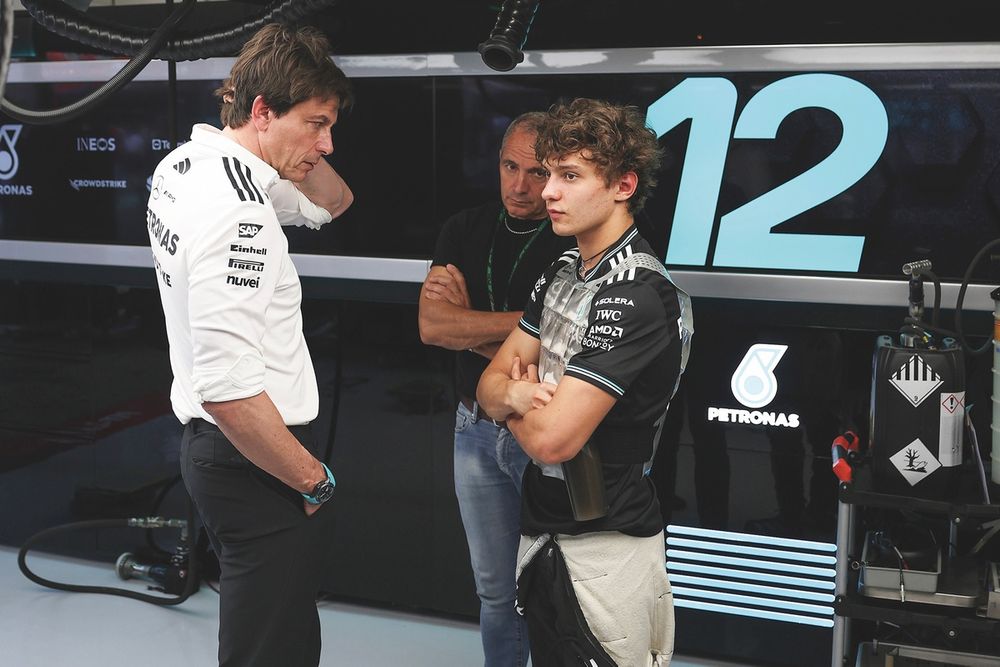
Wolff protege Antonelli still needs to deliver the goods on track
Photo by: Sam Bloxham / LAT Images via Getty Images
With his boyband looks and flamboyant, aggressive driving style, Mercedes prodigy Andrea Kimi Antonelli has won fans across the broad spectrum of the F1 audience.
But aside from qualifying on pole for the sprint race in Miami, and finishing third in Canada – making him the youngest-ever driver to stand on a grand prix podium – he has largely failed to match team-mate Russell on pace and results.
He went into the summer break a distant seventh in the drivers’ standings; Russell has scored almost three times as many points.
Belgium was arguably Antonelli’s lowest point in what he himself described as a poor European season. He was eliminated in the first phase of both qualifying sessions and started last of all in the sprint race.
Despite being one of the first drivers out in grand prix qualifying he was last of all to arrive in the interview ‘pen’ because he was so distraught that he had to compose himself – with a helping hand from Hamilton.
In response to this, and some supporting feedback from Russell, Mercedes decided to revert to the W16’s original rear suspension set-up. It introduced a new ‘anti-lift’ rear suspension geometry at the Emilia Romagna Grand Prix in May, dropped it for Monaco, then re-adopted it from Canada onwards.

While he finished outside the points in Hungary, Antonelli was more upbeat in tone having found new confidence in the car
Photo by: Simon Galloway / LAT Images via Getty Images
In theory, preventing the rear axle from lifting as the car’s weight balance shifts forwards under braking confers two key advantages: it mitigates the tendency of the rear wheels to lift and lock, and helps maintain a stable aerodynamic platform.
Among the trade-offs, though, is a lack of feedback to the driver, which accounts for both Russell and Antonelli reporting a lack of confidence in the W16’s rear end. But the picture has been muddied by the strong result in Canada, and different track configurations and weather conditions since then.
Although Antonelli was eliminated in Q2 in Hungary, consigning him to a DRS train in the race and a finish outside the points, he was much more optimistic.
“It’s a bit of a shame that we didn’t go earlier to the old suspension because definitely today [Saturday], this weekend overall, I felt far more confident in the car than I was before,” he said.
The question now is whether he can kick on. Given his relationship with the team, it’s likely he will stay – but even his mentor Wolff will need to see some improvement.
Tsunoda’s time is running out

RB21 remains a handful for Tsunoda. He is keen to avoid direct comparisons with Verstappen, hinting at car spec variation
Photo by: James Sutton / Motorsport Images
Yuki Tsunoda’s confidence has been buffeted ever since he swapped into the Red Bull RB21 after three grands prix this season and found it was even more of a brute than it seemed in the simulator.
After a spring and summer punctuated by high-profile shunts and qualifying mishaps, Tsunoda belatedly received a more recent floor spec – albeit not the very latest – at Spa and managed to get through to Q3 for the first time since Miami.
The race was a disaster but responsibility for that lies with Red Bull itself for not calling him into the pits sooner. While Tsunoda continues to find the car truculent, he is keen to point out that it’s impossible for him or anyone else to compare performance with Verstappen until they have an equivalent car spec.
“You know, how he [Verstappen] always extracts performance consistently every session, every grand prix, is very impressive,” said Tsunoda in Hungary. “It’s not things that you can do very easily. And it seems like he can.
“But at the same time, I just don’t think it’s fair to compare. And I don’t want to directly compare with him because he’s been here nine years in that car and I’m just jumping into the car.
“And also, I’m not – well, let’s see if I get exactly the same car. Until that point, I can’t compare directly.”
Tsunoda now has more of an ally in charge – Mekies – but he still needs to start scoring points lest the axe fall.

Will the arrival of Mekies at Red Bull prove to be key to unlocking Tsunoda’s full potential?
Photo by: Red Bull Content Pool


Italy’s next F1 world champion?

Why Norris doesn’t buy Russell’s driving style theory

How Antonelli is proving unbeatable, even when he's beaten

F1 Spanish GP live commentary and updates - Lap by lap of how Antonelli won

What the drivers think of the "crazy" Madrid F1 circuit

Why new Madrid F1 circuit will be a "challenging" test of cars and engines

What Jacques Villeneueve really learned from Gilles: “I can do this, you can’t”

Why Monza remains F1's eternal test of team bonds

Acosta's long road to his maiden MotoGP win

MotoGP Austrian GP: Acosta finally claims maiden win

Great debate: Which circuit should host the F1 2026 finale if the calendar has to change?

Live: MotoGP Austrian Grand Prix updates as it happens
Subscribe and access Autosport.com with your ad-blocker.
From Formula 1 to MotoGP we report straight from the paddock because we love our sport, just like you. In order to keep delivering our expert journalism, our website uses advertising. Still, we want to give you the opportunity to enjoy an ad-free and tracker-free website and to continue using your adblocker.


Top Comments