


The seven reasons why Monaco 2021 wasn’t a better F1 race
As several opportunities to enliven the 2021 Monaco Grand Prix failed to materialise, Max Verstappen took full advantage and romped to a comfortable victory. Now atop of the Formula 1 drivers' standings, the Red Bull driver will be one of few glad of the woes that robbed him of meaningful competition

The 2021 Monaco Grand Prix was a unique event in the race’s storied history. But this was down to the restrictions the COVID-19 pandemic imposed, meaning it was more subdued compared to its regular pomp than anything wildly unusual happening in the race’s 78 laps.
But there was nevertheless still something of a celebratory atmosphere the night ahead of the grand prix. Hometown hero Charles Leclerc had claimed pole in bizarre circumstances given his late Q3 crash, which prevented others improving. That led to Monegasque flag-bearing yachts and cars blaring their appreciation as dusk rolled in.
As he cycled home from the track, Leclerc remained anxious about the extent to which he’d smashed his SF21 against the barriers at the Swimming Pool complex’s exit, but the prospect of a famous home win was still tantalisingly talked up.
The next evening, the horns honoured another driver – Red Bull’s Max Verstappen. He’d dominated another dull Monaco procession, which was cruelly robbed of the storyline that might have kept it captivating even if there still had been zero lead exchanges. But no sole development led to the lifeless affair – several factors combined to create the eventual reality.
Charles Leclerc, Ferrari
Photo by: Mark Sutton / Motorsport Images
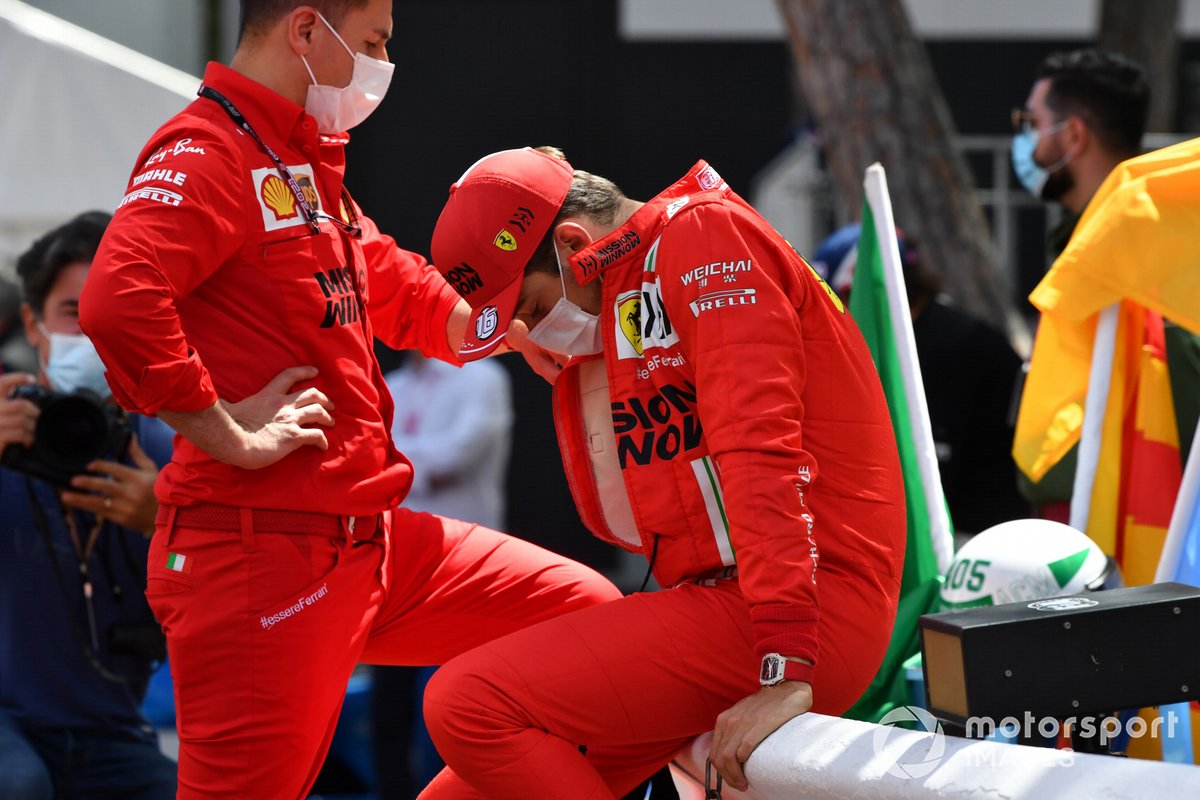
Reason one – Leclerc’s cruel DNS
After Leclerc’s crash, he was mainly worried the impact had damaged his gearbox (already changed post FP1), which would have meant a five-place grid drop if it needed replacing again.
But a preliminary Saturday night inspection had not revealed any serious damage, with Ferrari pledging to undertake further checks ahead of the race. These too were said to have found “no apparent defects” on Leclerc’s gearbox and he duly moved to take his car to the pole grid spot, which an advertising board bearing a giant version of his own face looked down upon, hung behind the giant grandstand beyond Tabac and overlooking the start/finish straight.
Ferrari was adamant that even if it had changed Leclerc’s gearbox, the driveshaft issue still would have occurred, but Binotto still couldn’t conclusively rule out the crash being a contributing factor
But, just a few minutes after the limited local spectators had cheered Leclerc into the Ferrari garage, he was being wheeled back into it after doing just a single pre-race lap.
Exiting the hairpin on what would have been the first of several tours ahead of lining up on the grid, Leclerc reported the problem he’d feared. “No, no… the gearbox, guys…” he exclaimed, his head in his hands as he toured back to the pits. There, Ferrari discovered the problem was actually coming from the “left hub driveshaft wheel”, per team boss Mattia Binotto.
Ferrari was adamant that even if it had changed Leclerc’s gearbox, the driveshaft issue still would have occurred as “those parts would still have been on the car because they were not damaged from [the] accident”, according to Binotto. But he still couldn’t conclusively rule out the crash being a contributing factor. Whatever, the damage was done. Leclerc was heartbreakingly out before the start.
“It's difficult because it's at home,” he later reflected. “It's not every day that we have the chance to be in such a good place. But, yeah, at the end, it's like this. It's part of motorsport and these things can happen.”

Max Verstappen gets the jump on Valtteri Bottas at the start
Photo by: Jerry Andre / Motorsport Images
Reason two – Verstappen nails the start from ‘pole’
Leclerc’s disaster handed Verstappen a golden chance to take a first Monaco win and make amends for having “shunted a few too many times” here in the past, as he acknowledged post-race.
Ahead of the start, Red Bull sporting director Jonathan Wheatley had cannily asked F1 race director Michael Masi if the drivers would all be shuffled up one spot, as Valtteri Bottas had the inside line on the run to Sainte Devote from third behind Verstappen. But Masi quickly quashed the question.
“The final grid was issued by the stewards, within the timeframes outlined within the sporting regulations,” he explained. “So, after that point there is no framework for it to happen and accordingly the position was left vacant.”
Verstappen “didn’t think [P2] was a great spot to start” as “the grip wasn’t amazing” at that point on the start/finish straight. And his concern became reality when the RB16B’s wheels spun up as the lights went out. This cost Verstappen momentum, as Bottas dived quickly forwards. But the net ‘polesitter’ wasn’t having it – he chopped off the Mercedes’ line to make certain he maintained the lead heading into the first corner.
“He was drifting to the right, and it meant I had to lift otherwise we would have crashed,” said Bottas. “He was still ahead so he can defend. Hard but within the limits I think. There was nowhere to go with it.”
Given the difficulty of passing at Monaco, another chance to enliven the race had rapidly been lost, with the fastest car/driver combo now in command at the head of the pack.

Valtteri Bottas, Mercedes W12, has a pit stop issue that to retirement
Photo by: Steve Etherington / Motorsport Images
Reason three – Bottas’s challenge fades then disappears
For the first 15 laps, Verstappen led proceedings at a rather sedate pace – his advantage over Bottas never exceeding two seconds in that period. The classic modern Monaco pace managing techniques were on full display – the leaders not wanting to stress their soft tyres while still building up enough margin over the drivers on the harder compounds to be sure of pitting and staying clear when the time eventually came.
But in the next 13 laps, which led up to what would be Bottas’s only stop of the race, Verstappen increased his lead by an average of 0.267 seconds per lap. This meant that when Bottas came into the pits at the end of lap 29, the gap to Verstappen had just ballooned to five seconds.
“Max started to lift his pace,” Bottas explained of this phase of the race. “And the more I had to push, the front left tyre started to give up more than his, so I lost a bit of ground.”
"Given the power of the [wheel] gun, you can end up with no driving face and you just machine the nut down to a place where there is nothing left to grab a hold of. That is what we had" James Allison
Bottas was sliding back from Verstappen and into the clutches of the pursuing Carlos Sainz Jr, who had initially dropped back from the two leaders in the early running. But once the slow tours eking out tyre life had passed, the Ferrari was suddenly looking strong. Sainz closed in on Bottas and was 1.8s behind the Mercedes at the end of the lap before it stopped, feeling “a bit stuck”. But help was on its way.
Sainz’s assistance arrived from a Mercedes wheelgun when Bottas came in to exchange his softs for hards.
“We call it machining the nut,” Mercedes’ technical director James Allison said of the problem that followed. It left Bottas sat in the pits for over a minute before his race was declared over, and meant the W12 is heading back to Brackley with the right-front soft still attached.
“The gun starts spinning and chipping off the driving faces of the wheelnut,” said Allison. “In quite short order given the power of the gun then you can end up with no driving face and you just machine the nut down to a place where there is nothing left to grab a hold of. That is what we had.”

Max Verstappen, Red Bull Racing RB16B
Photo by: Andy Hone / Motorsport Images
Reason four – Verstappen’s early stint two gap reduction was misleading
As his closest rival was suddenly removed, Red Bull opted to leave Verstappen out until lap 34, which took him two past Sainz’s stop, in which the Spaniard had taken the hards. The gap between them was 6.8s at the end of Verstappen’s out-lap, but four laps later it was just 3.2s.
Suddenly, Verstappen’s position didn’t look all that commanding. Ferrari’s pace had been evident from early in practice and Sainz had looked menacing behind Bottas before getting a free pass into second. The race was rather finely poised. But over the next 10 laps, Verstappen reversed the slump, held Sainz at a comfortable length and then finally drive away once again thereafter.
“Initially I had Checo in front of me,” Verstappen explained, referring to his out-lap where Sergio Perez briefly led as he executed a textbook overcut to leap past Lewis Hamilton, Pierre Gasly and Sebastian Vettel, with Verstappen ordered to “just stay behind him” as “he was pushing to get ahead of a few people”.
“I had to save a bit of fuel anyway,” Verstappen added. “I did that and then of course the gap got a lot smaller, but there was nothing that was worrying or anything behind it. [I was] just slowly building up to it, because these hard tyres are not very nice to drive around here. They’re like slippery in the beginning, especially when you come out of the pits. I just wanted to settle in first.”

Carlos Sainz Jr., Ferrari SF21
Photo by: Mark Sutton / Motorsport Images
Reason five – Sainz couldn’t hold the pace to really threaten
Sainz had been usurped as Ferrari’s faster driver come qualifying, but he made a real fist of keeping Verstappen honest in the race’s second half. The Red Bull’s early fuel saving behind Perez and only gradually leaning on the hards had brought Sainz nicely into play. But he knew his chances were heavily restricted by Monaco’s track position premium.
“The first 20 laps I was pushing but not like crazy,” he outlined. “Then I decided to try and close the gap to Max, to put him a bit under pressure, obviously knowing here that the chance of a mistake is super low and that he’s been quick all weekend.”
"Overtaking here requires a high level of risk that probably today, considering that it was such an important day in the championship, we can be pleased" Sergio Perez
A string of times in the 1m14s followed Sainz hitting the 30-laps-to-go mark, but Verstappen was equal to the barrage. The gap briefly dipped below three seconds (to 2.8s) on lap 49, but it never got that low again.
“We went through a phase of a lot of lapped cars,” explained Sainz. “[Then], it was difficult to keep the focus. Also, it cooled the tyres off and at the same time it opened a lot of graining – the combination of trying to catch Max, coming through blue flags and everything.”
Sainz’s eventual struggles meant Verstappen’s lead reached 9s by the finish, where the pair were joined on the podium by the driver who’d spent the majority of the race with third place in hand.

Lando Norris, McLaren MCL35M, Sergio Perez, Red Bull Racing RB16B
Photo by: Charles Coates / Motorsport Images
Reason six – Monaco layout thwarts a late Perez pass for P3
But things weren’t exactly calm for Lando Norris as the race reached the final stages.
For the first 15 laps after Perez had pitted and leapfrogged over the three cars he’d trailed in the race’s first half (there saving his tyres nicely to use his machine’s potential in free air to devastating effect), the gap to Norris was largely stable. There was a regular seven/eight second difference between the pair and things looked set in place.
But Norris, who had been doing “a lot of fuel-saving at certain times”, was not happy on the hards he’d taken on lap 30. They quickly turned his MCL35M into “a very hard car to drive” and when the race reached lap 50, this really started to bite him.
From there, Perez ate into Norris’s lead and the gap was at its smallest – 0.6s – at the end of lap 66. But he never got close enough try a passing attempt as “overtaking here requires a high level of risk that probably today, considering that it was such an important day in the championship, we can be pleased [with fourth and no more]”.
Norris’s run to the flag had been made all the more stressful because he’d received a black-and-white warning flag from Masi for cutting the chicane twice in the opening 18 laps.
“[It] made my engineer Will [Joseph] extremely nervous,” Norris admitted. “If I made one more mistake and went off [again] I would have a five-second penalty and Perez would be ahead of me…”
But it was all academic, as Norris held on to score his second podium in 2021’s first five races, 1.1s clear of Perez at the finish.

Lewis Hamilton, Mercedes, arrives in Parc Ferme
Photo by: Steve Etherington / Motorsport Images
Reason seven – Hamilton’s absence from the lead fight
Monaco’s tight, twisty nature meant the chances of 2021’s title protagonists going wheel-to-wheel for a fifth straight race were always slim. And they all but disappeared in qualifying when Hamilton’s struggles to warm the tyres to their best operating window left him seventh on the grid, five spots behind Verstappen. For once, Bottas was managing the tyres best at Mercedes.
Hamilton was then mired in the pack for the entire race, as, two weeks after a brilliantly bold strategy call got him the Spain win, this time Mercedes’ decision backfired.
The world champion had tracked Gasly across the first stint, only briefly getting within a second AlphaTauri’s fifth place, on lap 19. By lap 29, when Hamilton stopped, Mercedes had become sufficiently worried that Gasly would be “a road block forever”, per Allison, that it opted to drop Hamilton into the 16s gap that had formed between Perez and Antonio Giovinazzi. The team was trying to undercut Gasly, but its choice meant “the world did fall on our heads” – again, according to Allison.
For once, not being in the thick of a fight for the win gifted Hamilton the chance to chase the fastest lap bonus point, so he stopped for a second time on lap 67. He switched back to used softs, which he took to a new track record of 1m12.909s
That was the figurative summary of what occurred after Gasly had been able to pit one lap later and retain his place, as Hamilton struggled to fire the hards up to temperature. One lap further still, Vettel came in and his efforts to reach the low 1m16s ended up being good enough to jump the two cars he’d trailed. Then Perez’s string of trio of high 1m14s/low 1m15s popped him in front of all three, and Hamilton was left immensely frustrated.
“I don’t really have much of a reaction,” he said of Mercedes’ strategy afterwards. “Just looking at it, if we’d stayed out longer, maybe Gasly wouldn’t have pitted, maybe he would have. Who knows? I don’t really have a feeling towards it.”
For once, not being in the thick of a fight for the win gifted Hamilton the chance to chase the fastest lap bonus point, so he stopped for a second time on lap 67. He switched back to used softs, which he took to a new track record of 1m12.909s.
That meant Hamilton left Monaco trailing Verstappen by four points in the drivers’ standings – the Red Bull driver leading a championship for the first time in his car racing career. That alone is a more intriguing narrative than the final, eventual tale of Monaco 2021, a race robbed of its engaging pre-event potential, with Leclerc taking pole for the first time since Mexico 2019, one that he would never ultimately reach.

Max Verstappen, Red Bull Racing, 1st position, arrives on the podium
Photo by: Zak Mauger / Motorsport Images


Why Britain’s role in Formula 1 endured a troubled start

Why Bottas believes his F1 reserve driver role is the fastest route back to a race seat

Why Norris is now ready for his final exam

The key advantage for Bottas vs Perez in the 2026 F1 return race

Why Ferrari's management is under pressure after its bad start to F1 2025, not Hamilton or Leclerc

Why Red Bull can’t solve its second F1 car problem with a simple paint job

Hirakawa replaces Doohan at Alpine for Japanese GP FP1 outing

How Alonso and Bortoleto can be F1 rivals in a unique driver management deal

Acosta's long road to his maiden MotoGP win

MotoGP Austrian GP: Acosta finally claims maiden win

Great debate: Which circuit should host the F1 2026 finale if the calendar has to change?

Live: MotoGP Austrian Grand Prix updates as it happens
Subscribe and access Autosport.com with your ad-blocker.
From Formula 1 to MotoGP we report straight from the paddock because we love our sport, just like you. In order to keep delivering our expert journalism, our website uses advertising. Still, we want to give you the opportunity to enjoy an ad-free and tracker-free website and to continue using your adblocker.


Top Comments