


The ill-fated Italian ace rendered an outsider at Ferrari
Anointed as Italy’s next great racing hero after the tragic death of Alberto Ascari, Luigi Musso was pushed out of favour at Ferrari by Peter Collins and Mike Hawthorn. NIGEL ROEBUCK recalls a troubled soul…
Among the sizeable collection of memorabilia accumulated through a lifetime in motor racing are two small trophies, which sit on a shelf in my office. One of them, won by my childhood hero Jean Behra, is from the 1957 Caen Grand Prix, while the other – from the same year – was awarded by the Automobile Club Roma, and is inscribed, ‘Luigi Musso, Campione Italiano Assoluto’.
Following the death of Alberto Ascari in a testing accident at Monza in May 1955, Italian motor racing was in some despair. Gone was as great a driver as motorsport has known, and a new native superstar was urgently sought. The hope was that ultimately two young men – Musso and Eugenio Castellotti – might fit the bill.
Archive: The rise and fall of Ferrari's first great champion
In those days racing drivers were paid nickels and dimes, but that was of no account to Musso and Castellotti, both of whom came from wealthy backgrounds, and raced cars because they had a passion for it. Luigi, the son of a diplomat, was born in Rome in 1924, and grew up in a palazzo on the fabled Via Veneto. It was after buying a 2-litre Maserati A6GCS that he really began to make his mark in Italian sportscar racing, in 1954 finishing third in the Mille Miglia, second in the Targa Florio.
There were also spasmodic drives for the Maserati F1 team. Musso won at Pescara, and finished the season with a superb second place in the Spanish Grand Prix, behind Mike Hawthorn’s Ferrari – but ahead of Juan Manuel Fangio’s Mercedes. The following year (1955) Musso was a full-time member of the squad, and at the end of it switched camps to Ferrari.
Musso’s Maranello career could hardly have got off to a better start: in the Argentine Grand Prix he handed over his car to Fangio, whose own broke, and Juan Manuel went on to take the chequered flag, giving Luigi a shared victory. In May, though, he was seriously injured in the Nurburgring 1000kms, and missed much of the season.

Musso joined Ferrari for the 1956 season but missed much of the year through injury
Photo by: Motorsport Images
At the Italian Grand Prix Musso scrapped furiously with team-mate Castellotti for the lead, and later in the race was asked once more to give his car to Fangio. This time – an Italian with a chance to win at Monza – Luigi refused, and was leading with a few laps to go when a steering-arm broke.
Fierce rivals they might inevitably have been, but off the track Musso and Castellotti – like Tazio Nuvolari and Achille Varzi 20 years earlier – were always on friendly terms, and Luigi was stunned when Eugenio was killed in a testing accident at Modena in March 1957. Two months earlier they had shared the winning Ferrari with Masten Gregory in the Buenos Aires 1000kms.
Now, suddenly, Musso was the only Italian driver of consequence, and it was a pressure he felt deeply. Fangio having left for Maserati, Musso was partnered at Ferrari by Peter Collins and the returning Mike Hawthorn, and it was not a situation Luigi found comfortable, for the two Englishmen were close buddies, and even in this most Italian of teams he felt something of an outsider.
"I watched Musso testing, and when I saw what he was going through, I said we’ve got to get a safety belt in that thing. It wasn’t a matter of thinking about accidents – it was the fact that he was getting almost bounced out of the cockpit!" Phil Hill
“I got on very well with Mike and Peter,” said Phil Hill, then a member of the Ferrari sportscar squad, “but I really didn’t like the way they treated Musso – they never passed up a chance to belittle him.”
For all that, in 1957 Musso was emphatically Ferrari’s most successful driver. The team didn’t win any grands prix that year, but Luigi was second at Rouen and at Aintree, and won the non-championship race at Reims. Come season’s end, he was third in the championship, beaten only by Fangio and Stirling Moss.
In many ways, though, Musso’s life was in turmoil. For one thing, he had a new girlfriend, Fiamma Breschi, for whom he had left his wife and children; for another, his hopelessness with money was catching up with him. There were several ill-advised business investments, and as well as that he was an inveterate gambler.
“Luigi,” Fangio told me, “could never resist a casino…”
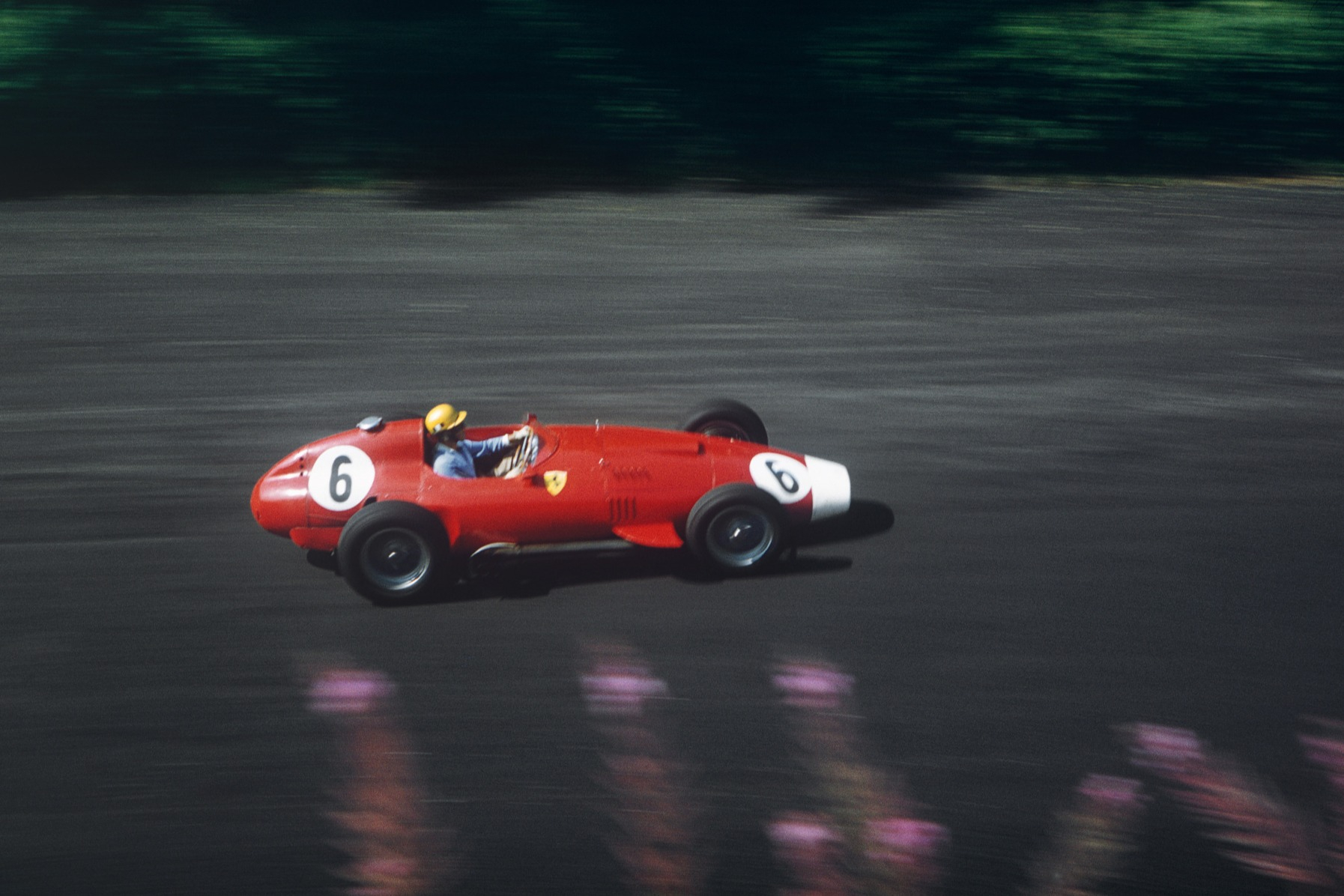
He didn't win any world championship grands prix, but Musso was Ferrari's most successful driver in 1957
Photo by: Motorsport Images
For all that, the 1958 season began well enough. In Argentina, Musso was a close second to Moss’s Cooper, Ferrari being duped into believing Stirling would have to stop for new tyres, which he never did. There were victories for Luigi at the Syracuse GP and, partnered with Olivier Gendebien, in the Targa Florio. At Monaco he was second, then survived unscathed a huge accident at Spa.
Next on the F1 agenda was the French Grand Prix, but the weekend before came the Race of Two Worlds, where Ferrari and Maserati took on the Indianapolis roadsters around Monza’s banked oval – and Musso shook the Americans by qualifying on pole at over 174mph.
“It was raw courage like you don’t often see,” said Hill. “The Monza banking was very fast, and also rough as hell. I watched Musso testing, and when I saw what he was going through, I said we’ve got to get a safety belt in that thing. It wasn’t a matter of thinking about accidents – it was the fact that he was getting almost bounced out of the cockpit! That was the first time belts were ever used in Europe – and they were just to keep us in the car...”
Come race day, Musso led the early laps, and mightily fought the roadster brigade until exhaustion from methanol fumes took its toll, and the car, handed over to an uninterested Hawthorn and later to Hill, eventually finished third. Musso’s heroism, I learned years later, made a deep impression on 23-year-old USAC rookie, one A.J. Foyt.
So to Reims, where Luigi had won the year before. This race traditionally paid more than any other on the European calendar, and another victory would go some way towards settling his gambling debts. In striving to stay with Hawthorn, to whom he had qualified second, on the 10th lap Musso put a wheel off at the exit of the ultra-fast first turn, Calvaire, and ran into a ditch. Thrown from the somersaulting Ferrari, he suffered severe head injuries, and died soon after reaching hospital.
“That weekend was my first F1 race,” said Hill, “and very sad it turned out to be. I liked Musso, who was always kind to me, and remember him as a good-looking guy with a dry sense of humour – there was a natural elegance about him, but also a kind of innate sadness. Somehow I wasn’t surprised it ended the way it did.”

Musso (right with Ferrari designer Carlo Chiti) was killed at Reims in 1958
Photo by: Motorsport Images

How Ratzenberger beat the odds to realise his cruelly short-lived F1 dream

F1 uncovered: A weekend behind the scenes with a chief mechanic

When McLaren was pipped by Red Bull in a modern F1 classic

The big opportunity Sainz’s Williams switch affords to F1’s latest centurion

Inside the science of F1 fuel

How F1’s plan for rotating races could look in practice

The early decisions that set Sauber’s rookie for success

How F1 media coverage has evolved in line with its subject

MotoGP Australian GP: Marquez crashes and then takes pole in wet qualifying

What we learned from Friday practice at the 2026 United States GP

Honda rider Marini withdraws from Australian GP due to virus

McLaren's aims for its final F1 2026 upgrades amid decline in form
Subscribe and access Autosport.com with your ad-blocker.
From Formula 1 to MotoGP we report straight from the paddock because we love our sport, just like you. In order to keep delivering our expert journalism, our website uses advertising. Still, we want to give you the opportunity to enjoy an ad-free and tracker-free website and to continue using your adblocker.


Top Comments