


The “glorified taxi” driver central to F1’s continued safety push
As the driver of Formula 1’s medical car, Alan van der Merwe’s job is to wait – and hope his skills aren’t needed. JAMES NEWBOLD hears from F1’s lesser-known stalwarts
The drawn-out wait for the decision everybody knew was coming, that the 2021 Belgian Grand Prix would not restart, was for many characterised by consumption of snacks and complaining on social media.
But for F1’s medical car driver Alan van der Merwe it was an intensely busy time. He and safety car driver Bernd Maylander completed more laps than the F1 field, regularly taking to the track to evaluate whether conditions were such that racing could get under way. It’s all part of the job for the 2003 British Formula 3 champion, who has been transporting F1’s medical rescue coordinator to incidents since 2009 – a gig which arose from an impromptu meet with then-F1 race director Charlie Whiting at Heathrow.
“I get attention for the oddest things on social media,” van der Merwe tells GP Racing. “Sometimes I’ll do the tiniest of skids on the track and it’ll be on Reddit and YouTube. We are anonymous the majority of the time, but it doesn’t take much to get a lot of attention.”
Have a go hero: Van der Merwe's short-lived GT racing career
By his own frank admission, the South African’s time on grand prix weekends involves “a lot of waiting around” for events the FIA has “actively tried to mitigate or avoid altogether”. It’s quite the departure from the life of a racing driver: van der Merwe and his important passenger Dr Ian Roberts remain strapped in and ready to go in the medical car during every live session. That applies to the support series too, when most F1 drivers are still having their breakfast…
It’s a claustrophobic environment in which to spend prolonged periods on high alert, and the pair’s intercom system is so sensitive that they can hear each other’s breathing.
“It’s a bit contradictory in that we put a huge amount of preparation into things that are becoming less likely to happen because of other efforts that we’re making at the same time,” the former BAR F1 test driver explains.

Van der Merwe and Roberts are primed and ready to go during all on-track sessions on GP weekends
Photo by: Charles Coates / Motorsport Images
“It’s a lot of being prepared, a lot of waiting to be required at a scene and it possibly never happening. Then, once in a blue moon, we’re called to something which is genuinely novel. It’s less about driving and more about understanding F1 and being ready. The end goal is avoiding drivers not making it out of the circuit and going back to their family.”
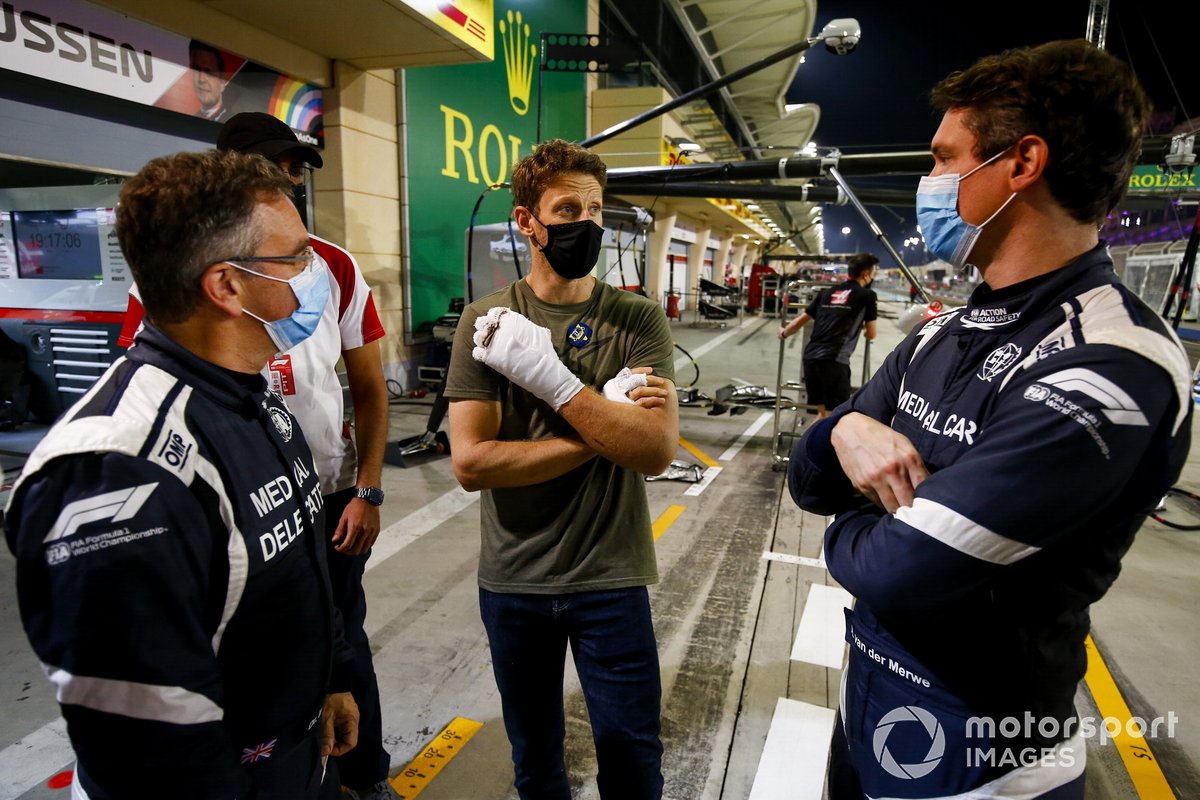
The medical car’s importance was brought sharply into focus during the 2020 Bahrain GP by Romain Grosjean’s fiery accident. First on the scene, together with extinguisher-wielding circuit marshal Thayer Ali Taher, was Roberts, who aided Grosjean’s escape from the wrecked Haas. Not far behind was van der Merwe, who sprayed the pair with the extinguisher he’d grabbed from the Merc’s boot as Grosjean staggered clear.
Calling on “experience you can only really get by doing icy tests at Pembrey in an F3 car”, van der Merwe is required “to be incredibly confident in all conditions” and acutely aware of what’s going on around him. Given the huge pace difference between the F1 field and the medical car, it has to be driven flat out
The rescue brought them a considerable amount of attention, which van der Merwe prefers to shy away from. But he concedes it was an “incredibly positive” experience that put the spotlight on Roberts’ competence and bravery.
“I’ve never been a fan of being in the spotlight,” van der Merwe says. “I like to be quite anonymous, but it was brilliant Ian got the recognition he deserves. He’s been working at this sort of thing for decades, he puts a lot into it. And it was good for people to see we’re not just there for show.
“But one thing that people probably didn’t understand from Bahrain is we didn’t actually have to do our job there – we didn’t do anything, we literally just turned up. If things hadn’t gone as well, then people would have seen what someone like Ian is really capable of, with such a huge amount of experience and bravery.
“It was nice to see it was appreciated and all of the things that we’ve been doing, which sometimes feel a little bit useless because they never get used, came together to work.”
Van der Merwe explains a key part of the job is preparing equipment and to keep it running as consistently and as reliably as possible. This includes the biometric gloves used by all F1 drivers, an innovation Roberts and van der Merwe were key in developing, which give Roberts an indication of a driver’s pulse, oxygen levels in blood, and detect movement to inform him of what to expect upon arrival.
Grosjean's 2020 Bahrain accident brought attention to the work of F1's medical car team
Photo by: Andy Hone / Motorsport Images
Those on-site preparations vary depending on the venue and its staff’s level of experience, and on the car van der Merwe uses on any given weekend. Mercedes and Aston Martin now share duties and each has “slightly different curves that they’re still on in terms of the car being where they want it to be”. Track time on Thursday, chiefly for testing systems including the start-lights sequence and exploring track limits, is also used to assist in vehicle development.
The actual driving, of course, is vitally important too. Calling on “experience you can only really get by doing icy tests at Pembrey in an F3 car”, van der Merwe is required “to be incredibly confident in all conditions” and acutely aware of what’s going on around him. Given the huge pace difference between the F1 field and the medical car, it has to be driven flat out.
“Why Charlie wanted people with F1 experience is he knew that the delta between an F1 car and a road car is silly, it’s a minute-plus quicker per lap,” he says. “If you’re learning on the job, you’re probably going to have some kind of an accident.”
That competence helps breeds trust between him and Roberts – who doesn’t need to be fearing for his life at every corner. Van der Merwe describes their relationship as being “as good as you possibly could have”.
“I know that I can depend on Ian if things really go quite downhill,” van der Merwe says. “I think we complement each other quite well.”
But relationships with drivers can’t be taken for granted. Having been around the paddock for over a decade, van der Merwe is now a familiar face to most, “whether it’s just through seeing me in the garage occasionally, if we’ve picked them up for something, or actually helped pull them out from underneath some barriers”. But he’s eager for them “to understand as much as possible that we’re always trying to improve”.
“It’s a tight-knit community and some drivers know us better than others,” he says. “I get along fine with all of them; we’re all here to do a job so sometimes our interactions are very short.

Roberts and van der Merwe have tight-knit relationship
Photo by: Charles Coates / Motorsport Images
“I’d like to think that they appreciate us being there, but I don’t really mind if they don’t because I didn’t think about it when I was competing.
“Some are more conscious of safety efforts and where things need improving or developing than others, and might raise questions during the drivers’ meetings. That’s where we build the relationships. We know it’s never going to be perfect, but it’s important the teams and drivers know we’re constantly doing our best.”
"A lot of the time when they get in the car, they’re still in race mode and it’s like it’s the end of the world. They might have just crashed in qualifying and think their weekend is ruined" Alan van der Merwe
Not all of his interactions with drivers follow an incident of Grosjean’s severity. As a dry run “to get the system moving”, van der Merwe is dispatched to collect drivers during practice if they suffer a breakdown which induces a red flag.
“We are a bit of a glorified taxi, we mainly do that to keep teams and drivers happy that we’re doing the best that we can, we’re not just letting them walk or ride back on a scooter,” he says.
Van der Merwe recalls an excited Sergio Perez following his Baku victory, the Mexican having stopped on track during his slowing-down lap. But not everybody is so delighted to see him.
“Sometimes they want to chat, sometimes not,” van der Merwe says. “A lot of the time when they get in the car, they’re still in race mode and it’s like it’s the end of the world. They might have just crashed in qualifying and think their weekend is ruined.
“It’s interesting,” he summarises. “It’s probably a bit like an Uber driver who meets all sorts of funny characters during their day…”

Van der Merwe and Roberts drop off Mick Schumacher after his Monaco FP3 crash in 2021
Photo by: Andy Hone / Motorsport Images

How Ratzenberger beat the odds to realise his cruelly short-lived F1 dream

F1 uncovered: A weekend behind the scenes with a chief mechanic

When McLaren was pipped by Red Bull in a modern F1 classic

The big opportunity Sainz’s Williams switch affords to F1’s latest centurion

Inside the science of F1 fuel

How F1’s plan for rotating races could look in practice

The early decisions that set Sauber’s rookie for success

How F1 media coverage has evolved in line with its subject

Why F1's Madring debut was a wasted opportunity

Bruising F1 2026 will not be the end for Russell - Wolff

Haas confident of getting 2027 F1 budget closer to cap with new partner talks

Top 10 Can-Am drivers
Subscribe and access Autosport.com with your ad-blocker.
From Formula 1 to MotoGP we report straight from the paddock because we love our sport, just like you. In order to keep delivering our expert journalism, our website uses advertising. Still, we want to give you the opportunity to enjoy an ad-free and tracker-free website and to continue using your adblocker.


Top Comments