


The challenge ahead of F1's future engineering hopefuls
Ask any Formula 1 engineer how to get into racing, and they'll tell you Formula Student is the place to start. Here's how the next generation of engineers prepare to compete with their own self-designed car...

Perhaps the most frequently asked question from teenage racing fans is this: what would I need to do work in motorsport? It's presumed that, in today's modern age, it's much less accessible compared to the early days - speculative letters and cold calls don't have as much of a place today, and nor can a prospective engineer knock on the garage door with their favourite spanners and offer to tighten a few bolts on weekends.
Formula 1, and all motorsport categories, are still accessible - it just requires a different approach. There's a much greater spread of roles today, since F1 teams are billion-dollar organisations that expand far beyond the design and operation of cars; media, marketing, logistics, and operations are just a smattering of the alternative disciplines along with engineering that are greatly valued in motorsport. Still, one would imagine the next generation would value some guidance of how to realise their dreams.
Take anyone who has joined F1 in an engineering role in the past 25 years, and you can probably guarantee that they took part in Formula Student when they were studying at university. Born out of the Formula SAE competition in the United States, Formula Student is - as the name suggests - a design competition for students in which they build and compete against other universities with a formula-style car built to a specific set of regulations. Formula SAE had been run by the Society of Automotive Engineers since 1981, and the Institution of Mechanical Engineers (IMechE) adopted the same regulations for Formula Student in 1998.
After the formation of the UK competition, Formula Student/SAE has since spread to 27 different competitions around the world, including the likes of Germany, Italy, Japan, Australia, and Brazil. Many teams compete in more than one competition per year, budgets permitting.
It's important to stress that the cars do not explicitly race each other. Held at Silverstone, two weeks after the British Grand Prix, Formula Student UK features "dynamic" events on-track; if a team gets through scrutineering, it can then run in the acceleration event (effectively a 75m drag race, with four runs per car; the top teams can run it within 4.5s), the figure-of-eight skidpad event, and the sprint - a lap of the course laid out around Copse corner, with penalties for hitting cones. The Sunday afternoon conclusion is the big-ticket endurance event, a 27-lap affair around the same course; this is a gruelling test of a car's reliability, lasting in excess of half an hour.
There's also the "static" events based on the team's justification of the cost and the design of the car, which the judges interrogate in great detail. Every single point is valuable here, especially if any reliability concerns cause a team to miss any of the dynamic events.
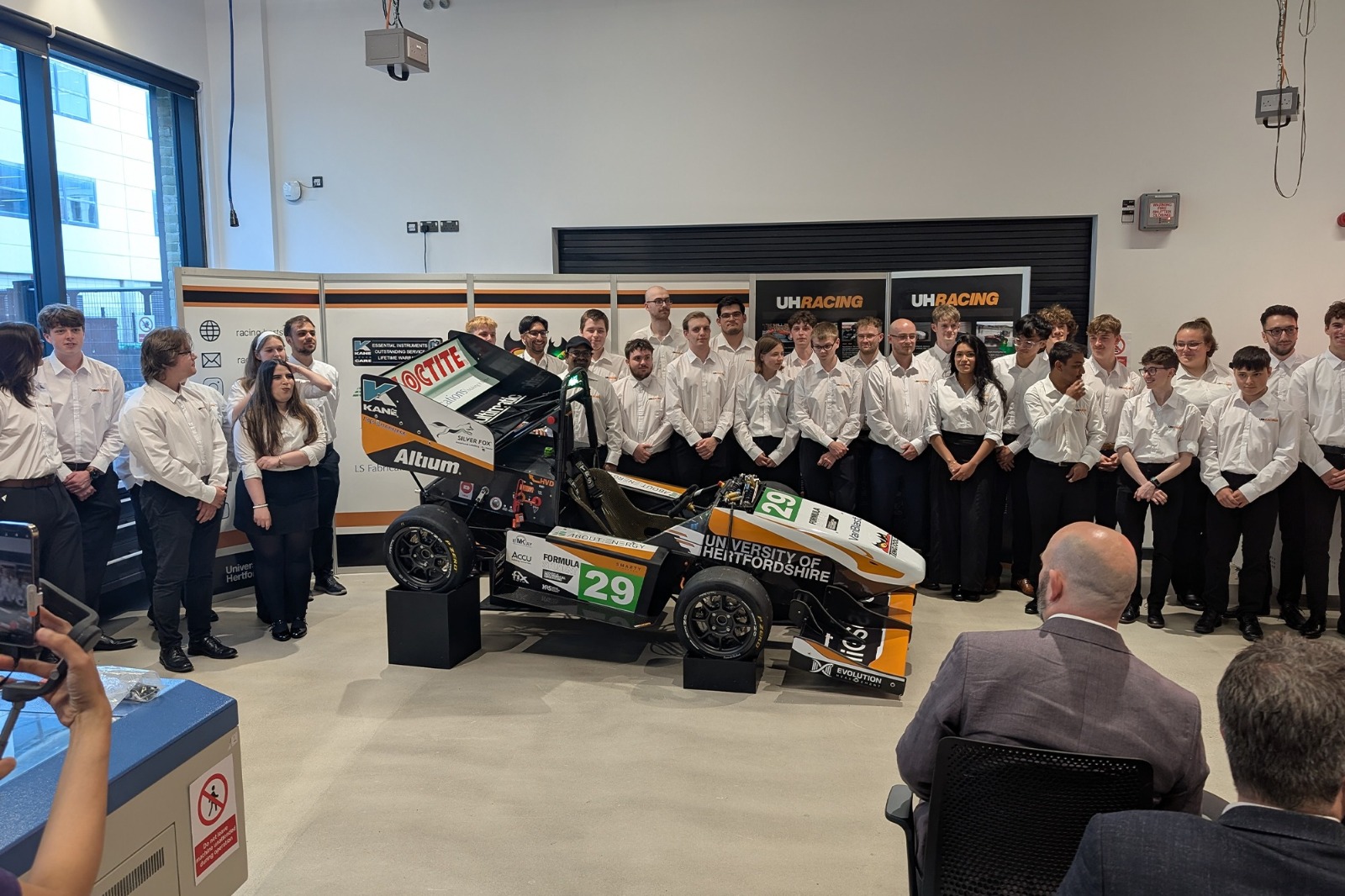
UH29 was unveiled in Hertfordshire's new engineering block
Photo by: Jake Boxall-Legge
The University of Hertfordshire has competed in every Formula Student event since it began in the UK with its UH Racing team. Back then, the cars appeared to sit between a go-kart and a Formula Ford chassis, but today's cars are increasingly sophisticated with intricate aerodynamics, electronics, and a variance between electric and combustion-engine powertrains.
The students design and build almost everything that goes on the car; unless you work for a top-level racing team or a chassis design firm, there's nowhere else that you can get as much hands-on experience from conception to competition. While the university's faculty supervises UH Racing's efforts, under the watchful eyes of Dr Howard Ash and Samadhi Samararatne, they do not get involved in any of the design decisions made by the team. It's all up to the students to design, build, test, and compete.
UH Racing is, by the way, of the most successful teams in the UK along with Oxford Brookes, Bath, Cardiff, Birmingham, 2021 FSUK outright winner Sheffield, and 2022 FSUK winner Glasgow. It also began an Autonomous subdivision in 2022, which is producing a driverless car for competition. This writer is also pleased to add that he was a part of UH Racing back in 2015 - and the memories of being part of such an excellent team are cherished immeasurably. Not that he was a particularly useful part of the team, however...
In its new Spectra building, UH Racing launched its latest competitor: UH29, an all-electric concept with four Fischer TI085 motors, one at each wheel, a two-stage gearbox, and a student-built battery. This year's team, led by Cedric Gackenbach, is aiming to make a splash on this year's Formula Student UK competition.
"You learn stuff in class that you get to apply to FS, but also you get faced with so many new and interesting challenges in FS that you can't replicate in a classroom" Cedric Gackenbach, team leader
Once the veil was peeled away from UH29, flanked by the full complement of the students responsible for its conception, it was rolled outside and into the evening air to be admired and scrutinised by the guests in attendance. Former Herts alumni gathered outside to share their war stories from competitions past: the sleepless nights, the heartbreak, and the laughter. One tells us that at the conclusion of one event, a host of universities gathered whatever tarpaulins they had on the final night, pegged them to the ground, and doused them with water to produce an ad-hoc slip-and-slide that security attempted to shut down. Even when the competition was over, the students continued to engineer some fun.
As we talk to Gackenbach, we follow the car being guided back to the workshop for a full service in the morning. The dawn of Formula Student UK's 2026 edition is just under a month away, and the team has a full schedule on its plate before it can make tracks for Northamptonshire.
But it's not been an easy road to get there. The previous year's car, UH28, showed great promise on paper and placed fourth overall in last year's Formula Student UK lap time simulation event. In the real world, however, it was unable to run in the dynamic events; electrical issues on the eve of the competition cost the team its running, leaving the concept largely untried. Yet UH Racing has adapted, and its technical team has elected to produce an evolutionary, debugged concept of the previous year's car.
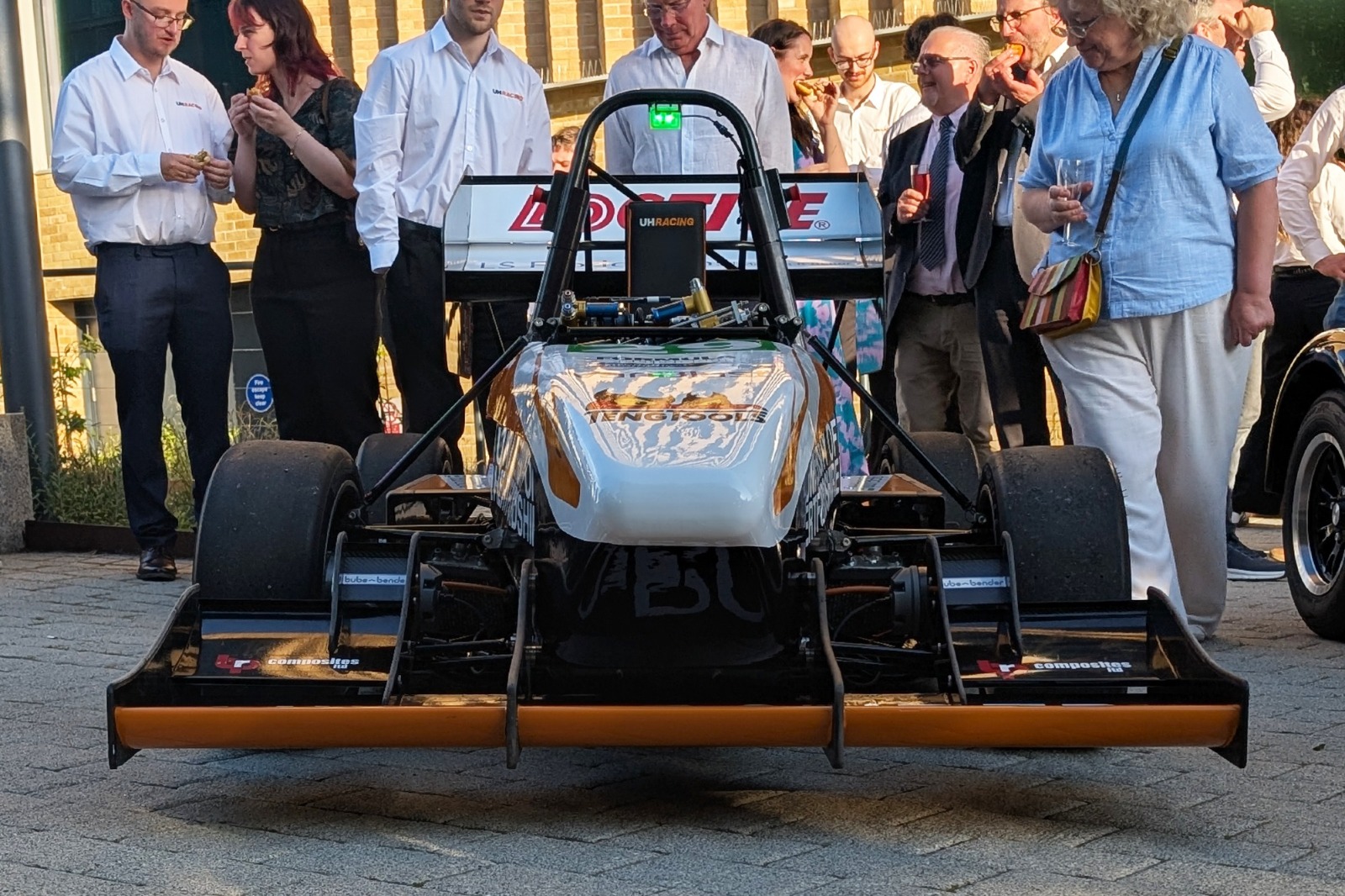
Guests admire the students' latest handiwork - which will compete at Silverstone in July
Photo by: Jake Boxall-Legge
"It's been a funny year," Gackenbach says. "Last year we had our new four-wheel-drive concept run for the first time. And we did all the calculations ahead of time and we thought it was going to be fast. And it was fast, it was cool...but ultimately, the car didn't run at comp. We had an electric gremlin that blew up a PCB, effectively.
"And so coming in this year we went, 'okay, look, we have a car that nearly runs'. [Last year's team leader] was graduating. And so it was, okay, he'll still be around, but he won't be in the day-to-day. We've got people who have to pick up the slack. We have a car that nearly runs, and we don't have a budget that means we can do whatever we want. So what are we going to do? We're going to try and keep the car quite simple, and leave as much money and time to the electronics folks to fix the problems that we have so we can get last year's car fixed and running, and then hopefully plug and play that into the new car.
"Because the other problem we ran into from a vehicle concept standpoint was that all we have is theoretical. And if we want to try and actually meaningfully improve the car, we have to have sort of a model we can compare it to.
"I did my dissertation this year on trying to do that. And I realised 'well if I want this to mean anything, I'm going to have to correlate my lap time simulation with something'. And to do that, I had to then go back to UH22 or UH20 and try and dredge that data up to build something, and then try and Frankenstein that into this car, as opposed to just being able to start with a model of this car and play with that to see what makes it better. But the outcome is a car that came together quite well mechanically."
When the car returns to the workshop bay, the team gathers around the car to prepare for the morning. They stop once Dr Ash and Gackenbach offer their thanks for putting together a smooth launch (aside from the dull, dreary guest speaker), and deliver a well-placed pep talk as the team enters the final stages of its preparation ahead of the competition.
The 40-odd strong squad operates like a baby F1 team, with different heads of department within. Each sub-team works to develop their new parts, and then brings it all together to ensure that the pieces of the jigsaw all fit together. Alongside Gackenbach, the team has Jan Yip as its technical director, head of operations Fernanda Herrejon, Rebecca Herbert leading the vehicle electronics division, and Nevan Dodhia looking after vehicle performance.
And that's just a small handful of the team - there's a wealth of expertise, from students who are returning from a placement year in industry, those who have 'spannered' for their local racing outfit, and relative newcomers looking to absorb knowledge from their fellow team-mates and from the experience of competition.
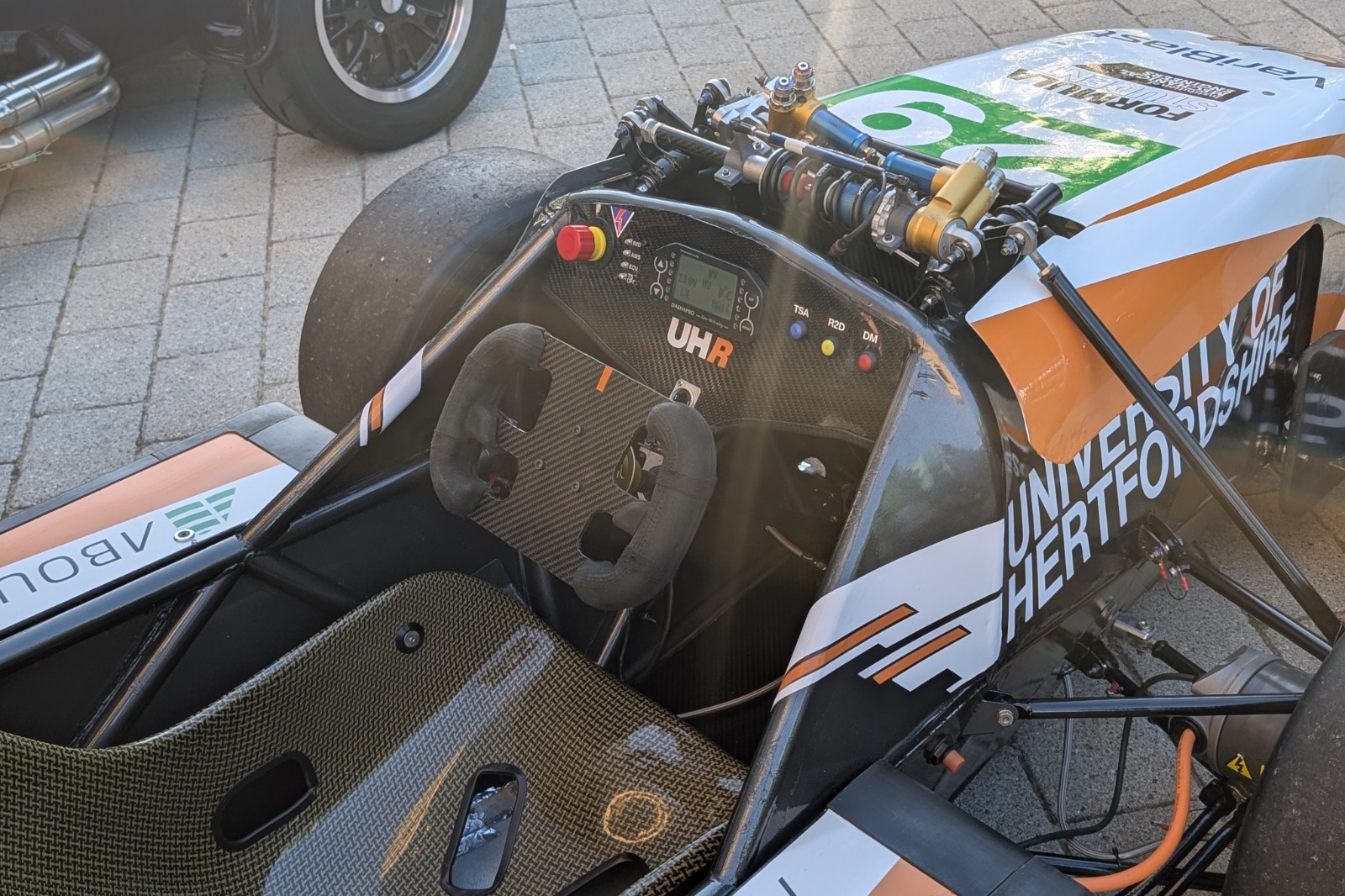
UH29's cockpit and front suspension layout
Photo by: Jake Boxall-Legge
Plus, Formula Student's static events are just as valuable when it comes to the points dished out by the judges. These events hinge on the premise that an FS car has to be built and sold, and thus each team must produce their business case, their costings and, in recent years, must also encapsulate the CO2 emissions involved in the car's build and operation. This falls under Herrejon's remit, who explains how the static events work.
"In the competition we have the business competition and the statics," Herrejon explains. "We're doing the bill of materials for the car and, this year and last year, they implemented a costed CO2 emission of the car as well, so it's adding the CO2 emissions for every single part of the car.
"This year we had to do the costed bill of materials for the tractive system - and the bill of materials for this year was 7,000 lines approximately! We had two nights straight in the [learning resources centre], I think it was like 36 hours. That was not cool. I'm not doing that ever again..."
"We've kept the car quite simple, and left as much money and time to the electronics folks to fix the problems, get last year's car fixed and running, and then plug and play that into the new car" Cedric Gackenbach
No stone was left unturned; the team not only gathered the cost of raw materials, but for shipping costs, labour rates, down to every last piece of solder used in the car's tractive system. The team will then have to present their business case during the event and, when discussing costs, will have to defend every penny spent on the car.
"We have our costing explanation file, which is like 70 pages, but it's just justifying how we did our calculations," she adds. "Obviously there's not like a right or wrong answer, how we cost our parts, where we got the information from, but it's basically just defending all of our bills.
"We wanted to also start the conversation with how we did the CO2 emissions, because last year we didn't have a lot of them. The feedback from last year that we needed to go into more depth, so one of the targets this year was to do like a proper bill, with a calculator on Excel. So that's what we want to bring to the competition, like 'this is what we had as feedback, and then this is what we bring for you guys this year'."
Herrejon says that the team has developed its CO2 calculator to be applicable for future iterations of UH Racing, to allow future teams to simply plug in its updated numbers rather than feel the need to develop its own system. There's always a transfer of knowledge year-on-year, particularly if third-year students stay on for a Masters' year to help guide the latest recruits to the team, and this is just one more addition into the team's existing infrastructure.
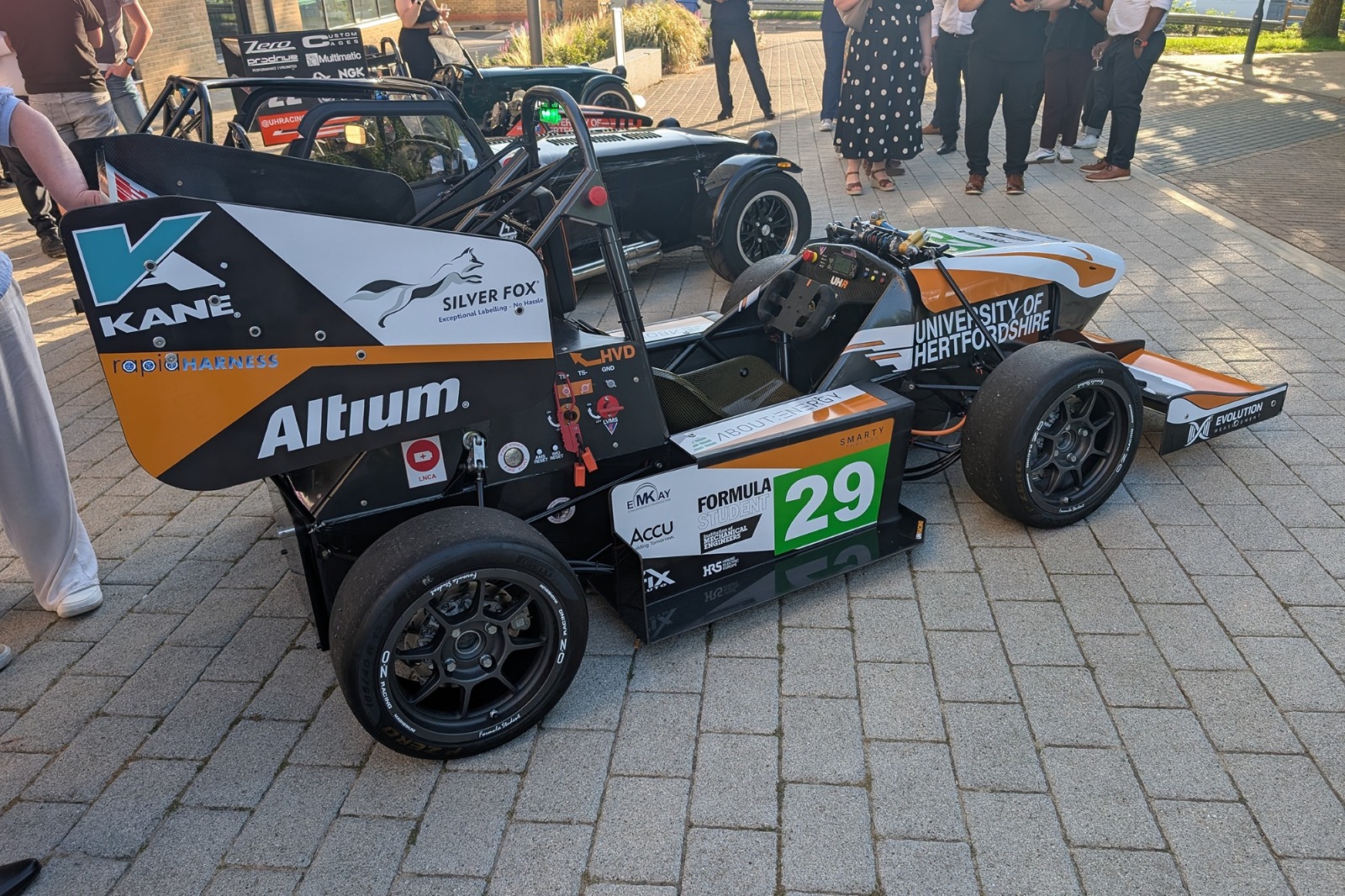
Torque of the town: UH29 has an electric motor at every wheel and a bespoke battery
Photo by: Jake Boxall-Legge
It's all very mindful of the way that future technology is moving. The IMechE must receive some plaudits for introducing the lap time simulation event and updating the cost stages to not only keep up with the global shift in the automotive sector, but how motorsport technology is becoming more reliant on simulation technology.
And, although this is primarily an engineering competition, the teams have their own media and marketing profiles too - and the team is open to students doing other degrees; UH Racing's current head of marketing Izabela Mocsel is a criminology student, and manages the team's media profile to ensure the team gets its due recognition - both within and outside of the university's walls... even if some of the team members are slightly more reticent to commit to the latest TikTok bit.
The team also has to manage relationships with sponsors and supporters, many of whom supply products or financial support to assist with the build and development of the car. Adhesives giant Loctite, for example, has been a supporter of UH Racing for decades and provides the team with thread-locking and bonding products - as such, many former UH alumni thus have a formative memory of accidentally bonding themselves to a bodywork panel with a cavalier use of Loctite 3090. Thankfully, the Swarfega flows like water...
If there's anyone out there who doesn't consider Formula Student an incredibly valuable experience, one should imagine that they would be in an incredibly small minority. University studies endeavour to apply theory to a practical application, but that has a natural limit without any extracurricular activities; if you're a motorsport engineering hopeful, there's an extra dimension that you miss without it.
Those who join their university's Formula Student team gain experience of how to work within a racing environment. You're testing ideas and parts and building knowledge as a vehicle dynamicist, or an aerodynamicist, or a powertrain engineer while you're in the automotive lab with your friends. Sure, there's sacrifice, and you're hanging around at university for a few more months while everyone else has gone home for the summer, but you're there for the sheer love of the game.
"[It's given me] so much," Gackenbach says. "It's funny, I've done FS in some capacity every year that I've been here. You learn stuff in class that you get to apply to FS, but also you get faced with so many new and interesting challenges in FS that you can't replicate in a classroom.
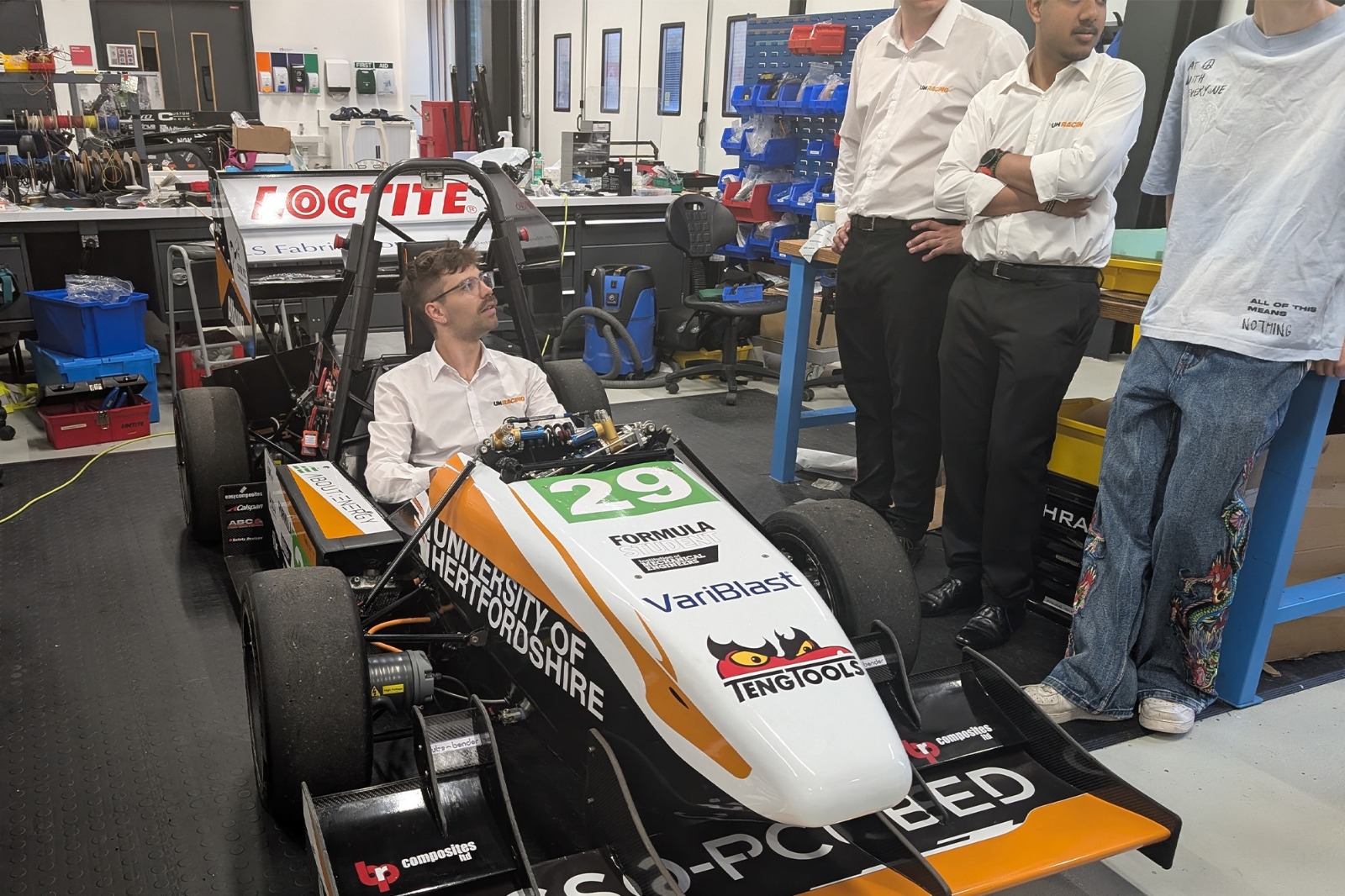
Cedric at the wheel: Team leader Gackenbach tries UH29 out for size
Photo by: Jake Boxall-Legge
"From a leadership standpoint, we do semester-long group projects in class, and that's great. And you learn a lot from it. But having to run a project over 11 months with 30, 40 people is a completely different beast to doing a class project with a few roommates. And that's been a massive learning experience for me this year, just how to manage all of that."
So, if you're a student looking at university options and wondering how to get into F1, go and look at who's got a Formula Student team. Don't worry if you've never picked up a spanner - by the end of your degree, you'll be CAD modelling, CFD testing, and scaring the rest of your team with your lackadaisical approach to operating an angle-grinder. The work's hard, there's no pay, you'll eat terribly, and you'll have the most fun of your life doing it.
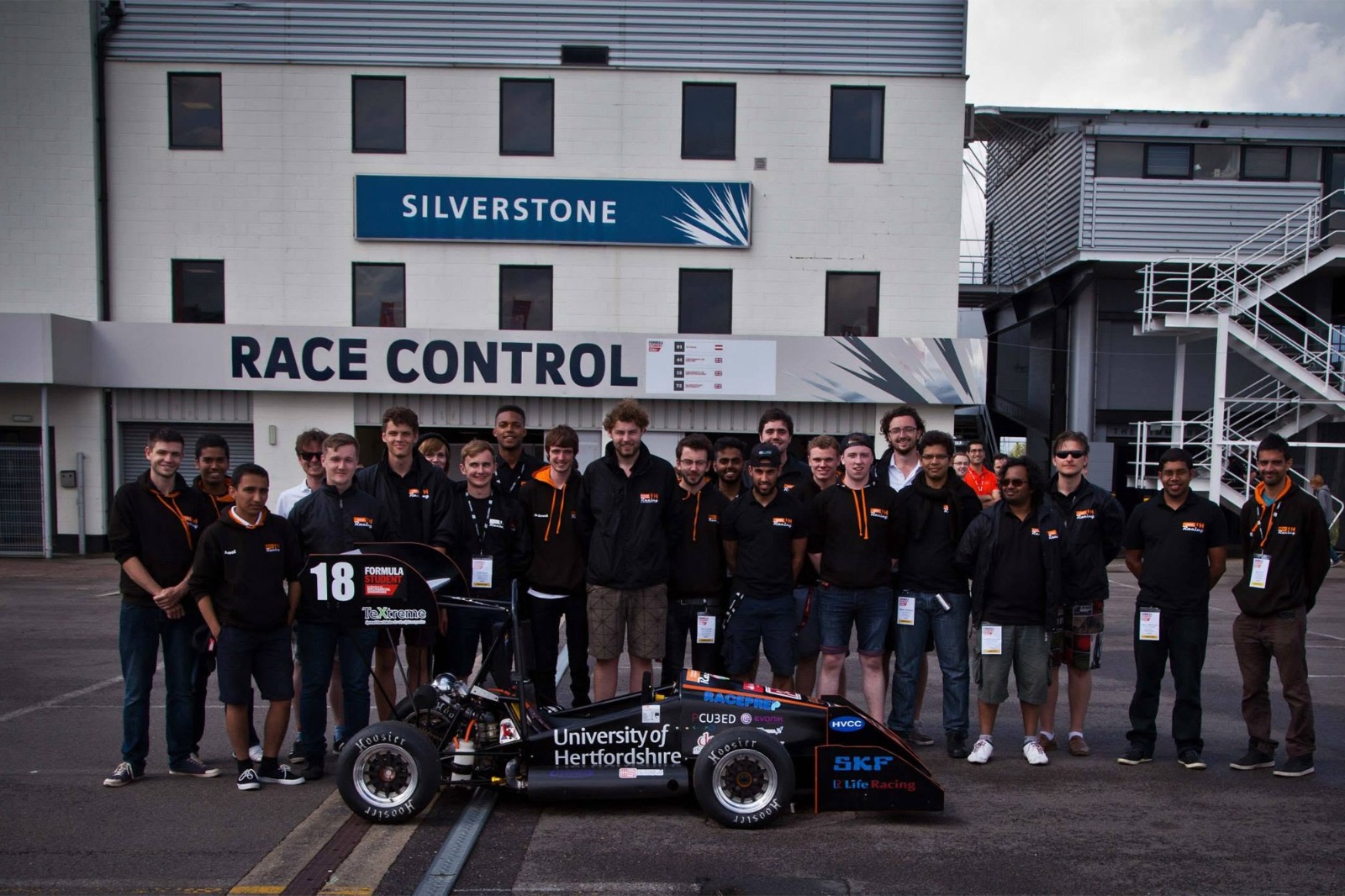
Class of 2015! Our writer (back row, second from left) has fond memories of his time at UH Racing...even if the car broke in the final event
Photo by: UH Racing


Lights, Camara, action: How Haas picked F1's latest rookie for 2027

Horner's inside story of how Red Bull built its own F1 engine

Why Mercedes' latest 2026 F1 update is no downgrade

Singapore Grand Prix Driver Ratings 2026

What we learned from the 2026 F1 Singapore GP sprint race and qualifying

The political minefield set out by F1’s recent cost-cap grievances

What caused Mercedes' pace deficit at Sepang despite upgraded W17?

Three kings: F1's generational stars shone at Sepang

How Toyota destroyed the competition to seal the WEC crowns

McLaren retains Fornaroli as F1 reserve and hands him WEC programme for 2027

How Andrew Jordan realised his teenage rallycross dream

Inside the competition building F1’s future engineering talent
Subscribe and access Autosport.com with your ad-blocker.
From Formula 1 to MotoGP we report straight from the paddock because we love our sport, just like you. In order to keep delivering our expert journalism, our website uses advertising. Still, we want to give you the opportunity to enjoy an ad-free and tracker-free website and to continue using your adblocker.


Top Comments