


The 70s US superteam that tried and failed to crack F1
Vel’s Parnelli Jones Racing was briefly one of the biggest names on the US motorsports scene, but its ambition outstripped its resources. STUART CODLING relates the story of a Formula 1 campaign cut off in its prime
You could drive past 20555 Earl Street, Torrance without any inkling of the site’s previous life. Once the hub of one of US racing’s most dynamic and ambitious operations, it’s now just another anonymous low-rise office complex in the greater Los Angeles urban sprawl.
In the early 1970s Vel’s Parnelli Jones Racing juggled successful IndyCar campaigns with Formula 5000, NHRA Top Fuel and Funny Car and USAC dirt racing, earning itself the somewhat unimaginative sobriquet of “the Superteam”. When VPJ hired Lotus 72 co-designer Maurice Phillippe in late 1971, Formula 1’s addition to that portfolio seemed inevitable.
Like many drivers who needed to conceal their racing activities from their families, Rufus Parnell Jones took on his thinly veiled pseudonym ‘Parnelli’ when he began to dabble in jalopy racing at the age of 17, below the legal minimum in his adopted home state of California. The Jones family had left their native Arkansas during the Great Depression, when Parnelli was two years old, and settled in Torrance, the hotbed of SoCal car culture. Jones developed into an astoundingly successful racer across a wide range of disciplines, from stock cars to open-wheelers to dirt buggies, to the extent that he became a household name and many a traffic cop’s opening gambit to a speeding motorist: “Who do you think you are? Parnelli Jones?”
Jones titled his own autobiography As A Matter Of Fact, I Am Parnelli Jones. It was he who won the 1963 Indy 500 in controversial circumstances, at the expense of Jim Clark’s Lotus, when officials broke their own rules and declined to black-flag Jones for an oil leak. Lotus didn’t protest because its engine supplier, Ford, prudently recognised that to overturn such a popular victory would be a staggering PR failure. In 1967 Jones was paid the unprecedented sum of $100,000 – in a suitcase, so the legend goes – to pilot Andy Granatelli’s four-wheel-drive STP gas turbine car in the 500, a race he led for 171 laps before a bearing in the transmission let go.
Wisely, perhaps, for this was a dangerous era, Jones forsook the IndyCar cockpit thereafter, continuing to race in other disciplines while building his successful tyre distribution business. Beginning with a single outlet in 1966 on Hawthorne Boulevard (now a Nissan dealership), Parnelli Jones Firestone dealers eventually spread across 14 states. Jones and his friend Vel Miletich, owner of a Ford dealership in Torrance, also diversified into automobile component distribution as well as founding Vel’s Parnelli Jones Racing, with which enterprise the duo aimed to “kick ass”.
This they duly did, in IndyCar and elsewhere. Al Unser won the 1970 and ’71 Indy 500s and the USAC championship for VPJ, while team-mate Joe Leonard was USAC champion in ’71, both driving Lola T150-based Colt chassis built up by the legendary George Bignotti. Leonard also won the title in 1972 aboard Maurice Phillippe’s first Indycar, the VPJ-1, though this victory owed much to the unreliability of the fast-but-fragile new Eagle piloted by Bobby Unser.
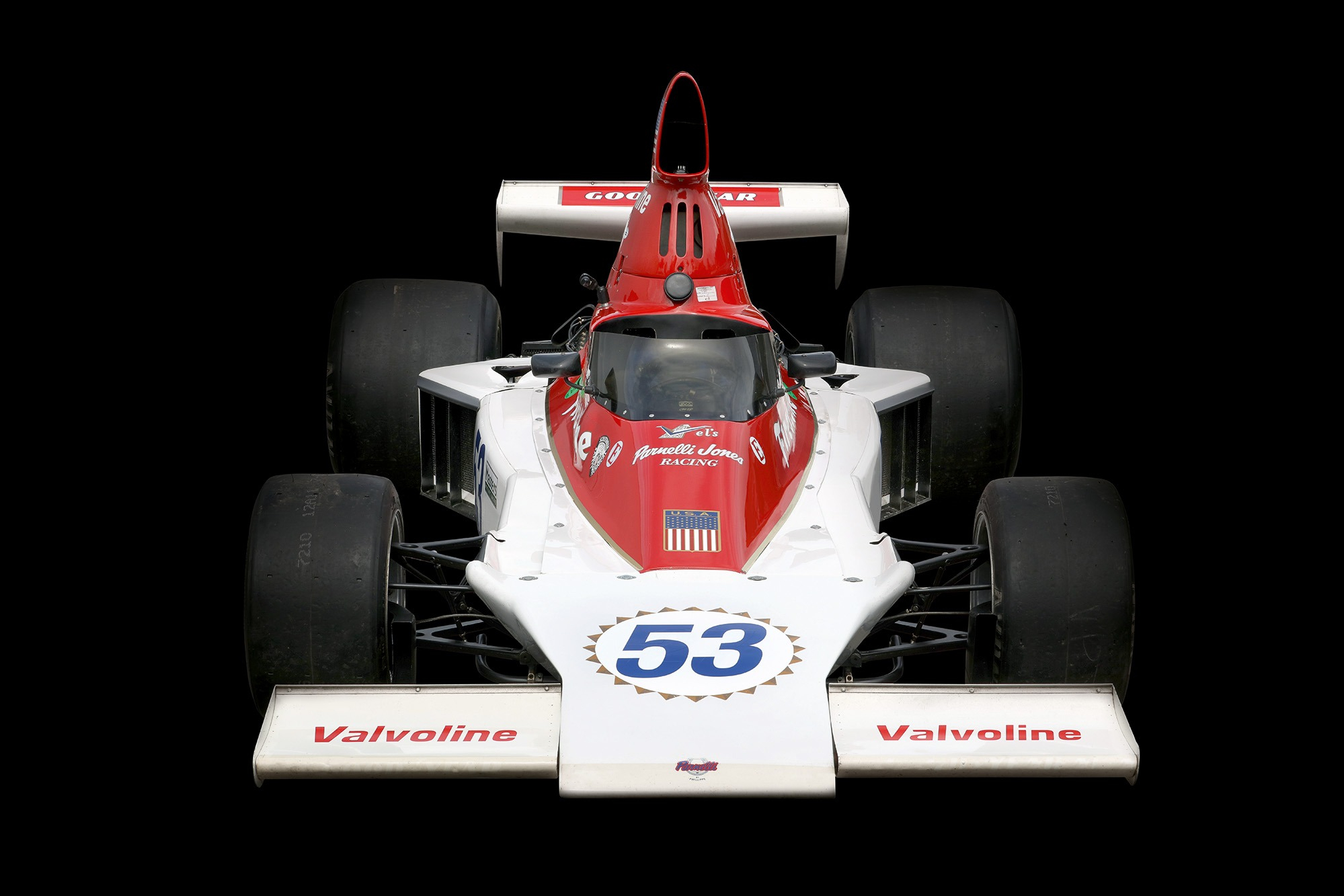
The Parnelli VPJ-4
Photo by: James Mann
The VPJ-1 was unveiled with eye-catching dihedral wings featuring integrated radiators. Phillippe’s reasoning was that when the car was in yaw the wings would be presented to the airstream, and therefore more effective. But the principle was never thoroughly tested since the wings were removed very quickly when initial runs proved unpromising and Al Unser gave it the thumbs-down. The rising rate suspension geometry also proved problematic and difficult to tune, as it had on the Lotus 72, and the complicated rear suspension, which featured a camber-compensation system, had to be redesigned when a conventional rear wing generated more downforce than its structural parameters could handle. For the drivers the main issue was the twitchiness of the car, a necessary evil in Formula 1 but no virtue at all in high-speed oval racing where stability is king.
George Bignotti remains the most successful mechanic/engineer/crew chief in IndyCar history, joining VPJ after winning the Indy 500 with AJ Foyt and Graham Hill. He had much in common with Brabham’s Ron Tauranac, in that engineering matters were concluded his way or the wrong way. Accordingly, he and Phillippe did not see eye to eye and it would generally fall to Bignotti to redesign elements of the cars along more conventional IndyCar lines when some of Phillippe’s more outside-the-box ideas failed to fly. Bignotti took his leave in 1973 and, after the VPJ-2 and VPJ-3 failed to please drivers Leonard, Unser and Mario Andretti, the team bought customer Eagle chassis instead.
When VPJ hired Lotus 72 co-designer Maurice Phillippe in late 1971, Formula 1’s addition to that portfolio seemed inevitable
Firestone had introduced the slick tyre to F1 in 1971, and by 1974, as the Cosworth DFV engine achieved virtual ubiquity, tyres had become key performance differentiators – and the subject of a brutal development war. An F1 campaign was a natural fit for VPJ, given its corporate alignment with Firestone, and would enable Phillippe to design a bespoke F1 car which Jones hoped could then be adapted to race in IndyCars. Firestone, initially, was more than happy to come on board as a major sponsor, alongside Viceroy cigarettes, and develop bespoke tyres. Andretti was the natural choice to drive, since his intermittent F1 experience encompassed putting a Lotus on pole for his grand prix debut and winning on his maiden appearance with Ferrari.
The VPJ-4 was shaped by Phillippe’s desire to claw back some credit for authorship of the Lotus 72, since Colin Chapman had begun to airbrush him out of the car’s development history after Phillippe’s move stateside. It had much in common with the earlier car, one which had proved so competitive – after some initial teething problems – that Lotus itself struggled to conjure an adequate replacement. It’s claimed that when the VPJ-4 arrived on the grid for the first time, at the penultimate round of the 1974 season, Chapman remarked to Lotus team manager Peter Warr that it represented a better follow-up to the 72 than Lotus’s own, the troubled 76.
Andretti was less enthusiastic, later describing the VPJ-4 as “basically a three-year-old Lotus 72”. Certainly the design cues were all present, from the extreme wedge nose – enabled by torsion bar front suspension – to the inboard brakes and hip-mounted radiators. It was certainly a bolder concept than the car fielded by the other US superteam which made its first appearance at Mosport Park for the Canadian GP that year: Penske’s Geoff Ferris-penned PC1, driven by Mark Donohue. Andretti qualified 16th and raced to seventh, on the cusp of scoring points, while Donohue started 24th and finished 12th.
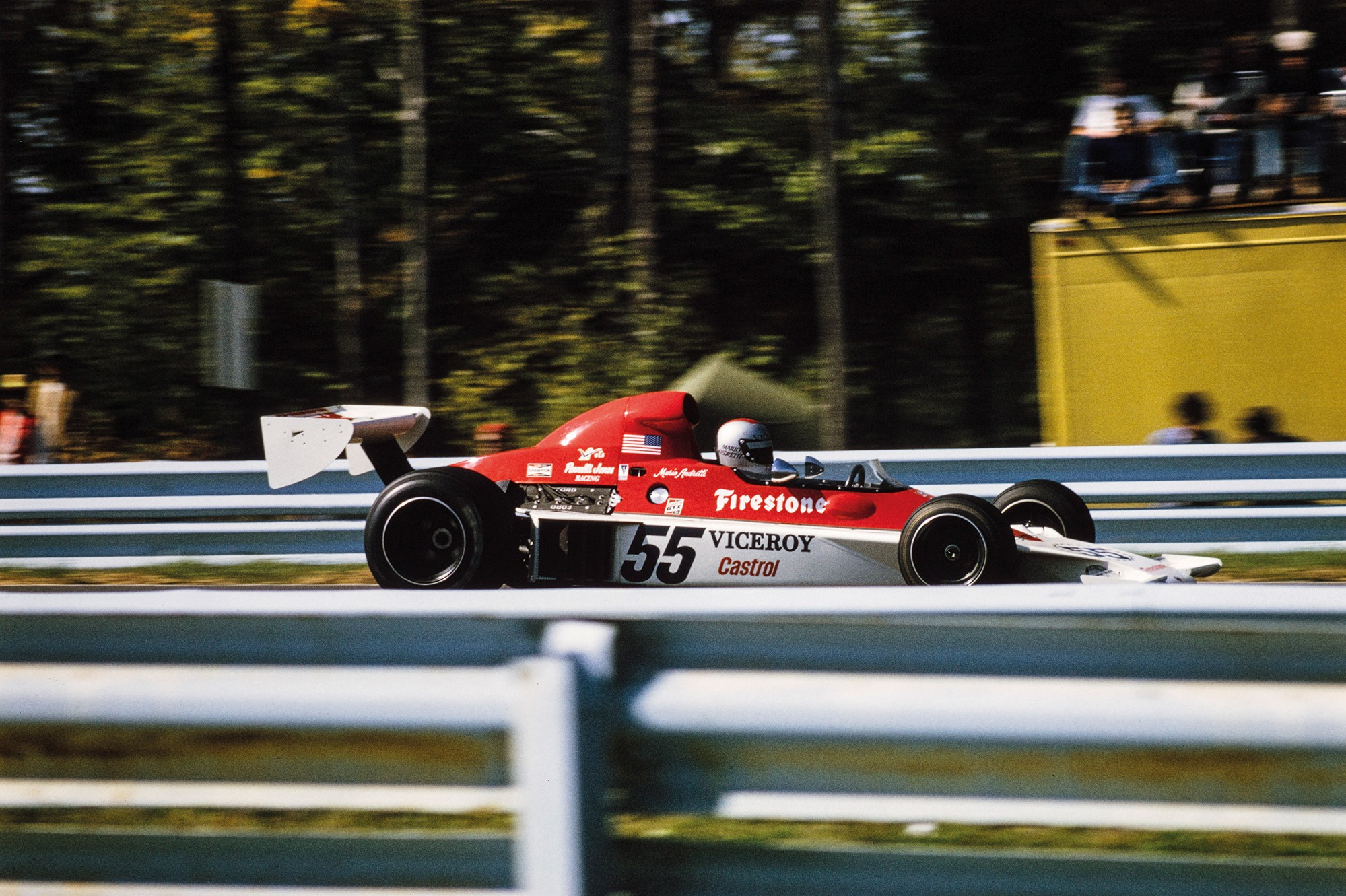
Mario Andretti drives the VPJ-4, a car he felt was "basically the Lotus 72"
Photo by: Motorsport Images
Two weeks later, at the season finale at Watkins Glen, Andretti qualified third. His principal complaint about the car remained that the rising-rate suspension was too soft throughout most of its working range but here, at a bumpy track, that characteristic worked in his favour. On race day, though, the engine spluttered out on the grid and then developed a vapour lock in the fuel system. Andretti was disqualified for receiving a push start.
Disaster struck as Firestone withdrew from grand prix racing, taking vital funds as well as the promise of bespoke rubber. VPJ would continue to be a one-car entry in 1975 as the car was hastily redeveloped to suit Goodyear’s tyres.
Lack of budget, as well as VPJ’s commitment to racing across multiple categories, meant the F1 project was starved of the resources and focus that were essential prerequisites to success, even in this less technologically rarefied era. Andretti spent much of 1975 fighting in the mid-pack and suffering retirements brought on by component failures.
Still, there were high points. While the 1975 Spanish Grand Prix is best remembered now for the tragic accident which underlined the Montjuic circuit’s hopelessly inadequate safety facilities, Andretti qualified fourth and briefly led (albeit after turfing Niki Lauda into the barriers) before a rear track rod bailed from its mountings. In Sweden, despite a scary accident in practice when a front brake shaft sheared – reminiscent of that which claimed the life of Jochen Rindt in 1970 – Andretti raced the spare car to fourth place, challenging Clay Regazzoni’s Ferrari throughout.
Phillippe had hoped to attend grands prix with the car, learn about its behaviour and debug it on the fly, but Jones required him to remain in California and spin the F1 design into an IndyCar, the VPJ-6. By mid-season Phillippe quit to return to the UK. Onward development of the VPJ-4 – along with Jones’s many other projects, including a Baja dirt racer – would fall to another engineering recruit from across the pond, the ambitious young John Barnard.
Among the first tasks was to relocate the brakes. Since most cars ran outboard front brakes, tyre development was naturally following this trend, with constructions and compounds to suit the greater weight within the wheel as well as the heat-rejection characteristics. Barnard also dropped the rear torsion bars for conventional coil-over-shocks and redesigned the front and rear wings and the radiator ducting.
1976 began with Andretti retiring from Brazil in a Lotus, but he switched back to Parnelli for South Africa where he was sixth – a place behind John Watson’s Penske. Watson would go on to win in Austria that year but it wasn’t enough to persuade Roger Penske not to shutter his F1 operation. Likewise Miletich and Jones decided the cost of competing in F1 outweighed the rewards and pulled the plug – after round three.
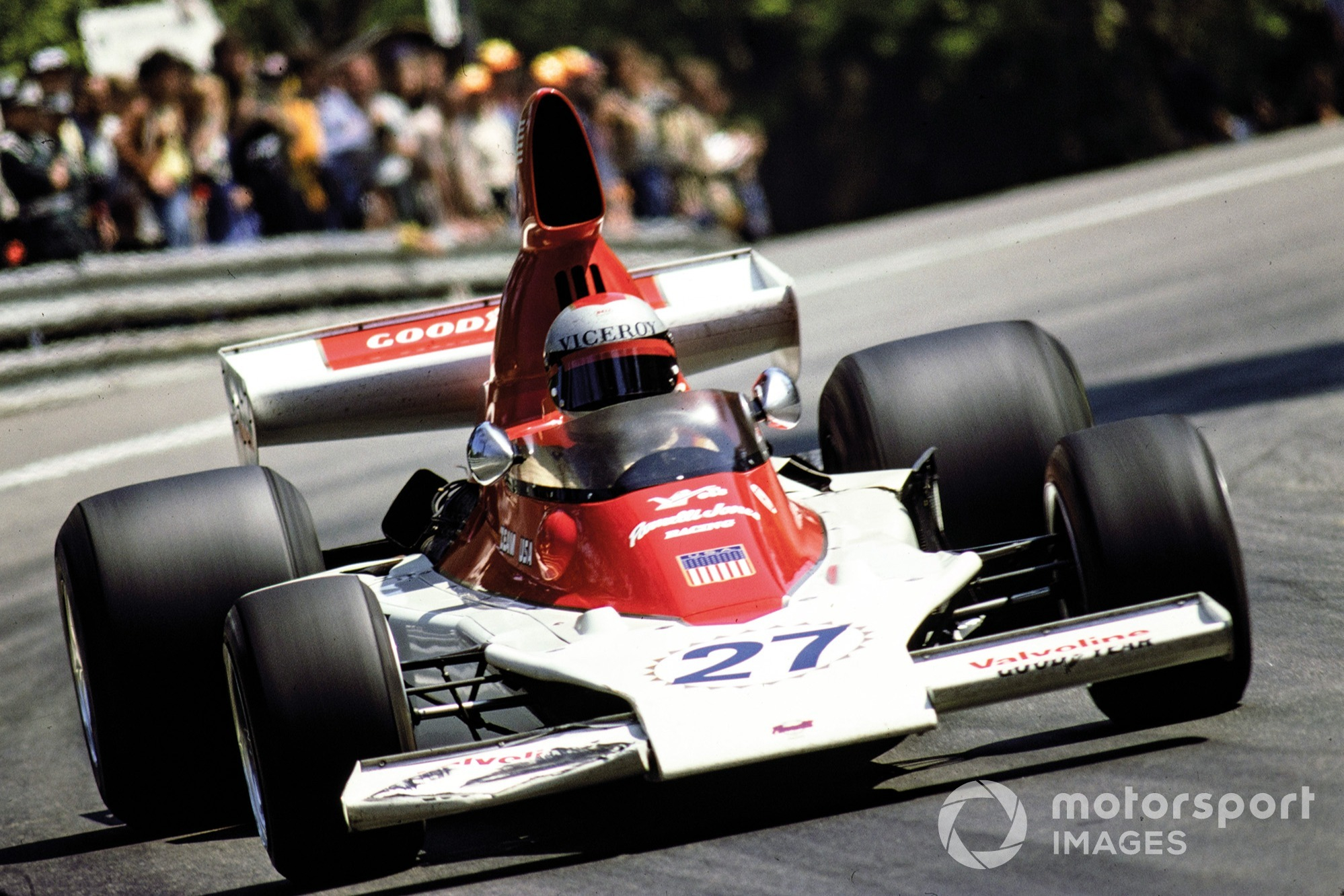
Mario Andretti, Parnelli VPJ4 Ford, Montjuic.
Photo by: Rainier Schlegelmilch
Andretti was among the last to know, learning only when the journalist Chris Economaki approached him on the grid at Long Beach for an on-the-record comment. Mario later recalled being so discombobulated by the revelation that he nearly forgot to put the VPJ-4 into first gear.
At breakfast in the hotel the following day Andretti encountered a similarly downbeat Colin Chapman, whose new 77 had proved a disappointing bust in the hands of Bob Evans and Gunnar Nilsson that weekend. “I’ll drive for you and we’ll make the car better,” Andretti told him.
Likewise Miletich and Jones decided the cost of competing in F1 outweighed the rewards and pulled the plug – after round three
He was as good as his word, honing the recalcitrant 77 into a winner by the end of the season – and then returning Lotus to world championship glory two years later. Vel’s Parnelli Jones successfully turbocharged the Cosworth V8 for IndyCar use and the DFX engine, as it became known, became the de facto choice, powering Indy 500 winners for another decade. But Miletich and Jones never got to see the commercial rewards for their investment: rather than appoint VPJ as a distributor, Cosworth set up its own facility in Torrance.
It was this, rather than the demise of the F1 project, which was the beginning of the end for ‘the Superteam’. Faced with diminishing sponsorship income and escalating costs, VPJ closed its IndyCar team at the end of 1978.
Race record
Starts: 16
Wins: 0
Poles: 0
Fastest laps: 1
Podiums: 0
Championship points: 6
Specification
Chassis: Aluminium monocoque
Suspension: Rocker arms with torsion bars (front and rear) and coil springs/dampers (rear, from 1975)
Engine: 90-degree naturally aspirated V8
Engine capacity: 2993cc
Power: 510bhp @ 11,000 rpm
Gearbox: Five-speed manual
Brakes: Discs front and rear
Tyres: Firestone (1974), Goodyear
Weight: 578kg
Notable drivers: Mario Andretti
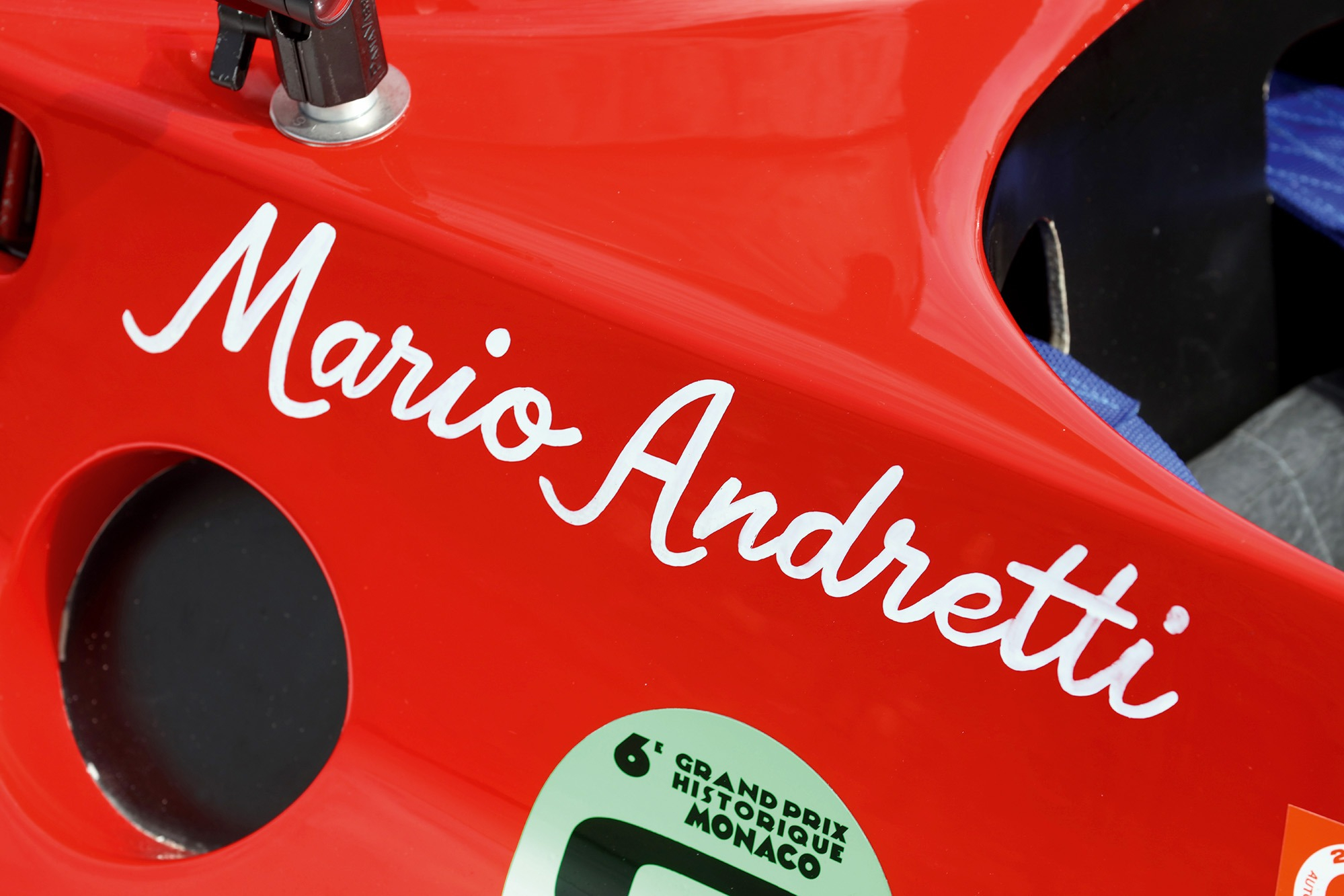
Photo by: James Mann

How Ratzenberger beat the odds to realise his cruelly short-lived F1 dream

F1 uncovered: A weekend behind the scenes with a chief mechanic

When McLaren was pipped by Red Bull in a modern F1 classic

The big opportunity Sainz’s Williams switch affords to F1’s latest centurion

Inside the science of F1 fuel

How F1’s plan for rotating races could look in practice

The early decisions that set Sauber’s rookie for success

How F1 media coverage has evolved in line with its subject

Acosta's long road to his maiden MotoGP win

MotoGP Austrian GP: Acosta finally claims maiden win

Great debate: Which circuit should host the F1 2026 finale if the calendar has to change?

Live: MotoGP Austrian Grand Prix updates as it happens
Subscribe and access Autosport.com with your ad-blocker.
From Formula 1 to MotoGP we report straight from the paddock because we love our sport, just like you. In order to keep delivering our expert journalism, our website uses advertising. Still, we want to give you the opportunity to enjoy an ad-free and tracker-free website and to continue using your adblocker.


Top Comments