


Shovlin: No porpoising in 2026, but F1 teams must be aware of aero "traps"
Porpoising and bouncing will be a thing of the past in next year's aero ruleset, but the 2026 F1 cars will likely present new pitfalls


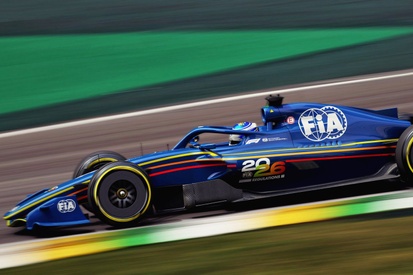
F1 concept
Photo by: FIA
Mercedes' trackside engineering director Andrew Shovlin does not expect the 2026 cars to suffer from the porpoising and bouncing issues that plagued the current generation of Formula 1 machinery - but says teams will have to remain vigilant against similar knock-on effects.
Next year's floor geometry will align more closely with those used prior to 2022, with a largely flat floor between the front and the diffuser. Due to the expected airflow structures underneath the car, porpoising is far less likely to occur with the new floor.
While many theories over the root cause of porpoising and bouncing prevailed in the early stages of the current regulations, it has been attributed to the vortex structures underneath the car bursting under load. At its core, the bursts caused the car to bounce up, before moving closer to the ground again, creating a cyclical motion.
Shovlin believes that, even if similar issues emerged with next year's cars, the teams now have the know-how to contend with the phenomena more easily. Regardless, he expects teams to trip up on something as the engineers explore the limits of the new aerodynamic formula.
"There's always going to be traps and there's always going to be teams that are disappointed with the job they've done. You would never walk into a new set of regulations thinking it will be straightforward," Shovlin explained.
"What you would say is that the regulations move back towards the previous generation of cars where you're unlikely to get the same issues with the porpoising that affected the start of these regs.
"Even if there were problems like that, with what we've learned in the intervening period with the tools we've developed to understand aerodynamics, we'd be in a better place to deal with it.

George Russell, Mercedes W13
Photo by: Zak Mauger / Motorsport Images
"There is always the challenge of trying to get a new formula balanced because we can do work in the simulators but really until you start running the car on track you don't know exactly how it's going to behave."
Shovlin also explored George Russell's claim that, due to a spread in battery states of charge and power unit maps, F1 drivers may find more "obscure" areas to pass other drivers next year.
He explained that the energy deployment aspect of next year's rules will offer further strategic variance, although drivers had to be careful not to over-consume energy in those situations to avoid being gazumped later in the lap.
"It's definitely a big factor in that there is a shortage of energy and you've got to do everything you can to harvest as much as possible," Shovlin added.
"However, across the grid that's going to be a similar situation for everyone. When you have that energy shortage it does create strategic opportunity for the driver so understanding where you can deploy it.
"There will be examples where it's relatively easy to pass early on in a lap but you're going to get retaken later if you actually drove like that. It is the way the formula is going to evolve.
"I don't think it will be necessarily a massive performance area but it will be a big factor in terms of the strategic racing."

Share Or Save This Story


F1 doesn't need to change its VSC rules despite Norris' Spain loss

Spanish Grand Prix Driver Ratings 2026

How Norris unfurled a surprising - and "unrepeatable" - Spanish GP pole lap

Top 10 Can-Am drivers

F1 reveals 2027 calendar as Monaco joins expanded sprint schedule

Ferrari not yet switching focus to 2027 F1 car

The verdict on the WRC Rally Chile tyre solution
Subscribe and access Autosport.com with your ad-blocker.
From Formula 1 to MotoGP we report straight from the paddock because we love our sport, just like you. In order to keep delivering our expert journalism, our website uses advertising. Still, we want to give you the opportunity to enjoy an ad-free and tracker-free website and to continue using your adblocker.


Top Comments