


On this day: Jaguar signing Newey sparks legal row
Across two weeks in the summer of 2001, a bruising fight over Formula 1’s most brilliant engineer raged as McLaren’s championship campaign self-destructed

On 1 June 2001, the Jaguar Racing Formula 1 team announced it had poached Adrian Newey from McLaren, and that the highly prized engineering guru would move once his contract expired at the end of July 2003.
That week’s issue of Autosport magazine had predicted this development. The press release which ticked out of the office fax machine at 8.30am that Friday, quoting both Jaguar Racing CEO Bobby Rahal and Ford Premier Performance Division CEO Niki Lauda, made official the story which had recently arrived on the newsstands.
Fax machines? Newsagents’ shelves? How quaint.
Over the following two weeks, a brutal battle for Newey’s services raged in which the only winners were the lawyers being paid by the hour.
"I'm thrilled at the prospect of having Adrian onboard," said Rahal in the statement. "We go back many years to our days together in Indy cars and our friendship has certainly played a key role in making this happen.
"Design teams led by Adrian have created six of the F1 cars that have won the constructors' and drivers' world championships in the last nine years, with an average win rate of fifty percent.
“His influence has dominated the last decade of the first century of motor racing and this new chapter with Jaguar Racing will provide Adrian with an opportunity to take one of the most emotive names in motor racing to the status of F1 world champions."
"This is great news for Jaguar Racing and we are obviously delighted at pulling off something of this magnitude,” added Lauda. “We have always been deadly serious about our F1 ambitions and this goes some way to proving our commitment to winning."

Bobby Rahal and Niki Lauda
Photo by: Charles Coates / Motorsport Images
If these corporate encomiums give the impression that Rahal and Lauda were marching in lockstep towards a bright future for Jaguar, the reality was rather different, and would play to Newey getting cold feet. But we’re getting ahead of ourselves.
"This has not been an easy decision for me to make,” Newey was quoted as saying in the Jaguar announcement.
“I have enjoyed hugely my four years to date at McLaren and take great satisfaction from the success that we as a team have achieved. But in the end, the prospect of working once again with my close friend Bobby, whom I have known since 1984 at March Racing, combined with the prospect of the exciting challenge that Jaguar Racing offers proved irresistible.
"In the meantime, I have a job to do, and I will continue to be fully committed to McLaren in our bid to win races and world championships."
As the lawsuits flew, Newey would come to disavow this statement – and, indeed, would remain at McLaren until 2005. But his position in the team was damaged.
McLaren’s first riposte came in the form of a press release issued that afternoon, announcing that not only would Newey not be leaving, he had signed a contract extension until August 2005.
It would be a busy couple of weeks not only for the office fax machine but also for this writer, whose remit as a junior functionary on F1 Racing magazine included sating said device’s prodigious appetite for paper and toner.
Both teams insisted they had successfully laid claim to Newey’s services, and a string of injunctions and counter-injunctions followed.
"It is a contract and it is that simple," said Rahal of his agreement with Newey. "McLaren is trying to spin it so that somehow one means more than the other, but they don't."
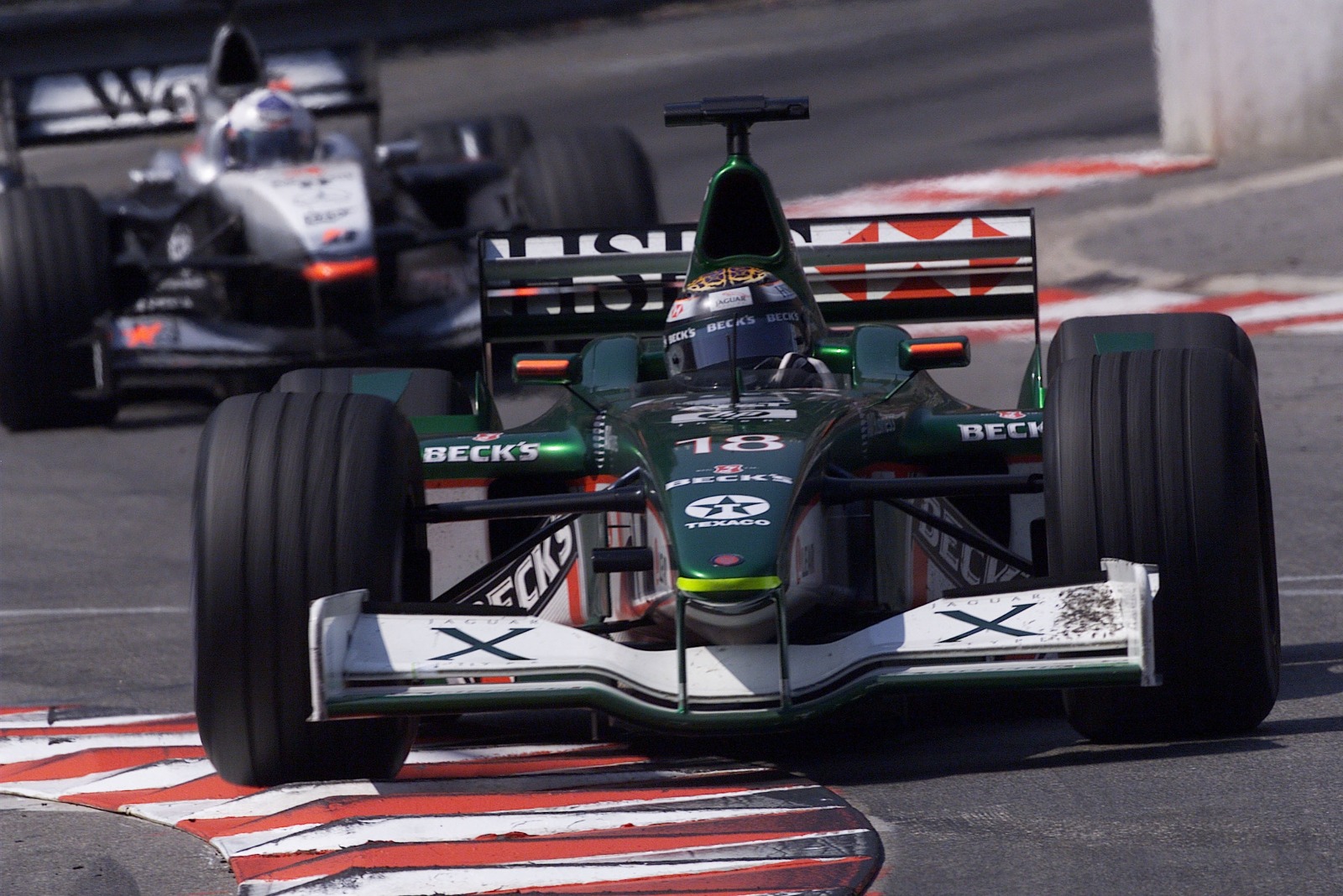
Eddie Irvine, Jaguar, at the 2001 Monaco GP
Photo by: Steve Etherington/LAT Images via Getty Images
As the dispute made its way towards the High Court, it emerged that Newey had changed his mind about the move – despite his long-standing friendship with Rahal, whom he race engineered to the 1986 CART title and Indy 500 win.
"Shortly after agreeing to join Jaguar there was a realisation that changing teams was not the way to go for me,” Newey was quoted as saying in a team statement issued on 10 June, race day in Canada.
"I had previously agreed with Jaguar that nothing would come out until 8.30am on Friday morning. When I spoke to them and informed them of my decision they agreed to stop the press release being issued.
“At that point only a few people were affected. Despite that, it appears they chose to issue the press release.
"One of the reasons I made this decision was because I was enthused about the idea of working with Bobby again. Maybe that persuaded me to go down a road that I might not have gone down in different circumstances."
It’s worth examining the cultural and competitive circumstances of McLaren at the time, and Newey’s problematic relationship with team boss Ron Dennis. In 2001 McLaren was coming off the back of a troubled campaign in which it lost both the drivers’ and constructors championship, and lost the off-track political battle to Ferrari too, with the banning of aluminium-beryllium piston material.
Newey found the unremitting greyness of the aesthetic in the McLaren world creatively discombobulating, to the extent that not long after his arrival he attracted Dennis’s ire by repainting his office duck egg blue. Nevertheless the cars were competitive until 2000, where the early season was blighted by a series of engine failures and Hakkinen’s mojo wobbled; that summer, Dennis suggested he take a break and stood him down from testing duties.
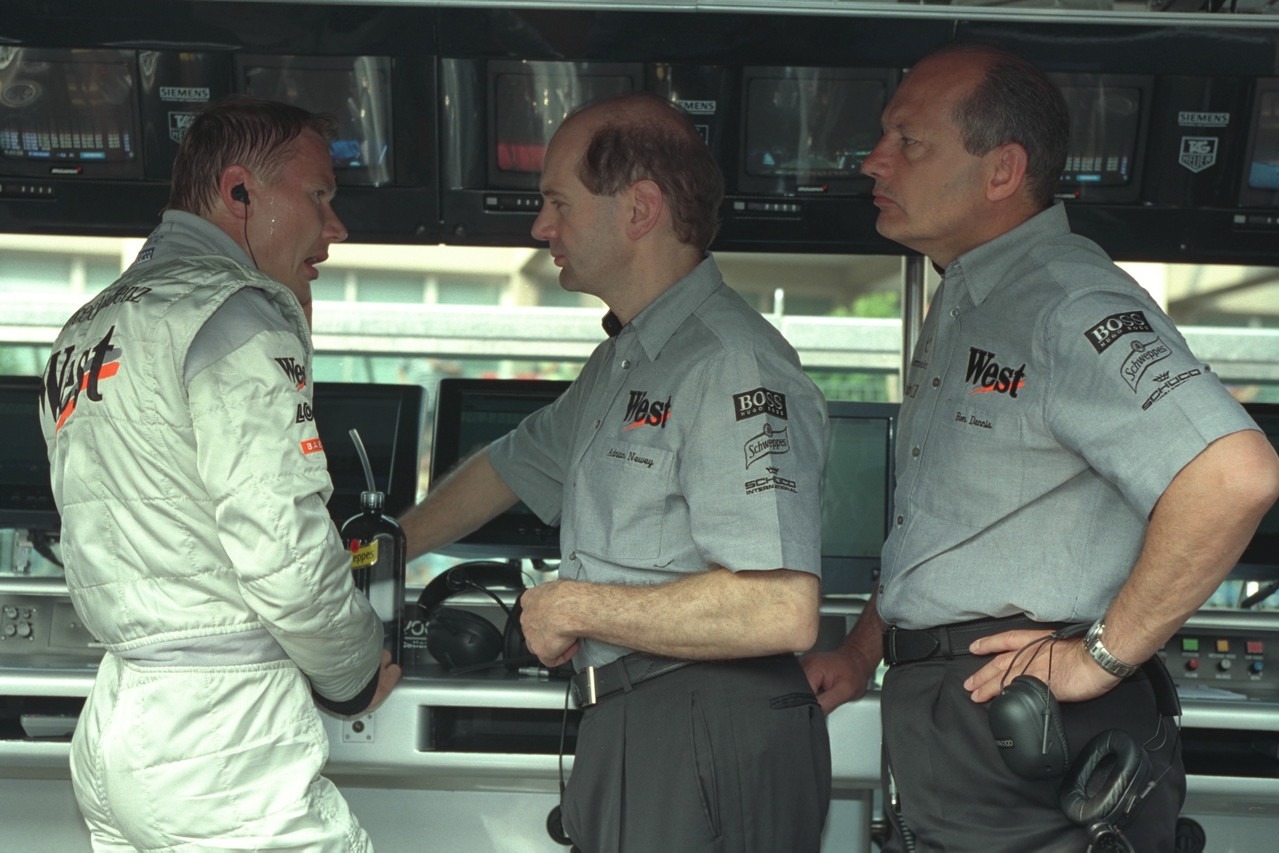
Hakkinen, Newey and Dennis at Monaco, 2000
Photo by: Pascal Le Segretain/Sygma via Getty Images
In his autobiography, How To Build A Car, Newey chronicles a poolside meeting at Dennis’s house in the south of France in August 2000. There, he says, Dennis intimated to Newey and McLaren COO Martin Whitmarsh that in the long term, he wished to step back and let them run the business – but this was contingent on their “commitment”, and he wouldn’t put a timescale on when he would choose to fade into the background.
Newey said he wasn’t prepared to sit around waiting for Dennis to retire.
“A chill wind blew across the pool that afternoon,” wrote Newey. “Ron has many strengths, but he has some significant weaknesses, and one of those is the expectation of unquestioning, undying loyalty from his staff.
“When I wasn’t prepared to show that, our relationship came off the heat, and from then on was never the same again. Painting my office was one thing. Not dropping to my knees with gratitude at his offer? That was quite another.”
Meanwhile Rahal was entering the frame at Jaguar, which had started life as Stewart Grand Prix and raced with moderate success until Jackie Stewart sold out to Ford, which owned Jaguar at the time, and the suits at Dearborn began to get involved in calling the shots. Some of these, such as moving aerodynamic development to the Swift Engineering windtunnel in California and barring technical director Gary Anderson from going there, were inexplicable.
Putting a seasoned racer such as Rahal in charge was easier to rationalise, though at the time there were those in the F1 paddock who expressed the tediously parochial view that Americans shouldn’t get involved in a sport they didn’t understand. But Ford was spending a lot of money – lead driver Eddie Irvine was famously its highest-paid employee – and in 2000 only getting ninth in the constructors’ championship as a reward, so it was easy for the board to conclude that change was needed.
McLaren’s 2001 began badly, with Hakkinen suffering a concussion-inducing crash in the season opener then narrowly missing another one when his car stalled on the grid in Brazil. Come round five in Spain he had just four points to his name, and left with the same amount when his clutch broke while he was leading the last lap of the race.

Brazil, 2001
Photo by: Motorsport Images
In Newey’s account, as the expiration date of his contract hovered into view, he was given an offer for a new one which amounted to a pay cut, at which he balked. Shortly afterwards Rahal made contact and offered Newey “two and a half times” what he was being paid at McLaren.
This figure was subsequently reported to be £3.5 million a year. Newey shook hands with Rahal, signed a letter of intent, then informed Dennis he was leaving.
At that point, Dennis sharpened his pencils, ultimately agreeing to match Jaguar’s financial terms – and enshrine in Newey’s next contract a clause enabling him to step down his involvement in the F1 project and get involved in the America’s Cup. This is entirely in keeping with Dennis’s tactics when Gordon Murray grew disenchanted with F1, but Dennis wanted to keep him within the organisation rather than open to offers from outside.
In that case, the result was the F1 road car project.
Dennis also sold Newey hard on the developing power struggle at Jaguar between Rahal and Lauda, who had arrived that February and was already expanding his influence. In this he was proved right, since Rahal ended up clearing his desk before the season was out.
“I was interested in Jaguar primarily because of my relationship with Bobby, the relationship between team principal and technical director within a team being key,” wrote Newey in his autobiography.
“I did not want to join, only to become a pawn in a Ford management-backed power struggle within the team. A big career risk.”
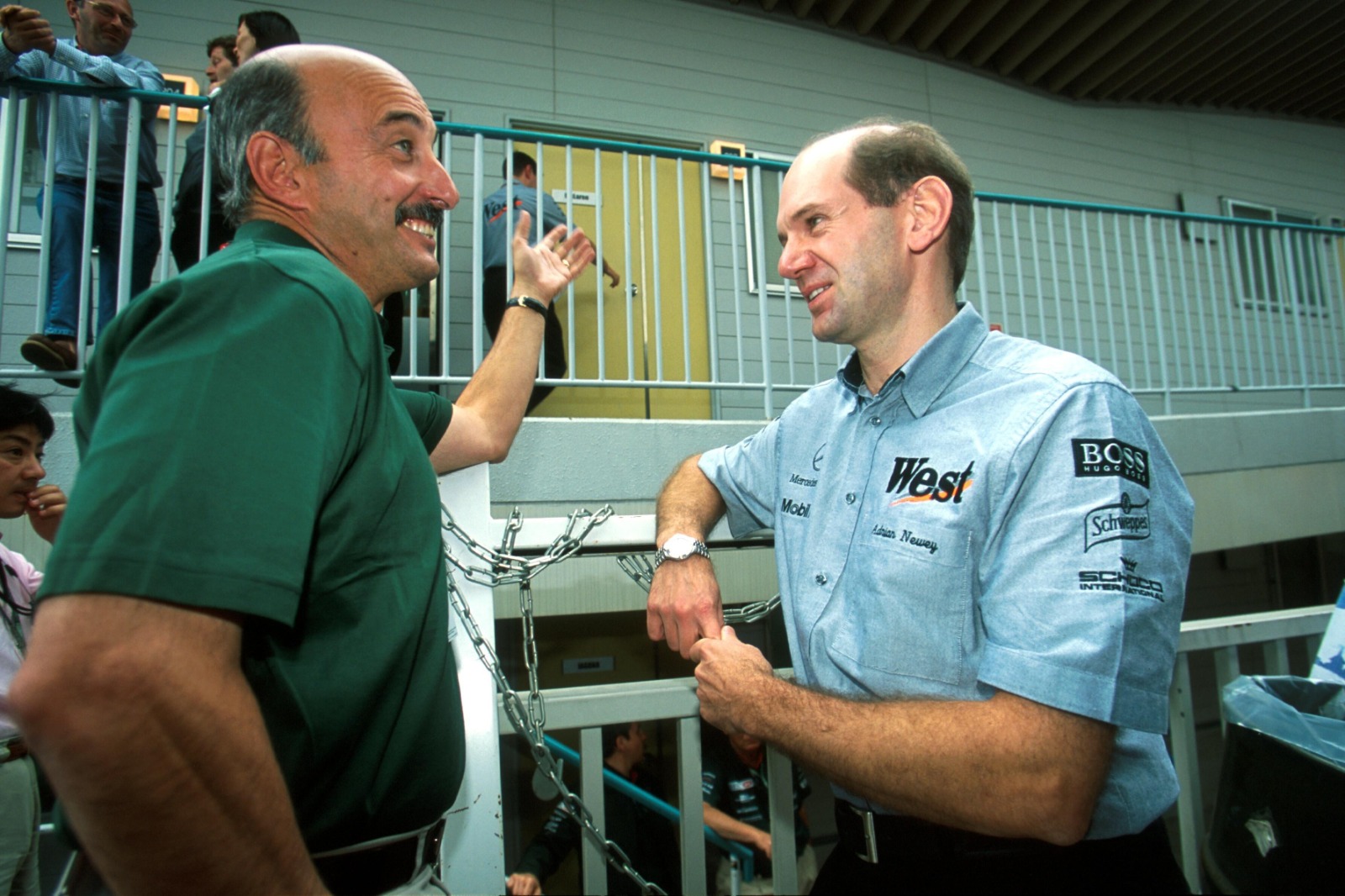
Bobby Rahal, Adrian Newey
Photo by: Sutton Images via Getty Images
So Newey faced the invidious task of notifying Rahal that he would not be going to Jaguar after all. Why, then, was the move announced anyway?
Once the contractual dust had settled, and Jaguar had to admit defeat, it was widely believed in the F1 paddock that Lauda was behind the whole affair in a bid to weaken Rahal’s position. If so, Newey ended up as a pawn in the power struggle anyway.
There is a famous quote, popularly but incorrectly attributed to Sun Tzu, that if you stand by the river for long enough, the bodies of your enemies will come floating past. Rahal’s thoughts when Lauda fell victim to Ford/Jaguar’s ongoing game of Spin The P45 in November the following year remain undocumented, however.
Newey remained at McLaren, but he liked neither the sterility of the Norman Foster-designed steel-and-glass Lubyanka the team moved to in 2003, nor the new ‘matrix management’ system imposed on the technical department by Whitmarsh and Dennis. In his book he described it as a wing-clipping exercise aimed at him.
Whatever the truth of that, he remained unhappy for the remainder of his tenure at Woking.


The intrigue caused by Cadillac's F1 boss dodging driver market question

McLaren's aims for its final F1 2026 upgrades amid decline in form

"It's pretty bad" – Why Norris needs headache tablets for bumpy Austin circuit

Why it's now Bearman versus Camara for the next Ferrari vacancy

Why Hamilton’s return to form is not straightforward

'Senior moment' or breakdown of trust? The implications of Hamilton's Singapore GP meltdown

Why Verstappen's dominance left rivals scrabbling for alternatives in Singapore

LIVE: F1 Singapore GP - Verstappen dominates to victory from Leclerc, nightmare for Hamilton

Supercars Gold Coast: Feeney converts Race 2 pole to win after Saturday defeat

MotoGP's final Australian GP at Phillip Island cancelled due to poor weather

Antonelli pole shows Mercedes is 'finally seeing the results' of car upgrades

Leclerc and Hamilton's differing theories behind Ferrari's Austin qualifying disappointment
Subscribe and access Autosport.com with your ad-blocker.
From Formula 1 to MotoGP we report straight from the paddock because we love our sport, just like you. In order to keep delivering our expert journalism, our website uses advertising. Still, we want to give you the opportunity to enjoy an ad-free and tracker-free website and to continue using your adblocker.


Top Comments