


Making sense of Wolff's claim that Mercedes "haven't got the money" for car development
There's no question that Mercedes' F1 team has deep pockets – but the budget cap means it also has short arms…

Autosport Business
Covering industry news and insight into the business of motorsport
After McLaren's Lando Norris won the Dutch Grand Prix ahead of Formula 1 championship leader Kimi Antonelli, Mercedes boss Toto Wolff made the extraordinary-sounding claim that "we haven't got the money to put developments on the car".
Mercedes began the 2026 season with demonstrably the most competitive car but appears to have taken a more staged approach to development, introducing just one major package so far. In the meantime Ferrari and McLaren have introduced significantly changed components more frequently and their machines are now arguably stronger than Mercedes' W17 in certain conditions.
The circumstances of the Dutch GP supported that proposition, given that Norris won at a canter by 11.5s from Antonelli and George Russell as Mercedes was forced to focus on defending from Lewis Hamilton's Ferrari. It would not be going out on a limb to say that Ferrari would have posed a greater threat for the podium places if it had executed the race better.
Upgrades and the pace of their introduction has become a hotly contested issue this season owing to F1's budget cap. Wolff has already provoked a schism with his old friend Fred Vasseur, Ferrari's team boss, by questioning how the Scuderia could afford to introduce so many new components over the opening phase of the year.
So in publicly channelling the Valentine Brothers' famous lament over money being too tight to mention, Wolff is returning to a familiar theme. But does his claim stack up?
Six billion dollar people
Late last year, the sale of 5% of the team to Crowdstrike founder George Kurtz for $300million placed the value of the organisation as a whole at $6billion. While this doesn't equate to having that amount of cash in the bank, it's fair to say Mercedes isn't short – indeed, its most recent financial reports indicated a $223m operating profit from revenue of $849m.
Before the budget cap structure was agreed in 2020, F1 teams would spend everything they earned – and more – on maintaining competitive position. Now they have an annual spending limit of $215m which, broadly speaking, covers everything pertaining to development and build of the car, including air freight. The cost of staff is covered by the cap, albeit with specific exclusions for non-performance functions (such as marketing/PR, finance, HR and legal) as well as the three highest-paid staff.
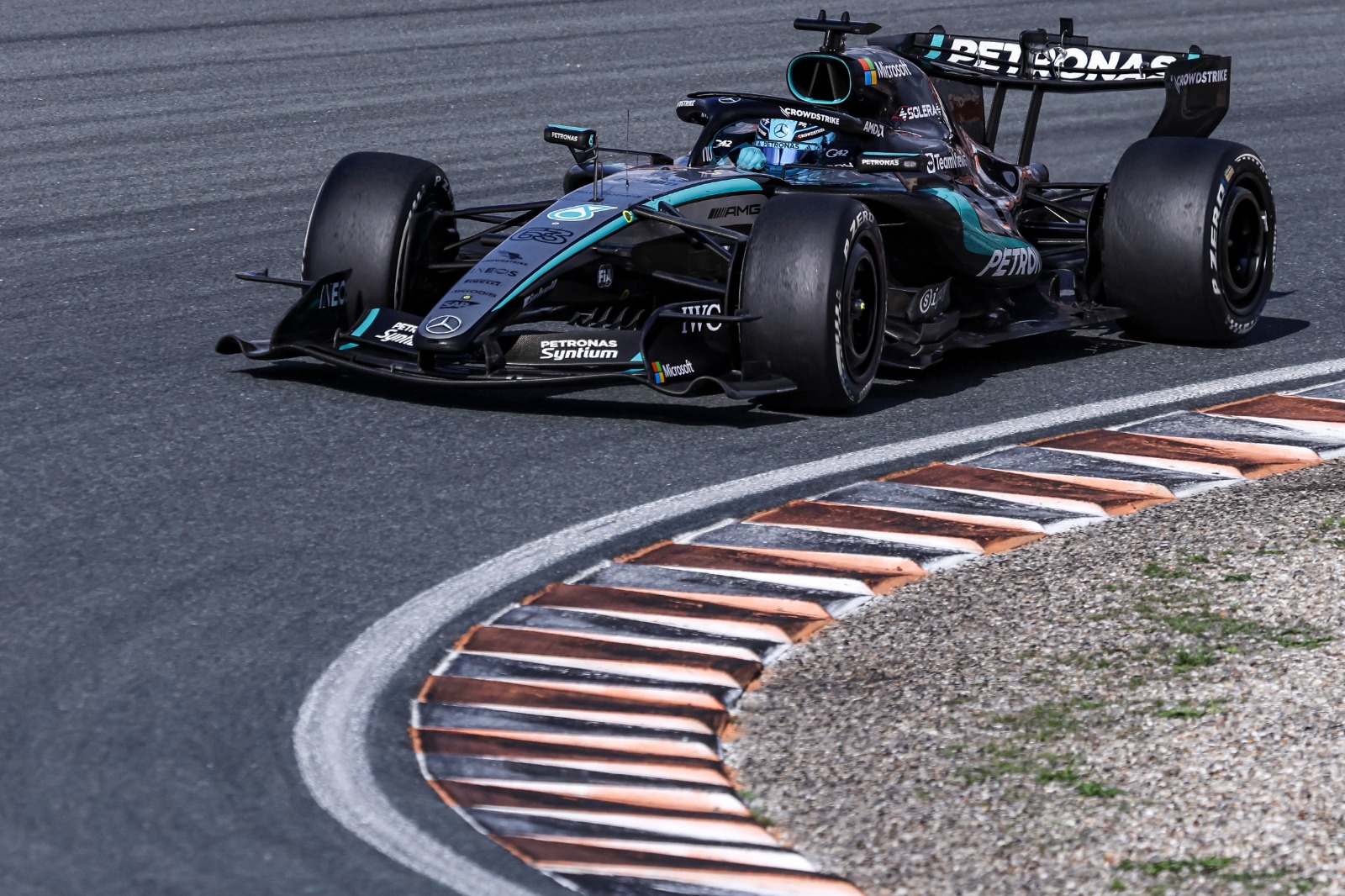
Russell won the sprint race from pole at Zandvoort but was a distant third in the grand prix
Photo by: Getty Images
So a team's upgrade strategy is informed by a mix of inputs, including relative staffing levels and the logistics of introducing new parts. But by far the biggest cost is the production of components, including spares, which is why some teams have made a point of staging upgrade packages when major parts come to the end of their operating lifespan.
Mercedes is one of these, while the likes of McLaren and Ferrari feel the competitive benefit of introducing development parts straight away is worth the expense. So, speaking on the latest episode of the Nu Silver Arrows Radio Show, deputy team principal Bradley Lord explained what Wolff really meant by his comments.
"There's a hidden battle in there as well in the cost cap and how you're managing that in the most efficient way," Lord said of the development race. "Are you able just to throw new parts at it as you find performance? Or are you waiting for certain parts to reach the end of their useful life to then bring the upgraded versions as well?
"It takes up a lot of people's time working out exactly the best way to navigate that. And lots of predictions on where we're going to score points, how the championship is likely to unfold and where those optimum moments are."
It's not quite accurate to say Mercedes has only upgraded its car once this season. While the Canada update was substantial, featuring a new front wing, floor and sidepod geometry, there have been race-specific tweaks and smaller changes to elements such as brake ducts. The next upgrade package will be introduced ahead of the final round of flyaway races, likely Baku.
Another factor complicating the financial picture is that the budget cap covers what a team spends on its next season's car within the calendar year. So the amount available to spend on the 2026 car, for instance, will be affected by how much is allocated to 2027 – as well as how much was spent on the '26 project in the pre-season phase.

Antonelli leads the drivers' standings by 59 points despite 'only' one win in the last six grands prix
Photo by: Sam Bagnall / Sutton Images via Getty Images
"Our competitors for a lot of the year were trying to catch up and we knew that they would be bringing updates more frequently," said trackside engineering director Andrew Shovlin. "It doesn't mean that by a certain point of the season, they've added more performance than we have. They've just done it in a more expensive but more staged way.
"And with us, the expensive things to do are front wings, floors, bodywork, and they're often all developed together and they've got to go together, often just because they fit. So you can't do a floor without the bodywork that goes with it if it's a different shape.
"Where we've been able to bring separate bits that we're confident will function well on the current car, we've done that. So it's not like we've been stood still."
The practicalities of introducing new parts in terms of how they fit with existing ones is common to all teams. So there are clearly other factors at play in Mercedes' thinking, including its dominance at the beginning of the season.
Protecting a lead is very different from being in catch-up mode – as Shovlin also said, "if we thought that these championships depended on us being able to have brought an update to Zandvoort, we'd have probably worked out a way to achieve it".
Headcounts and timing
"Did we spend too much at the beginning in the initial development? I don't think so," Wolff said with a rhetorical flourish in Zandvoort.
Mercedes was certainly in good shape at the Melbourne season opener. While the FIA's Additional Development and Upgrade Opportunities (ADUO) rubric enshrines the Red Bull-Ford engine as the most powerful in F1, it's clear the Mercedes power unit outguns it once electrical deployment is taken into account.
On top of that, the W17 was demonstrably superior to its immediate rivals in terms of efficient downforce straight out of the box. McLaren, for instance, has been limited by its short-wheelbase concept limiting the potential floor area.
Another input into the budget cap calculations is less obvious to outsiders: staffing levels and salaries.

Headcount is another influence on how much a team can spend on development
Photo by: Sam Bagnall / Sutton Images via Getty Images
"It's the reality of this year and the situation, I think, that every team faces in the cost cap and it's the big invisible constraint every team is balancing," said Lord. "How big is your team? How big is your organisation? What's your budget for salaries and headcount?
"How much of that is then left for the hardware that you need to be doing and the all-new car? How much of this year's car did people make this year versus last and how all of that drops into the cost cap?
"And then what's left as a development budget? Every team has to figure out how they're going to do that in the best possible way. It's also how many spare parts you carry, how much stock that you have and carry within the team and within the race team as well.
"It's a constant trying to find the most cost and performance-efficient way to get to the end of the season and bring the performance that we are continuing to find week on week in the wind tunnel. When do you cash that in and convert it into real world parts? That's the art in the science.
"Take a floor – if you need an all-new floor, do you bring an all-new floor when you found that performance? Or do you bring it when you also need to introduce a fresh floor in order to get to the end of the season with the quantities of parts that you hope to have?
"Those are the efficiencies you need to be thinking about and finding. And if you're in catch-up mode, that is a different scenario to if you're out front and therefore able to potentially just phase things slightly differently. But it won't mean that by the time we're racing in Mexico, Brazil, Vegas, anyone has necessarily brought more performance. They may just have staged it slightly differently through the season."
The real question, then, is whether the team boss is crying wolf over the budget – or whether Mercedes is, prudently and cleverly, spending as little as possible protecting its advantage this season while investing in a flying start to 2027…


'Senior moment' or breakdown of trust? The implications of Hamilton's Singapore GP meltdown

Why Verstappen's dominance left rivals scrabbling for alternatives in Singapore

A "better job" or more engine power? Verstappen's Singapore pole unpicked

FIA reveals "human error" caused latest software glitch in Singapore sprint qualifying

F1 Singapore GP live commentary and updates - Verstappen takes sprint pole

F1 Singapore GP live commentary and updates - Verstappen wins sprint while McLarens collide

F1 Singapore GP live commentary and updates - Verstappen on pole

LIVE: F1 Singapore GP - Verstappen dominates to victory from Leclerc, nightmare for Hamilton

WEC Barcelona: Genesis secures maiden series pole from Toyota

What drives Bortoleto as his junior rivals hit new heights in F1

How the M8B became the most dominant car in McLaren’s history

What Verstappen knew about Red Bull’s big upgrade when he signed his new F1 deal
Subscribe and access Autosport.com with your ad-blocker.
From Formula 1 to MotoGP we report straight from the paddock because we love our sport, just like you. In order to keep delivering our expert journalism, our website uses advertising. Still, we want to give you the opportunity to enjoy an ad-free and tracker-free website and to continue using your adblocker.


Top Comments