


FIA explains safety car formation lap after F1 driver criticism at Dutch GP
Several F1 drivers believe they were unable to warm up their tyres sufficiently behind the safety car ahead of a standing start. The FIA explains why it opted for this approach on safety grounds

The opening stages of the Formula 1 Dutch Grand Prix at Zandvoort descended into chaos after rain had started to fall during the grid procedure.
Max Verstappen crashed heavily on the exit of the final corner on the opening lap of the race. The Red Bull driver admitted that it was entirely his own mistake. The Dutchman thought he could get back on the throttle, but that part of the track was clearly still too wet.

Behind Verstappen, Gabriel Bortoleto also came close to crashing, although he miraculously managed to keep his Audi out of the wall, while it was even more remarkable that team-mate Nico Hulkenberg managed to avoid him.
The German immediately said over the radio that he feared he was going to T-bone Bortoleto.
"It was just that corner, if I'm very honest with you. It was full wets, that place. I think that's why Max lost it and it was the same for me," Bortoleto said in the media pen post-race.
"I was on the downside of the banking. I did a little reaction move to the left, I think, when I saw big smoke coming up ahead. And when I did that, I just went as well."
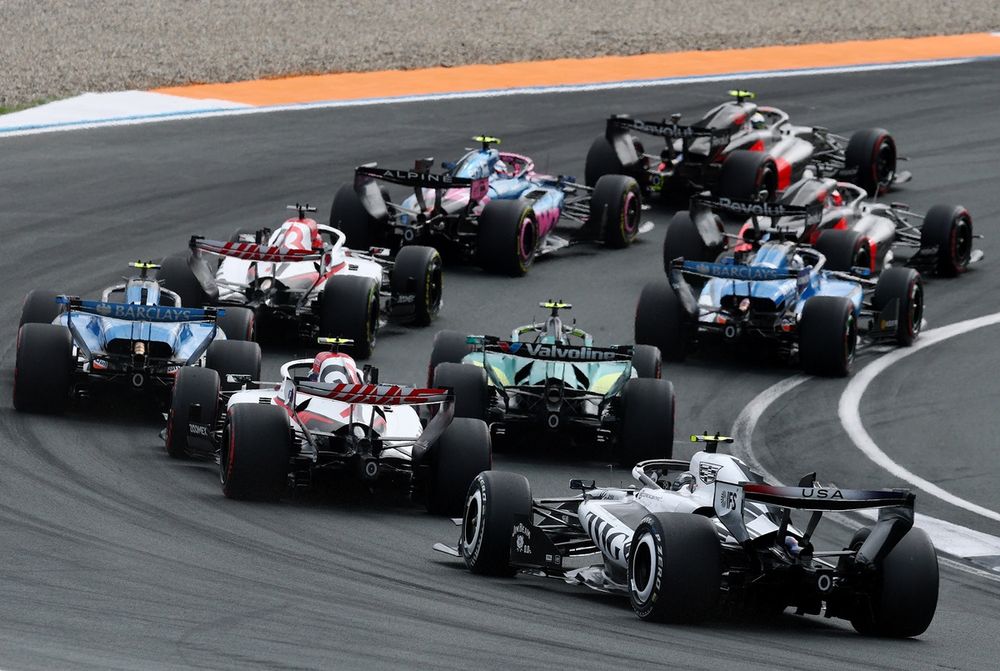
According to Gasly, F1 drivers would have been able to get their tyres up to temperature more effectively if the formation lap had been completed without the safety car
Photo by: Clive Rose / Getty Images
Would a normal formation lap have been better?
According to the drivers, the rest of the track had already dried by that point, meaning it was simply a matter of surviving the final two corners. Starting on slicks therefore made sense, as did the FIA’s decision to opt for a standing start.
That said, several drivers were critical of how the start procedure was carried out at Zandvoort.
"If we would go the way we did with one lap behind the safety car and a standing start, then I would have preferred to just do a normal out-lap, so we would have pushed a bit faster,” Pierre Gasly said when asked by Motorsport.com.
"I thought the point was to go at least once through the last corner and the banking with the safety car before doing the normal race start. And yeah, it was damp."
According to the Alpine driver, the FIA would have been better off choosing between two conventional options: a rolling start behind the safety car or a standing start with a normal formation lap.
"I'm sure we'll review at the next race what the drivers' feedback was," Gasly continued. "But I think it was either no safety car and only one formation lap or with the safety car at least giving us one extra lap."
Red Bull stand-in Liam Lawson shared that view and added that he already knew before the start that the procedure would lead to chaos.

Lawson emphasises that he deliberately left more margin than his team-mate Verstappen in the final corner
Photo by: Anni Graf - Formula 1 via Getty Images
"I don't know why we had the safety car. To do a standing start and also do a lap behind the safety car makes no sense," Lawson said when asked by Motorsport.com.
"I'm not sure what the reasoning of that was, but I feel like we could all see that coming. We were all probably saying the same thing before when we got the news, but we didn't have control over that."
FIA explains reasoning behind safety car formation lap
When asked by Motorsport.com, the FIA clarified that it acted on the information available at the time.
The race director first sent the medical car out for a reconnaissance lap, something an FIA spokesperson said does not normally happen.
The feedback from the medical car was that there was still standing water at Turns 2 and 3, with Turn 3 – the Hugenholtz corner – also being the first banked corner on the circuit. Based on that information, the FIA considered it safer to complete the formation lap behind the safety car.
The intention at that point was to have a standing start, but by completing the formation lap behind the safety car, race control kept both options open. If the standing water had been deemed too dangerous, it could still have opted for a rolling start.
Williams driver Carlos Sainz, however, felt the latter would not have been a solution and would not have prevented the chaos in the final corner.

Carlos Sainz, Williams
Photo by: Simon Galloway / LAT Images via Getty Images
"I think, given it was towards the end of the lap, a non-standing start, a rolling start, would have ended up in the same result, because by that time we were all one by one," Sainz said. "So I don't think it would have changed much. It's an unfortunate situation with a lot of water in only one corner."
It therefore came down to the drivers’ own judgement, with Lawson stressing that he deliberately left more margin – considerably more than Verstappen, who was running ahead of him.
"It was just impossible. The whole first half of the lap was dry and then the last few corners were completely soaked. So, it was really easy to do that [what Max has done] when you have this much power on a slick tyre," he said.
"I really lifted out of it because honestly I had no confidence in how much grip we were going to have there and I think Max was probably trying to get closer and make an overtake, and just lost it."
Verstappen himself, however, did not want to blame any external factors and stressed that he had simply made a mistake.
Share Or Save This Story


No denying it now – the one reason why F1’s ‘horrible’ start in Malaysia could be a good thing

How FIA software bug caused chaos in Bahrain GP in Malaysia – and the emergency fix that saved the race

Why Malaysia would be the perfect place for F1’s first wet-weather race in 2026

No denying it now – the one reason why F1’s ‘horrible’ start in Malaysia could be a good thing

Inside Alonso's decision to contest the 2027 Dakar Rally with Aston Martin

The greatest F1 campaigns with no wins

MotoGP to introduce sprint qualifying amid 2027 format changes
Subscribe and access Autosport.com with your ad-blocker.
From Formula 1 to MotoGP we report straight from the paddock because we love our sport, just like you. In order to keep delivering our expert journalism, our website uses advertising. Still, we want to give you the opportunity to enjoy an ad-free and tracker-free website and to continue using your adblocker.


Top Comments