




How three drivers 'won' the Azerbaijan GP
Formula 1's return to Baku after a year away had thrown up an eventful qualifying marred by four red flags, but the race appeared to be running to a familiar Red Bull vs Mercedes template entering the closing stages. That is, until a dramatic conclusion where victory was snatched away from two drivers, before landing in the lap of Sergio Perez

Autosport Plus content
The best content from Autosport Plus, our subscription service. Subscribe to get access to all the features
Considering all that was the come, the opening lap of the 2021 Azerbaijan Grand Prix was pretty much pure serenity. Ferrari’s Charles Leclerc led comfortably away from pole, while Lewis Hamilton and Max Verstappen slotted in behind, ready to unleash their expected race pace advantage over their red rival.
Behind the top three by the end of lap one of 51 was eventual race winner Sergio Perez, who’d passed Carlos Sainz Jr and Pierre Gasly to move up from sixth on the grid. The Ferrari was dispatched on the exit of the first corner, when Sainz lost momentum challenging Gasly on the outside line, and Perez then outdragged the AlphaTauri on the outside run down the back straight in the first sector.
So far, so normal. But the Baku race ultimately ended with a shocking coda for both the Red Bull and Mercedes squads, which will forever be how this event is remembered.
To get to through to the eventual high drama, first Hamilton and then the Red Bull pair had to pass Leclerc. The world champion, who had ridden a late FP3 set-up breakthrough to start unexpectedly high in second, aided by the late Q3 red flag preventing any improvements, received another slice of luck when the pack arrived at the fast, downhill Turn 15 left – where Leclerc and Verstappen had crashed in practice – on lap two.
“There was part of a tree in the middle of Turn 15,” explained Leclerc. “And there I actually lost quite a bit of time.”
All three leaders took avoiding action, with Leclerc and Verstappen cutting the corner while Hamilton nipped around the branch and still took the turn. Leclerc was “a bit worried” that he’d gained too much compared to Hamilton by diving off track and so sportingly slowed. This gave Hamilton all the momentum he needed, the Briton surging past Leclerc on the outside run well ahead of the start/finish line, without DRS.

Lewis Hamilton, Mercedes W12, Charles Leclerc, Ferrari SF21
Photo by: Mark Sutton / Motorsport Images
Leclerc gamely chased Hamilton for four laps, but was “behind Lewis in dirty air, which I struggled [with] a little bit”. He hung on, but when Leclerc dropped out of Hamilton’s DRS range on lap six, Verstappen seized his chance. The Red Bull got a healthy run on the Ferrari coming down the main straight and blasted by on the outside line towards Turn 1 to move up behind his title rival.
On the next lap, Perez demoted Leclerc in similar fashion, with the stage now set for another Mercedes versus Red Bull showdown. In the end, the race actually got two, with all three long-time race leaders having a chance to win the race that ultimately went to Perez.
Verstappen’s ‘win’
From the start of lap seven, just after he’d surged ahead of Leclerc, to the end of what would be Verstappen’s last full tour on lap 45, this was what we might consider a ‘normal’ Formula 1 race.
The Dutchman was chasing his title rival but possessed the far superior package on the day. As a bonus for the first time in 2021, he had his team-mate in play and a chance to strike a real blow to Hamilton’s championship points tally was on. But first, the two Red Bull drivers had to find their way ahead.
Verstappen's in-lap was a 1m50.389s compared to Hamilton’s 1m51.218s, and with Mercedes’ traditional difficulties in getting the harder compounds into the best operating window at all in 2021, let alone rapidly on an out-lap, the chance was there for a pass even without Hamilton’s hold-up
After passing Leclerc, Hamilton had edged out a 0.9-second lead over Verstappen by the time they were running 1-2 on the road. During the next few laps, as the drivers in the pack behind peeled off to kickstart the race’s main green-flag pitstop phase, with Leclerc coming in on lap nine, the gap began to shrink having briefly risen to 1.2s.
Hamilton was struggling for rear tyre life as Verstappen homed in, the leader’s pace slipping back to the mid-1m47s, while his Red Bull rivals lapped in the lower end of that bracket or high 1m46s. At the end of lap 11, Mercedes called Hamilton in. And, once again for the Black Arrows squad, it all went wrong in the pits.
Hamilton’s switch from the soft to hard tyres was hardly a Monaco or Sakhir GP pitstop disaster, but he was held for approximately two seconds longer than could be reasonably expected in the modern pitstop era. But this wasn’t Mercedes’ fault, as Gasly was trundling down the pits to make his own switch to the hards and Hamilton had to be held before the AlphaTauri had passed by.

Lewis Hamilton, Mercedes W12, Max Verstappen, Red Bull Racing RB16B, and Sergio Perez, Red Bull Racing RB16B
Photo by: Zak Mauger / Motorsport Images
But this delay may well have been irrelevant. In clean air, Verstappen was flying. His in-lap was a 1m50.389s compared to Hamilton’s 1m51.218s, and with Mercedes’ traditional difficulties in getting the harder compounds into the best operating window at all in 2021, let alone rapidly on an out-lap, the chance was there for a pass even without Hamilton’s hold-up. But whatever, the situation played out as it did and Verstappen rejoined in the net lead, with a 3.047s advantage over Hamilton.
Perez had stayed out for another lap, having been 1.550s behind Verstappen when he pitted, but like his team-mate used his time in free air to devastating effect. His in-lap was 1m49.960s, 0.429s better than Verstappen, but when Perez arrived for his stop, he made a mistake that may have cost him the chance to take the lead at this stage.
“He missed the mark and went a bit deep, and that’s why we were a bit slow on the pitstop,” Red Bull team boss Christian Horner later said of Perez’s 4.3s stationary time, with the left rear slow to go on as the pitcrew adjusted. “I think without that, he would have been right on top of Max, such was his pace on that in-lap.”
Again, whatever, the result was that Verstappen ended lap 14 with a 3.157s advantage in the net lead, as Perez nevertheless emerged from the pits in front of Hamilton. Suddenly, a first Red Bull 1-2 since the 2016 Malaysian GP was a very real possibility.
Over the following 16 tours, Verstappen gradually set about building that lead into a substantial 6.841s, edging away from Perez by 0.23s a lap, with Hamilton giving up 0.33s each time in that period.
“I was just initially matching the pace a bit [with] what was happening behind me,” Verstappen later explained. “And then at one point I was three or four tenths faster a lap, while I was not even pushing the tyres, so it all felt really comfortable.”
But on lap 30, the first of two shocking incidents took place, with Lance Stroll’s Aston Martin sent spearing into the inside wall on the high-speed approach to the pitlane entry by a sudden left-rear tyre failure. The Canadian was able to climb out unscathed but was understandably shaken.

The Safety Car Max Verstappen, Red Bull Racing RB16B, Sergio Perez, Red Bull Racing RB16B, Lewis Hamilton, Mercedes W12, and the rest of the field
Photo by: Mark Sutton / Motorsport Images
A five-lap safety car period followed. Ahead of the restart on lap 36, Verstappen sensibly waited until nearly the last possible moment to hit the gas to return to racing speed, only doing so just as he reached the pitlane entry line.
After the Red Bull cars had weaved around considerably to try and generate heat in their cooled hards (it was estimated there would be a two/three lap period before they switched back on), this gave him a nice buffer over Perez, who had Hamilton putting severe pressure on at what was his only realistic chance to get back by at this stage, as he’d fallen to 2.022s behind the second Red Bull before Stroll’s tyre let go.
From there, Verstappen looked in complete command, a second successive street race victory set to come.
“After the restart,” he said, “I opened up my gap, again to like four seconds, quite comfortable. And it was just basically at that point cruising home without taking risk or anything.”
"It just literally blew up. I expect of course [Pirelli] will say it's debris, but we already did quite a few laps and everyone is taking the same line. So, at one point I don't think there is debris anymore" Max Verstappen
Verstappen’s lead was so comfortable, Red Bull only had to make contact every now and then to remind him of the tailwind gusting into Turns 4/15/16, any worries over the hards wearing out gone, according to Horner.
“The tyre wasn't being abused, the temperatures were all good,” he explained. “The race engineer had basically only just checked in with him to make sure everything was under control and then ‘boom’…”
That succinctly sums up how Verstappen’s race ended, but it leaves out the sudden violence of his retirement. At the end of lap 46, his left-rear tyre blew out in shockingly similar circumstances to Stroll’s, with Verstappen sent spearing the other way – into the barriers on the outside of the track, opposite the pitwall. His RB16B spun around one and a half times, with the safety car sent out once again. Verstappen climbed from the wreckage and kicked the destroyed tyre.

Max Verstappen, Red Bull Racing walking with his head down after retiring from the race
Photo by: Andy Hone / Motorsport Images
“It just literally blew up,” he said. “I expect of course [Pirelli] will say it's debris, but we already did quite a few laps and everyone is taking the same line. So, at one point I don't think there is debris anymore. But probably they will blame it on that. At the end of the day, it doesn't matter, these things shouldn't happen."
Pirelli motorsport boss Mario Isola left Baku believing debris was indeed the cause of both tyre failures – with Hamilton’s left-rear hard tyre also found to have sustained a cut – but stressed investigations remained preliminary. As the right-rear takes the most load in Baku and the right front the most wear punishment, this strengthens the debris explanation.
“I believe it was debris, because they didn't have any warning that there was something strange on the car,” he said. “On the suspension, on the tyre, on the brake – nothing was giving any sign of failure. And it was a sudden failure [for both Verstappen and Stroll].”
Hamilton’s ‘win’
Verstappen’s tyre had let go with five laps left to run, with the safety car then leading the pack through the pitlane as the grid hatchings area was cleared. As the previous clean-up had taken five tours, there was a chance the race could have ended behind the safety car, but F1 race director Michael Masi assessed the situation “within the timeframe and within the format of the regulations” and opted to throw the red flags.
Masi had also received a message from Red Bull sporting director Jonathan Wheatley, who advised that his team had received no warning of Verstappen’s tyre failure and suggested a red flag would allow the drivers to change to fresh tyres given the uncertain situation.
“It was actually already on my mind,” Masi said of Wheatley’s message. “But we communicate to everyone equally. And, looking with the number of laps that we had to go, the recovery that was being undertaken, and the fact that there was so much debris on the pitstraight, at that point, it was in my opinion, my judgement, the best option to suspend the race. Clean everything up and then have a race finish.”
After a 35-minute delay, that’s what happened. And it was here that Hamilton staked his victory claim, albeit only for a few seconds.

The damaged rear wheel of Max Verstappen, Red Bull Racing RB16B
Photo by: Mark Sutton / Motorsport Images
Red Bull had opted to restart Perez’s engine as late as possible with the field waiting in the pitlane ahead of what would be a second standing start. This was because he’d been gradually losing hydraulic pressure since the safety car restart and “it was marginal whether he would get to the end of the race” without the red flag, per Horner. This in part explains why he was only 1.475s in front of Hamilton when Verstappen’s tyre failed.
Red Bull was also, understandably, so concerned about what had happened to its other car that it instructed Perez “not to weave – I couldn’t warm up the tyres at the restart”. And so, he lined up on ‘pole’ having completed less-than-ideal preparation, while Hamilton’s brakes smoked heavily across the grid.
When the lights went out again, Hamilton simply aced the start. Perez instantly knew “Lewis had a better one” and so chopped across the line. But the Mercedes was irresistibly coming by. The lead, with under two laps remaining, was his once more.
"There’s a button we have to help keep the front brakes up and as Perez pulled over, I reacted and accidentally latched on the switch. And [I] just locked up going straight because I only had front brakes" Lewis Hamilton
But it only lasted a moment. When Hamilton hit the brakes, his left-front locked heavily and he sailed right by the turn-in point for the left-hander, running deep into the runoff area beyond. At one point, he was turning right as the pack behind went the other way. In an instant his very real chance at taking an unfancied win – against a hobbled Perez and armed with enough power punch to overtake Leclerc without DRS over two hours previously – was gone.
And it turned out that Hamilton had experienced “a finger problem”, according to Mercedes team boss Toto Wolff. Hamilton sat in his W12 for over two and a half minutes once the race had finished and he’d come home visibly dejected in 15th (he let the Haas cars run clear on the final lap and crawled back to the pits in silence). There he understood what had happened.
“Did I leave the magic on?” He asked Peter Bonnington – concerning the steering wheel toggle that alters brake balance, sending it forwards to help put heat from the brakes into the tyres for grip at race starts and restarts. “I could have sworn I turned that off."

Lewis Hamilton overshoots Turn 1 at the race restart
Photo by: Clive Rose/Getty Images
Hamilton later explained that while he had indeed reset the switch to get the rear brakes working in line with the fronts ahead of the lights going out, he had inadvertently reactivated the system as he left the line.
“There’s a button we have to help keep the front brakes up and as Perez pulled over, I reacted and accidentally latched on the switch,” he said. “And [I] just locked up going straight because I only had front brakes.”
Perez’s actual win
As everything was going wrong for Hamilton, the world champion eventually recording his first finish outside the top 10 since coming 12th in the 2013 Spanish GP, Perez “just tried to brake as late as possible”.
“I was like ‘no way I’m losing this one’,” he added. “Lewis was on the inside line, the dirty line, and yeah, unfortunate for him.”
As Hamilton exited stage right instead of left, Perez was left leading Sebastian Vettel and Gasly to an unlikely podium cast (especially considering Vettel had started 11th). The Aston Martin driver had been the real leader when Verstappen was in ‘net’ command, as he ran nine laps longer than Leclerc, which he used to overcut Yuki Tsunoda and Fernando Alonso and slot in behind the Ferrari with fresher hard tyres.
This was crucial at the safety car restart, as for Vettel it was “easier to warm them up and it helped me at the restart to jump Charles”, with Leclerc losing momentum challenging Gasly on the outside of Turn 1’s exit in similar fashion to how his team-mate had lost out to Perez at the initial start.
On the first run down the main straight after the restart, Vettel got by Gasly too – the Frenchman, who had jumped Leclerc by overcutting for two more tours to lap 11, ruing an engine issue that meant he was “losing quite a lot of power down the straights”.
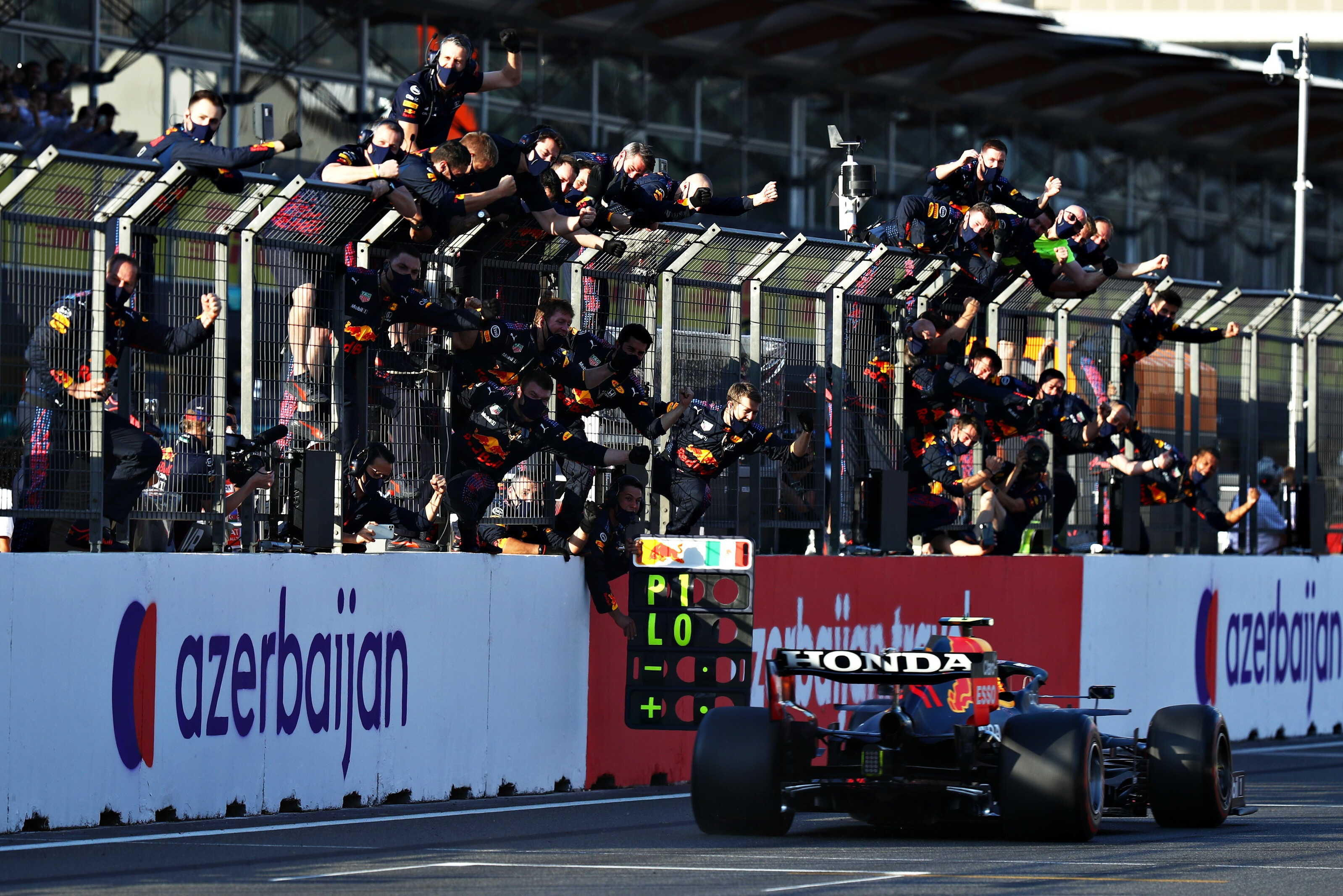
Sergio Perez crosses the line to win
Photo by: Francois Nel/Getty Images
Vettel and Gasly were therefore in position to chase Perez out of Turn 1 on lap 50, with the Red Bull driver running untroubled from there to take a second career win by 1.385s. Vettel was solid in second, while Gasly “took some big risks” to fend off the resurgent Leclerc and the marauding Lando Norris throughout the two-lap shootout.
"I thought ‘the only thing that can happen now is that we lose the race and give a chunk of points back to Lewis’. But, as it turned out, I'm glad they did do that restart" Christian Horner
After celebrating Perez’s first win with his new team – he had to hitch a lift with the medical car on the in-lap having been ordered to stop his car in the pit exit due to the hydraulic problem, arriving back while Hamilton was still contemplating what had gone wrong at the second start – Horner neatly summarised Red Bull’s rollercoaster race.
“[When] they red-flagged the race, part of you wanted the race just to be declared as a result,” he explained. “Then, when we got the restart, I thought ‘the only thing that can happen now is that we lose the race and give a chunk of points back to Lewis’. But, as it turned out, I'm glad they did do that restart. Checo's hydraulic pressure stayed intact, Lewis obviously made a mistake at Turn 1.
“We got the race win and Max leaves here in exactly the same position that he arrived. And we've extended our lead in the constructors’ championship, and Checo is now up to third in the drivers’.”

Sergio Perez, Red Bull Racing, 1st position, celebrates on the podium
Photo by: Zak Mauger / Motorsport Images


Why Britain’s role in Formula 1 endured a troubled start

Why Bottas believes his F1 reserve driver role is the fastest route back to a race seat

Why Norris is now ready for his final exam

The key advantage for Bottas vs Perez in the 2026 F1 return race

Why Ferrari's management is under pressure after its bad start to F1 2025, not Hamilton or Leclerc

Why Red Bull can’t solve its second F1 car problem with a simple paint job

Hirakawa replaces Doohan at Alpine for Japanese GP FP1 outing

How Alonso and Bortoleto can be F1 rivals in a unique driver management deal

How Toyota destroyed the competition to seal the WEC crowns

McLaren retains Fornaroli as F1 reserve and hands him WEC programme for 2027

How Andrew Jordan realised his teenage rallycross dream

Inside the competition building F1’s future engineering talent
Subscribe and access Autosport.com with your ad-blocker.
From Formula 1 to MotoGP we report straight from the paddock because we love our sport, just like you. In order to keep delivering our expert journalism, our website uses advertising. Still, we want to give you the opportunity to enjoy an ad-free and tracker-free website and to continue using your adblocker.


Top Comments