


How the third iteration of an F1 conqueror slipped McLaren from its perch
The McLaren MP4-15 was a silver arrow too often wreathed in smoke during the 2000 Formula 1 season. Millennial angst or over-reach in the engine bay? STUART CODLING examines the championship challenger that provoked a changing of the guard at McLaren
Change was in the air as the MP4-15 took shape in the late summer of 1999. The ticking over of the millennium was an inescapable hard point in the calendar, the new year of all new years, a potent cocktail of hopes and dreams and promises and, yes, nagging uncertainties, what with that pesky Millennium Bug… For once, the onset of 1 January carried a wider cultural significance than a wish list of soon-to-be-abandoned resolutions.
Such ferment for radical change passed the McLaren design office by. The move to swish new premises sculpted by Norman Foster was years away, and the byzantine ‘matrix management’ system was not yet a twinkle in deputy team principal Martin Whitmarsh’s eye.
If you were to visit the site where the McLaren Technology Centre stands today at the time of the MP4-15’s launch, you would find a disc of concrete peppered with steel reinforcements where the windtunnel was to be built, along with a portacabin containing samples of sanitary fittings awaiting personal review and sign-off from infamously pernickety head honcho Ron Dennis. All the action was taking place in an anonymous industrial unit on Albert Drive where, on CAD-CAM screens within grey-painted walls (apart from Adrian Newey’s rebel duck-egg blue set-up), iteration was the order of the day.
Disappointed by the unreliability of the fast-but-fragile MP4-14, in which Mika Hakkinen could have won the championship by mid-season but came sickeningly close to losing it to – of all people – Eddie Irvine, Newey’s design group focused on evolving the existing aerodynamic concept and mechanical package. This would be the third iteration of the car that had proved so successful in 1998, and a great deal of focus was applied to dialling out some of the wayward tendencies that had manifested themselves in 1999’s car.
The MP4-14 had proved more challenging to drive than its predecessor, less stable and more reactive to being kicked out of line by mid-corner bumps. At several rounds Hakkinen simply couldn’t build any confidence in the car and, after Monaco, the team completely stripped and rebuilt the chassis in a bid to exorcise any hidden problems.
Ferrari’s resurgence also proved taxing, even though Michael Schumacher missed several rounds after breaking a leg at Silverstone. The final races were a dispiriting grind as Irvine moved into the championship lead and Ferrari introduced a new bargeboard design that was initially declared illegal, then permitted under appeal. This scenario resulted in Hakkinen being declared champion after the Ferraris were excluded from the Malaysian GP results, then having to fight for it again in the final round when the decision was reversed.

Hakkinen beat Irvine to 1999 title in difficult MP4-14, but the success took it out of McLaren
Photo by: Motorsport Images
“By the end of the season, I’d almost had enough,” wrote Newey in his autobiography How To Build A Car. “The bargeboard incident was the low point of a season that had drained me mentally and physically, not to mention putting a huge strain on my marriage.”
Mechanically, the MP4-15 featured a revised version of the new torsion-bar rear suspension design that had been introduced the previous year, along with the latest member of the Mercedes FO 110 three-litre V10 family. While much of the aero package, including the front wing, looked familiar, the sidepod ‘chimneys’ that acted as hot-air vents were new – and rapidly copied by rivals. Less easy to imitate immediately was the exhaust configuration, which directed gases out into the diffuser via twin centrally mounted pipes.
When the FIA introduced controversial new rules to reduce car performance ahead of the 1998 season, including grooved tyres and a narrower track, McLaren had been quickest to claw back some of that lost performance. Among Newey’s team’s key discoveries was that the wake from the front wheels – more problematic now they were closer to the nosecone – could be managed to create an outwashing effect by elongating the sidepods. Even then, the changes made the cars more edgy to drive. And now McLaren’s rivals were catching up – in some cases arguably pulling ahead.
Both Benetton and Ferrari now had in-house windtunnels with the latest technology, while McLaren continued to rely on the National Physical Laboratory’s facilities in Teddington (across the road from GP Racing’s offices at the time). Besides inducing trickier on-the-limit car characteristics, another unintended side-effect of the regulations was to make subtleties of aero development, such as the shape of the brake ducts, more important than ever. Within a handful of seasons, some of the leading teams would be running development programmes in two or more windtunnels simultaneously.
While the McLarens qualified 1-2 at Interlagos, both Schumacher and team-mate Rubens Barrichello quickly got by Coulthard and Schumacher then passed Hakkinen, pulling clear at around a second per lap
Like McLaren, Ferrari came into 2000 with an iterative development of the package it had introduced in 1998, but with an aggressive focus on lowering the centre of gravity. Even the engine design had been adjusted to suit chassis dynamics and aero: the all-new V10 was 10 degrees wider in the vee.
Crucially, it was more reliable than the Mercedes FO 110J, as evinced when McLaren suffered four engine failures during the course of the season opener in Melbourne. Hakkinen qualified on pole and led team-mate David Coulthard in the early running around Albert Park, but both Merc engines let go messily when seals popped in their pneumatic springs. Schumacher gratefully accepted the gift.
Two weeks later, at Interlagos, Schumacher was again the beneficiary when Hakkinen retired from the lead, and McLaren suffered a further kick in the teeth when Coulthard was disqualified from second after his front wing was found to be seven millimetres too low. On the face of it, bad luck for McLaren to post two no-scores while Ferrari snared two victories, but the competitive picture was rather more complex.
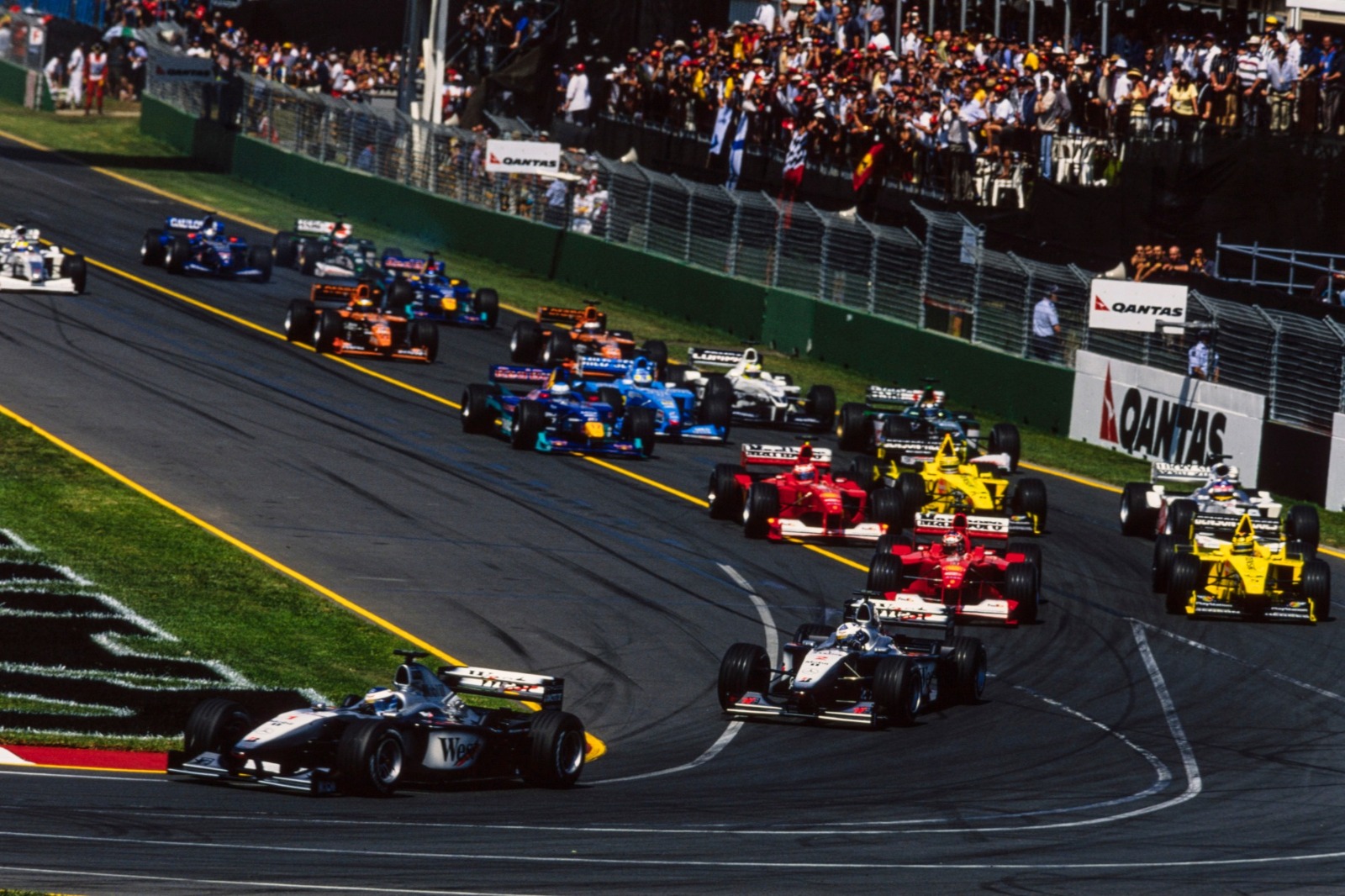
Engine reliability for McLaren was poor in the early stages of the season, with Hakkinen and Coulthard dropping out in Australia
Photo by: Motorsport Images
After Melbourne, Dennis had emphasised that, sub-optimal reliability aside, his cars were faster on pure pace. Events at Interlagos rather undermined that view: while the McLarens qualified 1-2, both Schumacher and team-mate Rubens Barrichello quickly got by Coulthard and Schumacher then passed Hakkinen, pulling clear at around a second per lap.
Ferrari had produced what technical director Ross Brawn described as a ‘sprint car’, optimised around a smaller-than-the-norm fuel tank. Ferrari’s go-to race strategy was to start off on a light fuel load and establish a virtually unassailable track position, do one short-ish pitstop then attack again before taking on another load with enough fuel to make the finish. Other teams, viewing pitstops as a significant risk factor for ‘finger trouble’, generally opted for the safety of a single stop.
In Brazil, while Schumacher pitted relatively early, he still came out ahead of Coulthard – who, admittedly, was stymied by gearbox problems. Schumacher delivered definitive proof of Ferrari’s tactical advantage next time out at Imola, where a sizzlingly quick in-lap and out-lap around his second stop delivered track position over long-time leader Hakkinen (who at least made the finish this time).
Regardless of whether the MP4-15 was the quickest car in the field, McLaren now lagged Ferrari by 29 points in the constructors’ table and Schumacher led Hakkinen by 30 points to six. It was Coulthard who claimed McLaren’s first scalp of the season, winning in front of his home crowd at Silverstone – and, significantly, passing Barrichello for the lead before the Ferrari succumbed to hydraulic failure. Hakkinen, complaining of a flawed set-up, was second ahead of Schumacher.
Hakkinen won in Spain and then began to claw back some ground. Gearbox trouble consigned him to sixth in Monaco but Schumacher retired with broken suspension, limiting the net damage to Hakkinen's hopes. Three more retirements for Schumacher enabled the McLaren drivers to close in and, after the German GP, Coulthard and Hakkinen were level on 54 points to Schumacher’s 56.
McLaren fitted a new power steering system to the MP4-15 and continued to apply aerodynamic developments, but arguably more valuable was a growing understanding of how to maximise the Bridgestone control tyres, formerly a weak spot. In France, where Coulthard won, Schumacher struggled with rear tyre wear and Hakkinen had him on the ropes for second place before the Ferrari retired.
Wins for Hakkinen in Hungary and Belgium enabled him to overhaul Schumacher in the drivers’ standings, but only just. A further engine blow-up in the US GP at Indianapolis with two rounds remaining enabled Schumacher, the winner there, to retake the lead. Schumacher then delivered the coup de grace at the penultimate round, the Japanese Grand Prix at Suzuka.

McLaren took the fight to the penultimate round, but it was no match for Ferrari's 'sprint' car at Suzuka as Schumacher clinched the title
Photo by: Motorsport Images
Having qualified on pole but lost the lead to Hakkinen on the opening lap, Schumacher and Ferrari orchestrated another strategic rout in damp conditions in the final segment of the race. When Hakkinen made his second stop, Schumacher stayed out three laps longer, making use of clear air and a lighter fuel load to parlay a two-second deficit into a four-second advantage over the McLaren when he emerged. This, alongside the occasionally explosive frailty of the Mercedes engine, was the story of the season. Schumacher’s points lead was now unassailable.
From then on, Newey felt their relationship changed for the worse and, when his contract came up for renewal and Dennis’s initial offer amounted to a pay cut, Newey took his first steps on the road to leaving McLaren
Off-track, all was not well within the McLaren leadership group. That summer, Dennis summoned Whitmarsh and Newey to his villa in the south of France for a poolside pow-wow. During the meeting Dennis signalled his intention to step aside in favour of them at some unspecified point, provided they pledged their futures to McLaren. Though Whitmarsh said yes, Newey demurred, unwilling to make that level of commitment with no defined date for handover of power.
From then on, Newey felt their relationship changed for the worse and, when his contract came up for renewal and Dennis’s initial offer amounted to a pay cut, Newey took his first steps on the road to leaving McLaren. In Newey’s mind, the failure of 2000 was rooted in the engine and not the car. One day his phone rang; at the other end of the line was his old mate Bobby Rahal, now running Jaguar Racing. It was time for a change…
Race record
Starts: 34
Wins: 7
Poles: 7
Fastest laps: 12
Podiums: 22
Constructors’ championship points: 152*
Drivers’ championship points: 162
*10 points deleted owing to missing seal on ECU in Austrian GP
Specification
Chassis: Carbonfibre monocoque
Suspension: Double wishbones with pushrod-actuated torsion bars front and rear
Engine: 72-degree naturally aspirated V10
Engine capacity: 2997cc
Power: 800bhp @ 17,800 rpm
Gearbox: Seven-speed semi-automatic
Brakes: Discs front and rear
Tyres: Bridgestone
Weight: 600kg
Notable drivers: Mika Hakkinen, David Coulthard

The failure of the MP4-15 to continue McLaren's run of titles was a crucial factor in design wizard Newey's eventual exit
Photo by: James Mann/GP Racing

How Ratzenberger beat the odds to realise his cruelly short-lived F1 dream

F1 uncovered: A weekend behind the scenes with a chief mechanic

When McLaren was pipped by Red Bull in a modern F1 classic

The big opportunity Sainz’s Williams switch affords to F1’s latest centurion

Inside the science of F1 fuel

How F1’s plan for rotating races could look in practice

The early decisions that set Sauber’s rookie for success

How F1 media coverage has evolved in line with its subject

Russell scrambling for answers after "not being quick enough" at US GP

A strategic masterclass: How Antonelli put himself on the cusp of F1 title at the US GP

The maths behind Antonelli becoming F1 world champion at Mexico GP

F1 United States GP: Antonelli dominates from pole - but forced to wait for title
Subscribe and access Autosport.com with your ad-blocker.
From Formula 1 to MotoGP we report straight from the paddock because we love our sport, just like you. In order to keep delivering our expert journalism, our website uses advertising. Still, we want to give you the opportunity to enjoy an ad-free and tracker-free website and to continue using your adblocker.


Top Comments