


How the 2025 F1 development war is still being fought
Everyone has been focused on next season’s rules for months, right? Well, as ever in F1, things aren’t quite that simple

There was a seed planted by Williams team principal James Vowles last year, as he plotted his team’s course back to the big time.
After many years spent floundering at the back of the Formula 1 order, Williams had been looking to find the best way to demonstrate its behind-closed-doors infrastructural revolution, as it updated its old systems and processes. Vowles, leaning on his past experiences with Mercedes, felt that putting most of the Grove team’s eggs in the 2026 basket would be the best way forward.
Soon, that seemed to be the rationale for most. Other teams openly suggested that their 2025 efforts would be sparing at best, before diverting focus to next year’s technical overhaul. The question became this: would anyone even dare to develop their cars over 2025 at all?
It turned out that there was plenty of room for teams to accommodate a bit of development for this season. Even Williams, which had sworn off its focus on 2025 in favour of 2026, trickled out a smattering of new parts across the first half of the year.
Maintaining some degree of effort on 2025 ensures that the teams’ infrastructures can remain up to date
The rationale was that there were already new designs in the pipeline when the launch specification of the car was frozen late last year, and that there was time to refine it to ensure the car could stay competitive through the season.
There’s still been value in developing the cars this year. Although the 2026 aero regulations largely reverse many of the changes implemented with the current generation, maintaining some degree of effort on 2025 ensures that the teams’ infrastructures can remain up to date.
Teams have continued to update the bigger ticket items, such as floors and wings, to pursue the larger financial gains accrued by jumping a few spots in the constructors’ standings – to a certain point, at least.
Red Bull, for example, owes its recent results at Monza and Baku to work carried out in 2025; having learned from last year’s struggles on low-downforce circuits, it defined a proper Monza package to glean more straightline speed. That it had boosted its own floor performance with a series of updates through the year generally made this possible.

Williams boss Vowles was an early advocate for the focus on 2026 development
Photo by: Rudy Carezzevoli / Getty Images
It helps that there’s a more modular approach to F1 car builds, given the scope of the cost cap. Teams are more accustomed to enshrouding crash structures within aerodynamic panels, or splitting up the bodywork into smaller pieces, cutting the costs associated with any required re-homologation of the larger parts.
Even as the season enters its latter stages, there’s still a sprinkling of development work for 2025 going on at many of the teams’ factories, as the engineers close out the current rules with the final cherry on the cake.
Chasing the ‘low effort’, low-hanging fruit
Across the second half of the season, many of the teams on the grid have kept a small group of engineers focused on chasing tiny gains from their 2025 cars. With modern manufacturing techniques, this is made possible; through rapid prototyping (better known as 3D printing) the teams have been able to quickly produce small parts that can evoke greater levels of performance from the existing infrastructure around the car.
This is made possible with the simulation techniques that are commonplace in modern F1. While wind tunnels and seven-post rigs are vital for a more holistic approach to car design and vehicle dynamics testing respectively, small additions can be implemented with any spare computational fluid dynamics (CFD) time available.
“If you look at it, it’s just an appendage to an existing brake drum. We’re basically glueing a winglet to an existing brake drum” Inaki Rueda
“Right now, we’ve shifted all of our main focus to 2026, but there are sometimes things that you can get with CFD, which don’t require a wind tunnel running,” explains Sauber sporting director Inaki Rueda.
“Or there’s things that maybe you’ve tried in the past that you were not sure about, and now you can just rerun it on CFD. So it’s the low-hanging fruit; it’s not something you spend a lot of time on.”
Rueda offers the example of Sauber’s recent Zandvoort update, which included an additional winglet to the existing cluster of aero devices attached to the outside of the rear uprights.
It’s only small in theory but, in such an aero-critical part of the car, it will have an effect on improving downforce and flow at the rear: “We haven’t redone the whole brake drum. If you look at it, it’s just an appendage to an existing brake drum. We’re basically glueing a winglet to an existing brake drum.”
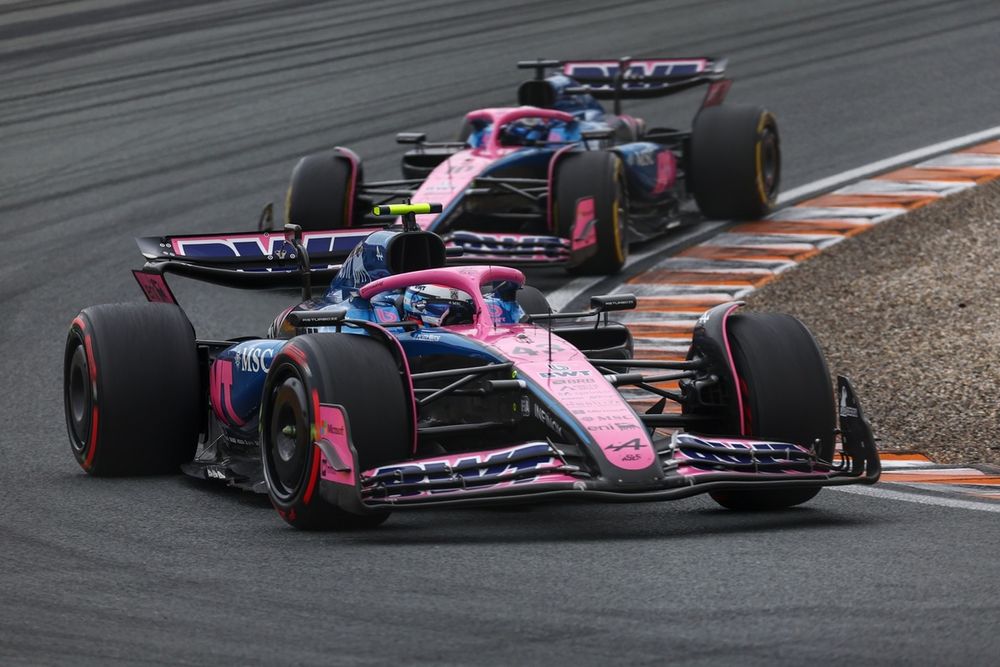
While Alpine’s focus is on 2026, it’s still open to making tweaks that are cheap in terms of resource
Photo by: Joe Portlock / LAT Images via Getty Images
Alpine executive technical director David Sanchez has revealed that the Enstone team was working to a similar framework, although it has long since called off its wider-scale development over 2025.
The Renault-owned operation, having cycled out at the bottom of the constructors’ standings, has chosen to focus on next season, where it will incongruously run with Mercedes powertrains after killing off its own power unit project.
That doesn’t preclude it from making the smaller-scale modifications that, while not responsible for colossal leaps in lap time, can at least make the most of the existing parts on the car.
“I think at this stage of the season you can expect [small updates],” Sanchez reflected after F1’s summer break. “I doubt there’s anyone developing in anger a floor or something, which is high cost or high resource demand. This area on the brake duct [the A525 sporting similar updates to Sauber at Zandvoort] is quite cheap and quick to develop or evaluate.
“If it’s quick and easy to evaluate, then we have a great CFD and then if we like what we see, we bring it to the race car” David Sanchez
“We keep having people thinking in the background and when an idea comes up, if it’s quick and easy to evaluate, then we have a great CFD and then if we like what we see, we bring it to the race car. It’s not a big component, it doesn’t require a lot of design time or design resource, so that’s why I’m saying it’s quite cheap in terms of resource.”
It’s worth explaining how rapid prototyping makes this possible. This goes beyond the usual polymer powders or similar materials that home 3D printing enthusiasts employ; teams have been keen to bring aboard partners who can develop bespoke solutions – carbon fibre filament or ultrasonic additive manufacturing products to render parts from metal.
This has been a key part of F1 manufacturing for over a decade, and some engine parts are even produced from the latter scenario.
Since parts can be manufactured quickly and reasonably cheaply, these can be affixed into position – and easily removed, if practice sessions show the test items in a different light to CFD simulations.
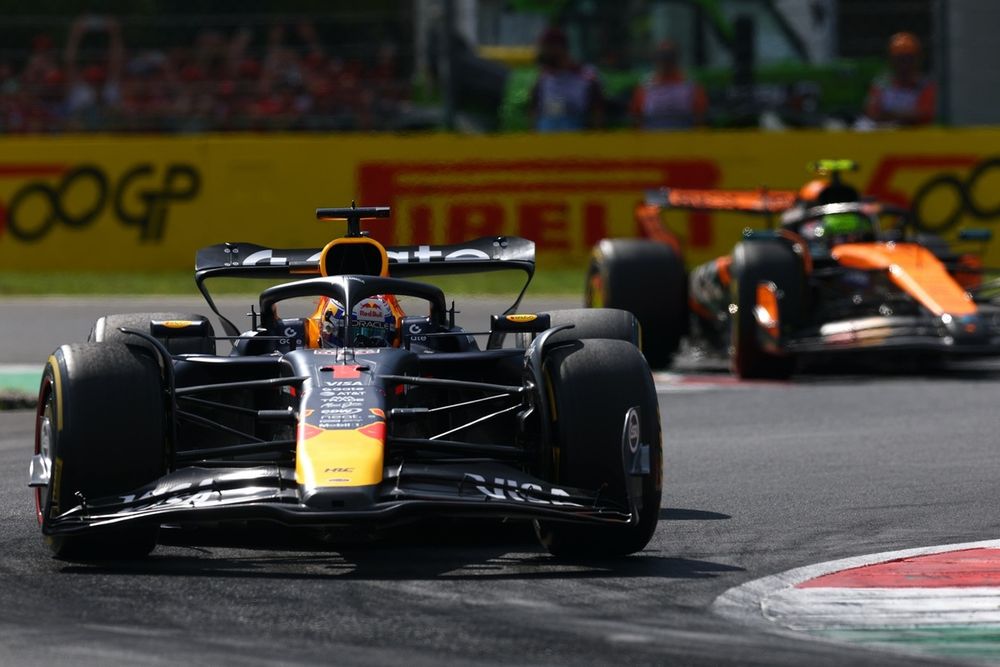
Red Bull’s updates to the RB21’s floor helped enable Verstappen’s Monza victory
Photo by: Zak Mauger / LAT Images via Getty Images
2025’s different approaches
A handful of teams have opted for a similar strategy to Williams, in taking a more hands-off approach to development for 2025. As discussed, Alpine is one of those teams – and given its lowly standing this season, it very much feels that this year has been a sacrificial lamb. Others, however, have found a happy medium in spinning the two plates throughout the year – although, for most, this has wound down following the summer break.
McLaren had continued to put effort into making its MCL39’s high ceiling of performance easier to access, and has done so in its own unique way. The Canadian Grand Prix weekend in June offers a perfect example, in that the team revised its front wing to now feature a series of small winglets on the inside face of the endplate to improve the outwash effect generated.
Although it conducted the customary back-to-back runs with it in practice in Montreal, McLaren didn’t race with it until the next round in Austria, having first digested the data.
But McLaren’s development has, for the time being, slowed down slightly as it puts a little more focus on next year’s regulations, aside from the usual circuit-specific array of wing variants.
Red Bull has continued to try to uncover the root cause of its RB21’s recalcitrance – a pursuit that has shown good results so far post-summer
Red Bull, meanwhile, has continued to try to uncover the root cause of its RB21’s recalcitrance – a pursuit that has shown good results so far post-summer. The floor updates have been the face of that return to form, helping Max Verstappen deliver dominant wins at Monza and Baku.
Much of those updates have been underneath, with a redefined floor body and fences, but this has also extended to the floor edge wings to extract more load from the underbody. This has been underpinned by its greater understanding of what the car needs with regards to set-up.
When you look at the teams lining the second half of the pecking order, the approaches have tended to differ. Take Alpine’s sacrifice of 2025, and compare that to Sauber. The Swiss team had, under its previous head honchos in Andreas Seidl and Oliver Hoffmann, chosen to earmark its resources for 2026, when it will first become known as Audi.
Following their departures, and the installation of Mattia Binotto as chief technical officer and chief operating officer, Sauber elected to change that.

Binotto reasoned that reopening development at Sauber would help the team stay sharp
Photo by: Jay Hirano / SOPA Images / LightRocket via Getty Images
Although the team was effectively treading water until the handover date, Binotto reasoned that there was no point in hanging around. He felt that the team should be keeping its development tools sharp by reopening development at the end of 2024 and into 2025.
Indeed, the series of floor updates added to this year’s C45 in the opening stages of the year demonstrated that the team could enact a leap from the back of the grid, and into the points-paying positions.
Like Sauber, Haas has continued to develop: partly out of necessity, and partly due to its initial gameplan. The team stumbled upon a chronic weakness of this year’s VF-25, where it struggled to maintain downforce through high-load, high-speed corners. The car struggled to contend with Turns 9 and 10 in Australia at the same speed as its competitors.
With limited testing and simulation work, Haas put together a floor update for April’s Japanese GP that set it on the right path. At the time, team principal Ayao Komatsu explained that the team had perhaps encountered similar issues with the floor that the likes of Ferrari and Racing Bulls experienced last year, which prompted a series of roll-backs and diversions into different directions.
“In a way, it was… I wouldn’t say a surprise, but positive that we actually found a gain that was worthwhile us making it, considering the money as well” Ayao Komatsu
Having largely set that right, Haas continued to plot developments through 2025 – and has one in the pipeline for the US GP at Austin to finish off the year. Like the earlier examples, the American-owned team kept engineers back to see whether there was any more low-hanging fruit that was ripe for the picking.
“I wouldn’t say it was no sacrifice at all, because we left a small team working on the 2025 car,” Komatsu explains. “But it’s not we were really focused on it beyond a certain point. We left one small team just to see if we can find a sizeable gain or not.
“In a way, it was… I wouldn’t say a surprise, but positive that we actually found a gain that was worthwhile us making it, considering the money as well. In fact, we didn’t deviate from our baseline plan; we had a few different options where, you know, if the car was amazingly competitive at the start of the year, we can shift our focus on 2026 earlier.
“Clearly, that wasn’t the case. If the car was really, really terrible, we had to spend more time on 2025, sacrificing more on 2026. We didn’t have to do that. So, we did it on the baseline strategy – it’s as we planned, as far as we are concerned.”

Australia highlighted Haas weakness that required a floor update
Photo by: Andy Hone / Motorsport Images
Will teams continue to pursue 2025 gains this late in the season?
If there’s scope in the budget and in simulation data, there’s no reason why teams can’t keep finessing their 2025 machines until the final few races. Teams will operate on a cost-benefit ratio, and a perceptible increase in lap time or general performance will be measured against the resources required to implement it.
At this late stage, it won’t be about developing a part that might not have an immediate impact but can open different development paths – there’s simply not the time to do that. Instead, it’ll be down to the quick-and-dirty little additions if teams want to make any final changes to their cars.
But the attention has, for most, shifted away. While 2026 is predominantly characterised by the lukewarm reception to the greater electrification in its powertrains, and occasional moments of fearmongering as drivers would rather not have to acquaint themselves with the resulting complexities, the aerodynamic formula is changing.
After four years back, the ground-effect tunnels defining the car’s nether regions will slide into the ether, as they did at the end of 1982. Three-element front wings and more conventional rear wings define the bounds of the active aerodynamic formula, and team principals lobbied for a bit more aero furniture having been largely constrained by the current rules’ aim of producing closer racing.
Iterations of the new cars have been available to most of the drivers in the simulator, with the continued development marginally upgrading their opinions – which admittedly started at rock-bottom.
The idea that these cars have conveniently reached the end of their development path within four years is misplaced; there’s always more performance to find
Yet there’s still time to perfect the current machines. While some might have sworn off development and could give fewer than two hoots about their final constructors’ championship placing – owing to the greater aero testing allowance associated with finishing lower down the pecking order – others see the opportunity to move up.
The rationale might change; some might want to go all-in on a specific circuit, others might want to seek validation or keep unravelling the root causes for underperformance. The idea that these cars have conveniently reached the end of their development path within four years is misplaced; there’s always more performance to find. It just depends how willing a team is to uncover it.
Red Bull proved back in 2021 that it was possible to keep pushing its developments through and simultaneously capture a lightning start to a new ruleset in 2022. That said, McLaren and Ferrari did the opposite in the transition from 2008 to 2009.
Will it really hurt a team’s 2026 project by developing a few aero tweaks this late on? Probably not; maybe it’s worth it to save the $25,000 or so needed for a new front wing element for next year. Maybe that $25,000 gets you the extra points needed to earn an extra $8-9million from a higher championship position. Is it worth the gamble?
This article is one of many in the monthly Autosport magazine. For more premium content, take a look at the November 2025 issue and subscribe today.

2026 will bring an end to the current ground-effect era with the move to active aero
Photo by: FIA


FIA expects F1 races in Qatar and Abu Dhabi to run as planned

Why Piastri has struggled to show his best with this year's McLaren MCL40

Lights, Camara, action: How Haas picked F1's latest rookie for 2027

Horner's inside story of how Red Bull built its own F1 engine

Why Mercedes' latest 2026 F1 update is no downgrade

Singapore Grand Prix Driver Ratings 2026

What we learned from the 2026 F1 Singapore GP sprint race and qualifying

The political minefield set out by F1’s recent cost-cap grievances

How Antonelli levelled up his character to be F1 2026's world champion-elect

FIA set to close F1 cost cap loophole with new rules

Norris promises to make "better decisions" following fresh talks over Singapore GP clash

FIA expects F1 races in Qatar and Abu Dhabi to run as planned
Subscribe and access Autosport.com with your ad-blocker.
From Formula 1 to MotoGP we report straight from the paddock because we love our sport, just like you. In order to keep delivering our expert journalism, our website uses advertising. Still, we want to give you the opportunity to enjoy an ad-free and tracker-free website and to continue using your adblocker.


Top Comments