


How Surtees became an unappreciated Ferrari great
John Surtees and Enzo Ferrari parted ways amicably but could have achieved more together. On the weekend that Formula 1 makes its bow in Qatar, a country best-known for staging bike racing, NIGEL ROEBUCK recalls the career of the formidable ‘Big John’ - the first man to achieve success at the highest level on two and four wheels
In November of 1978 I got a call from his secretary asking me to visit John Surtees in St Thomas Hospital, where he was undergoing surgery on his right leg, this the hangover of an accident 13 years earlier. No explanation was offered: simply, “John would like to talk to you”.
He was in good spirits, and we chatted, but still I wondered why I had been asked to visit. Finally, he said, “As long as you’re here, I may as well give you some news.” About what the team is doing next year? “That’s the news,” he said. “We’re stopping…”
In today’s world the announcement of a team’s withdrawal would make the 10 O’Clock News, but back then PR was essentially unknown in Formula 1, and Surtees was anyway not the sort of man to be bothered with it. Was he going to make a formal announcement? “No – you write the story in Autosport, and then everyone will know.”
John had driven his last race at Monza in 1972, and now, six years on, it was the end of Team Surtees. “We’ve never had big sponsors – frankly, my holding company has been the major sponsor, and I’ve decided enough is enough, simple as that.”
It was a poignant farewell for a man who might have failed as an owner but had been a truly great driver – and one who came to four wheels only after a blistering career on two. His many motorcycle world championships with MV Agusta were followed, in 1964, by another in F1 with Ferrari, a feat that will likely remain unique.

Surtees won twice at the Nurburgring for Ferrari, in 1963 and here in 1964 on his way to that year's title
Photo by: Motorsport Images
Surtees was a ‘natural’. In 1960, while winning his last title with MV, he was also driving for Lotus, as and when dates allowed. In only his second F1 race, at Silverstone, he finished second, and in his third, at Oporto, took pole position and led until retirement.
PLUS: John Surtees' 10 greatest F1 drives ranked
“I turned down Colin Chapman’s invitation to stay for 1961, which was silly because I liked him, and his cavalier attitude. He made the quickest cars, and if they’d been built to Ferrari engineering standards, no one else would have had a look-in.”
There followed a season with the Yeoman Credit (Reg Parnell) team, using ‘customer’ Coopers, and at the end of 1961 came a call from Maranello. When Surtees said no, he wasn’t ready, Ferrari said, ‘You know we won’t ask again…’
“But I didn’t really believe him – I’d been around Italians enough by then! To be honest, I thought, ‘You’re going to need me at some time’.”
For 1962 John therefore stayed put, the team now renamed Bowmaker and running cars from Lola. He finished fourth in the championship – ahead of the Ferrari drivers.
The situation was ridiculous: here was Surtees, driving with consistent brilliance, while the team manager sought to undermine him at every opportunity. At Le Mans it went past the point of no return.
“Then I got the call again, and this time I signed. The Old Man said, ‘We don’t have much money – but there are other advantages’, one of which was that I could stay at the Real Fini in Modena for 1800 lire a day, full board. That was the equivalent of one pound!”
Although Ferrari’s V6 was outpowered by the V8s of Climax and BRM, Surtees was well in the mix in 1963, and at the Nurburgring beat Jim Clark to claim his first grand prix victory. The following year, now with a V8, Surtees won there again and at Monza. Second place in the Mexican Grand Prix was enough to clinch his world championship.
There would be no F1 victories in 1965, but Surtees was successful in sportscar races with his own Lola T70, winning several times before suffering the biggest accident of his career at Mosport. Severely injured, he recovered to start testing the following spring, and was moved by his reception in Maranello. Surtees committed yet more firmly to Ferrari, anticipating he would see out his career with the team.
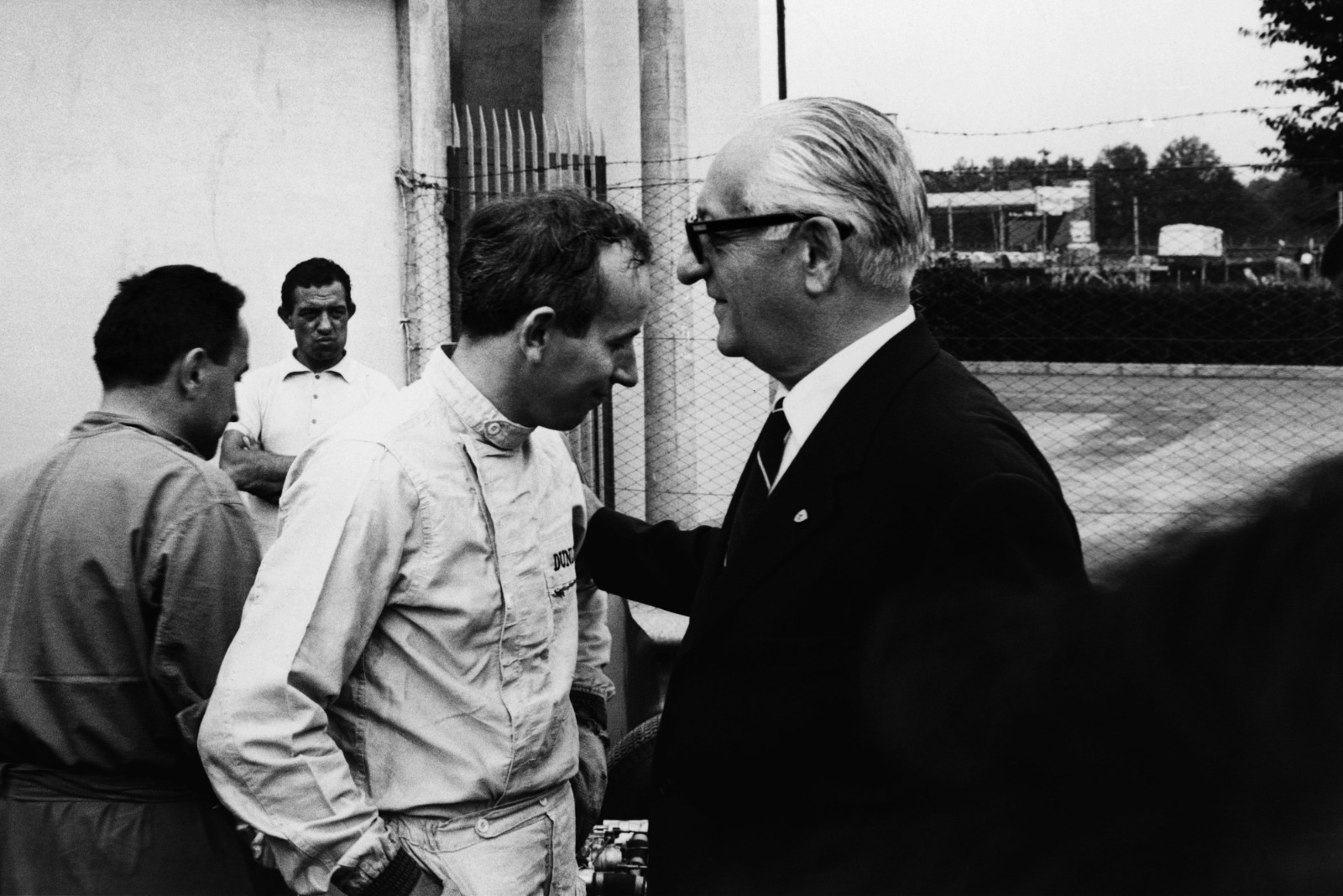
Surtees had a good relationship with Enzo Ferrari, but fell out with his team manager and abruptly left
Photo by: Motorsport Images
There remained, however, the problem of team manager Eugenio Dragoni, with whom he had never got along: “He was always jealous of the good, relaxed, relationship I had with the Old Man.”
At Monaco John’s Ferrari V12 led until it broke, and in appalling conditions at Spa he was supreme. “Afterwards everyone else was really happy – but Dragoni never said a word to me.”
The situation was ridiculous: here was Surtees, driving with consistent brilliance, while the team manager sought to undermine him at every opportunity. At Le Mans it went past the point of no return.
“I was paired with [Ludovico] Scarfiotti, and it was Ferrari against Ford. The plan was for me to go like hell from the beginning – but Dragoni said, no, Scarfiotti was going to do the first stint. And why? Because Gianni Agnelli was attending the start – and it would be nice for him to see his cousin, Ludovico, drive the car! I thought, ‘Oh, what’s the point? I don’t feel part of this family anymore’.”
On the spot Surtees left Le Mans for Maranello, where it was agreed with Ferrari that there should be a parting of the ways.
“I think,” John said. “I’d have won at least one more championship with Ferrari, and I was very sad.”
For all that, they parted amicably, and stayed in touch to the end of Enzo’s life: “Part of me is still in Modena, and always will be.”
Immediately there was an offer to join Cooper-Maserati, which Surtees accepted, and at their first race together, Reims, he qualified second – next to Lorenzo Bandini’s Ferrari! John liked the car. He finished second at the Nurburgring and third at Watkins Glen before dominating the season finale in Mexico.

Surtees won final race of 1966 for Cooper after his Ferrari split, but only took one more victory in F1
Photo by: Motorsport Images
What next? “If I’d been sensible, I’d have tried to sort something out with Chapman for 1967, but when Honda said they desperately needed me, I gave in…”
Two years of frustration followed: “The car – and its V12 engine – were terribly heavy, and also the budget was very tight. Through the season we had problems in getting the engines serviced – because we didn’t have the money to fly them back to Japan!”
The first F1 car to bear his name took him to victory in the Oulton Park Gold Cup in 1970, and again in 1971, at the end of which season John essentially retired from driving
Ultimately Surtees prevailed upon Honda to let him bring in his friends at Lola, and at Monza the ‘Hondola’ appeared, this a Lola Indycar reworked to take the Honda V12. Few, it must be said, were more surprised than John when he beat Jack Brabham by a few feet to score what would be his last grand prix victory.
Although Honda was more competitive in 1968, the Japanese team then withdrew from racing, after which Surtees spent a desultory season with BRM before launching his own outfit. The first F1 car to bear his name took him to victory in the Oulton Park Gold Cup in 1970, and again in 1971, at the end of which season John essentially retired from driving. Mike Hailwood’s second at Monza in 1972 was the nearest Team Surtees came to winning a GP.
Surtees died in 2017, at the age of 83. ‘Big John’ we always called him, and in Italy, where it all started, ‘Il Grande John’. That – on two wheels or four – assuredly he was.

Surtees, like Lauda and Schumacher after him, succeeded in picking Ferrari by the scruff of the neck and turning it into a competitive force
Photo by: Motorsport Images

How Ratzenberger beat the odds to realise his cruelly short-lived F1 dream

F1 uncovered: A weekend behind the scenes with a chief mechanic

When McLaren was pipped by Red Bull in a modern F1 classic

The big opportunity Sainz’s Williams switch affords to F1’s latest centurion

Inside the science of F1 fuel

How F1’s plan for rotating races could look in practice

The early decisions that set Sauber’s rookie for success

How F1 media coverage has evolved in line with its subject

Mekies extends contract as Red Bull's F1 team boss

What to expect from WEC's Barcelona debut

Acosta proposes new idea for monitoring tyre pressure in MotoGP

Horner's inside story of how Red Bull built its own F1 engine
Subscribe and access Autosport.com with your ad-blocker.
From Formula 1 to MotoGP we report straight from the paddock because we love our sport, just like you. In order to keep delivering our expert journalism, our website uses advertising. Still, we want to give you the opportunity to enjoy an ad-free and tracker-free website and to continue using your adblocker.


Top Comments